Indonesia Container Security Market Size & Growth Rate (2026-2032)
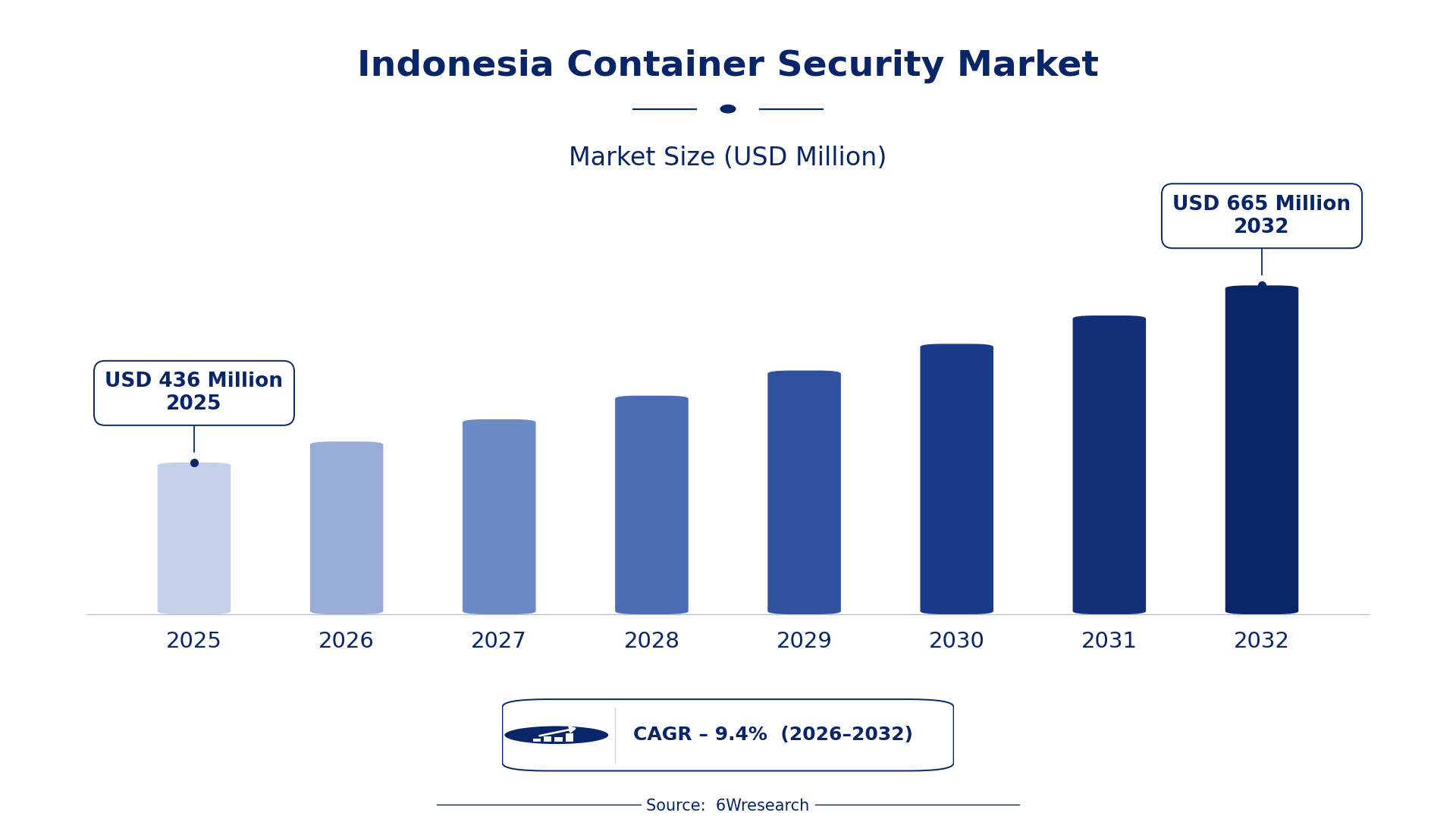
The Indonesia Container Security Market was estimated at USD 436 Million in 2025 and is projected to reach USD 665 Million by 2032, growing at a CAGR of 9.4% from 2026 to 2032.
Indonesia Container Security Market Synopsis
The Indonesia Container Security Market is on an upward trajectory, fueled by increasing container adoption across various sectors. As businesses prioritize efficiency and flexibility, they face escalating security challenges that cannot be ignored, setting the stage for intensified investment in security solutions.
Looking ahead, a surge in regulatory requirements and the ongoing evolution of cyber threats will further complicate the landscape for security professionals. This dynamic environment underscores the necessity for robust and adaptive container security measures to safeguard sensitive data and maintain operational integrity.
Indonesia Container Security Market Year-wise Growth Rate and Key Drivers
This graph illustrates the annual growth rates of the Indonesia Container Security Market from 2021 to 2032, highlighting a steady upward trajectory and projected expansion over the forecast period.
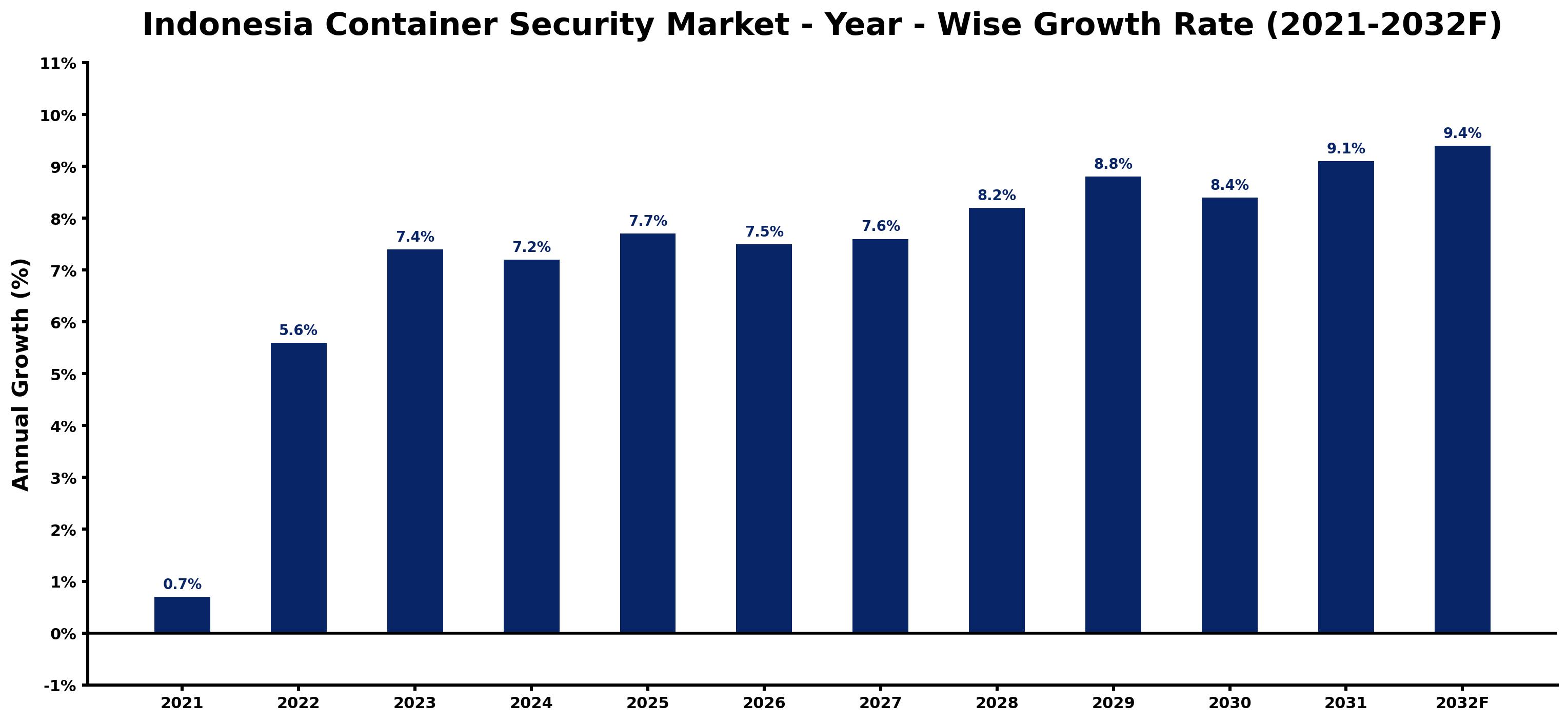
The table below presents the year‑wise growth rates along with the key drivers influencing the market
| Year | Growth Rate | Major Drivers |
| 2021 | 0.7% | Implementation of stricter port security regulations. |
| 2022 | 5.6% | Increased foreign investment in logistics and shipping sectors. |
| 2023 | 7.4% | Government initiatives promoting smart container technology adoption. |
| 2024 | 7.2% | Rise in e-commerce driving container security needs. |
| 2025 | 7.7% | Focused efforts on reducing smuggling and illicit trade. |
| 2026 | 7.5% | Enhanced maritime surveillance technology in Indonesian waters. |
| 2027 | 7.6% | Startup innovations enhancing container tracking capabilities. |
| 2028 | 8.2% | Growing awareness of supply chain vulnerabilities post-pandemic. |
| 2029 | 8.8% | Supportive policies from Ministry of Transportation for modernization. |
| 2030 | 8.4% | Partnerships with global security firms improving local standards. |
| 2031 | 9.1% | Increasing regional trade necessitating enhanced container security. |
| 2032 | 9.4% | Adoption of IoT solutions for real-time monitoring. |
Note: Market size estimations and growth projections presented in this report are based on 6Wresearch's proprietary forecasting methodology, utilizing the latest available industry data, government publications, and primary research inputs.
Indonesia Container Security Market Key Takeaways
Below are some of the specific key takeaways from the market, including:
- The market is benefiting from a boom in containerized applications and DevOps practices.
- Security solutions must address the entire container lifecycle from development to deployment.
- Regulatory compliance is a growing driver of investment in container security technology.
- COVID-19 has accelerated the shift toward cloud-based services, enhancing container security needs.
- Local and regional players are increasingly vital in shaping security offerings tailored to Indonesian businesses.
Evaluation of Restraints in Indonesia Container Security Market
While the Indonesia Container Security Market shows promise, several restraints challenge its growth. A major impediment is the persistent gap in understanding and managing security risks associated with containerization. Companies often prioritize speed over security, resulting in vulnerabilities that expose critical systems to attack. on top of that, the limited availability of skilled personnel in cybersecurity exacerbates the problem, hindering effective implementation of security solutions. As organizations rush to innovate, balancing the need for agility with adequate security measures remains a complex dilemma that must be addressed.
Indonesia Container Security Market Trends
Several key trends are shaping the Indonesia Container Security Market. Firstly, the integration of automation within security processes is becoming essential, enabling organizations to manage threats swiftly. Secondly, a noticeable shift towards zero-trust security models emphasizes the importance of strict identity verification and continuous monitoring. Another trend is the increasing adoption of hybrid cloud environments, which complicate security postures but also drive demand for innovative solutions that can protect data across diverse infrastructures.
Indonesia Container Security Market Opportunities
Opportunities abound for companies ready to invest in container security in Indonesia. Organizations looking to expand their digital capabilities will require comprehensive security frameworks that not only protect applications but also build trust with customers. Investment in next-generation solutions, such as AI-driven security analytics, can yield significant competitive advantages. Additionally, collaborations between local players and international tech giants could foster innovative products tailored to the Indonesian market, creating avenues for growth that are ripe for exploration.
Government Initiatives in the Indonesia Container Security Market
The government of Indonesia recognizes the critical role of security in the burgeoning digital economy. A regulatory focus on strengthening cybersecurity measures reflects a commitment to fostering trust in containerization and cloud services. Recent initiatives are aimed at enhancing infrastructure resilience and promoting best practices across industries, emphasizing the strategic importance of security for both public and private sectors.
- A national cybersecurity framework launched in early 2024 aims to bolster security protocols for containerized applications.
- Currently ongoing is a public-private initiative focused on developing training programs to address the skills gap in cybersecurity.
- A planned regulatory audit set for 2026 will assess compliance with new container security standards introduced by the government.
- The government is also implementing an awareness campaign to educate businesses on the importance of container security.
- In 2025, a collaborative project between tech companies and regulatory bodies was initiated to standardize security practices across industries.
Future Insights of the Indonesia Container Security Market
From 2026 to 2032, the Indonesia Container Security Market is expected to evolve significantly. As cloud adoption continues to rise, businesses will seek advanced solutions that not only protect containerized applications but also ensure compliance with regulatory demands. Innovation in security technologies, such as machine learning and threat intelligence, will be at the forefront, enabling organizations to better predict and mitigate risks. The market is set to grow as security becomes an integral component of digital transformation strategies across sectors.
Indonesia Container Security Market Latest Developments
In the past year, the Indonesia Container Security Market has witnessed substantial activity as businesses strive to fortify their security measures. The focus has shifted toward developing solutions that address the unique challenges associated with containerization. Companies are increasingly investing in solutions that provide comprehensive coverage across both traditional and cloud environments.
- A prominent technology vendor launched a new container security platform in Q2 2025 that integrates AI for real-time threat detection.
- An initiative began in early 2025 focusing on enhancing local infrastructure to support container security solutions for SMEs.
- A partnership formed between a leading regional operator and a cybersecurity firm in mid-2025 aims to develop tailored solutions for enterprise clients.
- A major upgrade to an existing security platform is underway, expected to enhance the container security functionalities by late 2025.
- An upcoming industry conference planned for early 2026 will address emerging threats and best practices in container security, fostering collaboration among stakeholders.
Indonesia Container Security Market - Key Attractiveness of the Report
- 10 Years of Market Numbers
- Historical Data Starting from 2022 to 2025
- Base Year: 2025
- Forecast Data until 2032
- Key Performance Indicators Impacting the Market
- Major Upcoming Developments and Projects
Key Highlights of the Report:
- Indonesia Container Security Market Outlook
- Market Size of Indonesia Container Security Market, 2025
- Forecast of Indonesia Container Security Market, 2032
- Historical Data and Forecast of Indonesia Container Security Revenues & Volume for the Period 2022-2032F
- Indonesia Container Security Market Trend Evolution
- Indonesia Container Security Market Drivers and Challenges
- Indonesia Container Security Price Trends
- Indonesia Container Security Porter's Five Forces
- Indonesia Container Security Industry Life Cycle
- Historical Data and Forecast of Indonesia Container Security Market Revenues & Volume By Component for the Period 2022-2032F
- Historical Data and Forecast of Indonesia Container Security Market Revenues & Volume By Container Security Products for the Period 2022-2032F
- Historical Data and Forecast of Indonesia Container Security Market Revenues & Volume By Services (Professional, Managed) for the Period 2022-2032F
- Historical Data and Forecast of Indonesia Container Security Market Revenues & Volume By Deployment Type for the Period 2022-2032F
- Historical Data and Forecast of Indonesia Container Security Market Revenues & Volume By Cloud for the Period 2022-2032F
- Historical Data and Forecast of Indonesia Container Security Market Revenues & Volume By On-premises for the Period 2022-2032F
- Historical Data and Forecast of Indonesia Container Security Market Revenues & Volume By Vertical for the Period 2022-2032F
- Historical Data and Forecast of Indonesia Container Security Market Revenues & Volume By BFSI for the Period 2022-2032F
- Historical Data and Forecast of Indonesia Container Security Market Revenues & Volume By Retail for the Period 2022-2032F
- Historical Data and Forecast of Indonesia Container Security Market Revenues & Volume By Government for the Period 2022-2032F
- Historical Data and Forecast of Indonesia Container Security Market Revenues & Volume By Healthcare for the Period 2022-2032F
- Indonesia Container Security Import Export Trade Statistics
- Market Opportunity Assessment By Component
- Market Opportunity Assessment By Deployment Type
- Market Opportunity Assessment By Vertical
- Indonesia Container Security Top Companies Market Share
- Indonesia Container Security Competitive Benchmarking By Technical and Operational Parameters
- Indonesia Container Security Company Profiles
- Indonesia Container Security Key Strategic Recommendations






































