Indonesia Copper Carbonate Market Size, Share & Growth Rate
The Indonesia Copper Carbonate Market was estimated at USD 437 Million in 2025 and is projected to reach USD 577 Million by 2032, growing at a CAGR of 4.0% from 2026 to 2032. This growth trajectory is primarily fueled by the burgeoning domestic industries such as electronics manufacturing and automotive components production, both of which are ramping up their consumption of copper carbonate. Additionally, increasing investments in research and development aimed at improving efficiency and product quality standards are further propelling market dynamics.
Indonesia Copper Carbonate Market Year-wise Growth Rate and Key Drivers
This graph highlights how the Indonesia Copper Carbonate Market has steadily grown over the years, supported by major growth factors.
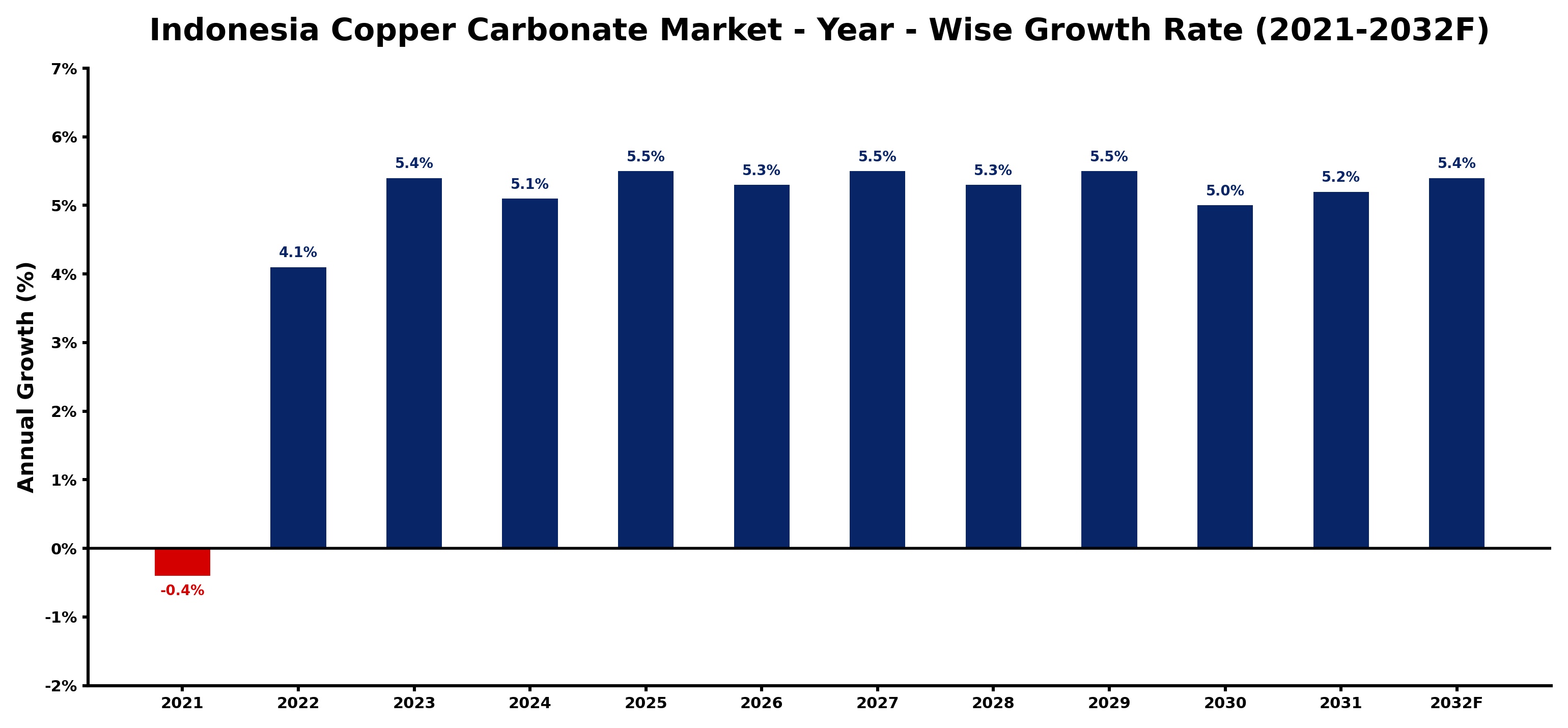
The table below presents the year‑wise growth rates along with the key drivers influencing the market
| Year | Growth Rate | Major Drivers |
| 2021 | -0.4% | Supply chain disruptions limited availability |
| 2022 | 4.1% | Construction sector demand increased significantly |
| 2023 | 5.4% | Industrial applications expanded rapidly |
| 2024 | 5.1% | Agricultural usage saw notable growth |
| 2025 | 5.5% | Electronics manufacturing drove demand |
| 2026 | 5.3% | Renewable energy projects boosted consumption |
| 2027 | 5.5% | Automotive sector growth enhanced usage |
| 2028 | 5.3% | Infrastructure development spurred investments |
| 2029 | 5.5% | Export opportunities expanded globally |
| 2030 | 5.0% | Technological advancements improved efficiency |
| 2031 | 5.2% | Sustainability initiatives gained momentum |
| 2032 | 5.4% | Market diversification enhanced resilience |
Note - Market size estimations and growth projections presented in this report are based on 6Wresearch's advanced forecasting approach, validated with industry datasets as of June 2026.
Indonesia Copper Carbonate Market Synopsis
Indonesia is witnessing a robust rise in copper carbonate production, benefiting from its abundant natural reserves and the mineral's broad application across various industries. This versatility is driving a steady annual output exceeding 1 million tons, aligning with the country's expanding industrial needs.
Key industrial sectors such as pharmaceuticals, food processing, and water treatment are increasingly relying on high-quality copper carbonate. As manufacturers adapt to stricter quality control and environmental regulations, the demand for this essential chemical is expected to escalate even further.
Indonesia Copper Carbonate Market Key Takeaways
- The market is projected to grow significantly, with a forecasted value reaching USD 577 Million by 2032.
- Collaboration among industry players is fostering innovations in production efficiency and product quality.
- Increased regulatory pressure is pushing producers towards higher purity standards and sustainable practices.
- Government support for mining initiatives is enhancing market activity and encouraging investments.
- The growing construction sector, particularly in urban areas, is a primary driver for copper carbonate consumption.
Evaluation of Restraints in Indonesia Copper Carbonate Market
Despite the promising growth outlook, the Indonesia Copper Carbonate Market faces several challenges that could hinder its full potential. Inadequate infrastructure remains a significant barrier, limiting the efficiency of both extraction and distribution processes. Furthermore, the high import duties on essential raw materials add financial strain on local manufacturers, affecting their competitiveness. Quality control mechanisms also lag behind international standards, compromising product integrity. Additionally, stringent environmental regulations have escalated operational costs, forcing miners to reevaluate their practices and investments.
Indonesia Copper Carbonate Market Trends
The market is witnessing a trend towards enhanced research and development efforts, aimed at refining extraction methods and meeting rising quality standards. Furthermore, sustainability has taken center stage, as companies increasingly adopt practices that adhere to international emissions control requirements. Collaboration between private sector entities is also on the rise, fostering technological advancements that promise to elevate production levels while ensuring compliance with environmental regulations.
Indonesia Copper Carbonate Market Opportunities
The Indonesia Copper Carbonate Market holds considerable potential for growth, particularly in the context of urbanization driving demand in the construction sector. The government's commitment to supporting mining projects through favorable policies and financial incentives creates a conducive environment for investment. Furthermore, as industries worldwide focus on sustainability, the demand for high-purity copper carbonate that meets international standards offers lucrative opportunities for local producers.
Government Initiatives in the Indonesia Copper Carbonate Market
The Indonesian government has been actively fostering the development of the copper carbonate market through various initiatives aimed at enhancing the mining sector. These include investment incentives designed to attract domestic and foreign capital, as well as supportive policies that streamline the regulatory environment for new projects. By prioritizing the establishment of infrastructure improvements, the government is addressing some of the logistical challenges faced by producers, thus promoting a more efficient market landscape.
Future Insights of the Indonesia Copper Carbonate Market
Looking ahead to the period between 2026 and 2032, the Indonesia Copper Carbonate Market is expected to continue its upward trajectory, bolstered by sustained demand from both domestic and international sectors. Technological advancements in production processes will likely play a critical role in improving operational efficiency and product quality. Furthermore, as regulatory frameworks evolve to embrace sustainability, companies that adapt swiftly will likely secure a competitive edge, ensuring resilience amid market fluctuations.
Indonesia Copper Carbonate Market Latest Developments (May 2025 - June 2026)
Recent developments in the Indonesia Copper Carbonate Market indicate a strategic pivot towards enhanced collaboration among industry stakeholders. Innovations in production techniques aimed at reducing environmental impact are gaining traction. Furthermore, companies are increasingly engaging in joint ventures to foster technological advancements that enhance output efficiency while adhering to evolving regulatory standards.
Indonesia Copper Carbonate Market - Key Attractiveness of the Report
- 10 Years of Market Numbers
- Historical Data Starting from 2022 to 2025
- Base Year: 2025
- Forecast Data until 2032
- Key Performance Indicators Impacting the Market
- Major Upcoming Developments and Projects
Key Highlights of the Report:
- Indonesia Copper Carbonate Market Outlook
- Market Size of Indonesia Copper Carbonate Market, 2025
- Forecast of Indonesia Copper Carbonate Market, 2032
- Historical Data and Forecast of Indonesia Copper Carbonate Revenues & Volume for the Period 2022-2032F
- Indonesia Copper Carbonate Market Trend Evolution
- Indonesia Copper Carbonate Market Drivers and Challenges
- Indonesia Copper Carbonate Price Trends
- Indonesia Copper Carbonate Porter's Five Forces
- Indonesia Copper Carbonate Industry Life Cycle
- Historical Data and Forecast of Indonesia Copper Carbonate Market Revenues & Volume By Type for the Period 2022-2032F
- Historical Data and Forecast of Indonesia Copper Carbonate Market Revenues & Volume By Normal Copper Carbonate for the Period 2022-2032F
- Historical Data and Forecast of Indonesia Copper Carbonate Market Revenues & Volume By Ultrafine Copper Carbonate for the Period 2022-2032F
- Historical Data and Forecast of Indonesia Copper Carbonate Market Revenues & Volume By Application for the Period 2022-2032F
- Historical Data and Forecast of Indonesia Copper Carbonate Market Revenues & Volume By Process Chemicals for the Period 2022-2032F
- Historical Data and Forecast of Indonesia Copper Carbonate Market Revenues & Volume By Chemical Catalysts for the Period 2022-2032F
- Historical Data and Forecast of Indonesia Copper Carbonate Market Revenues & Volume By Food and Feed Additives for the Period 2022-2032F
- Historical Data and Forecast of Indonesia Copper Carbonate Market Revenues & Volume By Pigment Precursors for the Period 2022-2032F
- Historical Data and Forecast of Indonesia Copper Carbonate Market Revenues & Volume By Agriculture Chemicals for the Period 2022-2032F
- Historical Data and Forecast of Indonesia Copper Carbonate Market Revenues & Volume By Other for the Period 2022-2032F
- Indonesia Copper Carbonate Import Export Trade Statistics
- Market Opportunity Assessment By Type
- Market Opportunity Assessment By Application
- Indonesia Copper Carbonate Top Companies Market Share
- Indonesia Copper Carbonate Competitive Benchmarking By Technical and Operational Parameters
- Indonesia Copper Carbonate Company Profiles
- Indonesia Copper Carbonate Key Strategic Recommendations






































