Indonesia Data Center Networking Market Size & Growth Rate (2026-2032)
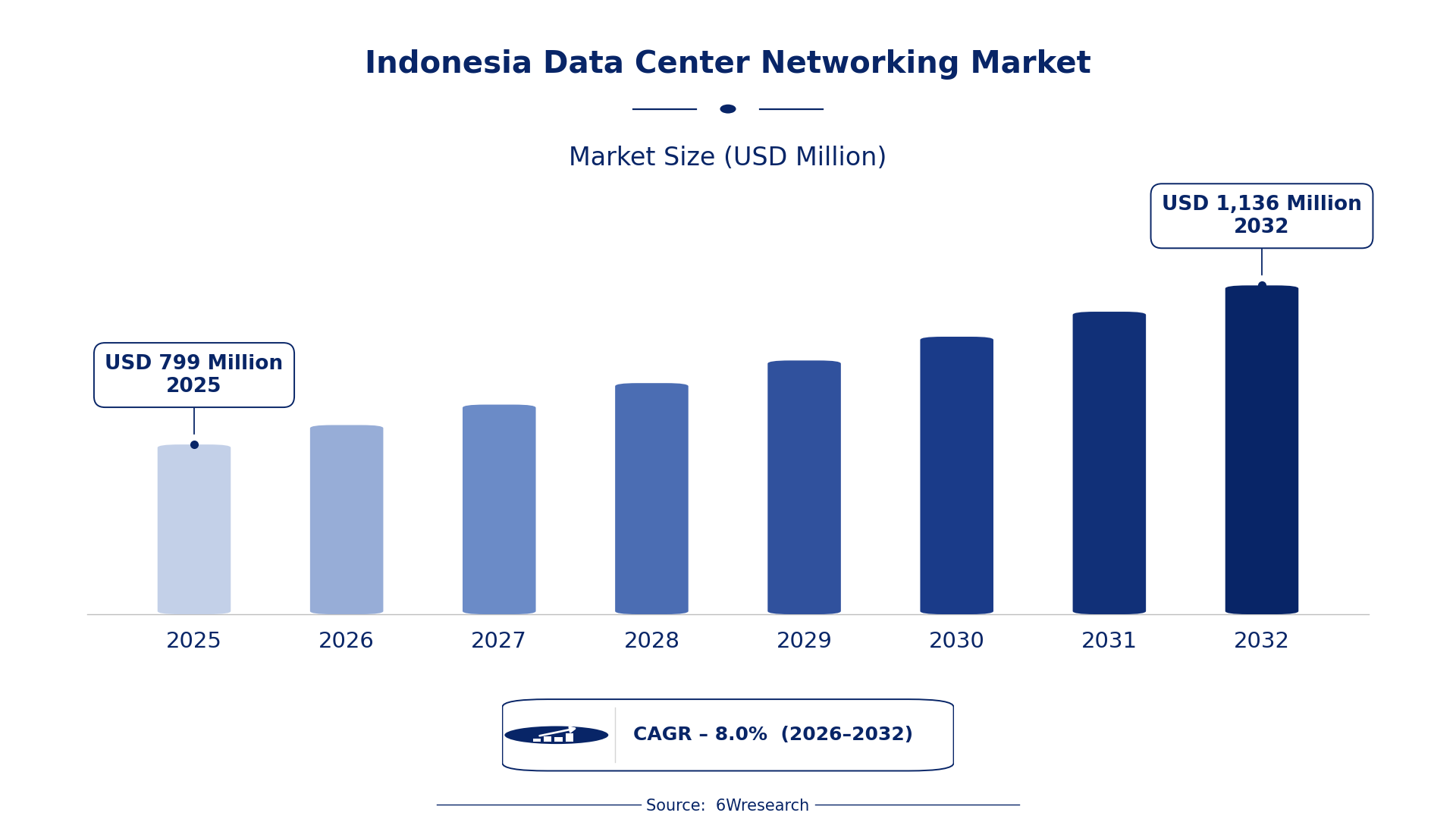
The Indonesia Data Center Networking Market was estimated at USD 799 Million in 2025 and is projected to reach USD 1136 Million by 2032, growing at a CAGR of 8.0% from 2026 to 2032.
Indonesia Data Center Networking Market Synopsis
The data center networking segment in Indonesia is on a clear upward trajectory, driven by the expansion of digital services and cloud adoption. Businesses are increasingly investing in high-speed and reliable networking infrastructure to accommodate the growing demand for data processing and storage capabilities.
As more enterprises migrate to cloud platforms, the need for advanced networking solutions like Software-Defined Networking (SDN) and virtualization is becoming paramount. This shift is propelling demand for a range of networking equipment, including switches and routers tailored specifically for the unique requirements of data centers.
Indonesia Data Center Networking Market Year-wise Growth Rate and Key Drivers
This graph illustrates the annual growth rates of the Indonesia Data Center Networking Market from 2021 to 2032, highlighting a steady upward trajectory and projected expansion over the forecast period.
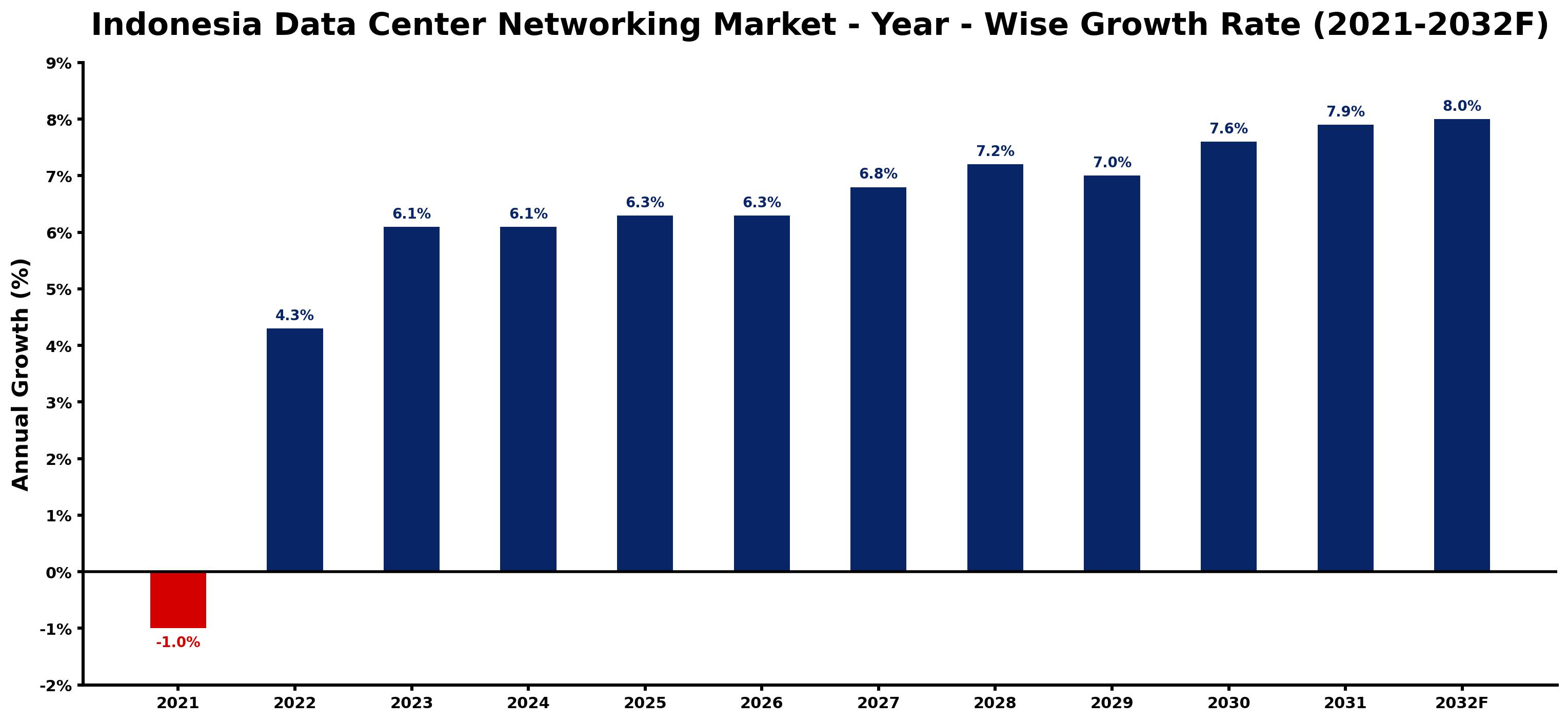
The table below presents the year‑wise growth rates along with the key drivers influencing the market
| Year | Growth Rate | Major Drivers |
| 2021 | -1.0% | Regulatory delays in fiber optic infrastructure development. |
| 2022 | 4.3% | Increased investment in local digital transformation initiatives. |
| 2023 | 6.1% | Government's push for national 5G rollout accelerates demand. |
| 2024 | 6.1% | Surge in e-commerce fueling data traffic growth. |
| 2025 | 6.3% | Rise in remote work boosting data center needs. |
| 2026 | 6.3% | Adoption of IoT solutions driving network infrastructure upgrades. |
| 2027 | 6.8% | Local enterprises increasing cybersecurity measures for data protection. |
| 2028 | 7.2% | Emerging tech hubs in Jakarta expanding networking requirements. |
| 2029 | 7.0% | Increased foreign investments in Indonesian tech startups. |
| 2030 | 7.6% | Strong mobile internet penetration enhancing data center reliance. |
| 2031 | 7.9% | Government policies incentivizing green data center solutions. |
| 2032 | 8.0% | Growing fintech sector demanding robust networking capabilities. |
Note: Market size estimations and growth projections presented in this report are based on 6Wresearch's proprietary forecasting methodology, utilizing the latest available industry data, government publications, and primary research inputs.
Indonesia Data Center Networking Market Key Takeaways
Below are some of the specific key takeaways from the market, including:
- The shift towards cloud services is a primary driver of demand for advanced networking solutions.
- High data traffic and the need for low-latency connections are pushing businesses to upgrade their network infrastructure.
- Challenges related to network speed and compatibility with existing systems remain significant concerns.
- Investment in data center infrastructure is essential for businesses looking to enhance their digital operations.
- The growing reliance on data centers post-COVID-19 has amplified the significance of robust networking solutions.
Evaluation of Restraints in Indonesia Data Center Networking Market
Despite robust growth, the Indonesia Data Center Networking Market faces notable restraints. One of the most pressing issues is the challenge of maintaining network speed while ensuring reliability and security. As businesses upgrade their infrastructure, the compatibility with existing systems often presents hurdles, complicating the integration of new technologies. on top of that, the increasing demand for high-speed data and low-latency connections requires continuous investment, which can be a barrier for smaller enterprises. These factors can stifle innovation and slow down the overall growth of the market.
Indonesia Data Center Networking Market Trends
Emerging trends in the Indonesia Data Center Networking Market indicate a strong shift toward automation and AI-driven networking solutions. Organizations are increasingly adopting intelligent networking systems to enhance operational efficiency and reduce downtime. Additionally, the integration of edge computing is becoming prevalent, as businesses look to process data closer to the source, improving response times and bandwidth utilization.
Cybersecurity remains a critical focus as the proliferation of data traffic raises concerns over data breaches. This has led to the implementation of advanced security protocols within networking solutions, making security a central component of data center planning and investment.
Indonesia Data Center Networking Market Opportunities
The Indonesia Data Center Networking Market presents numerous growth opportunities. As the government continues to push for digital transformation initiatives, public-private partnerships can facilitate significant investments in networking infrastructure. on top of that, the shift towards hybrid cloud environments opens new avenues for businesses to optimize their data management strategies, creating demand for tailored networking solutions.
Investments in sustainable technology are also gaining traction, with companies looking to reduce their carbon footprint. The introduction of energy-efficient networking equipment could not only improve operational efficiency but also align with broader environmental goals.
Government Initiatives in the Indonesia Data Center Networking Market
The Indonesian government is actively shaping the data center networking market through a variety of initiatives aimed at enhancing digital infrastructure and improving connectivity. Public policy prioritizes the expansion of high-speed internet access and the development of smart city projects, which are vital for fostering a competitive digital economy. These efforts are crucial for positioning Indonesia as a regional hub for data services.
- A national digital infrastructure upgrade programme launched in early 2025 aims to enhance broadband connectivity across urban and rural areas.
- Currently ongoing is a regulatory framework introduced in 2025 that focuses on improving data privacy and security standards within data centers.
- A planned public-private initiative expected to expand telecom infrastructure access by 2028 will facilitate greater investment in data center networking capabilities.
- Recent government incentives for foreign investments in tech infrastructure are encouraging global players to enter the market.
Future Insights of the Indonesia Data Center Networking Market
Looking ahead to 2026-2032, the Indonesia Data Center Networking Market is likely to experience sustained growth driven by the expanding digital economy. Increasing adoption of cloud services and enhanced data management solutions will remain key influencers. As organizations continue to prioritize agility and responsiveness, investments in cutting-edge networking technology will be critical. The integration of AI and machine learning into networking solutions will also define the market's evolution, providing organizations with the tools to optimize performance and enhance security.
Indonesia Data Center Networking Market Latest Developments
Over the past 12-14 months, the Indonesia Data Center Networking Market has seen a flurry of activity, reflecting the growing importance of advanced networking solutions. Companies are increasingly focusing on enhancing their capabilities to meet the demands of a rapidly digitizing economy. This period has also witnessed significant investments aimed at improving data center infrastructure and networking technologies.
- A major technology vendor launched a new line of high-capacity switches in Q1 2025, designed specifically for data centers.
- An initiative that began in mid-2025 and remains underway focuses on upgrading existing data center networks to support 5G technology.
- A partnership between local telecom operators and cloud service providers was announced in early 2025 to improve data access speeds across the region.
- A rollout expected to begin in the second half of 2026 aims to implement SDN solutions in multiple data centers throughout the country.
Indonesia Data Center Networking Market - Key Attractiveness of the Report
- 10 Years of Market Numbers
- Historical Data Starting from 2022 to 2025
- Base Year: 2025
- Forecast Data until 2032
- Key Performance Indicators Impacting the Market
- Major Upcoming Developments and Projects
Key Highlights of the Report:
- Indonesia Data Center Networking Market Outlook
- Market Size of Indonesia Data Center Networking Market, 2025
- Forecast of Indonesia Data Center Networking Market, 2032
- Historical Data and Forecast of Indonesia Data Center Networking Revenues & Volume for the Period 2022-2032F
- Indonesia Data Center Networking Market Trend Evolution
- Indonesia Data Center Networking Market Drivers and Challenges
- Indonesia Data Center Networking Price Trends
- Indonesia Data Center Networking Porter's Five Forces
- Indonesia Data Center Networking Industry Life Cycle
- Historical Data and Forecast of Indonesia Data Center Networking Market Revenues & Volume By Component for the Period 2022-2032F
- Historical Data and Forecast of Indonesia Data Center Networking Market Revenues & Volume By Solution for the Period 2022-2032F
- Historical Data and Forecast of Indonesia Data Center Networking Market Revenues & Volume By Services for the Period 2022-2032F
- Historical Data and Forecast of Indonesia Data Center Networking Market Revenues & Volume By End User for the Period 2022-2032F
- Historical Data and Forecast of Indonesia Data Center Networking Market Revenues & Volume By IT and telecom for the Period 2022-2032F
- Historical Data and Forecast of Indonesia Data Center Networking Market Revenues & Volume By Retail for the Period 2022-2032F
- Historical Data and Forecast of Indonesia Data Center Networking Market Revenues & Volume By BFSI for the Period 2022-2032F
- Historical Data and Forecast of Indonesia Data Center Networking Market Revenues & Volume By Public sector and utilities for the Period 2022-2032F
- Historical Data and Forecast of Indonesia Data Center Networking Market Revenues & Volume By Energy for the Period 2022-2032F
- Historical Data and Forecast of Indonesia Data Center Networking Market Revenues & Volume By Manufacturing for the Period 2022-2032F
- Historical Data and Forecast of Indonesia Data Center Networking Market Revenues & Volume By Healthcare for the Period 2022-2032F
- Historical Data and Forecast of Indonesia Data Center Networking Market Revenues & Volume By Others for the Period 2022-2032F
- Indonesia Data Center Networking Import Export Trade Statistics
- Market Opportunity Assessment By Component
- Market Opportunity Assessment By End User
- Indonesia Data Center Networking Top Companies Market Share
- Indonesia Data Center Networking Competitive Benchmarking By Technical and Operational Parameters
- Indonesia Data Center Networking Company Profiles
- Indonesia Data Center Networking Key Strategic Recommendations






































