Indonesia Edge Data Center Market Size & Growth Rate (2026-2032)
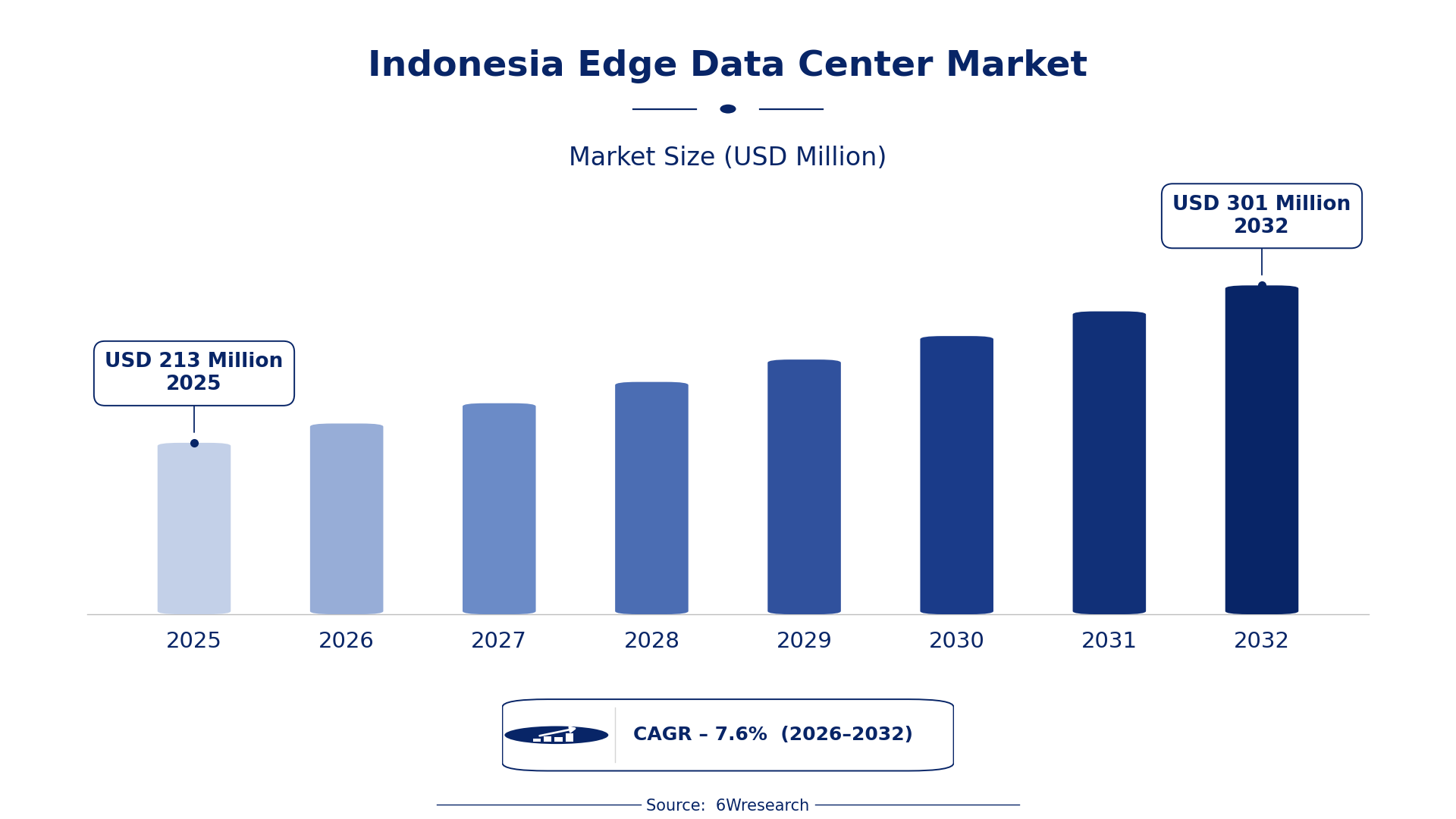
The Indonesia Edge Data Center Market was estimated at USD 213 Million in 2025 and is projected to reach USD 301 Million by 2032, growing at a CAGR of 7.6% from 2026 to 2032.
Indonesia Edge Data Center Market Synopsis
The increasing demand for low-latency processing in Indonesia is driving the growth of edge data centers, particularly in urban areas where IoT applications are proliferating. Businesses are recognizing that positioning data centers closer to end-users significantly enhances the efficiency of services ranging from autonomous vehicles to real-time analytics.
As companies in Indonesia ramp up their digital transformations, edge data centers are becoming integral to their strategies. This shift is fueled by the need for immediate data access and processing power, allowing organizations to respond swiftly to market changes and consumer demands.
Indonesia Edge Data Center Market Year-wise Growth Rate and Key Drivers
This graph illustrates the annual growth rates of the Indonesia Edge Data Center Market from 2021 to 2032, highlighting a steady upward trajectory and projected expansion over the forecast period.
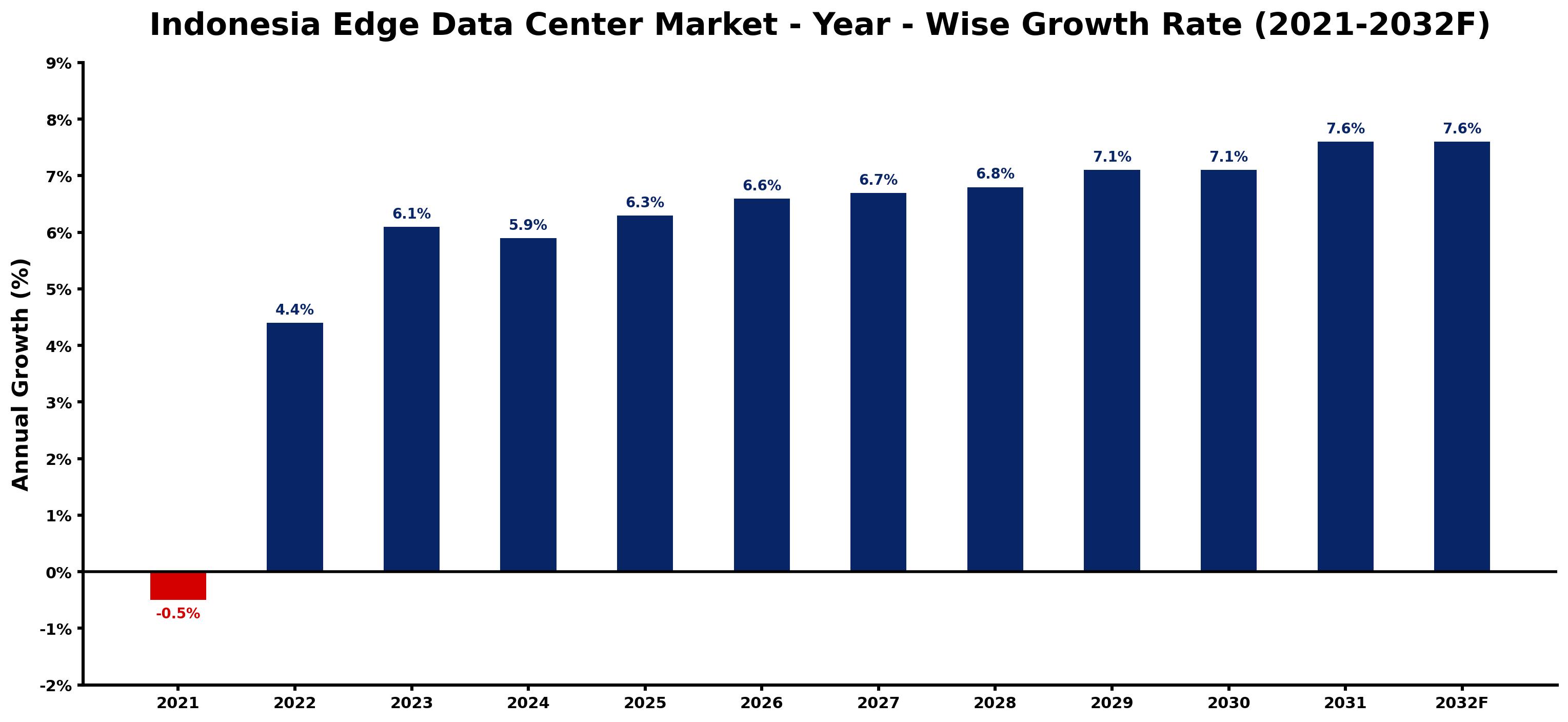
The table below presents the year‑wise growth rates along with the key drivers influencing the market
| Year | Growth Rate | Major Drivers |
| 2021 | -0.5% | Power supply issues hampered data center operations. |
| 2022 | 4.4% | Government's 5G rollout boosting demand for edge computing. |
| 2023 | 6.1% | Increased cloud adoption by local SMEs driving data center growth. |
| 2024 | 5.9% | Rise in mobile internet users enhancing edge infrastructure needs. |
| 2025 | 6.3% | Regulatory support for data localization encouraging regional data centers. |
| 2026 | 6.6% | Investment incentives from Indonesia's Ministry of Communications and Informatics. |
| 2027 | 6.7% | Growing fintech ecosystem creates demand for low-latency solutions. |
| 2028 | 6.8% | Local gaming industry's expansion requiring more edge computing resources. |
| 2029 | 7.1% | Emerging IoT applications necessitating decentralized data processing capabilities. |
| 2030 | 7.1% | Government's digital economy initiatives stimulating edge adoption across sectors. |
| 2031 | 7.6% | Increasing cyber security threats prompting investments in local data centers. |
| 2032 | 7.6% | Sustainable data center initiatives aligning with national green policies. |
Note: Market size estimations and growth projections presented in this report are based on 6Wresearch's proprietary forecasting methodology, utilizing the latest available industry data, government publications, and primary research inputs.
Indonesia Edge Data Center Market Key Takeaways
Below are some of the specific key takeaways from the market, including:
- Edge data centers are critical for supporting IoT applications, enhancing operational efficiency.
- The market is experiencing a notable rise in demand due to the acceleration of digital services and applications.
- Infrastructure challenges pose significant hurdles for the deployment of edge data centers in remote locations.
- Key innovations in edge computing technology are driving the decentralization of data processing.
- Government policies are increasingly focused on improving digital infrastructure to support edge data growth.
Evaluation of Restraints in Indonesia Edge Data Center Market
Despite the promising growth potential, the Indonesia Edge Data Center Market faces several restraints that can hinder its development. One primary concern is the lack of adequate infrastructure, particularly in rural areas. Deploying edge data centers in these locations requires not only substantial investment but also reliable connectivity to ensure efficient data processing. on top of that, existing regulatory frameworks may not always be conducive to swift development, adding another layer of complexity for stakeholders looking to expand their edge computing capabilities.
Indonesia Edge Data Center Market Trends
The Indonesian market is witnessing several trends that are reshaping the edge data center sector. One significant trend is the surge in IoT device adoption, which necessitates faster data processing and lower latency. As a result, businesses are increasingly investing in edge computing solutions to meet these demands.
Additionally, advancements in artificial intelligence and machine learning are driving innovations in edge technology. Companies are leveraging these technologies to enhance data processing capabilities and improve decision-making in real time. The focus on sustainability is also gaining traction, with many organizations seeking energy-efficient solutions for their edge data centers.
Indonesia Edge Data Center Market Opportunities
Opportunities abound in the Indonesia Edge Data Center Market as businesses and government entities look to enhance their digital infrastructure. The growth of 5G technology presents a significant opportunity for edge data centers, as faster connectivity will enable more robust edge computing applications.
on top of that, the increasing demand for smart city initiatives is likely to boost investments in edge computing solutions. As urban areas become more connected, the need for efficient data processing at the edge will only intensify, opening doors for new entrants and existing players alike.
Government Initiatives in the Indonesia Edge Data Center Market
The Indonesian government is actively shaping the edge data center market through various initiatives aimed at enhancing digital infrastructure. With a growing emphasis on digital transformation, public policy is increasingly focused on improving connectivity and reducing barriers to investment in this sector. By fostering a conducive regulatory environment, the government is encouraging private sector participation in building and expanding edge data centers across the country.
- A national digital infrastructure upgrade programme now in its rollout phase aims to enhance connectivity in underserved regions.
- A regulatory framework introduced in 2025 mandating improved data privacy and security standards has been launched.
- A planned public-private initiative expected to expand telecom infrastructure access by 2028 will support edge data center deployments.
- Ongoing efforts to streamline permitting processes for new data center construction are being implemented to reduce bureaucratic delays.
Future Insights of the Indonesia Edge Data Center Market
Looking ahead to 2026-2032, the Indonesia Edge Data Center Market is set to experience significant advancements driven by technology and increased demand for low-latency processing. As IoT adoption continues to rise, the necessity for efficient data handling will compel businesses to invest in edge solutions aggressively. on top of that, the anticipated rollout of 5G networks will catalyze a surge in applications requiring immediate data processing, solidifying the role of edge data centers as a cornerstone of digital infrastructure.
Indonesia Edge Data Center Market Latest Developments
In the past year, the Indonesia Edge Data Center Market has seen a flurry of activity, reflecting the growing importance of edge computing in the region. Companies are investing in new technologies and partnerships to enhance their service offerings and address the rising demand for low-latency applications.
- A major technology vendor launched a cutting-edge edge computing solution in early 2025, targeting industries reliant on real-time data processing.
- An ongoing initiative to establish a network of micro data centers across urban areas is currently underway, aimed at improving service delivery.
- A partnership between a leading regional operator and a cloud service provider, announced in late 2025, focuses on optimizing edge data processing capabilities.
- A planned expansion of an existing data center facility is expected to begin in mid-2026, aiming to increase capacity and support growing demand.
Indonesia Edge Data Center Market - Key Attractiveness of the Report
- 10 Years of Market Numbers
- Historical Data Starting from 2022 to 2025
- Base Year: 2025
- Forecast Data until 2032
- Key Performance Indicators Impacting the Market
- Major Upcoming Developments and Projects
Key Highlights of the Report:
- Indonesia Edge Data Center Market Outlook
- Market Size of Indonesia Edge Data Center Market, 2025
- Forecast of Indonesia Edge Data Center Market, 2032
- Historical Data and Forecast of Indonesia Edge Data Center Revenues & Volume for the Period 2022-2032F
- Indonesia Edge Data Center Market Trend Evolution
- Indonesia Edge Data Center Market Drivers and Challenges
- Indonesia Edge Data Center Price Trends
- Indonesia Edge Data Center Porter's Five Forces
- Indonesia Edge Data Center Industry Life Cycle
- Historical Data and Forecast of Indonesia Edge Data Center Market Revenues & Volume By Component for the Period 2022-2032F
- Historical Data and Forecast of Indonesia Edge Data Center Market Revenues & Volume By Solutions for the Period 2022-2032F
- Historical Data and Forecast of Indonesia Edge Data Center Market Revenues & Volume By Services for the Period 2022-2032F
- Historical Data and Forecast of Indonesia Edge Data Center Market Revenues & Volume By for the Period 2022-2032F
- Historical Data and Forecast of Indonesia Edge Data Center Market Revenues & Volume By APAC for the Period 2022-2032F
- Historical Data and Forecast of Indonesia Edge Data Center Market Revenues & Volume By Facility Size for the Period 2022-2032F
- Historical Data and Forecast of Indonesia Edge Data Center Market Revenues & Volume By Small for the Period 2022-2032F
- Historical Data and Forecast of Indonesia Edge Data Center Market Revenues & Volume By Medium Facilities for the Period 2022-2032F
- Historical Data and Forecast of Indonesia Edge Data Center Market Revenues & Volume By Large Facility for the Period 2022-2032F
- Historical Data and Forecast of Indonesia Edge Data Center Market Revenues & Volume By Vertical for the Period 2022-2032F
- Historical Data and Forecast of Indonesia Edge Data Center Market Revenues & Volume By IT and Telecom for the Period 2022-2032F
- Historical Data and Forecast of Indonesia Edge Data Center Market Revenues & Volume By BFSI for the Period 2022-2032F
- Historical Data and Forecast of Indonesia Edge Data Center Market Revenues & Volume By Healthcare and Lifesciences for the Period 2022-2032F
- Historical Data and Forecast of Indonesia Edge Data Center Market Revenues & Volume By Manufacturing for the Period 2022-2032F
- Historical Data and Forecast of Indonesia Edge Data Center Market Revenues & Volume By Government for the Period 2022-2032F
- Historical Data and Forecast of Indonesia Edge Data Center Market Revenues & Volume By Automotive for the Period 2022-2032F
- Historical Data and Forecast of Indonesia Edge Data Center Market Revenues & Volume By Gaming and Entertainment for the Period 2022-2032F
- Historical Data and Forecast of Indonesia Edge Data Center Market Revenues & Volume By Retail and E-commerce for the Period 2022-2032F
- Indonesia Edge Data Center Import Export Trade Statistics
- Market Opportunity Assessment By Component
- Market Opportunity Assessment By
- Market Opportunity Assessment By Facility Size
- Market Opportunity Assessment By Vertical
- Indonesia Edge Data Center Top Companies Market Share
- Indonesia Edge Data Center Competitive Benchmarking By Technical and Operational Parameters
- Indonesia Edge Data Center Company Profiles
- Indonesia Edge Data Center Key Strategic Recommendations






































