Indonesia Electric and Acoustic Guitar Strings Market Size, Share & Growth Rate
The Indonesia Electric and Acoustic Guitar Strings Market was estimated at USD 282 Million in 2025 and is projected to reach USD 375 Million by 2032, growing at a CAGR of 4.2% from 2026 to 2032. This growth trajectory is primarily fueled by an increasing number of guitar enthusiasts and a vibrant music industry that celebrates diverse musical styles. Furthermore, innovations in string technology are enhancing product quality, catering to the demands of both amateur and professional musicians.
Indonesia Electric and Acoustic Guitar Strings Market Year-wise Growth Rate and Key Drivers
This graph highlights how the Indonesia Electric and Acoustic Guitar Strings Market has steadily grown over the years, supported by major growth factors.
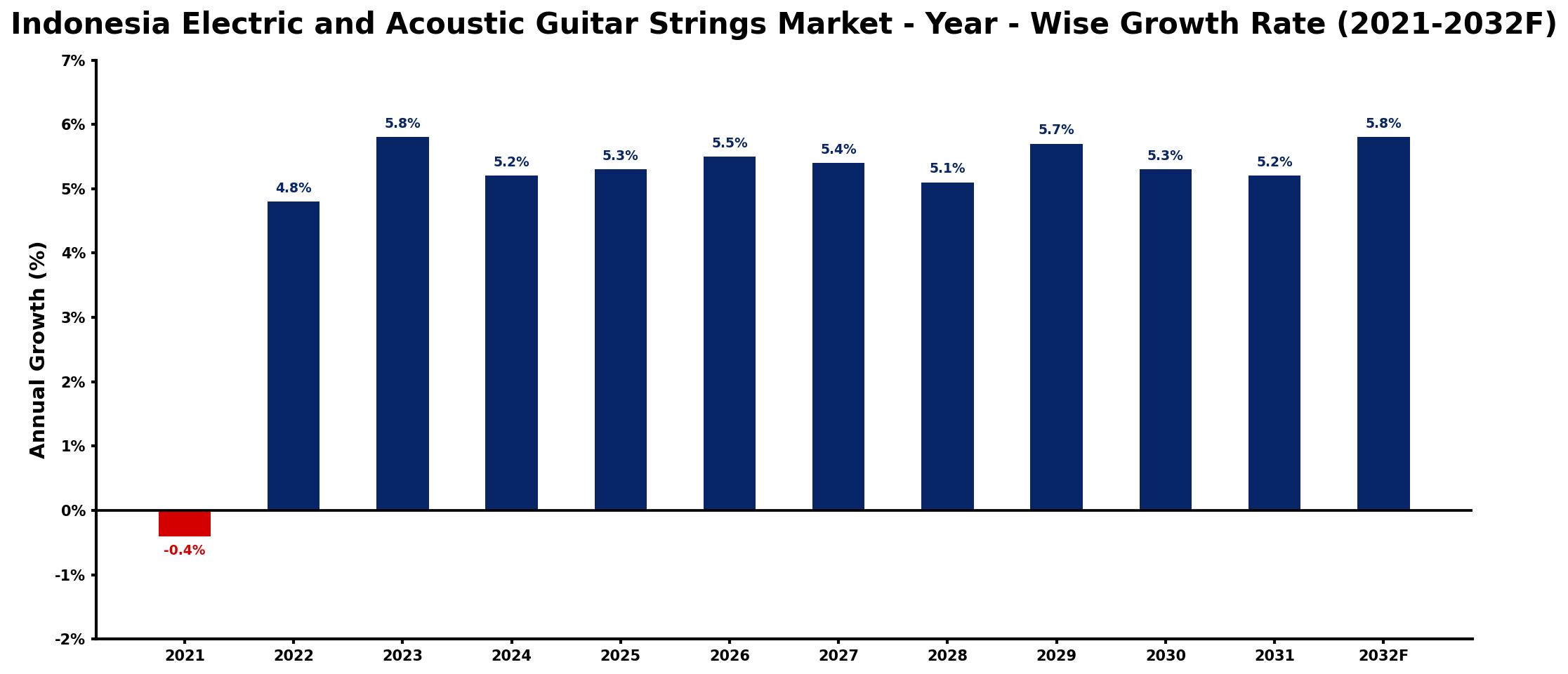
The table below presents the year‑wise growth rates along with the key drivers influencing the market
| Year | Growth Rate | Major Drivers |
| 2021 | -0.4% | decreased consumer purchasing power |
| 2022 | 4.8% | rise in music education programs |
| 2023 | 5.8% | growth in online music sales |
| 2024 | 5.2% | increased live performance venues |
| 2025 | 5.3% | expansion of music festivals |
| 2026 | 5.5% | surge in social media influencers |
| 2027 | 5.4% | greater interest in home recording |
| 2028 | 5.1% | increase in music streaming subscriptions |
| 2029 | 5.7% | growth of local music communities |
| 2030 | 5.3% | enhanced distribution networks established |
| 2031 | 5.2% | rising popularity of musical collaborations |
| 2032 | 5.8% | enhanced product quality standards |
Note: Market size estimations and growth projections presented in this report are based on 6Wresearch's proprietary forecasting methodology, utilizing the latest available industry data, government publications, and primary research inputs.
Indonesia Electric and Acoustic Guitar Strings Market Synopsis
The most significant force shaping the Indonesia Electric and Acoustic Guitar Strings Market is the burgeoning local music scene. With a rich cultural appreciation for music and increasing participation in both casual and professional performances, the demand for high-quality guitar strings is surging. Local and international manufacturers stand to benefit from this growing interest, which extends from urban centers to more remote regions.
Additionally, the rise of online platforms and social media has accelerated the dissemination of musical knowledge and skills, further driving interest in guitar playing. As more Indonesians engage in music, the need for reliable and high-performance strings becomes imperative, presenting a lucrative avenue for manufacturers willing to innovate and invest in marketing strategies.
Indonesia Electric and Acoustic Guitar Strings Market Key Takeaways
- The market is propelled by an expanding community of musicians and enthusiasts throughout Indonesia.
- Technological advancements in string manufacturing are enhancing the quality and durability of products.
- Competition from international brands poses a challenge for local manufacturers in maintaining market share.
- COVID-19 disruptions have reshaped consumer behavior, but recovery is on the horizon as live performances resume.
- Opportunities for growth exist in developing effective marketing and distribution strategies to reach wider audiences.
Evaluation of Restraints in Indonesia Electric and Acoustic Guitar Strings Market
Despite the positive outlook, several restraints continue to hold the market back. A major concern is the competition faced by domestic manufacturers from established international brands, which often have stronger marketing and distribution networks. This can lead to price wars that may disadvantage local producers. Additionally, ensuring a consistent supply of quality raw materials is critical, as fluctuations can impact production capabilities. The necessity for a robust infrastructure to support distribution and sales also presents challenges, limiting market growth potential in certain regions.
Indonesia Electric and Acoustic Guitar Strings Market Trends
Key trends are emerging within the Indonesia Electric and Acoustic Guitar Strings Market, notably the shift toward eco-friendly materials and manufacturing processes. With an increasing global focus on sustainability, consumers are showing a preference for products that minimize environmental impact. Moreover, the rise of online music education is fostering a new wave of learners, which in turn is increasing demand for various types of guitar strings tailored to beginners and seasoned players alike. Personalization and customization of guitar strings are also on the rise, appealing to musicians who want to express their individuality through their instruments.
Indonesia Electric and Acoustic Guitar Strings Market Opportunities
Opportunities for significant growth within the Indonesia Electric and Acoustic Guitar Strings Market lie in the potential to expand product lines that cater to niche markets. With the ongoing rise in popularity of genres such as pop, rock, and traditional Indonesian music, manufacturers can develop specialized strings that enhance sound quality for specific styles. Additionally, collaboration with local music schools and institutions can foster brand loyalty and create new distribution channels, further solidifying market presence and driving sales.
Government Initiatives in the Indonesia Electric and Acoustic Guitar Strings Market
The Indonesian government has been taking steps to promote the music industry as a key cultural asset. This includes funding for music education programs and festivals, which indirectly benefit the guitar strings market. Initiatives that focus on supporting local artisans and manufacturers may also create favorable conditions for the growth of domestic guitar string production, encouraging the use of local materials and craftsmanship. Public spending on arts and culture contributes to an overall supportive environment for the musical landscape.
Future Insights of the Indonesia Electric and Acoustic Guitar Strings Market
Looking ahead to the period from 2026 to 2032, the Indonesia Electric and Acoustic Guitar Strings Market is expected to thrive as the music industry stabilizes post-pandemic. Increased interest in music education and digital platforms will likely sustain demand for guitar strings, while manufacturers who embrace innovation and sustainable practices will be better positioned to capitalize on market opportunities. As the population's love for music deepens, the market is set to grow more robustly, driven by both local and global influences.
Indonesia Electric and Acoustic Guitar Strings Market Latest Developments (2025 - 2026)
Recent developments in the Indonesia Electric and Acoustic Guitar Strings Market indicate a significant uptick in product launches focusing on sustainable materials and technology-enhanced performance. Local manufacturers are increasingly collaborating with music educators to develop strings that cater specifically to students, fostering a new generation of musicians. Additionally, the influence of social media in promoting musical talent has led to a rise in consumer demand for customized and high-quality strings tailored to individual playing styles.
Indonesia Electric and Acoustic Guitar Strings Market - Key Attractiveness of the Report
- 10 Years of Market Numbers
- Historical Data Starting from 2022 to 2025
- Base Year: 2025
- Forecast Data until 2032
- Key Performance Indicators Impacting the Market
- Major Upcoming Developments and Projects
Key Highlights of the Report:
- Indonesia Electric and Acoustic Guitar Strings Market Outlook
- Market Size of Indonesia Electric and Acoustic Guitar Strings Market, 2025
- Forecast of Indonesia Electric and Acoustic Guitar Strings Market, 2032
- Historical Data and Forecast of Indonesia Electric and Acoustic Guitar Strings Revenues & Volume for the Period 2022-2032F
- Indonesia Electric and Acoustic Guitar Strings Market Trend Evolution
- Indonesia Electric and Acoustic Guitar Strings Market Drivers and Challenges
- Indonesia Electric and Acoustic Guitar Strings Price Trends
- Indonesia Electric and Acoustic Guitar Strings Porter's Five Forces
- Indonesia Electric and Acoustic Guitar Strings Industry Life Cycle
- Historical Data and Forecast of Indonesia Electric and Acoustic Guitar Strings Market Revenues & Volume By Product Type for the Period 2022-2032F
- Historical Data and Forecast of Indonesia Electric and Acoustic Guitar Strings Market Revenues & Volume By Light, Custom Light for the Period 2022-2032F
- Historical Data and Forecast of Indonesia Electric and Acoustic Guitar Strings Market Revenues & Volume By Extra Light for the Period 2022-2032F
- Historical Data and Forecast of Indonesia Electric and Acoustic Guitar Strings Market Revenues & Volume By Application for the Period 2022-2032F
- Historical Data and Forecast of Indonesia Electric and Acoustic Guitar Strings Market Revenues & Volume By Acoustic Guitar for the Period 2022-2032F
- Historical Data and Forecast of Indonesia Electric and Acoustic Guitar Strings Market Revenues & Volume By Electric Guitar for the Period 2022-2032F
- Indonesia Electric and Acoustic Guitar Strings Import Export Trade Statistics
- Market Opportunity Assessment By Product Type
- Market Opportunity Assessment By Application
- Indonesia Electric and Acoustic Guitar Strings Top Companies Market Share
- Indonesia Electric and Acoustic Guitar Strings Competitive Benchmarking By Technical and Operational Parameters
- Indonesia Electric and Acoustic Guitar Strings Company Profiles
- Indonesia Electric and Acoustic Guitar Strings Key Strategic Recommendations






































