Indonesia Electrical and electronics Market Summary
The indonesia electrical and electronics market was estimated at USD 400 Million in 2025 and is projected to reach USD 529 Million by 2032, growing at a CAGR of 5.5% from 2026 to 2032.
Indonesia Electrical and electronics Market Year-wise Growth Rate and Key Drivers
This graph highlights how the Indonesia Electrical and electronics Market has steadily grown over the past five years, supported by major growth factors.
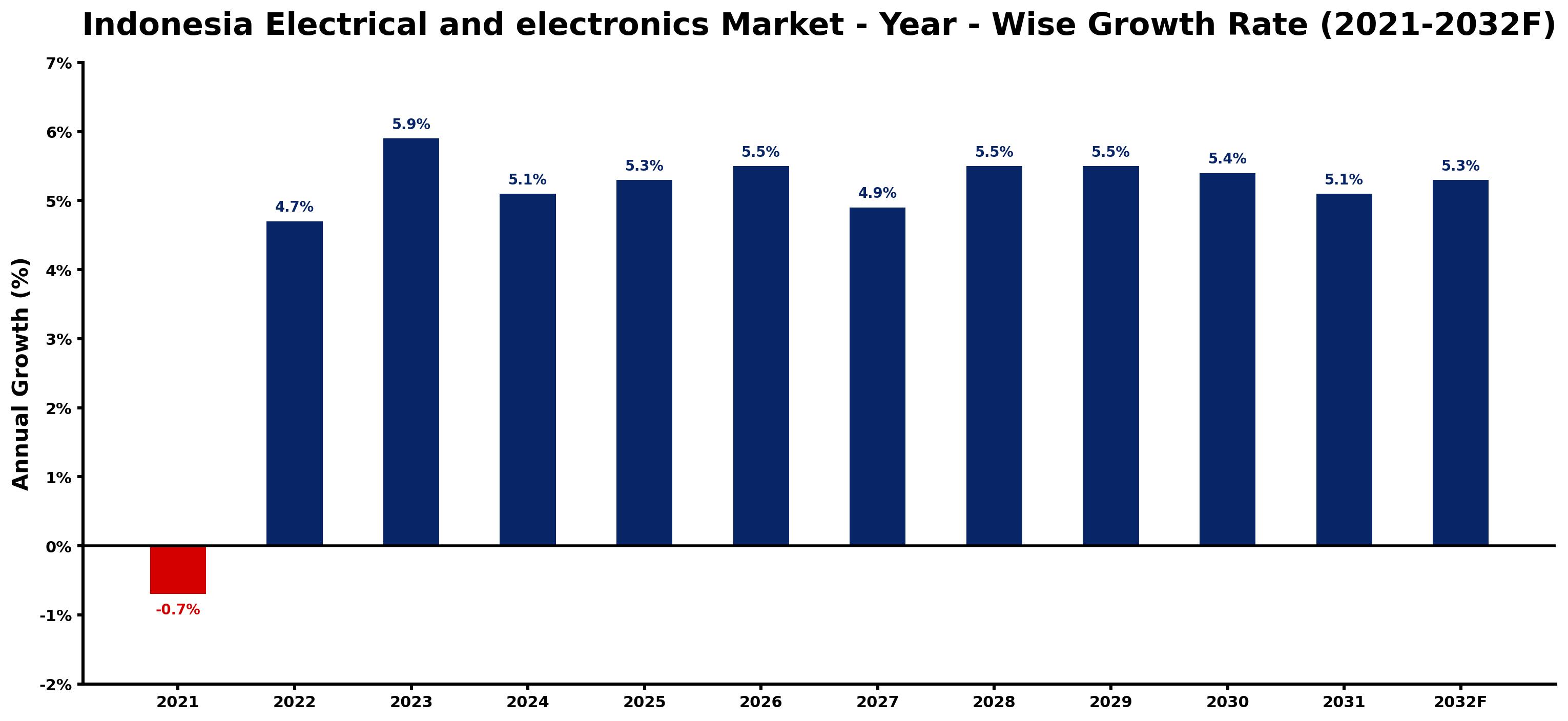
The table below presents the year wise growth rates along with the key drivers influencing the market
| Year | Growth Rate | Major Drivers |
| 2021 | -0.7% | Uncertain economic conditions curbed investment in new electrical infrastructure, leading to reduced market activity. |
| 2022 | 4.7% | Manufacturers focused on local sourcing, enhancing supply chain stability and efficiency. |
| 2023 | 5.9% | Consumer preferences shifted towards smart appliances, driving innovation in the electronics sector. |
| 2024 | 5.1% | E-commerce platforms gained traction, facilitating greater accessibility to electronic products nationwide. |
| 2025 | 5.3% | Urbanization trends prompted infrastructure investments, boosting demand for electrical equipment and services. |
| 2026 | 5.5% | Renewable energy initiatives spurred interest in sustainable electronics and energy-efficient technologies. |
| 2027 | 4.9% | Emerging tech startups introduced disruptive solutions, enhancing competition across the electronics landscape. |
| 2028 | 5.5% | Telecommunication expansions improved connectivity, elevating the demand for advanced electronic devices. |
| 2029 | 5.5% | Increased disposable incomes empowered more consumers to invest in premium electronic products. |
| 2030 | 5.4% | Environmental concerns prompted regulatory frameworks favoring eco-friendly electronics and production methods. |
| 2031 | 5.1% | Industry collaborations focused on innovations, enhancing product offerings to meet consumer expectations. |
| 2032 | 5.3% | Technological convergence brought advancements in smart home systems, reshaping electronics purchasing behaviors. |
Note - Market size estimations and growth projections presented in this report are based on 6Wresearch's advanced forecasting approach, validated with industry datasets as of June 2026.
Indonesia Electrical and electronics Market Synopsis
The Indonesia Electrical and electronics Market is projected to reach 5.5% and witness significant growth during the forecast period (2026-2032). This momentum is primarily driven by the increasing demand from various sectors, including automotive, telecommunications, and consumer electronics. The rising disposable income among the population, alongside the Indonesian government's initiatives to attract foreign investments in the manufacturing sector, is expected to further bolster the market throughout this timeframe.
Indonesia Electrical and electronics Market Growth Drivers
Key factors fueling the growth of the Indonesia Electrical and electronics Market include:
- Increasing salary levels, particularly among the growing middle-class demographic, are prompting consumers to invest in luxury electronic items such as premium audio systems and high-definition televisions. This trend is significantly enhancing the consumption patterns for electrical and electronic goods.
- The Indonesian government is actively providing incentives, including tax exemptions and subsidies for establishing manufacturing facilities in designated economic zones. Such initiatives are designed to attract foreign direct investments, promoting both the local production of electronic goods and the overall market growth.
- Rapid technological advancements across various industries, including healthcare, aerospace, and automotive, are leading to increased demand for sophisticated electronic equipment. The adoption of cutting-edge technology is further driving the need for advanced electronics in industrial automation and medical applications.
- Strong distribution channels throughout Indonesia are facilitating the swift delivery of electrical and electronic products to consumers. This robust logistics framework supports the growth of retail and e-commerce sectors, contributing to higher sales in the electrical and electronics market.
- The growing emphasis on sustainable and energy-efficient products is prompting manufacturers to innovate and launch environmentally friendly electrical appliances. This shift not only meets consumer preferences but also aligns with global sustainability trends, driving further market expansion.
Indonesia Electrical and electronics Market Challenges and Restraints
Despite the promising growth trajectory, the Indonesia Electrical and electronics Market faces several challenges:
- The unavailability of a skilled labor force poses a significant challenge for the electrical and electronics industry. A lack of vocational training centers offering specialized courses is impeding the development of critical competencies required for operating advanced electronic equipment.
- Labor shortages are prevalent in certain regions, leading to underutilization of existing resources. This inefficiency hampers the overall productivity of operations, impacting the profitability of businesses within the sector.
- Rising wage levels can create financial strain on manufacturers. High employment costs may result in reduced profit margins, compelling companies to reassess their operational strategies to maintain competitiveness.
- The fluctuating costs of raw materials and components can create volatility in production costs, making it challenging for manufacturers to maintain consistent pricing in the market.
- Intense competition from both local and international players necessitates ongoing innovation and marketing efforts. Companies must continuously adapt to shifting consumer preferences and technological advancements to remain relevant in this dynamic market landscape.
Indonesia Electrical and electronics Market Government Investment and Initiatives
The Indonesian government has initiated several substantial investments and development plans aimed at enhancing the electrical and electronics market:
- The government is focusing on increasing public spending on infrastructure to improve the logistics and distribution networks crucial for the electrical and electronics sector. This investment is expected to streamline supply chains and facilitate better access to consumers.
- In a bid to foster innovation, Indonesia is enhancing its support for research and development initiatives within the electrical and electronics sector. This includes providing grants and fostering partnerships between academia and industry.
- Strategic economic policies are being implemented to encourage foreign investment. These policies not only include tax incentives but also streamline regulatory processes to ease the establishment of manufacturing operations in the country.
- The government is emphasizing skill development programs to address the shortage of skilled labor. Partnerships with educational institutions are being formed to create vocational training programs tailored to the needs of the electrical and electronics industry.
- Indonesia is promoting initiatives aimed at bolstering sustainable manufacturing practices in the electrical and electronics sector, aligning with global environmental standards and enhancing the market's attractiveness for environmentally conscious investors.
Indonesia Electrical and electronics Market Latest Developments (May 2025 - June 2026)
During the period from May 2025 to June 2026, the Indonesia Electrical and electronics Market has experienced several notable developments:
- The government launched new policies aimed at attracting foreign direct investment, which have started showing positive results in the establishment of new manufacturing facilities within the country.
- A surge in consumer demand for smart home devices and appliances has prompted local manufacturers to increase production capacities, thereby enhancing the availability of these products in the market.
- There has been a significant rise in collaborations between local and international firms in research and development, focused on creating innovative electrical products that meet both local and global market standards.
- The electrical and electronics sector is witnessing an increase in digital transformation initiatives, with companies investing in e-commerce platforms to enhance customer reach and improve sales channels.
- Government-led sustainability initiatives are gaining momentum, leading to an uptick in the manufacturing of energy-efficient electronic products, which aligns with both consumer preferences and regulatory requirements.
Indonesia Electrical and electronics Market - Key Attractiveness of the Report
- 10 Years of Market Numbers
- Historical Data Starting from 2022 to 2025
- Base Year: 2025
- Forecast Data until 2032
- Key Performance Indicators Impacting the Market
- Major Upcoming Developments and Projects
Key Highlights of the Report:
- Indonesia Electrical and electronics Market Outlook
- Market Size of Indonesia Electrical and electronics Market, 2025
- Forecast of Indonesia Electrical and electronics Market, 2032F
- Historical Data and Forecast of Indonesia Electrical and electronics Revenues & Volume for the Period 2022-2032F
- Indonesia Electrical and electronics Market Trend Evolution
- Indonesia Electrical and electronics Market Drivers and Challenges
- Indonesia Electrical and electronics Price Trends
- Indonesia Electrical and electronics Porter's Five Forces
- Indonesia Electrical and electronics Industry Life Cycle
- Historical Data and Forecast of Indonesia Electrical and electronics Market Revenues & Volume By Type for the Period 2022-2032F
- Historical Data and Forecast of Indonesia Electrical and electronics Market Revenues & Volume By Electric Motors for the Period 2022-2032F
- Historical Data and Forecast of Indonesia Electrical and electronics Market Revenues & Volume By Primary And Storage Batteries for the Period 2022-2032F
- Historical Data and Forecast of Indonesia Electrical and electronics Market Revenues & Volume By Generators for the Period 2022-2032F
- Historical Data and Forecast of Indonesia Electrical and electronics Market Revenues & Volume By Semiconductors for the Period 2022-2032F
- Historical Data and Forecast of Indonesia Electrical and electronics Market Revenues & Volume By Household Appliances for the Period 2022-2032F
- Historical Data and Forecast of Indonesia Electrical and electronics Market Revenues & Volume By Applications for the Period 2022-2032F
- Historical Data and Forecast of Indonesia Electrical and electronics Market Revenues & Volume By Online for the Period 2022-2032F
- Historical Data and Forecast of Indonesia Electrical and electronics Market Revenues & Volume By Offline for the Period 2022-2032F
- Indonesia Electrical and electronics Import Export Trade Statistics
- Market Opportunity Assessment By Type
- Market Opportunity Assessment By Applications
- Indonesia Electrical and electronics Top Companies Market Share
- Indonesia Electrical and electronics Competitive Benchmarking By Technical and Operational Parameters
- Indonesia Electrical and electronics Company Profiles
- Indonesia Electrical and electronics Key Strategic Recommendations






































