Indonesia Electrical Components Market Size, Share & Growth Rate
The Indonesia Electrical Components Market was estimated at USD 454 Million in 2025 and is projected to reach USD 597 Million by 2032, growing at a CAGR of 4.0% from 2026 to 2032. This growth trajectory is largely fueled by the rapid industrialization and urbanization in Indonesia, leading to an increased demand for robust electrical infrastructure. Additionally, the expanding renewable energy sector and the increasing adoption of smart technologies in various industries are further propelling the market forward.
Indonesia Electrical Components Market Year-wise Growth Rate and Key Drivers
This graph highlights how the Indonesia Electrical Components Market has steadily grown over the years, supported by major growth factors.
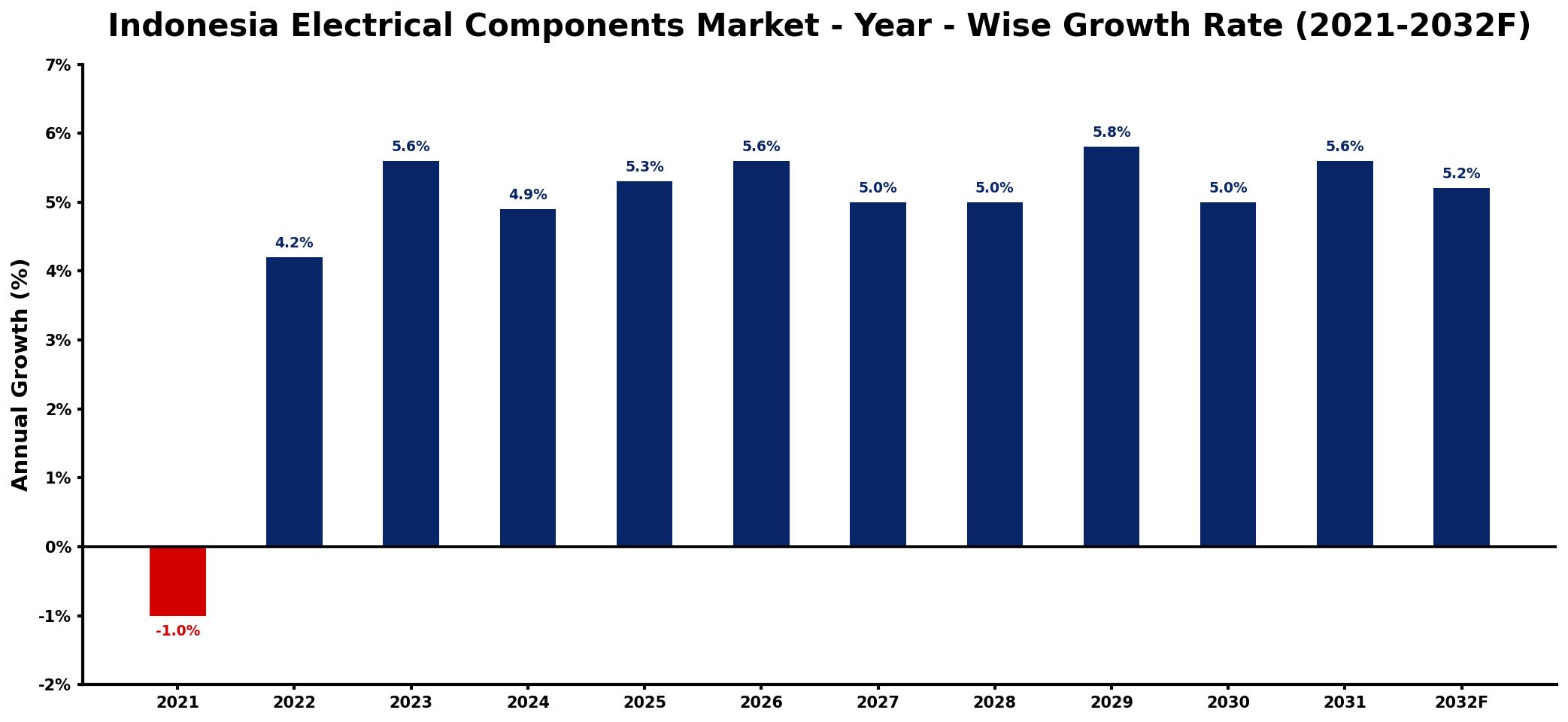
The table below presents the year‑wise growth rates along with the key drivers influencing the market
| Year | Growth Rate | Major Drivers |
| 2021 | -1.0% | Lower industrial investment activity |
| 2022 | 4.2% | Rising demand from construction sector |
| 2023 | 5.6% | Increased renewable energy projects |
| 2024 | 4.9% | Expansion of urban infrastructure projects |
| 2025 | 5.3% | Growth in manufacturing capabilities |
| 2026 | 5.6% | Surge in residential housing demand |
| 2027 | 5.0% | Investment in smart technologies |
| 2028 | 5.0% | Higher exports to regional markets |
| 2029 | 5.8% | Advancements in automation technologies |
| 2030 | 5.0% | Increased focus on sustainability initiatives |
| 2031 | 5.6% | Rising interest in smart cities |
| 2032 | 5.2% | stronger distribution network expansion |
Note: Market size estimations and growth projections presented in this report are based on 6Wresearch's proprietary forecasting methodology, utilizing the latest available industry data, government publications, and primary research inputs.
Indonesia Electrical Components Market Synopsis
A significant driver shaping the Indonesia Electrical Components Market today is the relentless pace of industrialization. As manufacturing and construction sectors thrive, the necessity for reliable electrical components—such as wiring, connectors, and circuit breakers—continues to rise. This demand is particularly acute in urban areas, where infrastructure development is a priority.
Moreover, advancements in energy efficiency technology are influencing market dynamics, leading to a preference for innovative and sustainable solutions. The increasing focus on renewable energy projects and the electrification of various sectors further highlights the essential role that electrical components play in Indonesia's growth narrative.
Indonesia Electrical Components Market Key Takeaways
- The market is experiencing sustained growth due to urbanization and industrial infrastructure demands.
- Energy-efficient and smart technologies are reshaping consumer preferences and driving innovation.
- Investment in renewable energy projects is a crucial factor influencing market dynamics.
- Manufacturers must prioritize product quality to address safety concerns and maintain competitiveness.
- Global supply chain fluctuations pose challenges for the consistent availability of raw materials.
Evaluation of Restraints in Indonesia Electrical Components Market
Despite the promising outlook for the Indonesia Electrical Components Market, certain restraints could hinder its growth. Manufacturers face considerable pressure to keep pace with rapid technological advancements, necessitating ongoing investments in research and development. Moreover, ensuring product quality is paramount; substandard components not only jeopardize safety but can also compromise the integrity of electrical systems. Additionally, disruptions in the global supply chain often lead to unpredictability in the availability of essential raw materials, complicating production and delivery schedules.
Indonesia Electrical Components Market Trends
Several trends are currently shaping the Indonesia Electrical Components Market. The shift toward energy efficiency is driving demand for advanced electrical solutions that minimize consumption and environmental impact. Additionally, the growing preference for smart home and building technologies is leading to increased use of specialized electrical components. Furthermore, the rising integration of digital infrastructure in industrial applications reflects a larger trend toward automation and connectivity, suggesting that smart solutions will play an increasingly central role in the sector.
Indonesia Electrical Components Market Opportunities
The Indonesia Electrical Components Market presents numerous growth and investment opportunities. With the governments focus on expanding renewable energy capacities, companies can capitalize on the demand for electrical components tailored to this sector. Moreover, the transition towards smart technologies in buildings and industries opens new avenues for innovation in product design and application. As businesses and consumers alike seek energy-efficient solutions, there is significant potential for development in advanced electrical products that align with sustainability goals.
Government Initiatives in the Indonesia Electrical Components Market
The Indonesian government is actively fostering the growth of the electrical components market through various initiatives aimed at enhancing infrastructure and promoting renewable energy. Public spending on energy-efficient projects and incentives for adopting smart technologies are key components of the government's strategy. Furthermore, policies encouraging investments in electrical infrastructure and the electrification of underserved areas signal a commitment to advancing the market's overall development.
Future Insights of the Indonesia Electrical Components Market
Looking ahead to 2026-2032, the Indonesia Electrical Components Market is poised for robust growth. The increasing emphasis on renewable energy and energy efficiency will likely drive innovation and demand for specialized products. As urbanization continues to accelerate, the need for reliable electrical components will remain critical. Furthermore, the integration of smart technologies into various sectors will facilitate the development of advanced solutions that align with market trends and consumer expectations.
Indonesia Electrical Components Market Latest Developments (2025 - 2026)
Recent developments in the Indonesia Electrical Components Market indicate a strong focus on sustainability and innovation. Key industry players are enhancing their product lines to include more energy-efficient and reliable options. Moreover, there is a noticeable shift towards smart technology integration within electrical systems, reflecting broader trends in the construction and manufacturing sectors. The ongoing projects in renewable energy and digital infrastructure signal a vibrant landscape ripe for further advancements and investments.
Indonesia Electrical Components Market - Key Attractiveness of the Report
- 10 Years of Market Numbers
- Historical Data Starting from 2022 to 2025
- Base Year: 2025
- Forecast Data until 2032
- Key Performance Indicators Impacting the Market
- Major Upcoming Developments and Projects
Key Highlights of the Report:
- Indonesia Electrical Components Market Outlook
- Market Size of Indonesia Electrical Components Market, 2025
- Forecast of Indonesia Electrical Components Market, 2032
- Historical Data and Forecast of Indonesia Electrical Components Revenues & Volume for the Period 2022-2032F
- Indonesia Electrical Components Market Trend Evolution
- Indonesia Electrical Components Market Drivers and Challenges
- Indonesia Electrical Components Price Trends
- Indonesia Electrical Components Porter's Five Forces
- Indonesia Electrical Components Industry Life Cycle
- Historical Data and Forecast of Indonesia Electrical Components Market Revenues & Volume By Building Automation for the Period 2022-2032F
- Historical Data and Forecast of Indonesia Electrical Components Market Revenues & Volume By Datacom Accessories for the Period 2022-2032F
- Historical Data and Forecast of Indonesia Electrical Components Market Revenues & Volume By Security & wiring Accessories for the Period 2022-2032F
- Historical Data and Forecast of Indonesia Electrical Components Market Revenues & Volume By Cables & Wires for the Period 2022-2032F
- Historical Data and Forecast of Indonesia Electrical Components Market Revenues & Volume By Datacom Cables for the Period 2022-2032F
- Historical Data and Forecast of Indonesia Electrical Components Market Revenues & Volume By LV Cables for the Period 2022-2032F
- Historical Data and Forecast of Indonesia Electrical Components Market Revenues & Volume By MV&HV Cables for the Period 2022-2032F
- Historical Data and Forecast of Indonesia Electrical Components Market Revenues & Volume By Special Cables for the Period 2022-2032F
- Historical Data and Forecast of Indonesia Electrical Components Market Revenues & Volume By Industrial Automation for the Period 2022-2032F
- Historical Data and Forecast of Indonesia Electrical Components Market Revenues & Volume By Automation Controls for the Period 2022-2032F
- Historical Data and Forecast of Indonesia Electrical Components Market Revenues & Volume By Auxiliary Controls for the Period 2022-2032F
- Historical Data and Forecast of Indonesia Electrical Components Market Revenues & Volume By Drives & Motion Controls for the Period 2022-2032F
- Historical Data and Forecast of Indonesia Electrical Components Market Revenues & Volume By Measurement Controls and Relays for the Period 2022-2032F
- Historical Data and Forecast of Indonesia Electrical Components Market Revenues & Volume By Lighting for the Period 2022-2032F
- Historical Data and Forecast of Indonesia Electrical Components Market Revenues & Volume By Fixtures for the Period 2022-2032F
- Historical Data and Forecast of Indonesia Electrical Components Market Revenues & Volume By Lamps & LEDs for the Period 2022-2032F
- Historical Data and Forecast of Indonesia Electrical Components Market Revenues & Volume By Power Distribution for the Period 2022-2032F
- Historical Data and Forecast of Indonesia Electrical Components Market Revenues & Volume By Cable Management for the Period 2022-2032F
- Historical Data and Forecast of Indonesia Electrical Components Market Revenues & Volume By Enclosures & Panels for the Period 2022-2032F
- Historical Data and Forecast of Indonesia Electrical Components Market Revenues & Volume By LV Electrical Distribution for the Period 2022-2032F
- Historical Data and Forecast of Indonesia Electrical Components Market Revenues & Volume By Renewable Energies for the Period 2022-2032F
- Historical Data and Forecast of Indonesia Electrical Components Market Revenues & Volume By HVAC for the Period 2022-2032F
- Historical Data and Forecast of Indonesia Electrical Components Market Revenues & Volume By Renewable energy for the Period 2022-2032F
- Historical Data and Forecast of Indonesia Electrical Components Market Revenues & Volume By Safety & Tools for the Period 2022-2032F
- Historical Data and Forecast of Indonesia Electrical Components Market Revenues & Volume By Safety Equipment for the Period 2022-2032F
- Historical Data and Forecast of Indonesia Electrical Components Market Revenues & Volume By Working Tools & Accessories for the Period 2022-2032F
- Indonesia Electrical Components Import Export Trade Statistics
- Market Opportunity Assessment By Building Automation
- Market Opportunity Assessment By Cables & Wires
- Market Opportunity Assessment By Industrial Automation
- Market Opportunity Assessment By Lighting
- Market Opportunity Assessment By Power Distribution
- Market Opportunity Assessment By Renewable Energies
- Market Opportunity Assessment By Safety & Tools
- Indonesia Electrical Components Top Companies Market Share
- Indonesia Electrical Components Competitive Benchmarking By Technical and Operational Parameters
- Indonesia Electrical Components Company Profiles
- Indonesia Electrical Components Key Strategic Recommendations






































