Indonesia Electron microscopes Market Size, Share & Growth Rate
The Indonesia Electron microscopes Market was estimated at USD 401 Million in 2025 and is projected to reach USD 530 Million by 2032, growing at a CAGR of 4.1% from 2026 to 2032. This growth trajectory is underpinned by increasing investments in healthcare and research facilities within the region. Additionally, the rising demand for advanced diagnostics, particularly in the context of infectious diseases, has made electron microscopes indispensable tools for researchers and healthcare professionals alike.
Indonesia Electron microscopes Market Growth Rate Analysis (2021-2032)
The Indonesian electron microscopes market is experiencing a robust uptick following a challenging period. After contracting by 1.0% in 2021, the market rebounded sharply, growing by 4.3% in 2022 and accelerating further to 5.6% in 2023. This growth can be attributed to increased investments in research and development across various sectors including healthcare and material sciences, driven by rising consumer demand for advanced analytical tools. Looking ahead, the market is projected to maintain a steady pace, with growth rates averaging around 5.3% to 5.6% through 2032. Factors such as ongoing digitalization efforts and enhanced infrastructure supporting technology adoption will likely sustain this upward trend, despite minor fluctuations.
Indonesia Electron microscopes Market Year-wise Growth Rate and Key Drivers
This graph highlights how the Indonesia Electron microscopes Market has steadily grown over the past five years, supported by major growth factors.
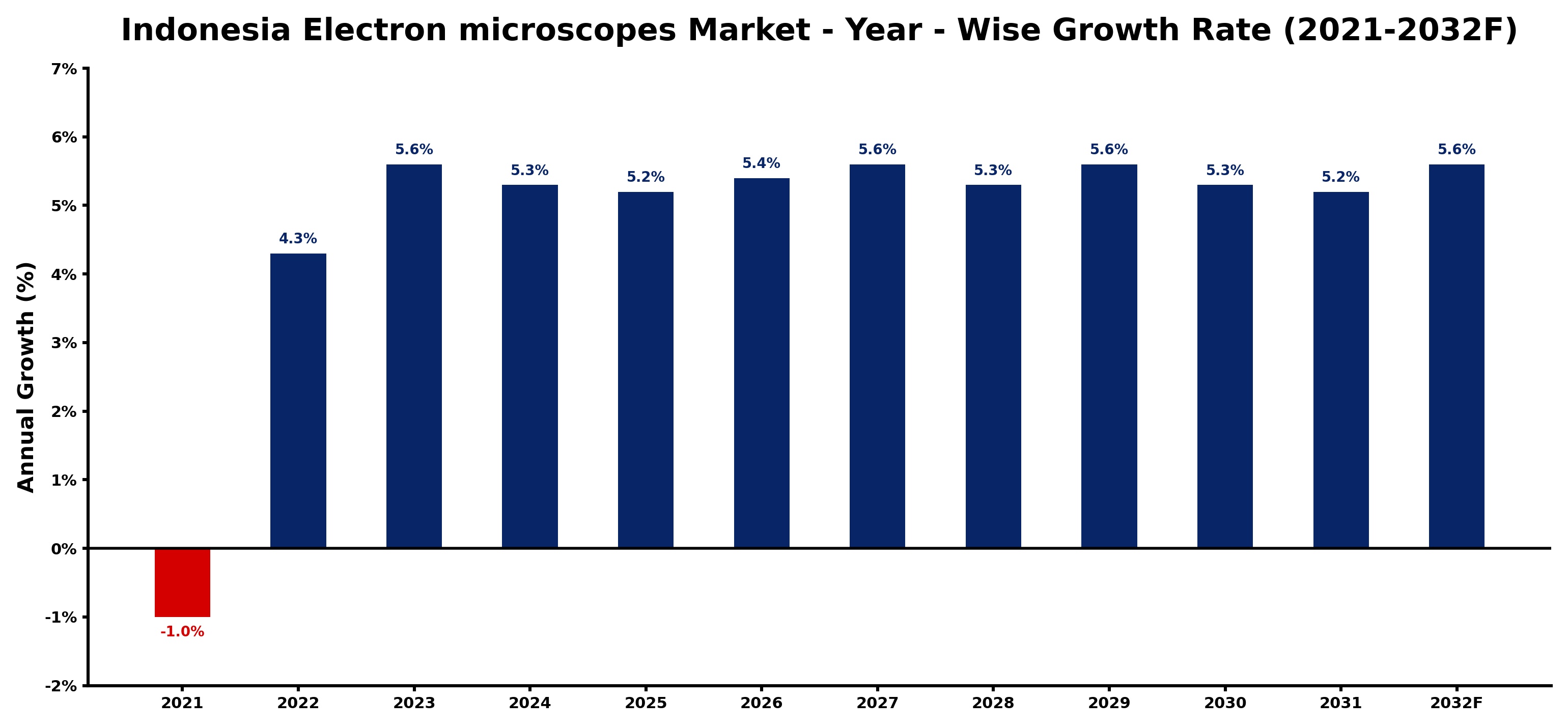
The table below presents the year‑wise growth rates along with the key drivers influencing the market
| Year | Growth Rate | Major Drivers |
| 2021 | -1.0% | Manufacturing slowdowns led to decreased demand for electron microscopes |
| 2022 | 4.3% | Higher vehicle production demands spurred electron microscope procurement efforts |
| 2023 | 5.6% | Manufacturing investments in semiconductor industry drive electron microscope demand |
| 2024 | 5.3% | Domestic manufacturing investments boost electron microscope procurement for quality control |
| 2025 | 5.2% | Technological upgrades in manufacturing boost precision measurement equipment demand |
| 2026 | 5.4% | Manufacturing modernization initiatives boosted electron microscope demand significantly |
| 2027 | 5.6% | Domestic semiconductor manufacturing boosts demand for precision electron microscopes |
| 2028 | 5.3% | Domestic vehicle manufacturing expansion boosts electron microscope demand |
| 2029 | 5.6% | Manufacturing investments boost advanced electron microscope production capabilities |
| 2030 | 5.3% | Laboratory upgrades drive electron microscope adoption in manufacturing sectors |
| 2031 | 5.2% | Local vehicle manufacturing expansion boosted electron microscope demand in Indonesia |
| 2032 | 5.6% | Domestic manufacturing upgrades fueled electron microscope technology investments |
Note - Market size estimations and growth projections presented in this report are based on 6Wresearch’s advanced forecasting approach, validated with industry datasets as of June 2026.
Indonesia Electron microscopes Market Synopsis
The Indonesian market for electron microscopes is evolving rapidly, driven by a growing emphasis on high-resolution imaging capabilities in laboratories. As research institutions and hospitals seek out cutting-edge technologies to enhance their diagnostic and therapeutic capabilities, the adoption of advanced electron microscopy techniques is anticipated to escalate. This demand is particularly pronounced in sectors focusing on nanotechnology and medical research.
Furthermore, local manufacturers are stepping up to offer cost-effective alternatives, making it feasible for hospitals with limited budgets to invest in these technologies. This influx of affordable options not only democratizes access to electron microscopy but also fosters an environment conducive to research and innovation across the archipelago.
Indonesia Electron microscopes Market Key Takeaways
- Growing demand for advanced diagnostic tools drives market growth.
- Investment in healthcare and research facilities significantly boosts market potential.
- Emerging local manufacturers provide competitive pricing, enhancing accessibility.
- Technological advancements enable the development of more efficient and compact models.
- Increased focus on nanotechnology research propels the adoption of electron microscopes.
Evaluation of Restraints in Indonesia Electron microscopes Market
The Indonesia Electron microscopes market faces notable restraints, primarily the scarcity of skilled personnel capable of operating these sophisticated devices. This skill gap can hinder the effective utilization of electron microscopy technologies. Furthermore, intense competition from international manufacturers, which often offer superior technology at competitive prices, poses significant challenges to local players. There is also a prevailing lack of awareness among potential customers regarding the advantages of electron microscopy over traditional imaging methods, which can impede broader market penetration.
Indonesia Electron microscopes Market Trends
The trend towards digitalization in the healthcare sector is reshaping the landscape of the Indonesia Electron microscopes Market. Companies are increasingly launching models that incorporate modern technologies such as 3D imaging and nanoimaging capabilities. These advancements not only enhance imaging precision but also facilitate a broader range of applications, from clinical diagnostics to research in nanotechnology. The integration of artificial intelligence in image analysis is another emerging trend that stands to revolutionize how electron microscopes are utilized across various fields.
Indonesia Electron microscopes Market Opportunities
Significant growth opportunities exist in the Indonesia Electron microscopes Market, particularly in research and educational institutions focusing on medical and materials sciences. The burgeoning field of nanotechnology research presents a critical growth avenue, as researchers seek advanced imaging techniques to explore new materials and biomedical applications. Furthermore, collaborations between local manufacturers and international entities can foster innovation, enhancing the market's competitive landscape and creating new investment opportunities.
Government Initiatives in the Indonesia Electron microscopes Market
The Indonesian government is actively promoting foreign investments in the healthcare sector, recognizing the importance of advanced medical technologies for public health. Initiatives aimed at improving research and development infrastructure are being rolled out, alongside financial incentives for institutions investing in cutting-edge diagnostic tools. Such governmental support is pivotal in creating a conducive environment for the growth of the electron microscopes market in Indonesia.
Future Insights of the Indonesia Electron microscopes Market
Looking ahead to the period from 2026 to 2032, the Indonesia Electron microscopes Market is poised for remarkable growth, primarily driven by continued advancements in technology and increasing public and private investments. The push for enhanced diagnostic capabilities, coupled with the rise of research in emerging fields such as nanotechnology, will create an ongoing demand for electron microscopes. Furthermore, strategic partnerships between domestic and international firms are likely to foster innovation, improving product offerings and market dynamics.
Indonesia Electron microscopes Market Latest Developments (May 2025 - June 2026)
Recent developments in the Indonesia Electron microscopes Market indicate a surge in new product launches featuring advanced imaging technologies, including enhanced resolution and real-time imaging capabilities. Local manufacturers are also enhancing their offerings in response to the competitive landscape. In addition, collaborative initiatives between academic institutions and private firms are being established to facilitate research projects aimed at improving the efficacy and application of electron microscopy in various scientific domains.
Indonesia Electron microscopes Market - Key Attractiveness of the Report
- 10 Years of Market Numbers
- Historical Data Starting from 2022 to 2025
- Base Year: 2025
- Forecast Data until 2032
- Key Performance Indicators Impacting the Market
- Major Upcoming Developments and Projects
Key Highlights of the Report:
- Indonesia Electron microscopes Market Outlook
- Market Size of Indonesia Electron microscopes Market, 2025
- Forecast of Indonesia Electron microscopes Market, 2032
- Historical Data and Forecast of Indonesia Electron microscopes Revenues & Volume for the Period 2022-2032F
- Indonesia Electron microscopes Market Trend Evolution
- Indonesia Electron microscopes Market Drivers and Challenges
- Indonesia Electron microscopes Price Trends
- Indonesia Electron microscopes Porter's Five Forces
- Indonesia Electron microscopes Industry Life Cycle
- Historical Data and Forecast of Indonesia Electron microscopes Market Revenues & Volume By Type for the Period 2022-2032F
- Historical Data and Forecast of Indonesia Electron microscopes Market Revenues & Volume By Scanning for the Period 2022-2032F
- Historical Data and Forecast of Indonesia Electron microscopes Market Revenues & Volume By Transmission for the Period 2022-2032F
- Historical Data and Forecast of Indonesia Electron microscopes Market Revenues & Volume By Application for the Period 2022-2032F
- Historical Data and Forecast of Indonesia Electron microscopes Market Revenues & Volume By Material Sciences for the Period 2022-2032F
- Historical Data and Forecast of Indonesia Electron microscopes Market Revenues & Volume By Nanotechnology for the Period 2022-2032F
- Historical Data and Forecast of Indonesia Electron microscopes Market Revenues & Volume By Lifesciences for the Period 2022-2032F
- Historical Data and Forecast of Indonesia Electron microscopes Market Revenues & Volume By Semiconductors for the Period 2022-2032F
- Historical Data and Forecast of Indonesia Electron microscopes Market Revenues & Volume By Others for the Period 2022-2032F
- Indonesia Electron microscopes Import Export Trade Statistics
- Market Opportunity Assessment By Type
- Market Opportunity Assessment By Application
- Indonesia Electron microscopes Top Companies Market Share
- Indonesia Electron microscopes Competitive Benchmarking By Technical and Operational Parameters
- Indonesia Electron microscopes Company Profiles
- Indonesia Electron microscopes Key Strategic Recommendations






































