Indonesia Energy Security Market Size & Growth Rate (2026-2032)
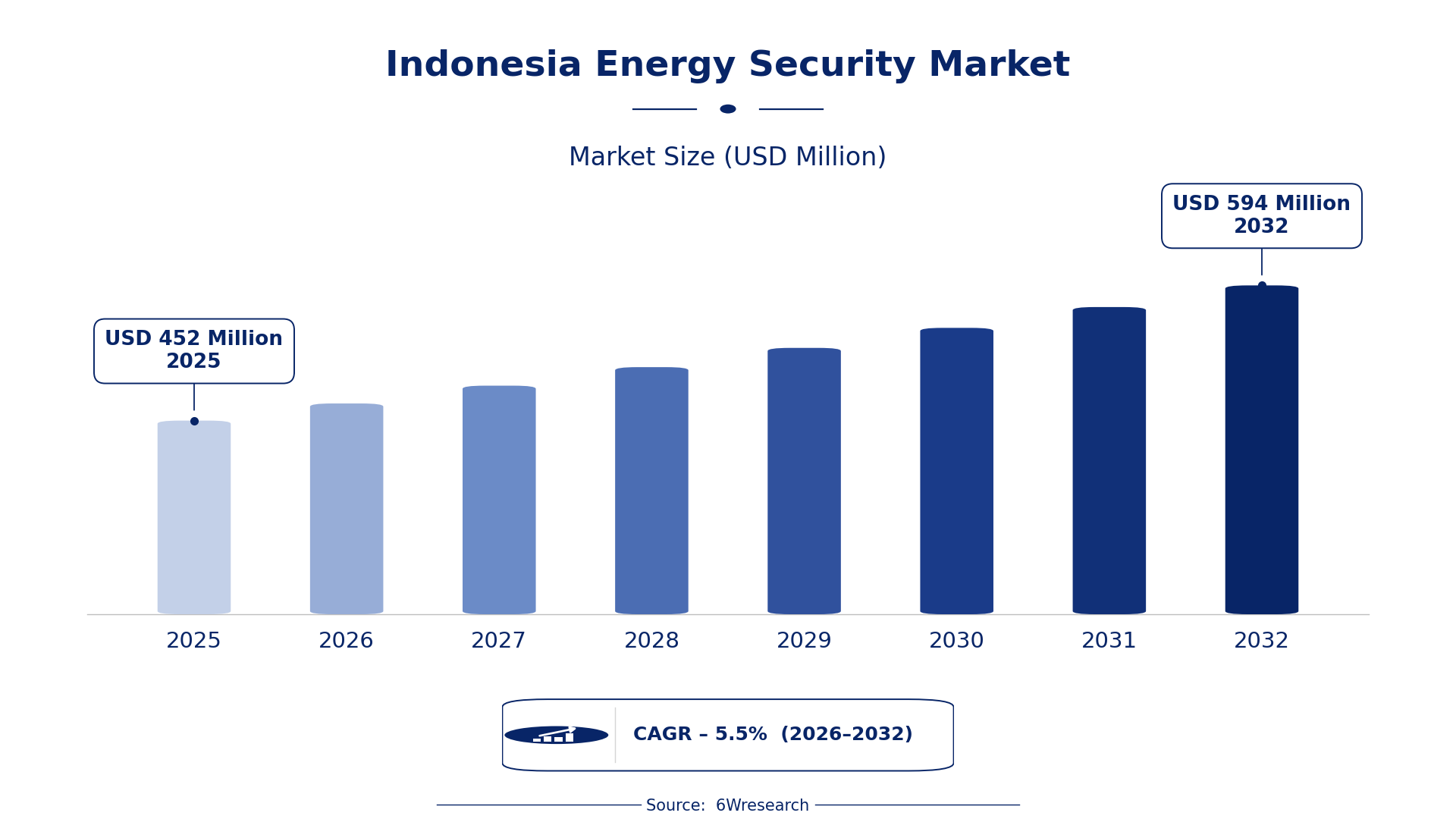
The Indonesia Energy Security Market was estimated at USD 452 Million in 2025 and is projected to reach USD 594 Million by 2032, growing at a CAGR of 5.5% from 2026 to 2032.
Indonesia Energy Security Market Synopsis
With Indonesia's rapid economic development, the need for reliable energy sources has never been more pressing. The market addresses crucial aspects of energy security, ensuring that both traditional and renewable energy infrastructures are protected from various threats.
As the government ramps up efforts to modernize energy systems, investment in advanced security technologies has surged. This shift is particularly important as Indonesia aims to diversify its energy mix and reduce dependence on fossil fuels, a transition that must be managed delicately to maintain stability.
Indonesia Energy Security Market Year-wise Growth Rate and Key Drivers
This graph illustrates the annual growth rates of the Indonesia Energy Security Market from 2021 to 2032, highlighting a steady upward trajectory and projected expansion over the forecast period.
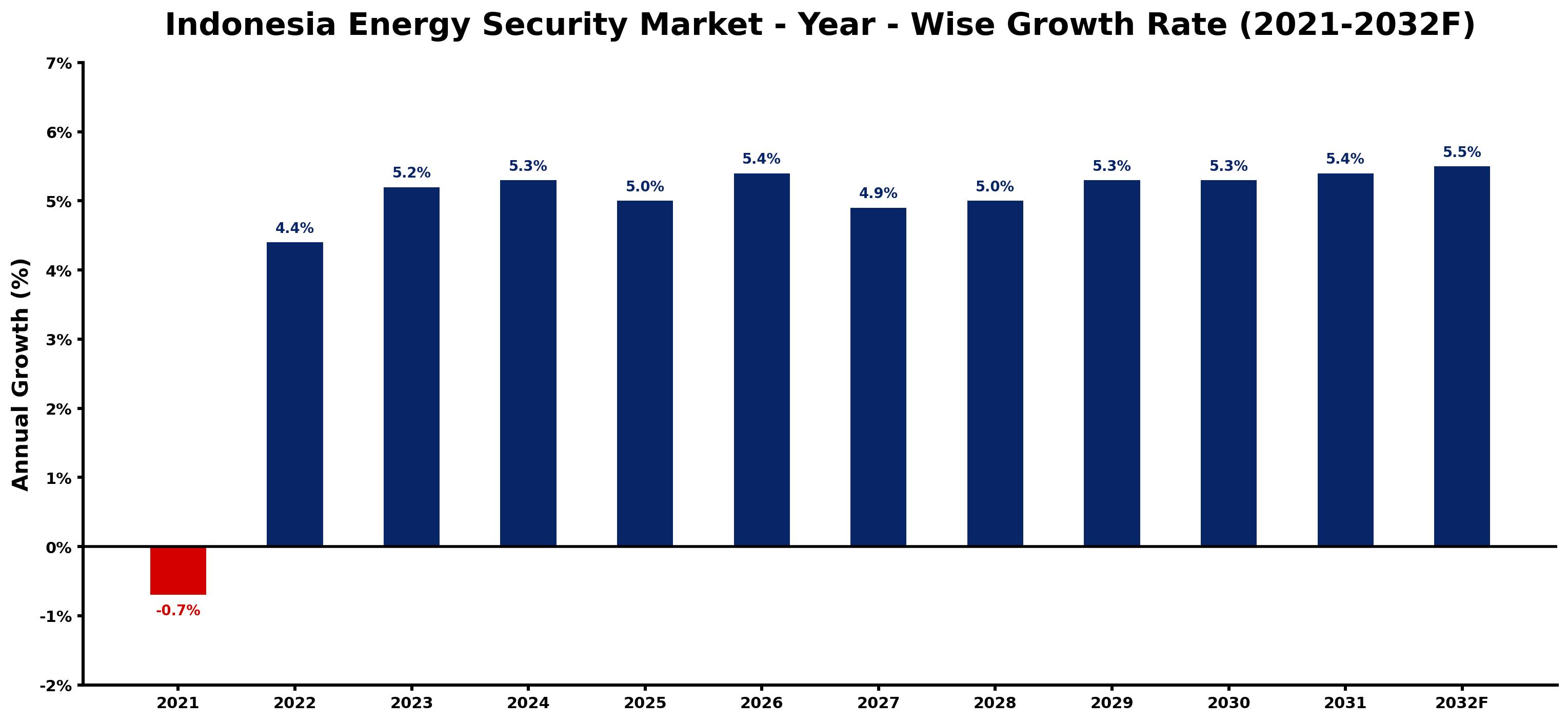
The table below presents the year‑wise growth rates along with the key drivers influencing the market
| Year | Growth Rate | Major Drivers |
| 2021 | -0.7% | Delayed renewable energy projects under Indonesian government regulations. |
| 2022 | 4.4% | Strengthening national energy resilience policies for sustainability. |
| 2023 | 5.2% | Increased investment in solar panel manufacturing incentives. |
| 2024 | 5.3% | Government push for geothermal energy resource development. |
| 2025 | 5.0% | Implementation of new energy storage technology policies. |
| 2026 | 5.4% | Rising foreign investments in renewable energy projects. |
| 2027 | 4.9% | Growing public-private partnerships in energy infrastructure. |
| 2028 | 5.0% | Launch of national electrification acceleration programs. |
| 2029 | 5.3% | Increased adoption of energy-efficient technologies nationwide. |
| 2030 | 5.3% | Expanding electric power generation capacity initiatives. |
| 2031 | 5.4% | New carbon reduction commitments enhancing energy policies. |
| 2032 | 5.5% | Enhanced regulatory frameworks for renewable energy adoption. |
Note: Market size estimations and growth projections presented in this report are based on 6Wresearch's proprietary forecasting methodology, utilizing the latest available industry data, government publications, and primary research inputs.
Indonesia Energy Security Market Key Takeaways
Below are some of the specific key takeaways from the market, including:
- Government initiatives are increasingly focusing on enhancing energy infrastructure resilience amid rising cybersecurity threats.
- Significant investments in renewable energy sources are reshaping the energy security dynamics.
- The impact of geopolitical shifts is pressuring stakeholders to fortify energy supply chains against potential disruptions.
- Technological advancements are driving the adoption of more sophisticated security measures across the energy sector.
- The ongoing transition to a more diversified energy portfolio is essential for achieving long-term energy security goals.
Evaluation of Restraints in Indonesia Energy Security Market
Indonesia faces serious constraints in its energy security market primarily due to its continued reliance on fossil fuels. This dependency not only exposes the economy to volatile global energy prices but also hampers the urgency needed for a transition toward renewable energy sources. Regulatory hurdles and infrastructural limitations further complicate these challenges, inhibiting the swift adoption of innovative security technologies needed for a modern energy landscape.
Indonesia Energy Security Market Trends
A shift toward renewable energy is gaining momentum, propelled by both government mandates and consumer demand for cleaner solutions. Stakeholders are investing heavily in cybersecurity measures to protect critical energy infrastructures from increasing digital threats. Additionally, there is a growing emphasis on smart grid technologies, which not only enhance operational efficiency but also improve overall security posture.
Indonesia Energy Security Market Opportunities
The demand for innovative energy solutions presents ample investment opportunities, particularly in renewable energy sectors like solar and wind. Projects focusing on smart infrastructure upgrades are likely to attract funding, especially those that incorporate cybersecurity features. Partnerships between public and private entities can lead to collaborative innovations that bolster energy security while also fostering sustainable development.
Government Initiatives in the Indonesia Energy Security Market
Indonesia's government is actively shaping the energy security market through a series of strategic initiatives. By prioritizing energy resilience and cybersecurity in its policies, the government aims to enhance the stability of energy supply while encouraging investments in cleaner technologies. Public policy plays a crucial role in directing funds and resources toward areas that fortify energy infrastructure against emerging threats.
- A national energy resilience program launched in early 2023 aims to strengthen infrastructure against both physical and cyber threats.
- Currently ongoing is a grid modernization initiative intended to integrate renewable energy sources while improving overall security protocols.
- A planned public-private partnership set to commence in late 2025 will focus on developing advanced cybersecurity frameworks across the energy sector.
- The introduction of new regulations in mid-2024 will mandate that energy companies adopt comprehensive risk management strategies.
- An incentive scheme for investments in renewable energy infrastructure is expected to launch by the end of 2025, aligning with global sustainability goals.
Future Insights of the Indonesia Energy Security Market
Looking ahead to 2026-2032, the Indonesia Energy Security Market is set for a transformative journey. The increasing push towards renewable energy is likely to reshape the dynamics of the market, as stakeholders must balance energy supply needs with security challenges. As investments in smart technologies and infrastructure resilience grow, the market will see substantial changes in how energy security is approached, ensuring a sustainable and secure energy future for Indonesia.
Indonesia Energy Security Market Latest Developments
In the last 12-14 months, the Indonesia Energy Security Market has witnessed notable activity as stakeholders respond to evolving energy demands and security challenges. There has been a clear focus on integrating advanced technologies and enhancing infrastructure resilience to better protect energy resources.
- A major technology vendor launched a new cybersecurity platform specifically designed for energy sectors in early 2023, aimed at safeguarding critical infrastructures.
- In Q3 2023, a regional operator began deploying advanced monitoring systems across various energy facilities, improving real-time threat detection capabilities.
- A significant investment project was announced in late 2023 to upgrade existing power plants, integrating renewable energy sources and enhancing security features.
- A partnership between energy companies and cybersecurity firms initiated in early 2024 aims to create standardized protocols for energy security across the market.
- Upcoming regulations expected by mid-2024 will focus on mandatory cybersecurity assessments for all new energy projects, aiming to reduce vulnerability to cyber threats.
Indonesia Energy Security Market - Key Attractiveness of the Report
- 10 Years of Market Numbers
- Historical Data Starting from 2022 to 2025
- Base Year: 2025
- Forecast Data until 2032
- Key Performance Indicators Impacting the Market
- Major Upcoming Developments and Projects
Key Highlights of the Report:
- Indonesia Energy Security Market Outlook
- Market Size of Indonesia Energy Security Market, 2025
- Forecast of Indonesia Energy Security Market, 2032
- Historical Data and Forecast of Indonesia Energy Security Revenues & Volume for the Period 2022-2032F
- Indonesia Energy Security Market Trend Evolution
- Indonesia Energy Security Market Drivers and Challenges
- Indonesia Energy Security Price Trends
- Indonesia Energy Security Porter's Five Forces
- Indonesia Energy Security Industry Life Cycle
- Historical Data and Forecast of Indonesia Energy Security Market Revenues & Volume By Power Plants for the Period 2022-2032F
- Historical Data and Forecast of Indonesia Energy Security Market Revenues & Volume By Nuclear for the Period 2022-2032F
- Historical Data and Forecast of Indonesia Energy Security Market Revenues & Volume By Thermal for the Period 2022-2032F
- Historical Data and Forecast of Indonesia Energy Security Market Revenues & Volume By Hydro for the Period 2022-2032F
- Historical Data and Forecast of Indonesia Energy Security Market Revenues & Volume By Oil for the Period 2022-2032F
- Historical Data and Forecast of Indonesia Energy Security Market Revenues & Volume By Gas for the Period 2022-2032F
- Historical Data and Forecast of Indonesia Energy Security Market Revenues & Volume By Renewable Energy for the Period 2022-2032F
- Historical Data and Forecast of Indonesia Energy Security Market Revenues & Volume By Technologies for the Period 2022-2032F
- Historical Data and Forecast of Indonesia Energy Security Market Revenues & Volume By Physical for the Period 2022-2032F
- Historical Data and Forecast of Indonesia Energy Security Market Revenues & Volume By Network Security for the Period 2022-2032F
- Indonesia Energy Security Import Export Trade Statistics
- Market Opportunity Assessment By Power Plants
- Market Opportunity Assessment By Technologies
- Indonesia Energy Security Top Companies Market Share
- Indonesia Energy Security Competitive Benchmarking By Technical and Operational Parameters
- Indonesia Energy Security Company Profiles
- Indonesia Energy Security Key Strategic Recommendations






































