Indonesia Equipment for Telephone Networks Market Summary
The indonesia equipment for telephone networks market was estimated at USD 317 Million in 2025 and is projected to reach USD 418 Million by 2032, growing at a CAGR of 5.1% from 2026 to 2032.
Indonesia Equipment for Telephone Networks Market Year-wise Growth Rate and Key Drivers
This graph highlights how the Indonesia Equipment for Telephone Networks Market has steadily grown over the years, supported by major growth factors.
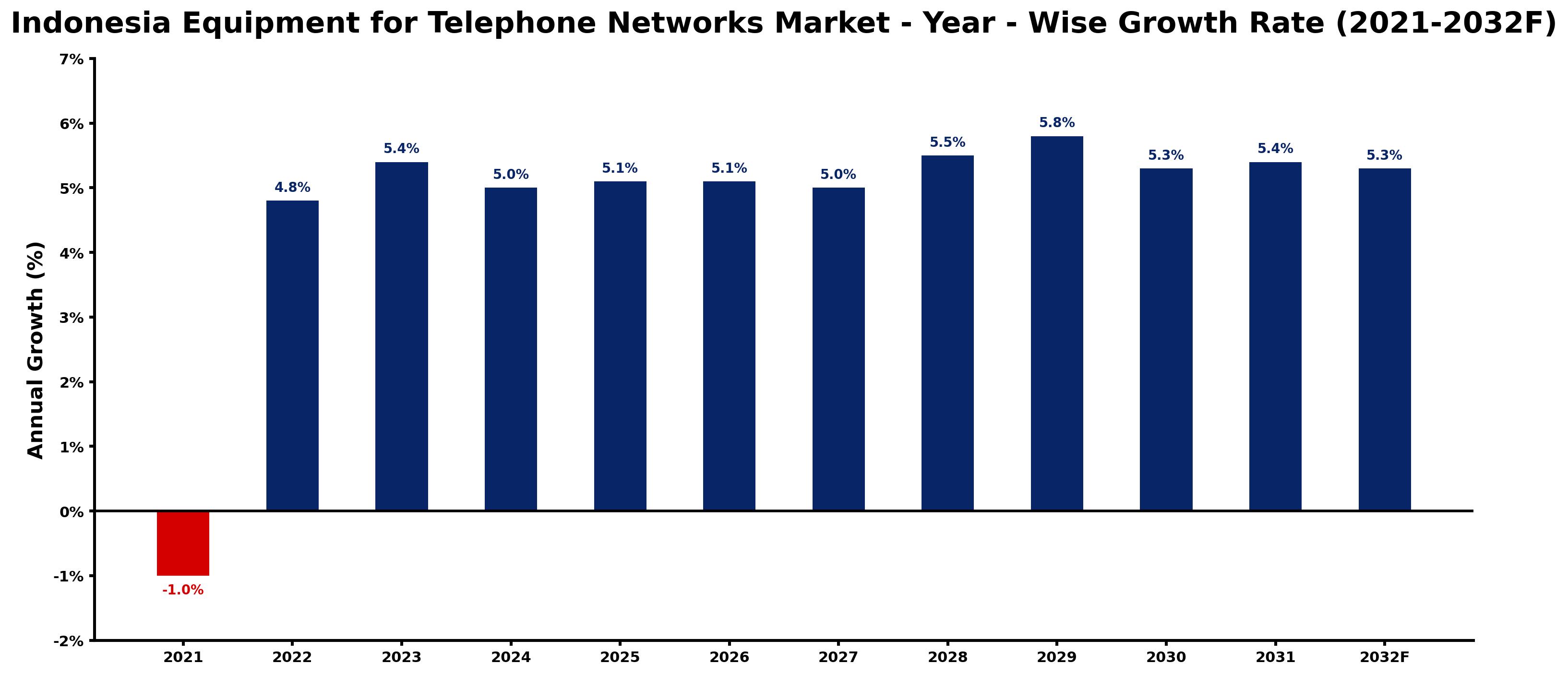
The table below presents the year wise growth rates along with the key drivers influencing the market
| Year | Growth Rate | Major Drivers |
| 2021 | -1.0% | Supply chain disruptions due to COVID19 restrictions hampered infrastructure projects, leading to decreased investment in telecommunications equipment. |
| 2022 | 4.8% | The shift towards 5G technology is compelling telecom providers to upgrade infrastructure. |
| 2023 | 5.4% | Investment in rural connectivity projects is enhancing telecom access across remote areas. |
| 2024 | 5.0% | Increased smartphone penetration is motivating enhanced network reliability and coverage improvements. |
| 2025 | 5.1% | Competition among telecom operators is driving innovation in service delivery and technology. |
| 2026 | 5.1% | Integration of IoT solutions is creating new market opportunities for network equipment suppliers. |
| 2027 | 5.0% | Urbanization trends are pushing demand for robust infrastructure to support growing populations. |
| 2028 | 5.5% | Emerging startups are investing in communication technologies, fostering market diversification. |
| 2029 | 5.8% | Sustainability practices are influencing equipment procurement decisions among telecom corporations. |
| 2030 | 5.3% | Collaborations with international firms are enhancing technological capabilities within local markets. |
| 2031 | 5.4% | Cybersecurity developments are becoming critical in shaping equipment requirements and standards. |
| 2032 | 5.3% | Evolving consumer expectations are pressuring operators to enhance their service quality continually. |
Note - Market size estimations and growth projections presented in this report are based on 6Wresearch's advanced forecasting approach, validated with industry datasets as of June 2026.
Indonesia Equipment for Telephone Networks Market Synopsis
The Indonesia Equipment for Telephone Networks Market is projected to reach 5.1% and witness significant growth during the forecast period (2026-2032). This growth can be attributed to the rapid expansion of Indonesia's telecommunications infrastructure alongside an increasing consumer demand for high-speed internet services. The country, recognized as one of Southeast Asia's fastest-growing telecommunications markets, is witnessing a transformational period driven by technological advancements and a greater emphasis on digital connectivity.
Indonesia Equipment for Telephone Networks Market Growth Drivers
The growth of the Indonesia Equipment for Telephone Networks Market is influenced by several key factors:
- Increased Internet Penetration: The rising need for internet services among both urban and rural populations is propelling demand for advanced telephone network equipment. As more people are gaining access to the internet, the requirement for robust network infrastructure is becoming imperative.
- Data Center Expansion: Indonesia's burgeoning data center infrastructure necessitates the deployment of advanced telephone network equipment to support the growing data transmission needs, leading to substantial investments in telecommunications infrastructure.
- Government Initiatives: The Indonesian government is actively promoting the expansion of telecommunications services, which encourages both foreign and domestic investments in the sector. Public-private partnerships are becoming increasingly common.
- Technological Advancements: Innovations in telecommunications technology, such as 5G networks, are creating new opportunities for equipment suppliers. These advancements require upgraded systems to meet the demands for higher data speeds and better connectivity.
- Urbanization: With ongoing urbanization in Indonesia, there is a significant push for better communication networks in crowded cities, thus enhancing the demand for sophisticated telephone networks.
Indonesia Equipment for Telephone Networks Market Trends and Opportunities
The Indonesia Equipment for Telephone Networks Market is observing notable trends that present opportunities for growth:
- 5G Network Rollout: The ongoing rollout of 5G technology in urban areas is a major trend. This advancement facilitates higher connectivity and capacity, thereby driving the demand for specialized equipment.
- Cloud-Based Solutions: There is a noticeable shift toward cloud-based telecommunications solutions, enabling greater flexibility and scalability for service providers and users alike.
- Local Partnerships: Collaborations between international equipment manufacturers and local firms are helping to enhance market penetration and distribution efficiency, making it easier to reach various customer segments.
- Sustainability Focus: As environmental concerns rise, sustainable technology solutions are gaining traction. Many telecommunication providers are seeking eco-friendly equipment to reduce their carbon footprint.
- Increased Mobile Usage: With a significant portion of the population utilizing mobile devices, there is a rising demand for network equipment that can support mobile communication services effectively.
Indonesia Equipment for Telephone Networks Market Challenges and Restraints
Despite its growth potential, the Indonesia Equipment for Telephone Networks Market faces several challenges:
- Regulatory Hurdles: Navigating the complex regulatory environment can pose challenges for new entrants and established players alike, particularly in obtaining necessary licenses and approvals.
- Infrastructure Gaps: Existing infrastructure issues in rural areas can limit the reach and effectiveness of new telecommunications technologies. Addressing these gaps requires substantial investment and strategic planning.
- Competition: The increasing competition among providers not only drives innovation but also pressures prices, impacting profit margins for equipment suppliers.
- Technological Obsolescence: Rapid technological changes can render existing equipment obsolete quickly, necessitating consistent investment in the latest technology to remain competitive.
- Funding Constraints: Limited access to financial resources can hinder investment in advanced technologies, especially for small and medium-sized enterprises within the telecommunications market.
Indonesia Equipment for Telephone Networks Market Government Investment and Initiatives
The Indonesian government is actively supporting the Equipment for Telephone Networks Market through various investments and initiatives aimed at enhancing telecommunications infrastructure:
- Infrastructure Improvement Plans: The government has initiated several projects aimed at improving the telecommunication infrastructure throughout the country, benefitting both urban and rural areas.
- Investment Incentives: Incentives for foreign direct investment (FDI) in telecommunications are being strengthened, encouraging international players to participate in the market dynamics.
- National Broadband Plan: The government is implementing a national broadband plan to ensure equitable access to high-speed internet across the archipelago, which will consequently drive demand for telecommunications equipment.
- Support for Startups: Initiatives to support telecommunications startups facilitate innovation, leading to the development of new technologies that can be integrated into existing systems.
- Public Awareness Campaigns: Promoting digital literacy among citizens is part of the government's strategy to increase the adoption of telecommunications services, thereby stimulating market growth.
Indonesia Equipment for Telephone Networks Market Latest Developments (May 2025 - June 2026)
The period from May 2025 to June 2026 has seen several significant developments in the Indonesia Equipment for Telephone Networks Market:
- Continued 5G Deployments: Major telecommunication companies have ramped up their 5G deployment initiatives, introducing services in key urban centers while strategizing for rural expansions.
- Expansion of Fiber Optic Networks: There has been a marked increase in investments focused on expanding fiber optic networks across Indonesia, aiming to enhance data transmission capabilities and service reliability.
- Launch of Smart City Initiatives: Integrating telecommunications technology into smart city projects is gaining momentum, leading to increased collaboration among technology providers and local governments.
- Focus on Cybersecurity: With the rise in cyber threats, telecommunications companies are investing in advanced security measures to protect their networks and customer data.
- Innovations in IoT Solutions: The market has seen a surge in the development of Internet of Things (IoT) solutions, facilitated by enhancements in network infrastructure, opening new avenues for growth in telecommunications services.
Indonesia Equipment for Telephone Networks Market - Key Attractiveness of the Report
- 10 Years of Market Numbers
- Historical Data Starting from 2022 to 2025
- Base Year: 2025
- Forecast Data until 2032
- Key Performance Indicators Impacting the Market
- Major Upcoming Developments and Projects
Key Highlights of the Report:
- Indonesia Equipment for Telephone Networks Market Outlook
- Market Size of Indonesia Equipment for Telephone Networks Market, 2025
- Forecast of Indonesia Equipment for Telephone Networks Market, 2032F
- Historical Data and Forecast of Indonesia Equipment for Telephone Networks Revenues & Volume for the Period 2022-2032F
- Indonesia Equipment for Telephone Networks Market Trend Evolution
- Indonesia Equipment for Telephone Networks Market Drivers and Challenges
- Indonesia Equipment for Telephone Networks Price Trends
- Indonesia Equipment for Telephone Networks Porter's Five Forces
- Indonesia Equipment for Telephone Networks Industry Life Cycle
- Historical Data and Forecast of Indonesia Equipment for Telephone Networks Market Revenues & Volume By Infrastructure for the Period 2022-2032F
- Historical Data and Forecast of Indonesia Equipment for Telephone Networks Market Revenues & Volume By Wire for the Period 2022-2032F
- Historical Data and Forecast of Indonesia Equipment for Telephone Networks Market Revenues & Volume By Wireless for the Period 2022-2032F
- Historical Data and Forecast of Indonesia Equipment for Telephone Networks Market Revenues & Volume By Offerings for the Period 2022-2032F
- Historical Data and Forecast of Indonesia Equipment for Telephone Networks Market Revenues & Volume By Product for the Period 2022-2032F
- Historical Data and Forecast of Indonesia Equipment for Telephone Networks Market Revenues & Volume By Software for the Period 2022-2032F
- Historical Data and Forecast of Indonesia Equipment for Telephone Networks Market Revenues & Volume By Services for the Period 2022-2032F
- Historical Data and Forecast of Indonesia Equipment for Telephone Networks Market Revenues & Volume By End-users for the Period 2022-2032F
- Historical Data and Forecast of Indonesia Equipment for Telephone Networks Market Revenues & Volume By Consumer Electronics for the Period 2022-2032F
- Historical Data and Forecast of Indonesia Equipment for Telephone Networks Market Revenues & Volume By Bfsi for the Period 2022-2032F
- Historical Data and Forecast of Indonesia Equipment for Telephone Networks Market Revenues & Volume By Retail for the Period 2022-2032F
- Historical Data and Forecast of Indonesia Equipment for Telephone Networks Market Revenues & Volume By Media for the Period 2022-2032F
- Historical Data and Forecast of Indonesia Equipment for Telephone Networks Market Revenues & Volume By Defense for the Period 2022-2032F
- Historical Data and Forecast of Indonesia Equipment for Telephone Networks Market Revenues & Volume By Others for the Period 2022-2032F
- Indonesia Equipment for Telephone Networks Import Export Trade Statistics
- Market Opportunity Assessment By Infrastructure
- Market Opportunity Assessment By Offerings
- Market Opportunity Assessment By End-users
- Indonesia Equipment for Telephone Networks Top Companies Market Share
- Indonesia Equipment for Telephone Networks Competitive Benchmarking By Technical and Operational Parameters
- Indonesia Equipment for Telephone Networks Company Profiles
- Indonesia Equipment for Telephone Networks Key Strategic Recommendations






































