Indonesia Film Dubbing Market Size, Share & Growth Rate
The Indonesia Film Dubbing Market was estimated at USD 439 Million in 2025 and is projected to reach USD 581 Million by 2032, growing at a CAGR of 4.1% from 2026 to 2032. This trajectory is primarily driven by the increasing demand for localized content as international films and TV series gain traction among Indonesian audiences. Furthermore, the rise of streaming platforms has amplified the need for high-quality dubbing services, enabling viewers to enjoy diverse content tailored to their linguistic and cultural preferences.
Indonesia Film Dubbing Market Year-wise Growth Rate and Key Drivers
This graph highlights how the Indonesia Film Dubbing Market has steadily grown over the years, supported by major growth factors.
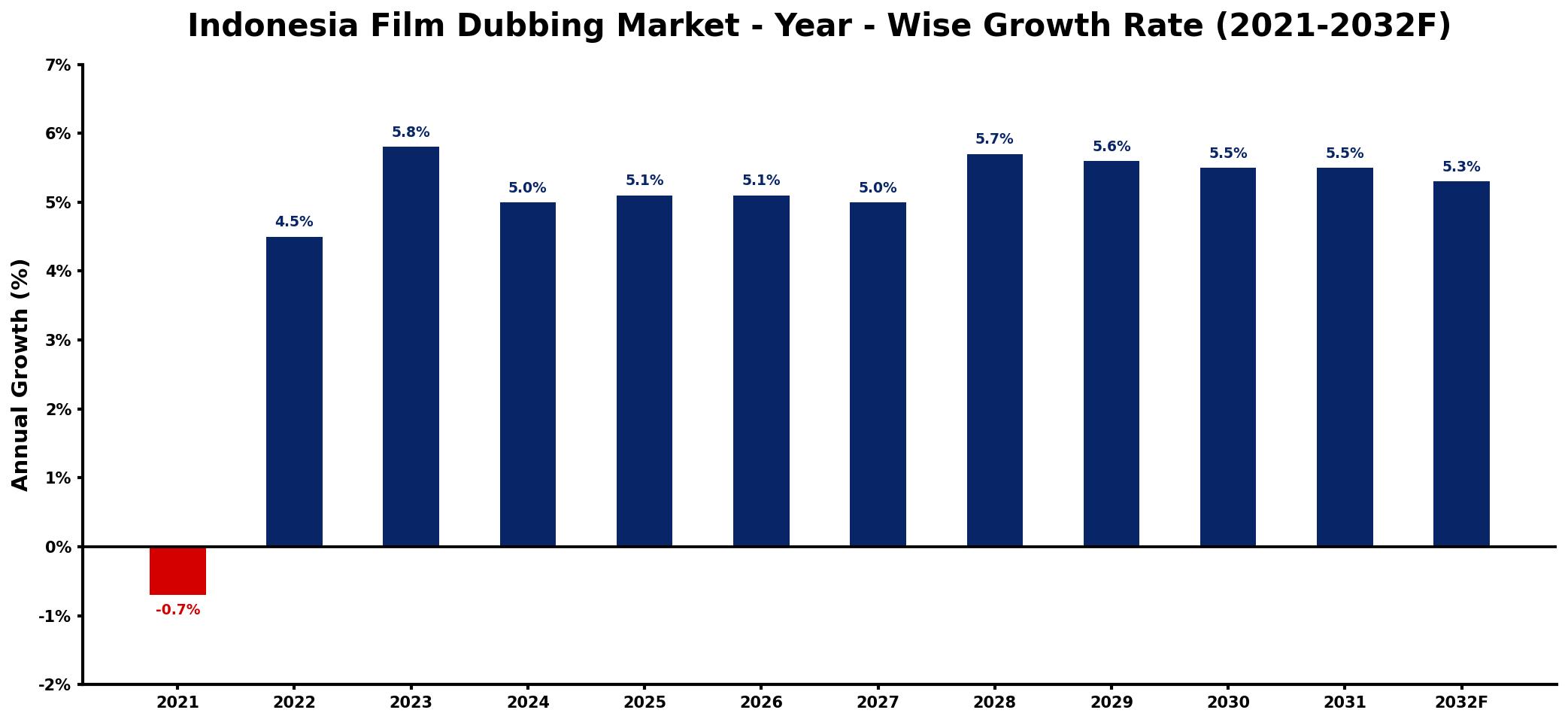
The table below presents the year‑wise growth rates along with the key drivers influencing the market
| Year | Growth Rate | Major Drivers |
| 2021 | -0.7% | Decreased consumer entertainment spending |
| 2022 | 4.5% | Rise in local content production |
| 2023 | 5.8% | Growing digital streaming platforms |
| 2024 | 5.0% | Increased foreign investment influx |
| 2025 | 5.1% | Expansion of local talent pool |
| 2026 | 5.1% | Higher demand for localized content |
| 2027 | 5.0% | Emergence of innovative technologies |
| 2028 | 5.7% | Strengthening regional distribution networks |
| 2029 | 5.6% | Surge in international collaborations |
| 2030 | 5.5% | Enhanced audience engagement strategies |
| 2031 | 5.5% | Development of new distribution channels |
| 2032 | 5.3% | Wider adoption of mobile platforms |
Note: Market size estimations and growth projections presented in this report are based on 6Wresearch's proprietary forecasting methodology, utilizing the latest available industry data, government publications, and primary research inputs.
Indonesia Film Dubbing Market Synopsis
The Indonesia Film Dubbing Market has seen significant momentum in recent years, reflecting an evolving entertainment landscape influenced by technological advancements and changing consumer tastes. As international content becomes more accessible, the market is poised for even greater growth, with localized dubbing services becoming a necessity rather than a luxury.
This evolving market is not merely about translating dialogues; it encompasses cultural adaptation, which is crucial for resonance with local viewers. As a result, dubbing studios and voice actors play a pivotal role in bridging the gap between foreign narratives and Indonesian audiences, ensuring an immersive viewing experience that resonates culturally and linguistically.
Indonesia Film Dubbing Market Key Takeaways
- The demand for high-quality dubbing services is on the rise, spurred by international film releases.
- Technological advancements in dubbing production are enhancing the quality and efficiency of services offered.
- Streaming platforms are increasingly prioritizing localized content, creating new avenues for growth in the market.
- Skilled voice actors and translators are in high demand to ensure cultural accuracy in dubbing.
- The increasing proliferation of digital content consumption trends indicates a promising future for the market.
Evaluation of Restraints in Indonesia Film Dubbing Market
Despite its growth prospects, the Indonesia Film Dubbing Market faces several significant restraints. Cultural diversity within the archipelago presents a challenge, as local tastes and values vary widely across different regions. Adapting foreign narratives to align with these diverse preferences demands high levels of expertise from translators and voice actors. Furthermore, achieving precise lip synchronization while maintaining linguistic fidelity is critical; failure to do so can lead to a diminished viewing experience. Additionally, competition from subtitling options and the pervasive issue of content piracy pose further hurdles that companies must navigate to secure their market presence.
Indonesia Film Dubbing Market Trends
Several key trends are shaping the demand and technology landscape within the Indonesia Film Dubbing Market. The surge in popularity of streaming platforms has shifted consumer behavior towards digital viewing, leading to an increased expectation for localized content. This digital pivot encourages dubbing studios to innovate and adopt advanced technologies that enhance dubbing quality. Moreover, collaborations between international production houses and local dubbing studios are becoming commonplace, enabling a more authentic representation of cultural nuances. As audiences seek content that reflects their experiences, personalized dubbing services are gaining traction, allowing for a more tailored viewing experience.
Indonesia Film Dubbing Market Opportunities
Opportunities for growth in the Indonesia Film Dubbing Market abound, primarily stemming from the expanding digital ecosystem. As more local content creators explore partnerships with international entities, the need for localized dubbing will escalate. Additionally, as younger audiences, who are more accustomed to international media, become the primary consumers, there will be a greater appetite for diverse dubbing options. Investments in new technologies, such as AI-driven dubbing, could further streamline production processes, enhance accuracy, and ultimately reduce costs, opening new doors for investment and expansion.
Government Initiatives in the Indonesia Film Dubbing Market
The Indonesian government has shown an increasing interest in supporting the local film and entertainment industry, which includes the dubbing sector. Initiatives aimed at promoting local content production and enhancing media literacy among audiences are being rolled out. Additionally, programs designed to foster collaborations between local studios and international production houses could incentivize the development of high-quality dubbing services. While specific figures are not provided, the ongoing support signifies a commitment to growing the entertainment landscape and the dubbing market as part of a larger cultural strategy.
Future Insights of the Indonesia Film Dubbing Market
Looking ahead, the Indonesia Film Dubbing Market is expected to continue its growth trajectory from 2026 to 2032, driven by evolving consumer preferences and technological advancements. As streaming platforms innovate to meet the demands of a diverse audience, localized dubbing will increasingly become a priority. Moreover, as more local productions emerge, the market will likely experience a shift towards higher-quality dubbing that captures the richness of Indonesian culture. This positions the market favorably for sustained growth, with ample opportunities for both established and emerging players.
Indonesia Film Dubbing Market Latest Developments (2025 - 2026)
Recent developments in the Indonesia Film Dubbing Market have showcased the rising collaboration between local dubbing studios and international content providers. This trend highlights a commitment to creating culturally relevant and high-quality dubbed content. Additionally, advancements in dubbing technologies, particularly in audio processing and voice synthesis, have streamlined production workflows. Increased investment in talent development programs is also evident, aiming to cultivate a new generation of skilled voice actors capable of meeting the demands of an evolving market.
Indonesia Film Dubbing Market - Key Attractiveness of the Report
- 10 Years of Market Numbers
- Historical Data Starting from 2022 to 2025
- Base Year: 2025
- Forecast Data until 2032
- Key Performance Indicators Impacting the Market
- Major Upcoming Developments and Projects
Key Highlights of the Report:
- Indonesia Film Dubbing Market Outlook
- Market Size of Indonesia Film Dubbing Market, 2025
- Forecast of Indonesia Film Dubbing Market, 2032
- Historical Data and Forecast of Indonesia Film Dubbing Revenues & Volume for the Period 2022-2032F
- Indonesia Film Dubbing Market Trend Evolution
- Indonesia Film Dubbing Market Drivers and Challenges
- Indonesia Film Dubbing Price Trends
- Indonesia Film Dubbing Porter's Five Forces
- Indonesia Film Dubbing Industry Life Cycle
- Historical Data and Forecast of Indonesia Film Dubbing Market Revenues & Volume By Type for the Period 2022-2032F
- Historical Data and Forecast of Indonesia Film Dubbing Market Revenues & Volume By Native Language Dubbing for the Period 2022-2032F
- Historical Data and Forecast of Indonesia Film Dubbing Market Revenues & Volume By Foreign Language Dubbing for the Period 2022-2032F
- Historical Data and Forecast of Indonesia Film Dubbing Market Revenues & Volume By Minority Language Dubbing for the Period 2022-2032F
- Historical Data and Forecast of Indonesia Film Dubbing Market Revenues & Volume By Special Language Dubbing for the Period 2022-2032F
- Historical Data and Forecast of Indonesia Film Dubbing Market Revenues & Volume By Application for the Period 2022-2032F
- Historical Data and Forecast of Indonesia Film Dubbing Market Revenues & Volume By Drama for the Period 2022-2032F
- Historical Data and Forecast of Indonesia Film Dubbing Market Revenues & Volume By Comedy for the Period 2022-2032F
- Historical Data and Forecast of Indonesia Film Dubbing Market Revenues & Volume By Horror Movie for the Period 2022-2032F
- Historical Data and Forecast of Indonesia Film Dubbing Market Revenues & Volume By Romance for the Period 2022-2032F
- Historical Data and Forecast of Indonesia Film Dubbing Market Revenues & Volume By Action Movie for the Period 2022-2032F
- Historical Data and Forecast of Indonesia Film Dubbing Market Revenues & Volume By Other for the Period 2022-2032F
- Indonesia Film Dubbing Import Export Trade Statistics
- Market Opportunity Assessment By Type
- Market Opportunity Assessment By Application
- Indonesia Film Dubbing Top Companies Market Share
- Indonesia Film Dubbing Competitive Benchmarking By Technical and Operational Parameters
- Indonesia Film Dubbing Company Profiles
- Indonesia Film Dubbing Key Strategic Recommendations






































