Indonesia Financial Analytics Market Size & Growth Rate (2026-2032)
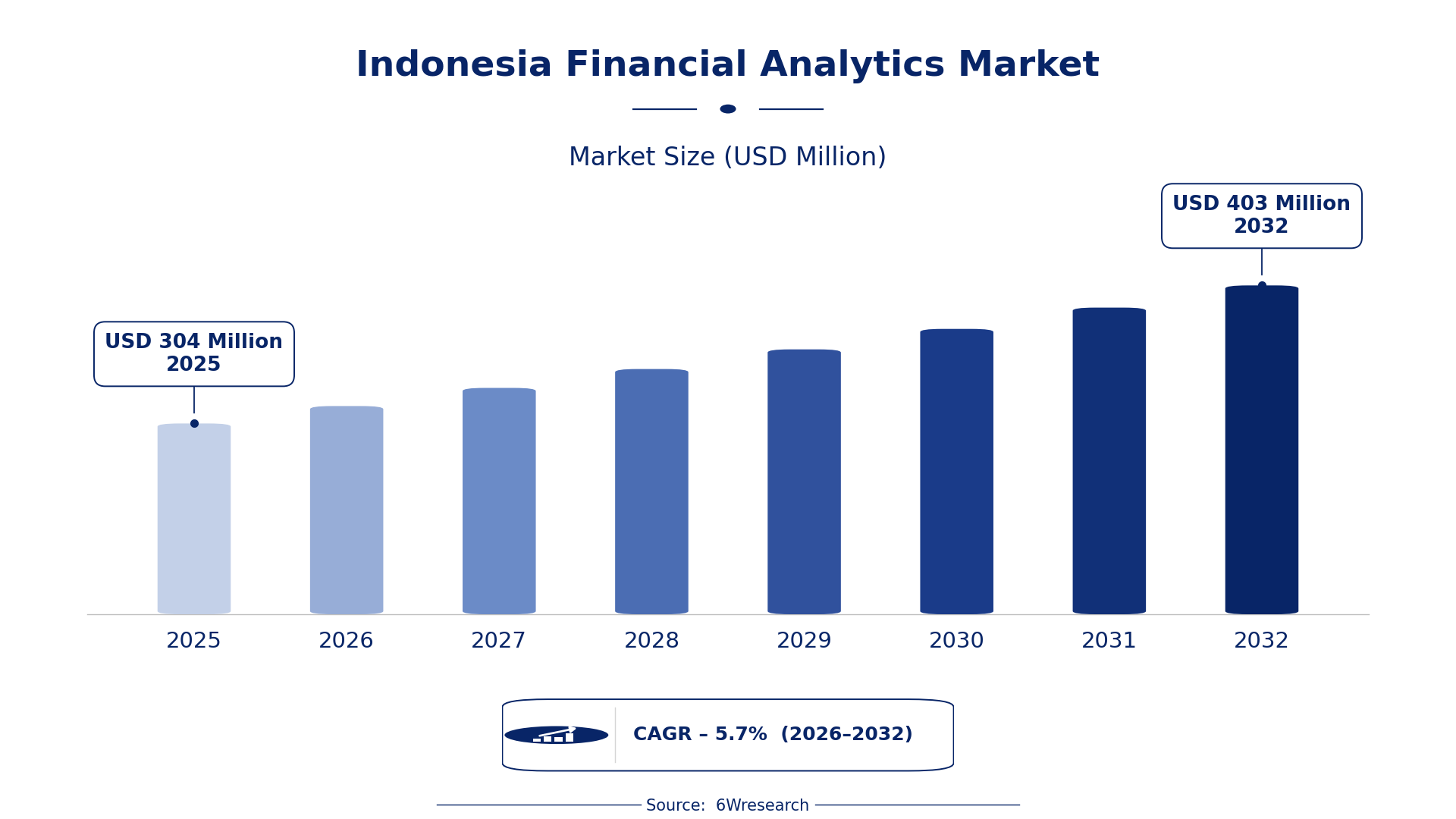
The Indonesia Financial Analytics Market was estimated at USD 304 Million in 2025 and is projected to reach USD 403 Million by 2032, growing at a CAGR of 5.7% from 2026 to 2032.
Indonesia Financial Analytics Market Synopsis
The financial analytics market in Indonesia is experiencing robust growth, fueled by increasing reliance on data-driven insights among financial institutions. While the demand for advanced analytics tools has surged, the market is on a trajectory toward deeper integration of technology and enhanced analytical capabilities.
As financial institutions adapt to a complex economic environment, they are harnessing analytics for risk management and investment strategies. This trend not only signifies a shift in operational strategy but also indicates a significant opportunity for analytics providers to enhance their offerings and expand their market presence.
Indonesia Financial Analytics Market Year-wise Growth Rate and Key Drivers
This graph illustrates the annual growth rates of the Indonesia Financial Analytics Market from 2021 to 2032, highlighting a steady upward trajectory and projected expansion over the forecast period.
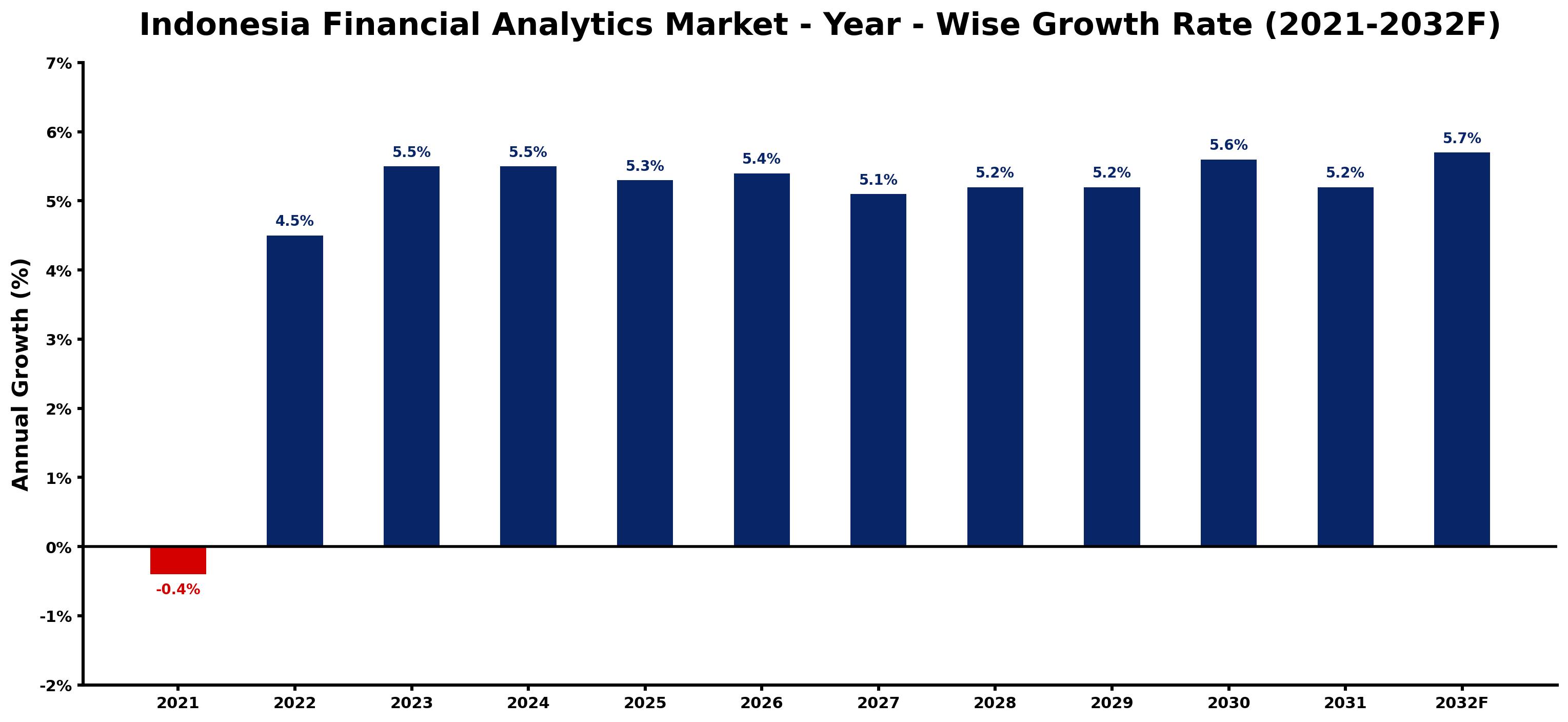
The table below presents the year‑wise growth rates along with the key drivers influencing the market
| Year | Growth Rate | Major Drivers |
| 2021 | -0.4% | Bank Indonesia limited credit access during pandemic recovery. |
| 2022 | 4.5% | Central Bank's digital ID initiative boosts financial insights. |
| 2023 | 5.5% | Increased fintech partnerships advancing data analytics capabilities. |
| 2024 | 5.5% | Growing e-commerce sector necessitates advanced financial reporting tools. |
| 2025 | 5.3% | Regulatory push for transparency enhances data utilization practices. |
| 2026 | 5.4% | Rising consumer demand for personalized financial products supports analytics. |
| 2027 | 5.1% | Investment in smart algorithms improves predictive financial modeling. |
| 2028 | 5.2% | Government incentives foster innovation in financial technology. |
| 2029 | 5.2% | Emergence of AI-driven start-ups enhances market competitiveness. |
| 2030 | 5.6% | Integration of blockchain technology improves transaction analysis efficiency. |
| 2031 | 5.2% | Expanding middle class increases need for wealth management analytics. |
| 2032 | 5.7% | Digital transformation strategies focus on data-driven decision-making. |
Note: Market size estimations and growth projections presented in this report are based on 6Wresearch's proprietary forecasting methodology, utilizing the latest available industry data, government publications, and primary research inputs.
Indonesia Financial Analytics Market Key Takeaways
Below are some of the specific key takeaways from the market, including:
- The growing complexity of financial services is driving the demand for analytics tools in Indonesia.
- Real-time data access is becoming crucial for effective risk management and investment decision-making.
- The Indonesian government's push for financial inclusion is accelerating the adoption of analytics solutions.
- COVID-19 has highlighted the necessity for predictive modeling in navigating financial uncertainties.
- Regulatory compliance and data security remain key concerns for financial institutions adopting analytics.
Evaluation of Restraints in Indonesia Financial Analytics Market
The financial analytics market in Indonesia is hampered by several constraints. Foremost among these is the challenge of data security; financial institutions are acutely aware that data breaches can lead to severe repercussions, not just financially but also in terms of customer trust. Developing sophisticated fraud detection algorithms is essential, yet it requires ongoing investment and expertise. on top of that, financial entities must navigate a labyrinth of regulatory requirements, which can be daunting and resource-intensive. The scarcity of skilled data analysts further complicates efforts to fully leverage financial analytics, hindering the pace of adoption.
Indonesia Financial Analytics Market Trends
Several trends are shaping the future of the Indonesia Financial Analytics Market. First, there is a noticeable shift towards artificial intelligence and machine learning in analytics tools, enhancing predictive capabilities. Additionally, businesses are increasingly integrating cloud-based solutions to facilitate real-time data analysis and collaboration. The rise of fintech startups is also prompting traditional financial institutions to innovate rapidly, focusing on enhancing customer experience through personalized financial services powered by analytics. Lastly, the emphasis on sustainability is influencing investment strategies, as companies seek to align their financial planning with environmental and social governance factors.
Indonesia Financial Analytics Market Opportunities
The landscape of opportunities within the Indonesia Financial Analytics Market is rich and multifaceted. The ongoing digital transformation of the financial sector presents an avenue for analytics solutions to penetrate deeper into traditional banking operations. on top of that, as more companies prioritize financial inclusion, analytics tools will be vital in assessing creditworthiness and extending services to underserved communities. The potential for partnerships between traditional financial institutions and fintech companies is another promising area, enabling the sharing of insights and resources to foster innovation. Finally, the focus on enhancing regulatory compliance through advanced analytics solutions creates a niche for tailored offerings in this space.
Government Initiatives in the Indonesia Financial Analytics Market
The Indonesian government is increasingly shaping the financial analytics market through various initiatives aimed at promoting financial stability and inclusion. By prioritizing data-driven policy frameworks, the government encourages financial institutions to adopt analytics tools that can enhance risk management and transparency. These efforts are critical as the nation seeks to bolster its economic resilience and expand access to financial services.
- A recently completed initiative involved the launch of a national digital infrastructure program aimed at improving data access for financial institutions.
- A currently ongoing regulatory framework focuses on mandating enhanced data security measures across financial analytics applications.
- A planned public-private partnership is expected to kick off by 2026, aimed at expanding financial literacy programs that utilize analytics tools.
- In 2025, the government introduced a policy to incentivize the adoption of predictive analytics in credit assessment processes.
- Upcoming initiatives will likely include grants for fintech startups that integrate advanced analytics into their service offerings.
Future Insights of the Indonesia Financial Analytics Market
Looking ahead to 2026-2032, the Indonesia Financial Analytics Market is set to evolve significantly. As financial institutions increasingly recognize the value of data-driven insights, investment in analytics tools will intensify. The integration of AI and machine learning will likely accelerate, enabling institutions to enhance their predictive capabilities and operational efficiencies. on top of that, with the government's support for financial inclusion, analytics solutions will play an essential role in expanding access to financial services across diverse demographics. These trends indicate a vibrant future, with ample opportunities for innovation and growth in the sector.
Indonesia Financial Analytics Market Latest Developments
In the past year, the Indonesia Financial Analytics Market has witnessed significant activity as financial institutions strive to enhance their analytics capabilities. The need for real-time insights has never been more critical, particularly in light of the economic fluctuations observed during and after the pandemic. Companies are increasingly investing in advanced analytics technologies to stay competitive and improve decision-making processes.
- A major technology vendor launched a new suite of financial analytics tools in early 2025, focusing on real-time risk assessment features.
- An initiative that began in mid-2025 and remains underway is the development of a collaborative platform for sharing financial data among institutions.
- A partnership between several banks and a fintech company was established in Q4 2025, aiming to enhance fraud detection capabilities using machine learning.
- By mid-2026, a rollout is expected for a new analytics training program designed to address the skills gap in data analysis within financial institutions.
Indonesia Financial Analytics Market - Key Attractiveness of the Report
- 10 Years of Market Numbers
- Historical Data Starting from 2022 to 2025
- Base Year: 2025
- Forecast Data until 2032
- Key Performance Indicators Impacting the Market
- Major Upcoming Developments and Projects
Key Highlights of the Report:
- Indonesia Financial Analytics Market Outlook
- Market Size of Indonesia Financial Analytics Market, 2025
- Forecast of Indonesia Financial Analytics Market, 2032
- Historical Data and Forecast of Indonesia Financial Analytics Revenues & Volume for the Period 2022-2032F
- Indonesia Financial Analytics Market Trend Evolution
- Indonesia Financial Analytics Market Drivers and Challenges
- Indonesia Financial Analytics Price Trends
- Indonesia Financial Analytics Porter's Five Forces
- Indonesia Financial Analytics Industry Life Cycle
- Historical Data and Forecast of Indonesia Financial Analytics Market Revenues & Volume By Components for the Period 2022-2032F
- Historical Data and Forecast of Indonesia Financial Analytics Market Revenues & Volume By Software for the Period 2022-2032F
- Historical Data and Forecast of Indonesia Financial Analytics Market Revenues & Volume By Services for the Period 2022-2032F
- Historical Data and Forecast of Indonesia Financial Analytics Market Revenues & Volume By Deployment Modes for the Period 2022-2032F
- Historical Data and Forecast of Indonesia Financial Analytics Market Revenues & Volume By On-premises for the Period 2022-2032F
- Historical Data and Forecast of Indonesia Financial Analytics Market Revenues & Volume By Cloud for the Period 2022-2032F
- Historical Data and Forecast of Indonesia Financial Analytics Market Revenues & Volume By Application for the Period 2022-2032F
- Historical Data and Forecast of Indonesia Financial Analytics Market Revenues & Volume By Wealth Management for the Period 2022-2032F
- Historical Data and Forecast of Indonesia Financial Analytics Market Revenues & Volume By Governance, Risk, and Compliance Management for the Period 2022-2032F
- Historical Data and Forecast of Indonesia Financial Analytics Market Revenues & Volume By Financial Forecasting and Budgeting for the Period 2022-2032F
- Historical Data and Forecast of Indonesia Financial Analytics Market Revenues & Volume By Customer Management for the Period 2022-2032F
- Historical Data and Forecast of Indonesia Financial Analytics Market Revenues & Volume By Transaction Monitoring for the Period 2022-2032F
- Historical Data and Forecast of Indonesia Financial Analytics Market Revenues & Volume By Claim Management for the Period 2022-2032F
- Historical Data and Forecast of Indonesia Financial Analytics Market Revenues & Volume By Fraud Detection and Prevention for the Period 2022-2032F
- Historical Data and Forecast of Indonesia Financial Analytics Market Revenues & Volume By Stock Management for the Period 2022-2032F
- Historical Data and Forecast of Indonesia Financial Analytics Market Revenues & Volume By Organization Size for the Period 2022-2032F
- Historical Data and Forecast of Indonesia Financial Analytics Market Revenues & Volume By Small and Medium-sized Enterprises (SMEs) for the Period 2022-2032F
- Historical Data and Forecast of Indonesia Financial Analytics Market Revenues & Volume By Large Enterprises for the Period 2022-2032F
- Historical Data and Forecast of Indonesia Financial Analytics Market Revenues & Volume By Verticals for the Period 2022-2032F
- Historical Data and Forecast of Indonesia Financial Analytics Market Revenues & Volume By Banking, Financial Services, and Insurance (BFSI) for the Period 2022-2032F
- Historical Data and Forecast of Indonesia Financial Analytics Market Revenues & Volume By Telecom and IT for the Period 2022-2032F
- Historical Data and Forecast of Indonesia Financial Analytics Market Revenues & Volume By Government for the Period 2022-2032F
- Historical Data and Forecast of Indonesia Financial Analytics Market Revenues & Volume By Energy and Utilities for the Period 2022-2032F
- Historical Data and Forecast of Indonesia Financial Analytics Market Revenues & Volume By Manufacturing and Automotive for the Period 2022-2032F
- Historical Data and Forecast of Indonesia Financial Analytics Market Revenues & Volume By Healthcare and Pharmaceutical for the Period 2022-2032F
- Historical Data and Forecast of Indonesia Financial Analytics Market Revenues & Volume By Retail and eCommerce for the Period 2022-2032F
- Historical Data and Forecast of Indonesia Financial Analytics Market Revenues & Volume By Media and Entertainment for the Period 2022-2032F
- Indonesia Financial Analytics Import Export Trade Statistics
- Market Opportunity Assessment By Components
- Market Opportunity Assessment By Deployment Modes
- Market Opportunity Assessment By Application
- Market Opportunity Assessment By Organization Size
- Market Opportunity Assessment By Verticals
- Indonesia Financial Analytics Top Companies Market Share
- Indonesia Financial Analytics Competitive Benchmarking By Technical and Operational Parameters
- Indonesia Financial Analytics Company Profiles
- Indonesia Financial Analytics Key Strategic Recommendations






































