Indonesia Food Packaging Market Summary
The indonesia food packaging market was estimated at USD 276 Million in 2025 and is projected to reach USD 367 Million by 2032, growing at a CAGR of 5.2% from 2026 to 2032.
Indonesia Food Packaging Market Year-wise Growth Rate and Key Drivers
This graph highlights how the Indonesia Food Packaging Market has steadily grown over the past five years, supported by major growth factors.
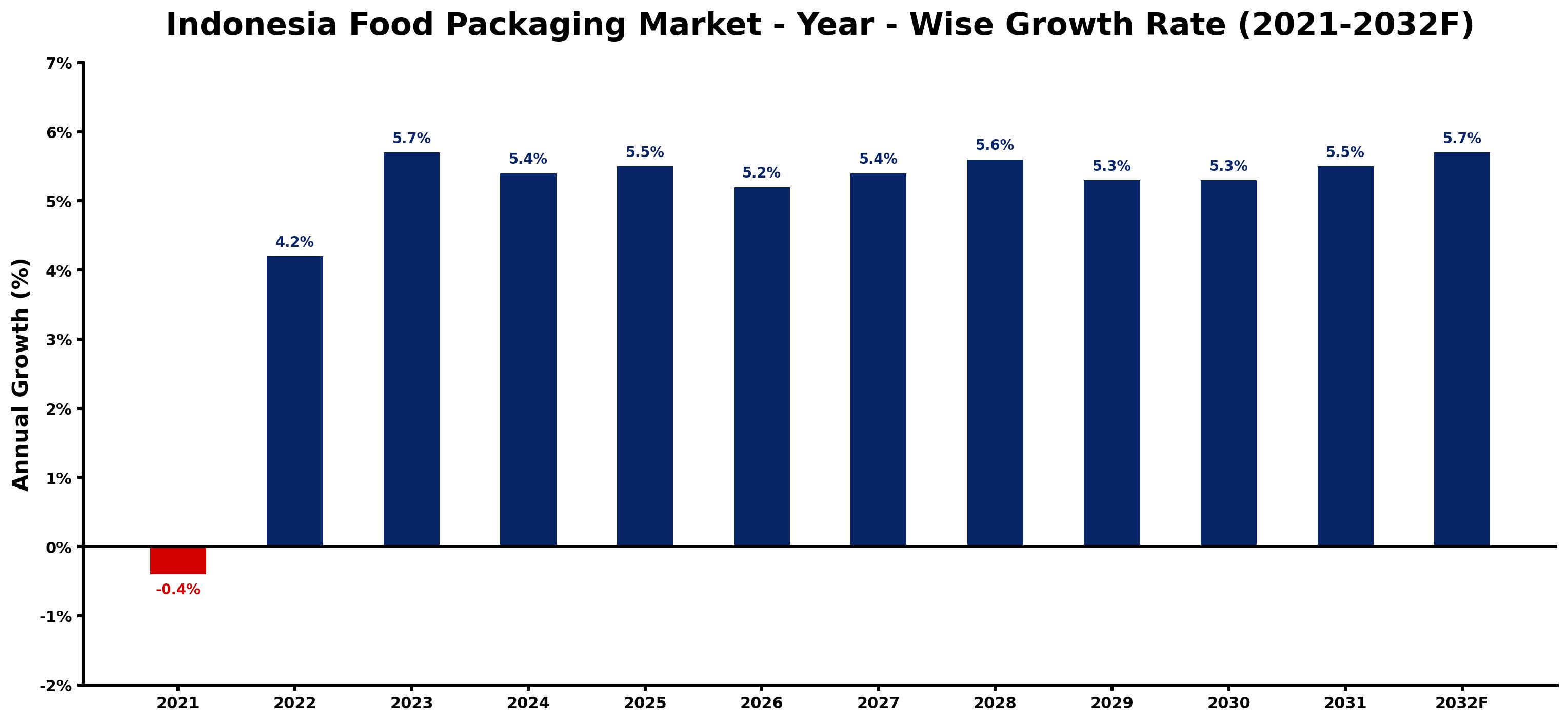
The table below presents the year wise growth rates along with the key drivers influencing the market
| Year | Growth Rate | Major Drivers |
| 2021 | -0.4% | Supply chain disruptions and logistic challenges led to increased costs and decreased availability of food packaging products. |
| 2022 | 4.2% | E-commerce expansion prompted innovative packaging solutions for online food delivery services. |
| 2023 | 5.7% | Health-conscious trends fueled demand for tamper-proof and hygiene-focused packaging formats. |
| 2024 | 5.4% | Investment in local production facilities enhanced supply chain efficiencies across regions. |
| 2025 | 5.5% | Rising disposable income levels increased spending power for premium food packaging options. |
| 2026 | 5.2% | Urbanization trends fostered the need for convenient and ready-to-eat food packaging. |
| 2027 | 5.4% | Technological advancements in biodegradable materials revolutionized packaging sustainability efforts. |
| 2028 | 5.6% | Collaboration between food manufacturers and packaging firms streamlined innovative product launches. |
| 2029 | 5.3% | Emerging startups focused on custom packaging solutions tailored for local preferences. |
| 2030 | 5.3% | Increased environmental awareness among consumers pressured brands toward responsible packaging practices. |
| 2031 | 5.5% | Market consolidation through mergers and acquisitions optimized production capabilities and distribution. |
| 2032 | 5.7% | Focus on circular economy principles encouraged recycling innovations in food packaging design. |
Note - Market size estimations and growth projections presented in this report are based on 6Wresearch's advanced forecasting approach, validated with industry datasets as of June 2026.
Indonesia Food Packaging Market Synopsis
The Indonesia Food Packaging Market is projected to reach 5.2% and witness significant growth during the forecast period (2026-2032). This growth can be attributed to several key factors, including rising disposable incomes, increasing urbanization, heightened awareness regarding hygiene and safety standards, and a growing demand for packaged foods. Furthermore, the easy availability of low-cost materials for producing food packaging products has facilitated market expansion. The entry of various multinational corporations into the Indonesia food packaging arena with innovative product offerings has further solidified the potential of this sector.
Indonesia Food Packaging Market Growth Drivers
The growth of the Indonesia Food Packaging Market is driven by a multitude of factors:
- The surge in disposable incomes in Indonesia has led consumers to allocate greater expenditures towards packaged food products, as they opt for convenience and quality.
- Urbanization continues to change consumer buying patterns, with a significant percentage of the population now residing in urban areas, thereby increasing the demand for packaged foods and beverages.
- Growing health consciousness among consumers has prompted heightened awareness of hygiene standards, bolstering the demand for safe and reliable food packaging solutions.
- Increased availability of affordable raw materials like plastics and biodegradable options is facilitating manufacturers to produce packaging at competitive prices.
- The expansion of the retail sector, particularly in urbanized areas, enhances access to a variety of packaged goods, thereby driving overall consumption.
Indonesia Food Packaging Market Challenges and Restraints
Despite its promising growth potential, the Indonesia Food Packaging Market faces certain challenges:
- High production costs associated with raw materials—such as quality plastics and paperboard—alongside energy expenditures in manufacturing can make final products costly, thereby affecting profit margins.
- The fluctuating prices of raw materials can lead to unpredictable costs for food producers, complicating financial forecasting and pricing strategies.
- Smaller enterprises may struggle to compete against established players due to these high production costs, potentially leading to an oligopolistic market structure.
- Challenges in sustainability and environmental regulations may require companies to adapt to new materials and processes, increasing operational complexity.
- Limited infrastructure in certain regions can hinder the distribution of packaged goods, posing logistical challenges for food producers and retailers.
Indonesia Food Packaging Market Trends and Opportunities
The Indonesia Food Packaging Market presents a range of trends and opportunities for stakeholders:
- There is a noticeable trend towards sustainable and eco-friendly packaging solutions, which aligns with global consumer preferences for environmentally responsible products.
- Technological advancements in packaging design and materials, including smart packaging that enhances user experience, are on the rise and offer innovative opportunities for differentiation.
- The COVID-19 pandemic has accelerated the shift towards online shopping, increasing demand for robust and protective packaging solutions for deliveries.
- As health and hygiene take precedence, manufacturers are exploring packaging innovations that emphasize safety features, appealing to health-conscious consumers.
- With the rapid growth of the foodservice sector in Indonesia, there is an opportunity for customized packaging solutions tailored to restaurant and catering needs.
Indonesia Food Packaging Market Government Investment and Initiatives
The Indonesian government is increasingly recognizing the importance of the food packaging sector, implementing various policies and initiatives to promote its growth:
- Government incentives aimed at attracting foreign direct investment (FDI) in manufacturing and packaging sectors are driving development in technology and production capabilities.
- Programs encouraging the use of sustainable materials in food packaging have been initiated, aligning with global sustainability goals and improving environmental outcomes.
- Public spending on infrastructure improvements is expected to enhance the logistics and distribution capabilities within the packaging industry.
- Research and development grants are being offered to companies that innovate in the field of food packaging, leading to enhanced product offerings and competitiveness.
- Regular assessments of industry regulations are being conducted to ensure a balance between growth opportunities and environmental considerations, fostering a conducive business environment.
Indonesia Food Packaging Market Latest Developments (May 2025 - June 2026)
Over the recent period from May 2025 to June 2026, several significant developments have taken place within the Indonesia Food Packaging Market:
- Innovative packaging solutions incorporating advanced barrier technologies have gained traction, improving the shelf life of food products and reducing spoilage rates.
- The market has seen a shift toward locally sourced materials, allowing companies to reduce dependency on imported goods and better cater to the local landscape.
- Increased collaboration between companies and academic institutions has fostered the development of new packaging materials that are both cost-effective and environmentally friendly.
- Efforts to enhance supply chain resilience have been prioritized, with investments focusing on better forecasting and inventory management systems.
- Growing consumer awareness around waste management has prompted brands to implement take-back schemes and recyclable packaging designs, aligning with environmental sustainability goals.
Indonesia Food Packaging Market - Key Attractiveness of the Report
- 10 Years of Market Numbers
- Historical Data Starting from 2022 to 2025
- Base Year: 2025
- Forecast Data until 2032
- Key Performance Indicators Impacting the Market
- Major Upcoming Developments and Projects
Key Highlights of the Report:
- Indonesia Food Packaging Market Outlook
- Market Size of Indonesia Food Packaging Market, 2025
- Forecast of Indonesia Food Packaging Market, 2032
- Historical Data and Forecast of Indonesia Food Packaging Revenues & Volume for the Period 2022-2032F
- Indonesia Food Packaging Market Trend Evolution
- Indonesia Food Packaging Market Drivers and Challenges
- Indonesia Food Packaging Price Trends
- Indonesia Food Packaging Porter's Five Forces
- Indonesia Food Packaging Industry Life Cycle
- Historical Data and Forecast of Indonesia Food Packaging Market Revenues & Volume By Material Types for the Period 2022-2032F
- Historical Data and Forecast of Indonesia Food Packaging Market Revenues & Volume By Paper & board for the Period 2022-2032F
- Historical Data and Forecast of Indonesia Food Packaging Market Revenues & Volume By Plastic for the Period 2022-2032F
- Historical Data and Forecast of Indonesia Food Packaging Market Revenues & Volume By Metal for the Period 2022-2032F
- Historical Data and Forecast of Indonesia Food Packaging Market Revenues & Volume By Glass for the Period 2022-2032F
- Historical Data and Forecast of Indonesia Food Packaging Market Revenues & Volume By Others for the Period 2022-2032F
- Historical Data and Forecast of Indonesia Food Packaging Market Revenues & Volume By Product Types for the Period 2022-2032F
- Historical Data and Forecast of Indonesia Food Packaging Market Revenues & Volume By Rigid for the Period 2022-2032F
- Historical Data and Forecast of Indonesia Food Packaging Market Revenues & Volume By Semi-Rigid for the Period 2022-2032F
- Historical Data and Forecast of Indonesia Food Packaging Market Revenues & Volume By Flexible for the Period 2022-2032F
- Historical Data and Forecast of Indonesia Food Packaging Market Revenues & Volume By Applications for the Period 2022-2032F
- Historical Data and Forecast of Indonesia Food Packaging Market Revenues & Volume By Bakery & Confectionary for the Period 2022-2032F
- Historical Data and Forecast of Indonesia Food Packaging Market Revenues & Volume By Dairy Products for the Period 2022-2032F
- Historical Data and Forecast of Indonesia Food Packaging Market Revenues & Volume By Fruits & Vegetables for the Period 2022-2032F
- Historical Data and Forecast of Indonesia Food Packaging Market Revenues & Volume By Meat, Poultry, & Seafood for the Period 2022-2032F
- Historical Data and Forecast of Indonesia Food Packaging Market Revenues & Volume By Sauces & Dressings for the Period 2022-2032F
- Historical Data and Forecast of Indonesia Food Packaging Market Revenues & Volume By Others for the Period 2022-2032F
- Indonesia Food Packaging Import Export Trade Statistics
- Market Opportunity Assessment By Material Types
- Market Opportunity Assessment By Product Types
- Market Opportunity Assessment By Applications
- Indonesia Food Packaging Top Companies Market Share
- Indonesia Food Packaging Competitive Benchmarking By Technical and Operational Parameters
- Indonesia Food Packaging Company Profiles
- Indonesia Food Packaging Key Strategic Recommendations






































