Indonesia Food Processing & Handling Equipment Market Summary
The indonesia food processing & handling equipment market was estimated at USD 383 Million in 2025 and is projected to reach USD 505 Million by 2032, growing at a CAGR of 5.5% from 2026 to 2032.
Indonesia Food Processing & Handling Equipment Market Year-wise Growth Rate and Key Drivers
This graph highlights how the Indonesia Food Processing & Handling Equipment Market has steadily grown over the past five years, supported by major growth factors.
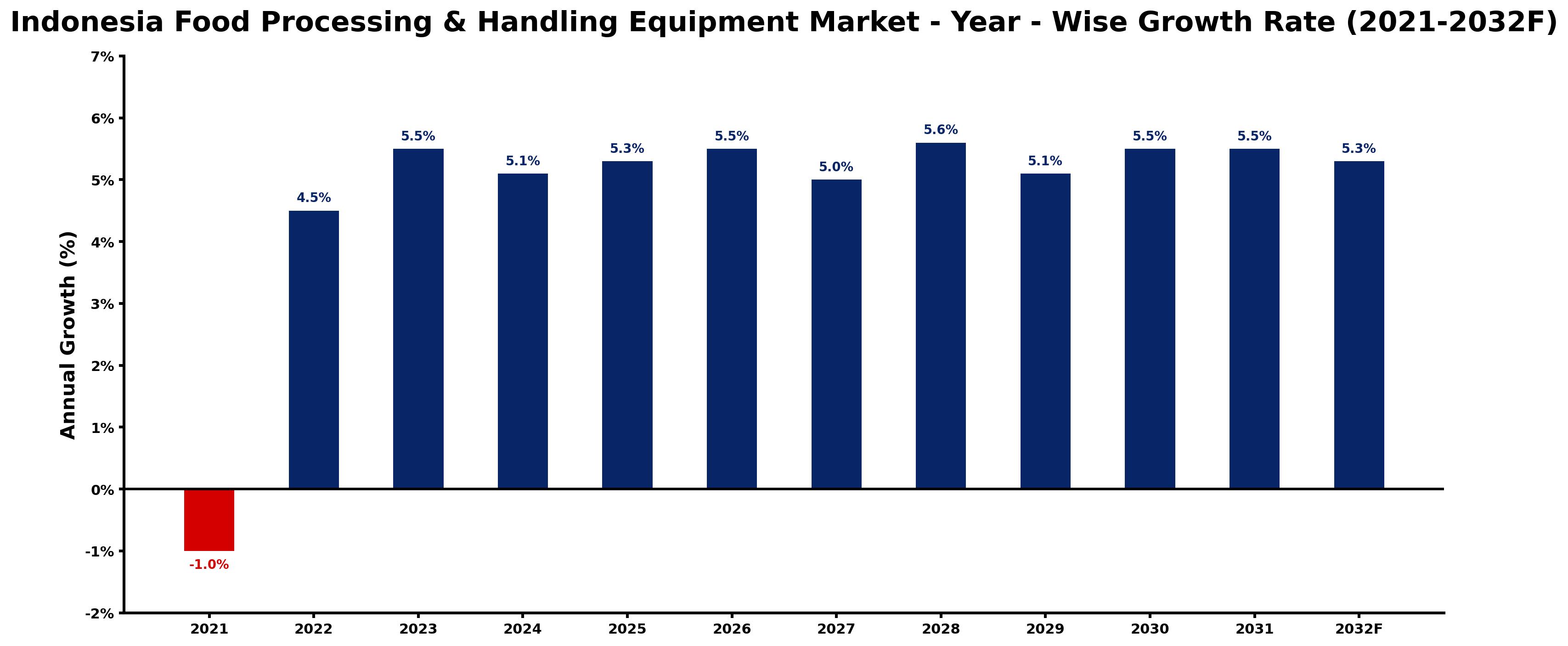
The table below presents the year wise growth rates along with the key drivers influencing the market
| Year | Growth Rate | Major Drivers |
| 2021 | -1.0% | Supply chain disruptions led to increased equipment costs and limited availability, stifling market growth potential. |
| 2022 | 4.5% | Local manufacturers pursued automation to enhance productivity and reduce labor costs. |
| 2023 | 5.5% | Investment in cold chain logistics became crucial due to increased consumer demands. |
| 2024 | 5.1% | Sustainability trends prompted organizations to seek more eco-friendly processing solutions. |
| 2025 | 5.3% | Infrastructure improvements in rural areas allowed for better distribution of food products. |
| 2026 | 5.5% | Health-conscious consumers favored processed foods with better nutritional profiles. |
| 2027 | 5.0% | Technological partnerships emerged, focused on innovation in food safety and quality. |
| 2028 | 5.6% | Exports of processed foods increased, necessitating compliance with international standards. |
| 2029 | 5.1% | Urbanization trends shifted consumer preferences toward convenience in food options. |
| 2030 | 5.5% | Digital transformation in operations led to more efficient equipment management practices. |
| 2031 | 5.5% | Emerging culinary trends inspired new product lines, increasing equipment variety needs. |
| 2032 | 5.3% | Cross-border trade agreements opened markets, enhancing foreign investment in processing technologies. |
Note - Market size estimations and growth projections presented in this report are based on 6Wresearch's advanced forecasting approach, validated with industry datasets as of June 2026.
Indonesia Food Processing & Handling Equipment Market Synopsis
The Indonesia Food Processing Handling Equipment Market is projected to reach 5.5% and witness significant growth during the forecast period (2026-2032). This growth is primarily driven by increased demand for processed and packaged food products, advancements in food processing technologies, rising disposable incomes, and the expanding landscape of global trade. Additionally, evolving consumer preferences towards healthier eating habits are creating new opportunities for manufacturers of food processing and handling machinery.
Indonesia Food Processing & Handling Equipment Market Growth Drivers
Several key factors are contributing to the growth of the Indonesia Food Processing & Handling Equipment Market:
- Urbanization and changing lifestyles have resulted in a notable increase in the consumption of processed foods, including frozen foods and snacks. This trend necessitates the deployment of sophisticated machinery for efficient production and packaging.
- The demand for automated industrial machines has surged as manufacturers seek to enhance operational efficiency. Equipment that performs slicing, chopping, grinding, mixing, and blending operations quickly and accurately is increasingly sought after.
- Technological advancements, such as PID temperature control systems and HACCP compliance safety systems, are leading to more efficient automation techniques across the food processing sector, resulting in enhanced performance and reduced waste.
- An increase in consumer awareness surrounding healthy eating habits is driving the demand for innovative food processing solutions that accommodate healthier product lines, thereby expanding market opportunities.
- The rising trend of globalization has facilitated greater trade opportunities, allowing local manufacturers to access international markets and increase their production capacities through advanced food handling equipment.
Indonesia Food Processing & Handling Equipment Market Challenges and Restraints
Despite the promising growth prospects, the Indonesia Food Processing & Handling Equipment Market faces several challenges:
- Significant capital investment is required for the acquisition of high-capacity industrial machines. This can pose a barrier for small-scale producers who lack the financial resources to invest in advanced equipment, potentially limiting their market participation.
- Periodic maintenance costs associated with sophisticated machinery can be burdensome, further inhibiting entry for smaller players who may struggle to sustain ongoing operational expenditures.
- Rapid technological changes necessitate continuous investments in upgrading equipment. This can lead to increased operational costs and affect competitiveness, especially among smaller producers.
- Regulatory compliance can also be a challenge, as manufacturers must adhere to stringent food safety and quality standards, necessitating ongoing investment in compliance-related measures.
- The fluctuating cost of raw materials and supply chain disruptions can impact production schedules, further complicating the operational landscape for food processing companies.
Indonesia Food Processing & Handling Equipment Market Government Investment and Initiatives
The Indonesian government has been proactive in fostering the growth of the food processing and handling equipment sector. Various public policies and development plans are in place to support local manufacturers and enhance the industry. Initiatives include:
- Investment in infrastructure development, aimed at improving logistics and supply chain efficiency, which is crucial for the food processing industry.
- Incentives for technology adoption, encouraging manufacturers to upgrade their equipment and processes to meet international standards.
- Support for research and development in food processing technologies, promoting innovation and enhancing productivity in the sector.
- Establishment of training programs aimed at improving the skill sets of the workforce in the food processing industry, thereby increasing operational efficiency.
- Collaborations with international organizations to align local standards with global practices, facilitating easier access to export markets for Indonesian food products.
Indonesia Food Processing & Handling Equipment Market Latest Developments (May 2025 - June 2026)
Recent developments in the Indonesia Food Processing & Handling Equipment Market indicate a strong trajectory towards modernization and increased efficiency. Over the period from May 2025 to June 2026, several trends have emerged:
- A notable increase in the adoption of automation technologies has been observed, with manufacturers increasingly investing in robotic and AI-driven solutions to streamline production processes.
- Sustainability has become a focal point, with many companies seeking equipment that reduces energy consumption and waste, in line with global environmental standards.
- There has been a surge in the introduction of smart equipment that integrates IoT capabilities, allowing for real-time monitoring and data analytics to optimize production efficiency.
- Partnerships between local manufacturers and international technology firms have strengthened, facilitating technology transfer and enhancing local capabilities.
- The government has launched specific initiatives aimed at bolstering exports of processed foods, further stimulating demand for advanced food processing equipment.
Indonesia Food Processing & Handling Equipment Market - Key Attractiveness of the Report
- 10 Years of Market Numbers
- Historical Data Starting from 2022 to 2025
- Base Year: 2025
- Forecast Data until 2032
- Key Performance Indicators Impacting the Market
- Major Upcoming Developments and Projects
Key Highlights of the Report:
- Indonesia Food Processing & Handling Equipment Market Outlook
- Market Size of Indonesia Food Processing & Handling Equipment Market, 2025
- Forecast of Indonesia Food Processing & Handling Equipment Market, 2032F
- Historical Data and Forecast of Indonesia Food Processing & Handling Equipment Revenues & Volume for the Period 2022-2032F
- Indonesia Food Processing & Handling Equipment Market Trend Evolution
- Indonesia Food Processing & Handling Equipment Market Drivers and Challenges
- Indonesia Food Processing & Handling Equipment Price Trends
- Indonesia Food Processing & Handling Equipment Porter's Five Forces
- Indonesia Food Processing & Handling Equipment Industry Life Cycle
- Historical Data and Forecast of Indonesia Food Processing & Handling Equipment Market Revenues & Volume By Equipment Type for the Period 2022-2032F
- Historical Data and Forecast of Indonesia Food Processing & Handling Equipment Market Revenues & Volume By Food Processing equipment for the Period 2022-2032F
- Historical Data and Forecast of Indonesia Food Processing & Handling Equipment Market Revenues & Volume By Foodservice equipment for the Period 2022-2032F
- Historical Data and Forecast of Indonesia Food Processing & Handling Equipment Market Revenues & Volume By Food Packaging equipment for the Period 2022-2032F
- Historical Data and Forecast of Indonesia Food Processing & Handling Equipment Market Revenues & Volume By Application for the Period 2022-2032F
- Historical Data and Forecast of Indonesia Food Processing & Handling Equipment Market Revenues & Volume By Bakery & confectionery products for the Period 2022-2032F
- Historical Data and Forecast of Indonesia Food Processing & Handling Equipment Market Revenues & Volume By Meat & poultry products for the Period 2022-2032F
- Historical Data and Forecast of Indonesia Food Processing & Handling Equipment Market Revenues & Volume By Dairy products for the Period 2022-2032F
- Historical Data and Forecast of Indonesia Food Processing & Handling Equipment Market Revenues & Volume By Alcoholic beverages for the Period 2022-2032F
- Historical Data and Forecast of Indonesia Food Processing & Handling Equipment Market Revenues & Volume By Non-alcoholic beverages for the Period 2022-2032F
- Historical Data and Forecast of Indonesia Food Processing & Handling Equipment Market Revenues & Volume By Fish & seafood products for the Period 2022-2032F
- Historical Data and Forecast of Indonesia Food Processing & Handling Equipment Market Revenues & Volume By Others? for the Period 2022-2032F
- Historical Data and Forecast of Indonesia Food Processing & Handling Equipment Market Revenues & Volume By Form for the Period 2022-2032F
- Historical Data and Forecast of Indonesia Food Processing & Handling Equipment Market Revenues & Volume By Solid for the Period 2022-2032F
- Historical Data and Forecast of Indonesia Food Processing & Handling Equipment Market Revenues & Volume By Liquid for the Period 2022-2032F
- Historical Data and Forecast of Indonesia Food Processing & Handling Equipment Market Revenues & Volume By Semi-solid for the Period 2022-2032F
- Indonesia Food Processing & Handling Equipment Import Export Trade Statistics
- Market Opportunity Assessment By Equipment Type
- Market Opportunity Assessment By Application
- Market Opportunity Assessment By Form
- Indonesia Food Processing & Handling Equipment Top Companies Market Share
- Indonesia Food Processing & Handling Equipment Competitive Benchmarking By Technical and Operational Parameters
- Indonesia Food Processing & Handling Equipment Company Profiles
- Indonesia Food Processing & Handling Equipment Key Strategic Recommendations






































