Indonesia Gluten-free Products Market (2026-2032) | Forecast, Share, Growth, Analysis, Industry, Size, Revenue, Value, Trends & Companies
Market Forecast By Type (Bakery products, Snacks & RTE products, Condiments & dressings, Pizzas & pastas), By Distribution channel (Conventional stores, Specialty stores , Drugstores & Pharmacies) And Competitive Landscape
| Product Code: ETC4541429 | Publication Date: Jul 2023 | Updated Date: Mar 2026 | Product Type: Report | |
| Publisher: 6Wresearch | Author: Ravi Bhandari | No. of Pages: 85 | No. of Figures: 45 | No. of Tables: 25 |
Indonesia Gluten-free Products Market: Import Trend Analysis
In the Indonesia gluten-free products market, the import trend showed a growth rate of 3.92% from 2023 to 2024, with a compound annual growth rate (CAGR) of 4.42% for the period 2020-2024. This import momentum could be attributed to the increasing demand for healthier food options among Indonesian consumers, driving market stability and indicating a sustained interest in gluten-free products.
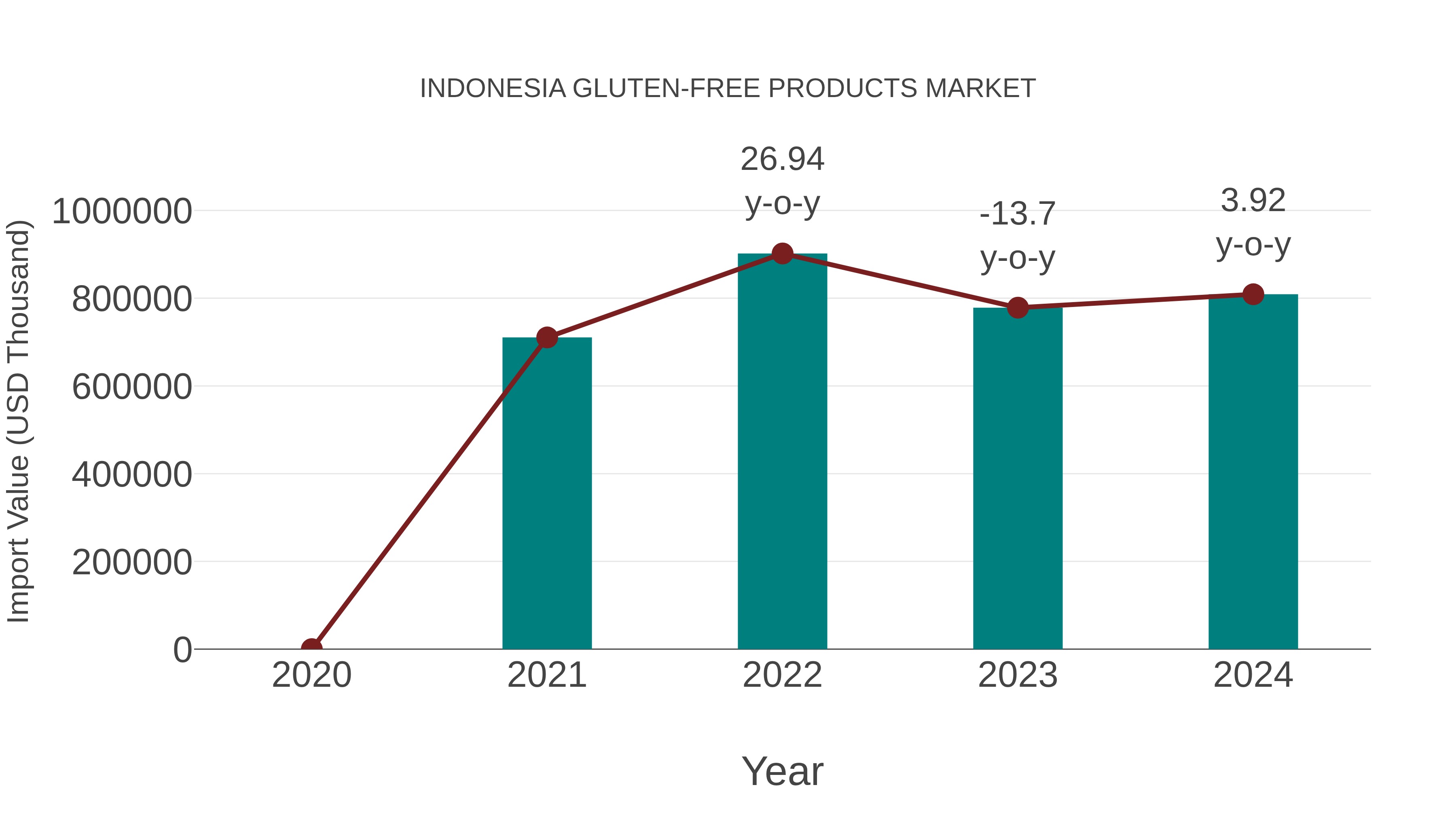
Indonesia Gluten-Free Products Market Growth Rate
According to 6Wresearch internal database and industry insights, the Indonesia Gluten-Free Products Market is projected to grow at a compound annual growth rate (CAGR) of 7.8% during the forecast period (2026-2032).
Topics Covered in the Indonesia Gluten-Free Products Market Report
Indonesia Gluten-Free Products Market report thoroughly covers the market by type and distribution channel. The report provides a detailed analysis of ongoing market trends, growth opportunities, and market drivers that will help stakeholders make informed decisions based on current and future market dynamics.
Indonesia Gluten-Free Products Market Highlights
| Report Name | Indonesia Gluten-Free Products Market |
| Forecast period | 2026–2032 |
| CAGR | 7.8% |
| Growing Sector | Bakery Products and Snacks & RTE Products |
Indonesia Gluten-Free Products Market Synopsis
Indonesia Gluten-Free Products Market is expected to witness significant growth in the coming years driven by a rise in the number of individuals with gluten intolerance and an increasing focus on health and wellness. As the awareness of gluten-related health conditions grows, there is a growing demand for gluten-free food products, particularly in the bakery, snacks, and ready-to-eat (RTE) categories. The market is also seeing growth due to an increase in retail and online distribution channels, making gluten-free products more accessible to the Indonesian population.
Evaluation of Growth Drivers in the Indonesia Gluten-Free Products Market
Below are some major growth drivers and their influence on the market dynamics:
| Drivers | Primary Segment Affected | Why It Matters |
| Increasing Gluten Sensitivity Awareness | Bakery Products | There is an increase in consumer awareness regarding gluten sensitivity as well as health-related benefits. |
| Health & Wellness Trends | Snacks & RTE Products | Consumers are becoming more focused on health & wellness, which will continue to drive demand for gluten free snacks and RTE products amongst health-minded consumers. |
| Rise in Celiac Disease Diagnoses | Bakery Products, Snacks | An increase in the diagnosis of celiac disease and gluten sensitivity has pushed consumers towards gluten-free alternatives in baked goods and snack foods. |
| Growth in Retail and Online Distribution | All Product Categories | With the recent increase in both brick-and-mortar retail stores, as well as e-commerce channels, gluten free products are now becoming more accessible to Indonesian consumers. |
| Government Support and Regulation | All Product Categories | The Indonesian government’s increased emphasis on areas relating to public health also adds to the increasing number and availability of gluten free options available in the market. |
Indonesia Gluten-Free Products Market is projected to accelerate, growing at a CAGR of 7.8% during the forecast period (2026-2032). This growth stems from many people knowing that consuming gluten-free food can provide tremendous health benefits and is increasing the amount of gluten-free products being produced in Indonesia. More people in Indonesia are becoming health-conscious and will purchase gluten-free products due to their health issues such as celiac disease and gluten intolerance, or simply due to a desire to lead healthier lifestyles. The emergence of a large number of new gluten-free companies in both Indonesia and the rest of the world will provide more opportunities for consumers to experience gluten-free foods than ever before.
Evaluation of Restraints in the Indonesia Gluten-Free Products Market
Below are some prominent restraints and their influence on the market dynamics:
| Restraints | Primary Segment Affected | What This Means |
| High Cost of Gluten-Free Products | Bakery Products, Snacks | Gluten-free products typically have a higher cost, due to their production processes. This has the effect of limiting how many consumers can afford to purchase gluten-free products. |
| Limited Consumer Knowledge | Snacks & RTE Products | Lack of awareness regarding the benefits of gluten-free products may limit market adoption in certain consumer segments. |
| Supply Chain and Import Dependency | Bakery Products, Snacks | As the gluten-free market is heavily dependent on imports, it is vulnerable to disruptions in supply chains and unexpected changes in import duties. |
| Consumer Resistance to New Products | Bakery Products | Many consumers may not be comfortable switching to gluten-free alternatives as they are used to the taste and texture of gluten-filled foods. |
Indonesia Gluten-Free Products Market Challenges
While the Indonesia Gluten-Free Products Market is expected to grow steadily, it faces several challenges as price point of gluten-free products remains higher than that of regular products, which can limit adoption in price-sensitive market segments. Although product variety is expanding, there is still limited availability of high-quality gluten-free options, particularly in traditional snack and bakery categories. Apart from this, traditional Indonesian foods often include gluten-based ingredients, which can present a cultural barrier to the widespread adoption of gluten-free products.
Indonesia Gluten-Free Products Market Trends
Significant developments are expected to shape the outlook for the gluten-free products market in Indonesia:
- Expanded Availability of Gluten-Free Products: Increased availability (screened for gluten-free status) in major retail outlets has led to a rise in mainstream acceptance of products across multiple categories including bakery, snack, and condiment items.
- Focus on Product Innovation: Gluten-free product manufacturers continue innovating and expanding upon their current offerings through new formulation techniques designed to enhance taste and texture, as well as improve nutritional quality, leading to a higher level of appeal within the global; global markets.
- Increasing Popularity of Online Shopping: The rise of e-commerce in Indonesia has allowed consumers to have access to a broader variety of gluten-free options through digital channels; thus making it easier for consumers that wish to purchase gluten-free food items via e-commerce platforms.
Investment Opportunities in the Indonesia Gluten-Free Products Market
Promising investment opportunities in the Indonesia Gluten-Free Products Market include:
- E-Commerce Partnerships: Creating partnerships with other companies who sell gluten-free products online, such as Tokopedia and Bukalapak, can help gluten-free product manufacturers to reach many more customers in both urban and rural areas.
- Research and Development of New Gluten-Free Products: Investments in developing healthy convenience snack foods that are gluten free will allow food companies to take advantage of the increasing demand for this type of food.
- Investment in Marketing to Drive Demand for Gluten-Free Products: Marketing to educate consumers on the health benefits of using gluten-free products will likely increase demand for gluten-free products.
Top 5 Leading Players in Indonesia Gluten-Free Products Market
The prominent companies within the Indonesia Gluten-Free Products Market are listed here:
1. Nestlé S.A.
| Company Name | Nestlé S.A. |
| Headquarters | Switzerland |
| Established | 1867 |
| Website | Click Here |
Nestlé is one of the leading players in the Indonesian gluten-free products market, offering a wide range of gluten-free snacks and bakery products under its various brands, such as Maggi and Nescafé.
2. General Mills, Inc.
| Company Name | General Mills, Inc. |
| Headquarters | United States |
| Established | 1866 |
| Website | Click Here |
General Mills offers popular gluten-free products under its Betty Crocker and Cheerios brands, catering to the growing demand for safe and tasty gluten-free alternatives in Indonesia.
3. Kellogg's Company
| Company Name | Kellogg's Company |
| Headquarters | United States |
| Established | 1906 |
| Website | Click Here |
Kellogg’s provides a wide variety of gluten-free snacks and cereal products, positioning itself as a major player in the market by offering health-conscious solutions for consumers seeking gluten-free options.
4. Freedom Foods Group
| Company Name | Freedom Foods Group |
| Headquarters | Australia |
| Established | 1991 |
| Website | - |
Freedom Foods Group is known for its gluten-free and organic product lines, including snacks, cereals, and baking ingredients, which have found a strong presence in the Indonesian market.
5. PT. Indofood Sukses Makmur Tbk
| Company Name | PT. Indofood Sukses Makmur Tbk |
| Headquarters | Jakarta, Indonesia |
| Established | 1990 |
| Website | Click Here |
One of Indonesia's largest food companies, expanding into gluten-free products through diversified brands. The company manufactures gluten-free snacks, noodles, and processed foods, responding to the growing demand for healthier and alternative food options.
Indonesia Gluten-Free Products Market: Government Initiatives
Several programs have been implemented by the Indonesian government to accelerate the Indonesia gluten-free products market growth:
- Health Awareness Initiative: The Ministry of Health is performing education initiatives designed to build awareness of both gluten intolerance and celiac disease creating an environment that is conducive to consuming gluten-free products.
- Regulations/Labeling: Government regulations were created to help ensure that gluten-free products meet safety and labeling standards which gives consumers trust in the gluten-free market.
- Healthy Eating Promotion: There have been governmental programs encouraging healthy eating behaviours and improved dietary awareness thus resulting in increased consumer demand for gluten-free alternatives in Indonesia.
Future Insights of the Indonesia Gluten-Free Products Market
Indonesia Gluten-Free Products Market is expected to continue its growth, driven by increased awareness about the benefits of gluten-free diets, advancements in gluten-free product innovation, and a supportive retail environment. The market will be further supported by government initiatives and a rising health-conscious consumer base. As local demand for gluten-free products grows, the market presents significant opportunities for both local and international brands to expand their presence.
Market Segmentation Analysis
The report offers a comprehensive study of the following market segments and their leading categories:
By Product Type – Bakery Products to Lead the Market
According to Rohit, Senior Research Analyst, 6Wresearch, Bakery products will dominate the Indonesia gluten-free products market share in the coming years, driven by increasing demand for gluten-free bread, cakes, and cookies, particularly among health-conscious consumers.
Key attractiveness of the report
- 10 Years Market Numbers
- Historical Data Starting from 2022 to 2025
- Base Year: 2025
- Forecast Data until 2032
- Key Performance Indicators Impacting the Market
- Major Upcoming Developments and Projects
Key Highlights of the Report:
- Indonesia Gluten-free Products Market Outlook
- Market Size of Indonesia Gluten-free Products Market, 2025
- Forecast of Indonesia Gluten-free Products Market, 2032
- Historical Data and Forecast of Indonesia Gluten-free Products Revenues & Volume for the Period 2022-2032F
- Indonesia Gluten-free Products Market Trend Evolution
- Indonesia Gluten-free Products Market Drivers and Challenges
- Indonesia Gluten-free Products Price Trends
- Indonesia Gluten-free Products Porter's Five Forces
- Indonesia Gluten-free Products Industry Life Cycle
- Historical Data and Forecast of Indonesia Gluten-free Products Market Revenues & Volume By Type for the Period 2022-2032F
- Historical Data and Forecast of Indonesia Gluten-free Products Market Revenues & Volume By Bakery products for the Period 2022-2032F
- Historical Data and Forecast of Indonesia Gluten-free Products Market Revenues & Volume By Snacks & RTE products for the Period 2022-2032F
- Historical Data and Forecast of Indonesia Gluten-free Products Market Revenues & Volume By Condiments & dressings for the Period 2022-2032F
- Historical Data and Forecast of Indonesia Gluten-free Products Market Revenues & Volume By Pizzas & pastas for the Period 2022-2032F
- Historical Data and Forecast of Indonesia Gluten-free Products Market Revenues & Volume By Distribution channel for the Period 2022-2032F
- Historical Data and Forecast of Indonesia Gluten-free Products Market Revenues & Volume By Conventional stores for the Period 2022-2032F
- Historical Data and Forecast of Indonesia Gluten-free Products Market Revenues & Volume By Specialty stores for the Period 2022-2032F
- Historical Data and Forecast of Indonesia Gluten-free Products Market Revenues & Volume By Drugstores & Pharmacies for the Period 2022-2032F
- Indonesia Gluten-free Products Import Export Trade Statistics
- Market Opportunity Assessment By Type
- Market Opportunity Assessment By Distribution channel
- Indonesia Gluten-free Products Top Companies Market Share
- Indonesia Gluten-free Products Competitive Benchmarking By Technical and Operational Parameters
- Indonesia Gluten-free Products Company Profiles
- Indonesia Gluten-free Products Key Strategic Recommendations
Market Covered
The report offers a comprehensive study of the subsequent market segments:
By Type
- Bakery products
- Snacks & RTE products
- Condiments & dressings
- Pizzas & pastas
By Distribution channel
- Conventional stores
- Specialty stores
- Drugstores & Pharmacies
Indonesia Gluten-free Products Market (2026-2032): FAQs
Indonesia Gluten-Free Products Market is predicted to grow at a CAGR of 7.8% over the forecast period from 2026 to 2032.
Conventional stores such as supermarkets and grocery stores are the most common distribution channel.
The primary growth drivers include increased awareness of gluten-related health conditions and rising demand for healthier and organic food options.
Some leading players in the market include Nestlé, General Mills, Kellogg’s, Freedom Foods Group, and others.
6Wresearch actively monitors the Indonesia Gluten-free Products Market and publishes its comprehensive annual report, highlighting emerging trends, growth drivers, revenue analysis, and forecast outlook. Our insights help businesses to make data-backed strategic decisions with ongoing market dynamics. Our analysts track relevent industries related to the Indonesia Gluten-free Products Market, allowing our clients with actionable intelligence and reliable forecasts tailored to emerging regional needs.
Yes, we provide customisation as per your requirements. To learn more, feel free to contact us on sales@6wresearch.com
|
1 Executive Summary |
|
2 Introduction |
|
2.1 Key Highlights of the Report |
|
2.2 Report Description |
|
2.3 Market Scope & Segmentation |
|
2.4 Research Methodology |
|
2.5 Assumptions |
|
3 Indonesia Gluten-free Products Market Overview |
|
3.1 Indonesia Country Macro Economic Indicators |
|
3.2 Indonesia Gluten-free Products Market Revenues & Volume, 2022 & 2032F |
|
3.3 Indonesia Gluten-free Products Market - Industry Life Cycle |
|
3.4 Indonesia Gluten-free Products Market - Porter's Five Forces |
|
3.5 Indonesia Gluten-free Products Market Revenues & Volume Share, By Type, 2022 & 2032F |
|
3.6 Indonesia Gluten-free Products Market Revenues & Volume Share, By Distribution channel, 2022 & 2032F |
|
4 Indonesia Gluten-free Products Market Dynamics |
|
4.1 Impact Analysis |
|
4.2 Market Drivers |
|
4.2.1 Increasing health consciousness and awareness about gluten intolerance among consumers in Indonesia. |
|
4.2.2 Rising disposable incomes leading to higher spending on premium and health-focused food products. |
|
4.2.3 Growing availability and variety of gluten-free products in the Indonesian market. |
|
4.3 Market Restraints |
|
4.3.1 Higher prices of gluten-free products compared to conventional products may limit adoption. |
|
4.3.2 Lack of clear regulations and standards for gluten-free labeling in Indonesia. |
|
5 Indonesia Gluten-free Products Market Trends |
|
6 Indonesia Gluten-free Products Market, By Types |
|
6.1 Indonesia Gluten-free Products Market, By Type |
|
6.1.1 Overview and Analysis |
|
6.1.2 Indonesia Gluten-free Products Market Revenues & Volume, By Type, 2022-2032F |
|
6.1.3 Indonesia Gluten-free Products Market Revenues & Volume, By Bakery products, 2022-2032F |
|
6.1.4 Indonesia Gluten-free Products Market Revenues & Volume, By Snacks & RTE products, 2022-2032F |
|
6.1.5 Indonesia Gluten-free Products Market Revenues & Volume, By Condiments & dressings, 2022-2032F |
|
6.1.6 Indonesia Gluten-free Products Market Revenues & Volume, By Pizzas & pastas, 2022-2032F |
|
6.2 Indonesia Gluten-free Products Market, By Distribution channel |
|
6.2.1 Overview and Analysis |
|
6.2.2 Indonesia Gluten-free Products Market Revenues & Volume, By Conventional stores, 2022-2032F |
|
6.2.3 Indonesia Gluten-free Products Market Revenues & Volume, By Specialty stores , 2022-2032F |
|
6.2.4 Indonesia Gluten-free Products Market Revenues & Volume, By Drugstores & Pharmacies, 2022-2032F |
|
7 Indonesia Gluten-free Products Market Import-Export Trade Statistics |
|
7.1 Indonesia Gluten-free Products Market Export to Major Countries |
|
7.2 Indonesia Gluten-free Products Market Imports from Major Countries |
|
8 Indonesia Gluten-free Products Market Key Performance Indicators |
|
8.1 Percentage increase in the number of specialty stores and supermarkets stocking gluten-free products. |
|
8.2 Growth in the number of gluten-free product launches by food manufacturers in Indonesia. |
|
8.3 Consumer awareness levels about gluten-free diet and products in the Indonesian market. |
|
9 Indonesia Gluten-free Products Market - Opportunity Assessment |
|
9.1 Indonesia Gluten-free Products Market Opportunity Assessment, By Type, 2022 & 2032F |
|
9.2 Indonesia Gluten-free Products Market Opportunity Assessment, By Distribution channel, 2022 & 2032F |
|
10 Indonesia Gluten-free Products Market - Competitive Landscape |
|
10.1 Indonesia Gluten-free Products Market Revenue Share, By Companies, 2025 |
|
10.2 Indonesia Gluten-free Products Market Competitive Benchmarking, By Operating and Technical Parameters |
|
11 Company Profiles |
|
12 Recommendations |
|
13 Disclaimer |
Global Go To Market Strategy - 2030
Export potential enables firms to identify high-growth global markets with greater confidence by combining advanced trade intelligence with a structured quantitative methodology. The framework analyzes emerging demand trends and country-level import patterns while integrating macroeconomic and trade datasets such as GDP and population forecasts, bilateral import–export flows, tariff structures, elasticity differentials between developed and developing economies, geographic distance, and import demand projections. Using weighted trade values from 2020–2024 as the base period to project country-to-country export potential for 2030, these inputs are operationalized through calculated drivers such as gravity model parameters, tariff impact factors, and projected GDP per-capita growth. Through an analysis of hidden potentials, demand hotspots, and market conditions that are most favorable to success, this method enables firms to focus on target countries, maximize returns, and global expansion with data, backed by accuracy.
By factoring in the projected importer demand gap that is currently unmet and could be potential opportunity, it identifies the potential for the Exporter (Country) among 190 countries, against the general trade analysis, which identifies the biggest importer or exporter.
To discover high-growth global markets and optimize your business strategy:
Click Here
Pricing
- Single User License$ 1,995
- Department License$ 2,400
- Site License$ 3,120
- Global License$ 3,795

Leadership Perspectives from Industry Events
Search
Thought Leadership and Analyst Meet





Our Clients








6WResearch In News
- India Export Attractiveness Tracker 2026
- India Air Conditioner Market Set for Strong Rebound in 2026 After Weather-Led Correction and GST-Driven Recovery: 6Wresearch
- ADAS in India: How Automatic Emergency Braking, Blind Spot Detection & Driver Monitoring are Transforming Road Safety
- Doha a strategic location for EV manufacturing hub: IPA Qatar
- Demand for luxury TVs surging in the GCC, says Samsung
- Empowering Growth: The Thriving Journey of Bangladesh’s Cable Industry
Latest Reports
- Qatar Access and Home Network Market (2026-2032)
- Nicaragua RPG Gaming Market (2026-2032)
- New Zealand RPG Gaming Market (2026-2032)
- Netherlands RPG Gaming Market (2026-2032)
- Nauru RPG Gaming Market (2026-2032)
- Namibia RPG Gaming Market (2026-2032)
- Mozambique RPG Gaming Market (2026-2032)
- Montenegro RPG Gaming Market (2026-2032)
- Mongolia RPG Gaming Market (2026-2032)
- Monaco RPG Gaming Market (2026-2032)
Industry Events and Analyst Meet

EV India Expo 2026

HIMTEX 2026

India Refining Summit 2026

India EV Show 2026

EV tech India Expo 2026
Whitepaper
- Middle East & Africa Commercial Security Market Click here to view more.
- Middle East & Africa Fire Safety Systems & Equipment Market Click here to view more.
- GCC Drone Market Click here to view more.
- Middle East Lighting Fixture Market Click here to view more.
- GCC Physical & Perimeter Security Market Click here to view more.


