Indonesia Gold Plating Chemicals Market Size, Share & Growth Rate
The Indonesia Gold Plating Chemicals Market was estimated at USD 426 Million in 2025 and is projected to reach USD 563 Million by 2032, growing at a CAGR of 4.1% from 2026 to 2032. This trajectory is largely driven by the increasing consumer demand for gold jewelry and accessories, aligning with rising disposable incomes across the nation. Furthermore, the market is buoyed by the growing trend towards electroplating as a cost-effective and visually appealing option in consumer goods.
Indonesia Gold Plating Chemicals Market Year-wise Growth Rate and Key Drivers
This graph highlights how the Indonesia Gold Plating Chemicals Market has steadily grown over the years, supported by major growth factors.
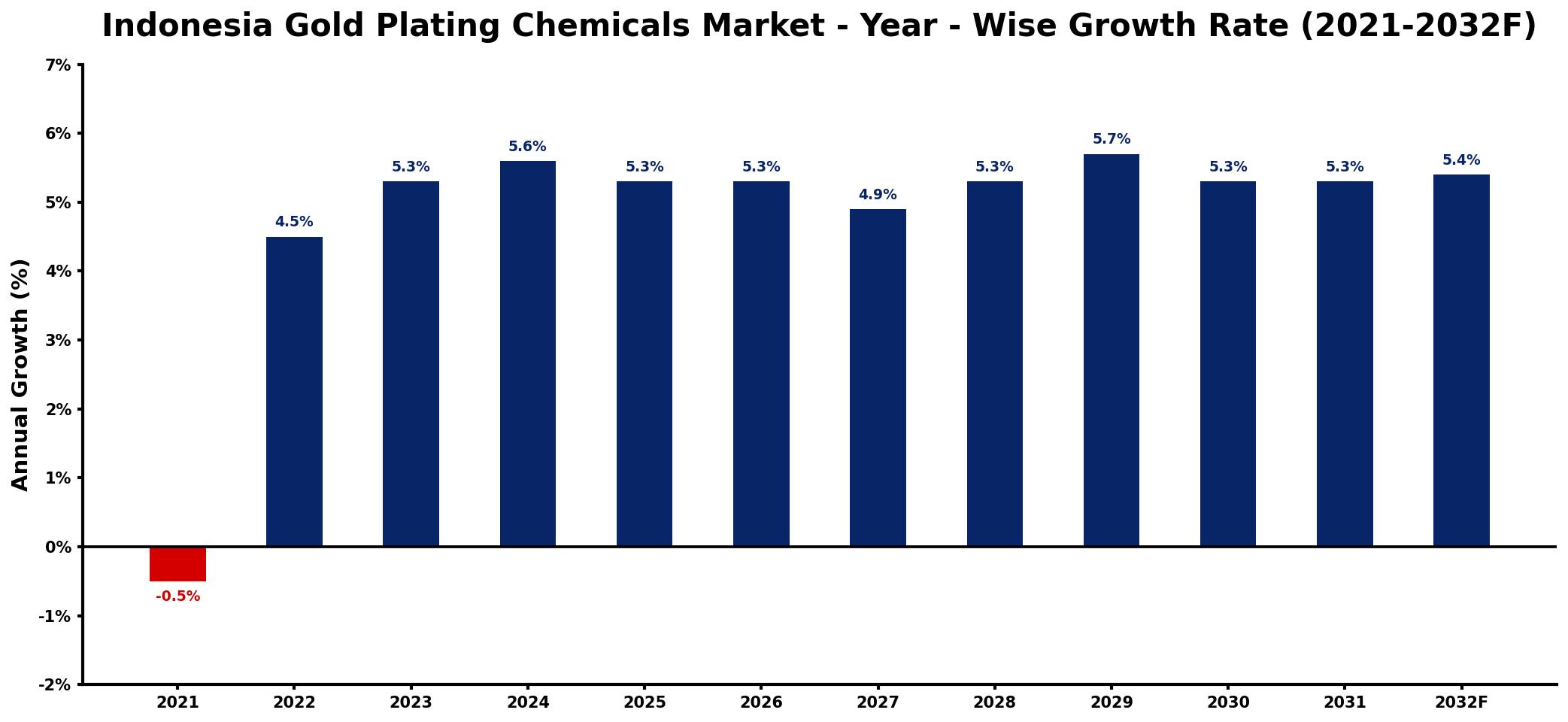
The table below presents the year‑wise growth rates along with the key drivers influencing the market
| Year | Growth Rate | Major Drivers |
| 2021 | -0.5% | Decreased demand from manufacturing sector |
| 2022 | 4.5% | Rise in electronics manufacturing activities |
| 2023 | 5.3% | Expansion of automotive industry investments |
| 2024 | 5.6% | Growth in renewable energy projects |
| 2025 | 5.3% | Increased consumer electronics production |
| 2026 | 5.3% | Surge in luxury goods market |
| 2027 | 4.9% | Boost in aerospace sector requirements |
| 2028 | 5.3% | Rising demand for jewelry applications |
| 2029 | 5.7% | Advancements in telecommunications infrastructure |
| 2030 | 5.3% | Growing interest in decorative finishes |
| 2031 | 5.3% | Emergence of smart technology applications |
| 2032 | 5.4% | improved raw material availability |
Note: Market size estimations and growth projections presented in this report are based on 6Wresearch's proprietary forecasting methodology, utilizing the latest available industry data, government publications, and primary research inputs.
Indonesia Gold Plating Chemicals Market Synopsis
While the Indonesia Gold Plating Chemicals Market faced initial setbacks due to the COVID-19 pandemic, recent months have seen a notable recovery as consumer purchasing patterns shift back towards luxury goods. The industry's long-term outlook remains promising, bolstered by technological advancements and a burgeoning urban middle class eager to invest in premium quality products.
Looking ahead, the market is expected to harness its momentum further, driven by innovations in eco-friendly chemical formulations that align with regulatory mandates on environmental protection. This focus not only addresses consumer preferences but also opens avenues for new entrants looking to capitalize on sustainable practices.
Indonesia Gold Plating Chemicals Market Key Takeaways
- The market is projected to grow significantly due to rising disposable incomes and changing fashion trends.
- Urbanization is driving demand for luxury goods that require gold plating, creating a more affluent consumer base.
- Technological advancements in manufacturing processes are enhancing product quality and reducing waste.
- Government regulations promoting eco-friendly practices are likely to favor sustainable growth in the sector.
- Despite past disruptions, the market is rebounding swiftly, indicating resilience and future growth potential.
Evaluation of Restraints in Indonesia Gold Plating Chemicals Market
The gold plating chemicals market in Indonesia faces several notable restraints that could impede its growth. A significant barrier is the high initial investment required for setting up gold plating facilities, which may deter potential new entrants from capitalizing on emerging opportunities. Furthermore, many local players demonstrate a lack of awareness regarding environmental regulations, posing risks of legal complications and potential fines. The use of low-quality raw materials by some manufacturers, in an attempt to cut costs, also compromises the overall performance and durability of the final products, impacting brand reputation and consumer trust.
Indonesia Gold Plating Chemicals Market Trends
Current trends within the Indonesia Gold Plating Chemicals Market highlight a shift towards eco-friendly plating solutions. With growing awareness about environmental sustainability, manufacturers are increasingly focusing on green chemistry and innovative formulations that minimize chemical inputs. Additionally, there is a rising interest in unique and customizable electroplated products, as consumers seek to express individuality through their purchases. The increase in online retailing, especially post-COVID, has also expanded consumer access to gold-plated goods, further fueling market growth.
Indonesia Gold Plating Chemicals Market Opportunities
A wealth of opportunities lies ahead for the Indonesia Gold Plating Chemicals Market. The surge in urban population is presenting untapped markets for luxury items, including electroplated jewelry and fashion accessories. Furthermore, the growing inclination towards environmentally-friendly products can allow innovative companies to differentiate themselves through sustainable practices. Collaborations with local artisans and designers can also facilitate unique product offerings that resonate with consumers, thereby enhancing market penetration. Companies that can effectively navigate these avenues stand to gain significant market share.
Government Initiatives in the Indonesia Gold Plating Chemicals Market
The Indonesian government has implemented several initiatives aimed at enhancing the environmental sustainability of manufacturing practices, particularly within the gold plating sector. Incentives for the adoption of greener technologies and processes are being promoted to encourage manufacturers to comply with environmental regulations. Public spending on waste management infrastructure also supports the chemical industry, ensuring that waste is managed responsibly. These government efforts collectively aim to create a more favorable regulatory landscape that encourages eco-friendly innovation and sustainable growth.
Future Insights of the Indonesia Gold Plating Chemicals Market
From 2026 to 2032, the Indonesia Gold Plating Chemicals Market is poised for robust expansion. As consumer trends continue to tilt towards luxury and customizable products, the demand for high-quality gold plating solutions will soar. The influx of technological innovations coupled with a heightened awareness of environmental responsibility is likely to create a fertile ground for industry growth. Additionally, as more international players enter the market, competition will drive quality improvements and broaden consumer choices, ultimately benefiting the entire sector.
Indonesia Gold Plating Chemicals Market Latest Developments (2025 - 2026)
In recent months, the Indonesian gold plating chemicals industry has observed several key developments. Leading manufacturers are increasingly investing in research and development to create innovative eco-friendly products. A notable emphasis has been placed on enhancing supply chain resilience post-pandemic, with many firms re-evaluating their logistics strategies. Meanwhile, local artisans are collaborating with chemical suppliers to develop bespoke, sustainable gold-plated items, responding to the growing consumer demand for unique and personalized products.
Indonesia Gold Plating Chemicals Market - Key Attractiveness of the Report
- 10 Years of Market Numbers
- Historical Data Starting from 2022 to 2025
- Base Year: 2025
- Forecast Data until 2032
- Key Performance Indicators Impacting the Market
- Major Upcoming Developments and Projects
Key Highlights of the Report:
- Indonesia Gold Plating Chemicals Market Outlook
- Market Size of Indonesia Gold Plating Chemicals Market, 2025
- Forecast of Indonesia Gold Plating Chemicals Market, 2032
- Historical Data and Forecast of Indonesia Gold Plating Chemicals Revenues & Volume for the Period 2022-2032F
- Indonesia Gold Plating Chemicals Market Trend Evolution
- Indonesia Gold Plating Chemicals Market Drivers and Challenges
- Indonesia Gold Plating Chemicals Price Trends
- Indonesia Gold Plating Chemicals Porter's Five Forces
- Indonesia Gold Plating Chemicals Industry Life Cycle
- Historical Data and Forecast of Indonesia Gold Plating Chemicals Market Revenues & Volume By Product Type for the Period 2022-2032F
- Historical Data and Forecast of Indonesia Gold Plating Chemicals Market Revenues & Volume By Cleaning Chemicals for the Period 2022-2032F
- Historical Data and Forecast of Indonesia Gold Plating Chemicals Market Revenues & Volume By Pre-treaters for the Period 2022-2032F
- Historical Data and Forecast of Indonesia Gold Plating Chemicals Market Revenues & Volume By Electrolyte Solutions for the Period 2022-2032F
- Historical Data and Forecast of Indonesia Gold Plating Chemicals Market Revenues & Volume By Acids for the Period 2022-2032F
- Historical Data and Forecast of Indonesia Gold Plating Chemicals Market Revenues & Volume By Additives for the Period 2022-2032F
- Historical Data and Forecast of Indonesia Gold Plating Chemicals Market Revenues & Volume By Others for the Period 2022-2032F
- Historical Data and Forecast of Indonesia Gold Plating Chemicals Market Revenues & Volume By Chemical Type for the Period 2022-2032F
- Historical Data and Forecast of Indonesia Gold Plating Chemicals Market Revenues & Volume By Potassium Gold Cyanide for the Period 2022-2032F
- Historical Data and Forecast of Indonesia Gold Plating Chemicals Market Revenues & Volume By Palladium acetate for the Period 2022-2032F
- Historical Data and Forecast of Indonesia Gold Plating Chemicals Market Revenues & Volume By Sodium succinate for the Period 2022-2032F
- Historical Data and Forecast of Indonesia Gold Plating Chemicals Market Revenues & Volume By Succinic acid for the Period 2022-2032F
- Historical Data and Forecast of Indonesia Gold Plating Chemicals Market Revenues & Volume By EDTA for the Period 2022-2032F
- Historical Data and Forecast of Indonesia Gold Plating Chemicals Market Revenues & Volume By Others for the Period 2022-2032F
- Historical Data and Forecast of Indonesia Gold Plating Chemicals Market Revenues & Volume By Application for the Period 2022-2032F
- Historical Data and Forecast of Indonesia Gold Plating Chemicals Market Revenues & Volume By Jewellery for the Period 2022-2032F
- Historical Data and Forecast of Indonesia Gold Plating Chemicals Market Revenues & Volume By Infrared Reflectors for the Period 2022-2032F
- Historical Data and Forecast of Indonesia Gold Plating Chemicals Market Revenues & Volume By Grating for the Period 2022-2032F
- Indonesia Gold Plating Chemicals Import Export Trade Statistics
- Market Opportunity Assessment By Product Type
- Market Opportunity Assessment By Chemical Type
- Market Opportunity Assessment By Application
- Indonesia Gold Plating Chemicals Top Companies Market Share
- Indonesia Gold Plating Chemicals Competitive Benchmarking By Technical and Operational Parameters
- Indonesia Gold Plating Chemicals Company Profiles
- Indonesia Gold Plating Chemicals Key Strategic Recommendations






































