Indonesia Hair Care Market (2026-2032) | Size, Analysis, Trends, Industry, Share, Growth, Revenue, Forecast & Value
Market Forecast By Type (Product, Services), By Product Type (Shampoo, Hair Color, Conditioner, Hair Styling Product, Hair Oil, Hair Spray, Hair Gel, Others), By Distribution Channel (Online Stores, Hypermarkets, Direct Selling) and Competitive landscape
| Product Code: ETC003516 | Publication Date: Feb 2023 | Updated Date: Mar 2026 | Product Type: Report | |
| Publisher: 6Wresearch | Author: Ravi Bhandari | No. of Pages: 70 | No. of Figures: 35 | No. of Tables: 5 |
Indonesia Hair Care Market: Import Trend Analysis
In the Indonesia hair care market, the import trend experienced a decline from 2023 to 2024, with a growth rate of -5.26%. The compound annual growth rate (CAGR) for imports over the period 2020-2024 stood at -1.6%. This negative momentum can be attributed to shifts in consumer preferences or changes in trade policies impacting the market`s stability.
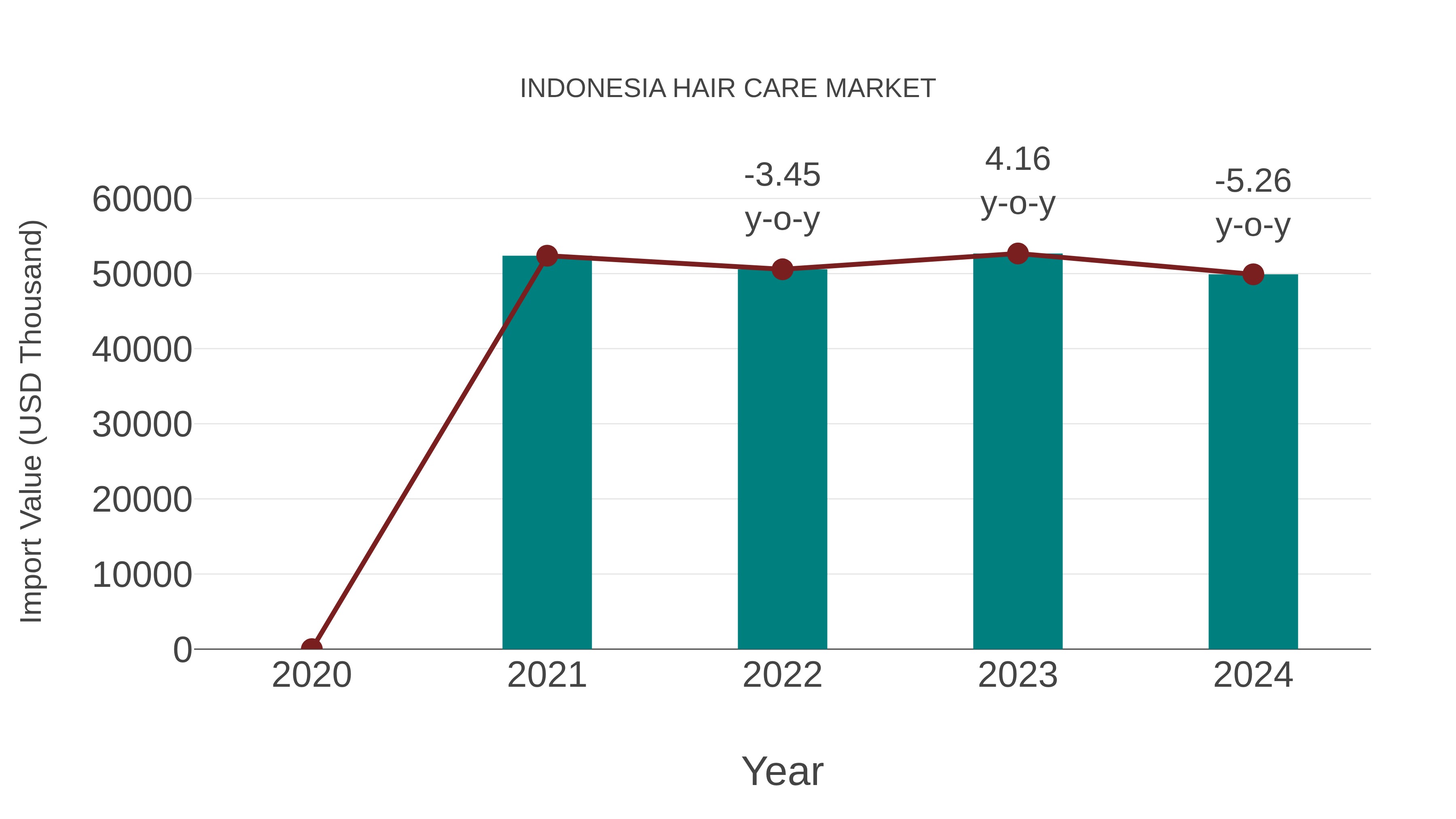
Indonesia Hair Care Market Growth Rate
According to 6Wresearch internal database and industry insights, the Indonesia Hair Care Market is projected to grow at a compound annual growth rate (CAGR) of 6.4% during the forecast period (2026–2032).
Topics Covered in the Indonesia Hair Care Market Report
The Indonesia Hair Care Market report thoroughly covers the market by type, product type, and distribution channel. The report provides a detailed analysis of ongoing market trends, opportunities/high-growth areas, and market drivers that will help stakeholders align strategies based on current and future market dynamics.
Indonesia Hair Care Market Highlights
| Report Name | Indonesia Hair Care Market |
| Forecast Period | 2026–2032 |
| CAGR | 5.6% |
| Growing Sector | Halal-Certified and Hijab-Care Products |
Indonesia Hair Care Market Synopsis
Indonesia Hair Care Market currently reflects steady expansion, supported by growing disposable income, rising beauty consciousness and strong demand for halal organic personal grooming products. Urbanization, a growing middle class and increased awareness of scalp and hair health are strengthening consumption. Some of the trends that are growing in the Indonesia Hair Care Market are the rise of digital salon services, the strong influence of social media, and the growing demand for products with natural ingredients.
Evaluation of Growth Drivers in Indonesia Hair Care Industry
Below are some prominent drivers and their influence on the market dynamics:
| Drivers | Primary Segments Affected | Why It Matters |
| Halal Mandates | By Type (Product) | Mandatory certification ensures 100% compliance for the massive Muslim population. |
| Social Commerce | By Distribution (Online) | Livestream shopping on platforms like TikTok Shop drives impulsive beauty purchases. |
| Hijab-Care Focus | By Product (Shampoo/Oil) | Specialized needs for scalp cooling and hair fall prevention for hijab wearers. |
| Urbanization | By Type (Services) | Increase in professional salon chains in cities such as Jakarta and Surabaya. |
| Natural Ingredients | By Product (Hair Oil) | Traditional use of candlenut and aloe vera is being modernized by tech-led brands. |
Indonesia Hair Care Market is expected to grow at a significant CAGR of 6.4% during the forecast period 2026–2032. The market is driven by rising urban income levels, increasing grooming awareness, and a strong preference for halal and organic hair care products demand. Indonesia Hair Care Market growth is further supported by the rising expansion of e-commerce platforms, growing impact of influencer marketing, and ongoing research and development into natural-ingredient-based formulations. These innovations are tailored specifically to address local hair and scalp conditions, reflecting a change toward culturally relevant and sustainable beauty solutions across Indonesia.
Evaluation of Restraints in Indonesia Hair Care Market
Below are some prominent restraints and their influence on the market dynamics:
| Restraints | Primary Segments Affected | What This Means |
| Complex Logistics | By Distribution Channel | The archipelagic nature of Indonesia makes distribution to remote islands expensive. |
| Strict BPOM Rules | By Type (Product) | Stringent safety testing procedures by the Food and Drug Authority may cause delays in the launch of new products. |
| Price Sensitivity | By Product Type (Premium) | Fluctuations in raw material prices may cause the company to increase prices, which may not appeal to price-sensitive consumers. |
| Counterfeit Goods | By Distribution (Online) | Unregulated sellers on marketplaces can damage brand reputation with fake products. |
| Ad Fatigue | By Type (Services) | Frequent exposure to salon advertisements in the main cities might result in a drop in the conversion rate. |
Indonesia Hair Care Market Challenges
In the Indonesia Hair Care Market, local and international brands face intense competition and pressure to differentiate. Complex supply chain logistics across Indonesia vast archipelago, along with strict halal certification requirements, present further challenges. Additionally, regional disparities in consumer awareness hinder demand standardisation and brand loyalty, making it difficult for companies to establish consistent nationwide market penetration.
Indonesia Hair Care Market Trends
There are various emerging trends shaping the landscape of Indonesia Hair Care Market:
- “Skinification” of Hair Care: With shampoo, scalp exfoliation, night serums, etc. becoming part of more customers’ daily routines just as beauty products have for years now.
- Hyper-local Herbalism: Using traditional Indonesian herbs like false daisy (Urang Aring) and candlenut (Kemiri) in more widely used and visually attractive ways.
- Virtual Hair Color Try-Ons: Using Augmented Reality in e-commerce mobile applications allows customers to visualize new hair colors prior to purchasing products, decreasing customer “risk” of coloring their own hair.
Investment Opportunities in the Indonesia Hair Care Market
Here are the major investment opportunities in the Indonesia Hair Care Market:
- Men Grooming Market: Men’s grooming is starting to become more mainstream and as such male-specific hair products (e.g. beard oil, anti-thinning treatments) will benefit greatly from growth due to increased awareness of vanity amongst males.
- Scalp Technology Solutions: There is a clear gap in the marketplace for good quality, affordable, AI-based scalp analyzers that can give personalized product recommendations at retail outlets.
- Sustainable Packaging: With the push by the government to create a “Green Indonesia,” there are good investment opportunities in fuel pouches and other environmentally friendly alternatives to traditional sachets.
- Salon Franchising in Tier 2 Cities: An expanding number of professional salon services in rapidly growing cities (e.g. Medan).
Top 5 Leading Players in the Indonesia Hair Care Market
Below is a list of prominent companies leading the Indonesia Hair Care Market share:
1. RK Marble
| Company Name | RK Marble |
|---|---|
| Established Year | 1989 |
| Headquarters | Udaipur, Rajasthan |
| Official Website | Click Here |
A global leader in the marble industry, famously known for its high-volume production and ownership of significant quarries. The company is a pioneer in bringing international marble varieties to India while maintaining a strong domestic presence.
2. ARO Granite Industries Ltd.
| Company Name | ARO Granite Industries Ltd. |
|---|---|
| Established Year | 1988 |
| Headquarters | Hosur, Tamil Nadu |
| Official Website | Click Here |
One of India's largest exporters of granite tiles and slabs. The company operates state-of-the-art processing plants and caters primarily to the international market with premium quality finishes.
3. Pokarna Limited
| Company Name | Pokarna Limited |
|---|---|
| Established Year | 1991 |
| Headquarters | Secunderabad, Telangana |
| Official Website | Click Here |
A major player in the granite segment, known for its wide range of colors and finishes. They also have a significant presence in the engineered stone market through their subsidiary, Pokarna Engineered Stone Limited.
4. Stonex India Pvt. Ltd.
| Company Name | Stonex India Pvt. Ltd. |
|---|---|
| Established Year | 2001 |
| Headquarters | New Delhi |
| Official Website | - |
A premium brand specializing in luxury marble and exotic stones. They are known for their curated collections and high-end retail galleries that target the luxury residential and hospitality segments.
5. Mumal Marbles Pvt. Ltd.
| Company Name | Mumal Marbles Pvt. Ltd. |
|---|---|
| Established Year | 1988 |
| Headquarters | Udaipur, Rajasthan |
| Official Website | Click Here |
A vertically integrated company involved in the mining, processing, and export of green marble and other natural stones, maintaining a strong foothold in the international supply chain.
Government Regulations in the Indonesia Hair Care Market
The Indonesian government mandates halal certification via MUI and BPOM, effective since 2019, ensuring all cosmetics, including hair care products, meet Islamic ethical standards. The Halal Product Assurance Law (Law No. 33/2014) and subsequent regulations promote safe consumption and support market trust. Regulatory support for digital trade and e commerce via the Omnibus Law accelerates market growth, while campaigns by health authorities raise awareness on scalp hygiene, indirectly supporting product demand.
Future Insights of the Indonesia Hair Care Market
The Indonesia Hair Care Market is expected to grow through rising demand for customized and eco-friendly products. Consumers are showing more interest in natural and halal-certified ingredients. Companies are emphasizing products that cater to the hair requirements of the local community. Furthermore, businesses are employing innovative approaches to consumer engagement, such as virtual consultations and adaptable subscription services.This is primarily due to the enhancement of logistics. However, the ability to maintain a balance between affordability and innovation while simultaneously adhering to the rigorous regulatory requirements will be the determining factor in achieving success.
Market Segmentation Analysis
The report offers a comprehensive study of the subsequent market segments and their leading categories.
Hair Care Products to Dominate the Market – By Type
According to Mohit, Senior Research Analyst, 6Wresearch, the product segment dominates the Indonesia Hair Care Market share due to consistent consumer preference for tangible, over-the-counter solutions for daily grooming. Urban and semi, urban consumers are becoming increasingly engaged with the new products, thanks to the continuous changes in the formulations and packaging. These new products have thus become the chosen segment in the market.
Shampoo to Dominate the Market – By Product Type
Shampoo is the leader in product type classification, as it satisfies the basic human hair care requirement, i. e., cleanliness and scalp hygiene. Growing awareness of scalp-specific issues and the influx of herbal and sulphate-free shampoos support its fast adoption among various income and age groups.
Key Attractiveness of the Report
- 10 Years of Market Numbers
- Historical Data Starting from 2022 to 2025
- Base Year: 2025
- Forecast Data until 2032
- Key Performance Indicators Impacting the Market
- Major Upcoming Developments and Projects
Key Highlights of the Report:
- Indonesia Hair Care Market Overview
- Indonesia Hair Care Market Outlook
- Market Size of Indonesia Hair Care Market, 2025
- Forecast of Indonesia Hair Care Market, 2032
- Historical Data and Forecast of Indonesia Hair Care Revenues & Volume for the Period 2022-2032F
- Indonesia Hair Care Market Trend Evolution
- Indonesia Hair Care Market Drivers and Challenges
- Indonesia Hair Care Price Trends
- Indonesia Hair Care Porter's Five Forces
- Indonesia Hair Care Industry Life Cycle
- Historical Data and Forecast of Indonesia Hair Care Market Revenues & Volume By Type for the Period 2022-2032F
- Historical Data and Forecast of Indonesia Hair Care Market Revenues & Volume By Product for the Period 2022-2032F
- Historical Data and Forecast of Indonesia Hair Care Market Revenues & Volume By Services for the Period 2022-2032F
- Historical Data and Forecast of Indonesia Hair Care Market Revenues & Volume By Product Type for the Period 2022-2032F
- Historical Data and Forecast of Indonesia Hair Care Market Revenues & Volume By Shampoo for the Period 2022-2032F
- Historical Data and Forecast of Indonesia Hair Care Market Revenues & Volume By Hair Colour for the Period 2022-2032F
- Historical Data and Forecast of Indonesia Hair Care Market Revenues & Volume By Conditioner for the Period 2022-2032F
- Historical Data and Forecast of Indonesia Hair Care Market Revenues & Volume By Hair Styling Product for the Period 2022-2032F
- Historical Data and Forecast of Indonesia Hair Care Market Revenues & Volume By Hair Oil for the Period 2022-2032F
- Historical Data and Forecast of Indonesia Hair Care Market Revenues & Volume By Hair Spray for the Period 2022-2032F
- Historical Data and Forecast of Indonesia Hair Care Market Revenues & Volume By Hair Gel for the Period 2022-2032F
- Historical Data and Forecast of Indonesia Hair Care Market Revenues & Volume By Others for the Period 2022-2032F
- Historical Data and Forecast of Indonesia Hair Care Market Revenues & Volume By Distribution Channel for the Period 2022-2032F
- Historical Data and Forecast of Indonesia Hair Care Market Revenues & Volume By Online Stores for the Period 2022-2032F
- Historical Data and Forecast of Indonesia Hair Care Market Revenues & Volume By Hypermarkets for the Period 2022-2032F
- Historical Data and Forecast of Indonesia Hair Care Market Revenues & Volume By Direct Selling for the Period 2022-2032F
- Indonesia Hair Care Import Export Trade Statistics
- Market Opportunity Assessment By Type
- Market Opportunity Assessment By Product Type
- Market Opportunity Assessment By Distribution Channel
- Indonesia Hair Care Top Companies Market Share
- Indonesia Hair Care Competitive Benchmarking By Technical and Operational Parameters
- Indonesia Hair Care Company Profiles
- Indonesia Hair Care Key Strategic Recommendations
Market Covered
The report offers a comprehensive study of the subsequent market segments:
By Type
- Product
- Services
By Product Type
- Shampoo
- Hair Colour
- Conditioner
By Hair Styling Product
- Hair Oil
- Hair Spray
- Hair Gel
- Others
By Distribution Channel
- Online Stores
- Hypermarkets
- Direct Selling
Indonesia Hair Care Market (2026-2032): FAQs
The Indonesia Hair Care Market is expected to grow at a CAGR of approximately 6.4% during the forecast period (2026-2032).
Urbanization and beauty awareness drives Indonesia Hair Care Market growth.
Price sensitivity, logistics, competition, and compliance with regulations are the major factors limiting the expansion of the Indonesia Hair Care Market.
personalization, influencer impact, and natural ingredient innovation trends are shaping the Indonesia Hair Care Market.
6Wresearch actively monitors the Indonesia Hair Care Market and publishes its comprehensive annual report, highlighting emerging trends, growth drivers, revenue analysis, and forecast outlook. Our insights help businesses to make data-backed strategic decisions with ongoing market dynamics. Our analysts track relevent industries related to the Indonesia Hair Care Market, allowing our clients with actionable intelligence and reliable forecasts tailored to emerging regional needs.
Yes, we provide customisation as per your requirements. To learn more, feel free to contact us on sales@6wresearch.com
| Table of Contents |
| 1. Executive Summary |
| 2. Introduction |
| 2.1. Key Highlights of the Report |
| 2.2. Report Description |
| 2.3. Market Scope & Segmentation |
| 2.4. Research Methodology |
| 2.5. Assumptions |
| 3. Indonesia Hair Care Market Overview |
| 3.1. Indonesia Country Macro Economic Indicators |
| 3.2. Indonesia Hair Care Market Revenues & Volume, 2022 & 2032F |
| 3.3. Indonesia Hair Care Market - Industry Life Cycle |
| 3.4. Indonesia Hair Care Market - Porter's Five Forces |
| 3.5. Indonesia Hair Care Market Revenues & Volume Share, By Type, 2022 & 2032F |
| 3.6. Indonesia Hair Care Market Revenues & Volume Share, By Product Type, 2022 & 2032F |
| 3.7. Indonesia Hair Care Market Revenues & Volume Share, By Distribution Channel, 2022 & 2032F |
| 4. Indonesia Hair Care Market Dynamics |
| 4.1. Impact Analysis |
| 4.2. Market Drivers |
| 4.2.1 Increasing disposable income of consumers in Indonesia leading to higher spending on personal care products. |
| 4.2.2 Growing awareness about hair care products and routines among the Indonesian population. |
| 4.2.3 Rising urbanization and influence of Western beauty trends driving the demand for hair care products in Indonesia. |
| 4.3. Market Restraints |
| 4.3.1 Economic uncertainties impacting consumer purchasing power and preferences. |
| 4.3.2 Presence of counterfeit or low-quality hair care products affecting market growth. |
| 4.3.3 Cultural norms and traditional practices influencing the adoption of modern hair care products. |
| 5. Indonesia Hair Care Market Trends |
| 6. Indonesia Hair Care Market, By Types |
| 6.1. Indonesia Hair Care Market, By Type |
| 6.1.1 Overview and Analysis |
| 6.2.2. Indonesia Hair Care Market Revenues & Volume, By Type, 2022-2032F |
| 6.2.3. Indonesia Hair Care Market Revenues & Volume, By Product, 2022-2032F |
| 6.2.4. Indonesia Hair Care Market Revenues & Volume, By Services, 2022-2032F |
| 6.2. Indonesia Hair Care Market, By Product Type |
| 6.2.1. Overview and Analysis |
| 6.2.2. Indonesia Hair Care Market Revenues & Volume, By Shampoo, 2022-2032F |
| 6.2.3. Indonesia Hair Care Market Revenues & Volume, By Hair Colour, 2022-2032F |
| 6.2.4. Indonesia Hair Care Market Revenues & Volume, By Conditioner, 2022-2032F |
| 6.2.5. Indonesia Hair Care Market Revenues & Volume, By Hair Styling Product, 2022-2032F |
| 6.2.6. Indonesia Hair Care Market Revenues & Volume, By Hair Oil, 2022-2032F |
| 6.2.7. Indonesia Hair Care Market Revenues & Volume, By Hair Spray, 2022-2032F |
| 6.2.8. Indonesia Hair Care Market Revenues & Volume, By Others, 2022-2032F |
| 6.2.9. Indonesia Hair Care Market Revenues & Volume, By Others, 2022-2032F |
| 6.3. Indonesia Hair Care Market, By Distribution Channel |
| 6.3.1. Overview and Analysis |
| 6.3.2. Indonesia Hair Care Market Revenues & Volume, By Online Stores, 2022-2032F |
| 6.3.3 Indonesia Hair Care Market Revenues & Volume, By Hypermarkets, 2022-2032F |
| 6.3.4. Indonesia Hair Care Market Revenues & Volume, By Direct Selling, 2022-2032F |
| 7. Indonesia Hair Care Market Import-Export Trade Statistics |
| 7.1. Indonesia Hair Care Market Export to Major Countries |
| 7.2. Indonesia Hair Care Market Imports from Major Countries |
| 8. Indonesia Hair Care Market Key Performance Indicators |
| 8.1 Number of salons and beauty parlors offering specialized hair care services. |
| 8.2 Growth in online searches for hair care tips and products in Indonesia. |
| 8.3 Percentage of consumers engaging with hair care brands on social media platforms. |
| 8.4 Rate of new product launches and innovations in the Indonesian hair care market. |
| 8.5 Participation in hair care-related events and workshops in Indonesia. |
| 9. Indonesia Hair Care Market - Opportunity Assessment |
| 9.1. Indonesia Hair Care Market Opportunity Assessment, By Type, 2022 & 2032F |
| 9.2. Indonesia Hair Care Market Opportunity Assessment, By Product Type, 2022 & 2032F |
| 9.3. Indonesia Hair Care Market Opportunity Assessment, By Distribution Channel, 2022 & 2032F |
| 10. Indonesia Hair Care Market - Competitive Landscape |
| 10.1. Indonesia Hair Care Market Revenue Share, By Companies, 2025 |
| 10.2. Indonesia Hair Care Market Competitive Benchmarking, By Operating and Technical Parameters |
| 11. Company Profiles |
| 12. Recommendations |
| 13. Disclaimer |
Global Go To Market Strategy - 2030
Export potential enables firms to identify high-growth global markets with greater confidence by combining advanced trade intelligence with a structured quantitative methodology. The framework analyzes emerging demand trends and country-level import patterns while integrating macroeconomic and trade datasets such as GDP and population forecasts, bilateral import–export flows, tariff structures, elasticity differentials between developed and developing economies, geographic distance, and import demand projections. Using weighted trade values from 2020–2024 as the base period to project country-to-country export potential for 2030, these inputs are operationalized through calculated drivers such as gravity model parameters, tariff impact factors, and projected GDP per-capita growth. Through an analysis of hidden potentials, demand hotspots, and market conditions that are most favorable to success, this method enables firms to focus on target countries, maximize returns, and global expansion with data, backed by accuracy.
By factoring in the projected importer demand gap that is currently unmet and could be potential opportunity, it identifies the potential for the Exporter (Country) among 190 countries, against the general trade analysis, which identifies the biggest importer or exporter.
To discover high-growth global markets and optimize your business strategy:
Click Here
Request Primary Research & Report
- Single User License$ 1,995
- Department License$ 2,400
- Site License$ 3,120
- Global License$ 3,795

Leadership Perspectives from Industry Events
Search
6Wresearch in the News
 Forbes
Citing 6Wresearch analytics to map global infrastructure and pharmaceutical industry trajectories.
 Bloomberg Law
Direct syndication of 6Wresearch's macro data points, capturing complex supply chain shifts.
 Reuters
Tracking industrial manufacturing adjustments and electronic security ecosystem scaling.
 Mint
Mint
Utilizing deep-tech sector market sizing to analyze global automation and robotics.
 The Economic Times
Anchoring features on industrial IoT growth metrics and connected smart-grid devices.
 Business Standard
Featuring strategic evaluations of Advanced Driver Assistance Systems (ADAS) and AI road safety.
 The Hindu
Spotlighting core commercial metrics ranging from unmanned aerial vehicles (UAVs) to consumer durables.
 Financial Express
Anchoring quarterly reviews on cross-border real estate tech and structural hardware manufacturing.
 Yahoo Finance
Syndicating the tracker's $30.1 billion untapped-market findings, spotlighting Japan, the US and China as India's top new-potential importers.
 India Today
Carrying the release on smartphones leading India's export potential to $94 billion by 2031, per 6WExportGTM data.
 Dailyhunt
Distributing the tracker findings to its regional readership, framing India's export diversification into Japan and Mexico.
 PR Newswire Original release
Publishing the full India Export Attractiveness Tracker 2026, detailing new trade corridors across iron ore, LCVs and pharmaceuticals.
 The Industrial
Highlighting the tracker's read on India's semiconductor ambitions and long-term chip-assembly export potential.
 PTI News
Reporting on the $66.81 billion pharmaceuticals export opportunity flagged in the tracker, amid looming US generic-drug tariffs.
 Tribune India
Covering the tracker's tariff-versus-regulation analysis across India's mature export markets in the US, China and UAE.
 ANI News
Amplifying the report's findings on polished diamonds, refined petroleum and medicines as India's core export engines.
 International Business Magazine
Covering the report's insight into how AEB, blind spot detection, and driver monitoring are reshaping India's ADAS market.
 Focus Gaming News
Highlighting the research forecast for Egypt's gambling market, projecting steady growth through 2032.
Thought Leadership and Analyst Meet





Our Clients








Latest Reports
- Bahrain Vehicle-Supported Bicycle Drive Chains Market (2026-2032)
- Azerbaijan Vehicle-Supported Bicycle Drive Chains Market (2026-2032)
- Australia Vehicle-Supported Bicycle Drive Chains Market (2026-2032)
- Argentina Vehicle-Supported Bicycle Drive Chains Market (2026-2032)
- Algeria Vehicle-Supported Bicycle Drive Chains Market (2026-2032)
- Zimbabwe Vehicle-Grade Aluminum Materials Market (2026-2032)
- Zambia Vehicle-Grade Aluminum Materials Market (2026-2032)
- Yemen Vehicle-Grade Aluminum Materials Market (2026-2032)
- Vanuatu Vehicle-Grade Aluminum Materials Market (2026-2032)
- Uzbekistan Vehicle-Grade Aluminum Materials Market (2026-2032)
Industry Events and Analyst Meet

EV India Expo 2026

HIMTEX 2026

India Refining Summit 2026

India EV Show 2026

EV tech India Expo 2026
Whitepaper
- Middle East & Africa Commercial Security Market Click here to view more.
- Middle East & Africa Fire Safety Systems & Equipment Market Click here to view more.
- GCC Drone Market Click here to view more.
- Middle East Lighting Fixture Market Click here to view more.
- GCC Physical & Perimeter Security Market Click here to view more.


