Indonesia Home Furniture and Bedding Market Size, Share & Growth Rate
The Indonesia Home Furniture and Bedding Market was estimated at USD 398 Million in 2025 and is projected to reach USD 526 Million by 2032, growing at a CAGR of 4.1% from 2026 to 2032. This growth trajectory is predominantly driven by rising disposable incomes and an expanding middle class, which is increasingly seeking stylish and functional furniture solutions. Furthermore, the surge in urbanization and changing consumer lifestyles are fostering a robust demand for diverse home furnishing options.
Indonesia Home Furniture and Bedding Market Year-wise Growth Rate and Key Drivers
This graph highlights how the Indonesia Home Furniture and Bedding Market has steadily grown over the years, supported by major growth factors.
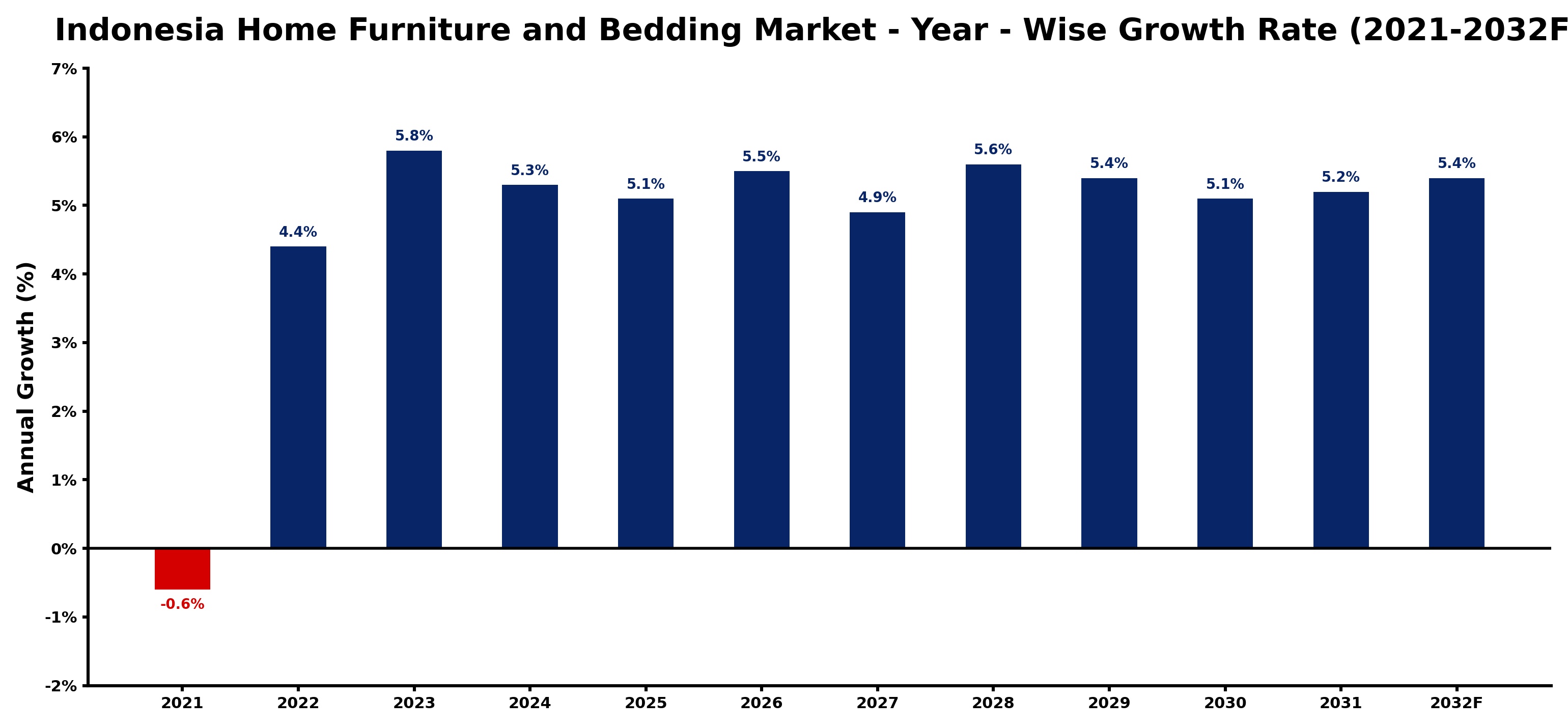
The table below presents the year‑wise growth rates along with the key drivers influencing the market
| Year | Growth Rate | Major Drivers |
| 2021 | -0.6% | Consumer spending decreased significantly |
| 2022 | 4.4% | E-commerce platforms expanded rapidly |
| 2023 | 5.8% | Sustainable materials gained popularity |
| 2024 | 5.3% | Smart home integration enhanced appeal |
| 2025 | 5.1% | Local craftsmanship attracted attention |
| 2026 | 5.5% | Urbanization increased housing demand |
| 2027 | 4.9% | Home renovation projects surged upward |
| 2028 | 5.6% | Design trends influenced purchasing behavior |
| 2029 | 5.4% | Health and wellness focus grew |
| 2030 | 5.1% | Customization options attracted consumers |
| 2031 | 5.2% | Collaborations with designers increased visibility |
| 2032 | 5.4% | International brands entered market |
Note - Market size estimations and growth projections presented in this report are based on 6Wresearch's advanced forecasting approach, validated with industry datasets as of June 2026.
Indonesia Home Furniture and Bedding Market Synopsis
The Indonesia home furniture and bedding market has shown resilience despite recent economic challenges. Recent years have marked a period of steady growth, but the market is now poised for a new phase of expansion driven by innovations in design and material sustainability. The influx of international brands has diversified the offerings, catering to a wider array of consumer preferences.
As consumer awareness of interior design trends rises, the demand for personalized and eco-friendly furnishings is on the upswing. This shift not only reflects a desire for aesthetic appeal but also for products that align with sustainable living principles. As e-commerce continues to reshape the retail landscape, accessibility to various home furnishings will only enhance market growth moving forward.
Indonesia Home Furniture and Bedding Market Key Takeaways
- The market is experiencing significant growth due to a burgeoning middle class with increased purchasing power.
- Trends towards eco-friendly materials and customizable designs are reshaping consumer preferences.
- Rising e-commerce sales are facilitating access to a broader range of home furniture and bedding options.
- High demand for multi-functional and space-saving designs is prevalent in urban areas.
- Innovation and competition in product offerings are essential for capturing the evolving market segment.
Evaluation of Restraints in Indonesia Home Furniture and Bedding Market
While the Indonesia home furniture and bedding market is poised for growth, several constraints remain. Economic uncertainty due to the aftermath of the COVID-19 pandemic has led to low consumer confidence. Many potential buyers are hesitant to make significant purchases, opting instead to delay decisions. Moreover, competition from affordable imported goods presents a challenge for local manufacturers, who must differentiate themselves in a crowded market. Rising labor costs also complicate the landscape, as manufacturers strive to maintain profitability without passing excessive costs onto consumers.
Indonesia Home Furniture and Bedding Market Trends
Emerging trends within the Indonesia home furniture and bedding market highlight a growing consumer preference for durable and sustainable materials such as bamboo, rattan, and solid wood. Additionally, the integration of smart technology into furniture design is gaining traction, appealing to the tech-savvy urban consumer. Another significant trend is the rise of customizable and modular designs that cater to the needs of small living spaces, reflecting the realities of urban living.
Indonesia Home Furniture and Bedding Market Opportunities
Significant opportunities are arising in the Indonesia home furniture and bedding market for both existing and new entrants. With a growing middle class, manufacturers can tap into a consumer base eager for stylish yet affordable furnishings. The increasing popularity of online shopping presents an avenue for brands to reach consumers directly, circumventing traditional retail limitations. Furthermore, eco-friendly products are poised to capture the attention of environmentally conscious shoppers, making sustainability a key area for innovation and investment.
Government Initiatives in the Indonesia Home Furniture and Bedding Market
The Indonesian government has been supportive of the furniture industry through various initiatives aimed at boosting domestic production and exports. Policies encouraging the use of local materials and craftsmanship are in place to enhance the competitiveness of local manufacturers. Additionally, government-backed trade exhibitions and promotional events help to highlight Indonesia's furniture potential on a global stage, attracting international buyers and fostering collaborations.
Future Insights of the Indonesia Home Furniture and Bedding Market
Looking ahead to 2026-2032, the Indonesia home furniture and bedding market is set to experience notable shifts. As urbanization continues and consumer preferences evolve, companies that prioritize sustainable practices and innovative design will likely excel. The integration of technology into home furnishings will create further opportunities for differentiation. Anticipating the needs of a younger, more eco-conscious generation will be vital, as this demographic's purchasing habits will shape the market's future landscape.
Indonesia Home Furniture and Bedding Market Latest Developments (May 2025 - June 2026)
Recent developments in the Indonesia home furniture and bedding market indicate a strong shift towards sustainability and customization. Various companies have begun launching lines of eco-friendly furniture that cater to the growing demand for environmentally conscious products. Additionally, e-commerce platforms are expanding, enhancing consumer access to a wide range of products, including stylish accessories and multifunctional furniture. Industry players are increasingly adopting new technologies to streamline production and improve customer engagement.
Indonesia Home Furniture and Bedding Market - Key Attractiveness of the Report
- 10 Years of Market Numbers
- Historical Data Starting from 2022 to 2025
- Base Year: 2025
- Forecast Data until 2032
- Key Performance Indicators Impacting the Market
- Major Upcoming Developments and Projects
Key Highlights of the Report:
- Indonesia Home Furniture and Bedding Market Outlook
- Market Size of Indonesia Home Furniture and Bedding Market, 2025
- Forecast of Indonesia Home Furniture and Bedding Market, 2032
- Historical Data and Forecast of Indonesia Home Furniture and Bedding Revenues & Volume for the Period 2022-2032F
- Indonesia Home Furniture and Bedding Market Trend Evolution
- Indonesia Home Furniture and Bedding Market Drivers and Challenges
- Indonesia Home Furniture and Bedding Price Trends
- Indonesia Home Furniture and Bedding Porter's Five Forces
- Indonesia Home Furniture and Bedding Industry Life Cycle
- Historical Data and Forecast of Indonesia Home Furniture and Bedding Market Revenues & Volume By Product Type for the Period 2022-2032F
- Historical Data and Forecast of Indonesia Home Furniture and Bedding Market Revenues & Volume By Sofa for the Period 2022-2032F
- Historical Data and Forecast of Indonesia Home Furniture and Bedding Market Revenues & Volume By Bed for the Period 2022-2032F
- Historical Data and Forecast of Indonesia Home Furniture and Bedding Market Revenues & Volume By Chair for the Period 2022-2032F
- Historical Data and Forecast of Indonesia Home Furniture and Bedding Market Revenues & Volume By Cupboard for the Period 2022-2032F
- Historical Data and Forecast of Indonesia Home Furniture and Bedding Market Revenues & Volume By Others for the Period 2022-2032F
- Historical Data and Forecast of Indonesia Home Furniture and Bedding Market Revenues & Volume By Sales Channel for the Period 2022-2032F
- Historical Data and Forecast of Indonesia Home Furniture and Bedding Market Revenues & Volume By Online for the Period 2022-2032F
- Historical Data and Forecast of Indonesia Home Furniture and Bedding Market Revenues & Volume By Offline for the Period 2022-2032F
- Indonesia Home Furniture and Bedding Import Export Trade Statistics
- Market Opportunity Assessment By Product Type
- Market Opportunity Assessment By Sales Channel
- Indonesia Home Furniture and Bedding Top Companies Market Share
- Indonesia Home Furniture and Bedding Competitive Benchmarking By Technical and Operational Parameters
- Indonesia Home Furniture and Bedding Company Profiles
- Indonesia Home Furniture and Bedding Key Strategic Recommendations






































