Indonesia Hotel Furniture Market Summary
The indonesia hotel furniture market was estimated at USD 281 Million in 2025 and is projected to reach USD 371 Million by 2032, growing at a CAGR of 5.4% from 2026 to 2032.
Indonesia Hotel Furniture Market Year-wise Growth Rate and Key Drivers
This graph highlights how the Indonesia Hotel Furniture Market has steadily grown over the past five years, supported by major growth factors.
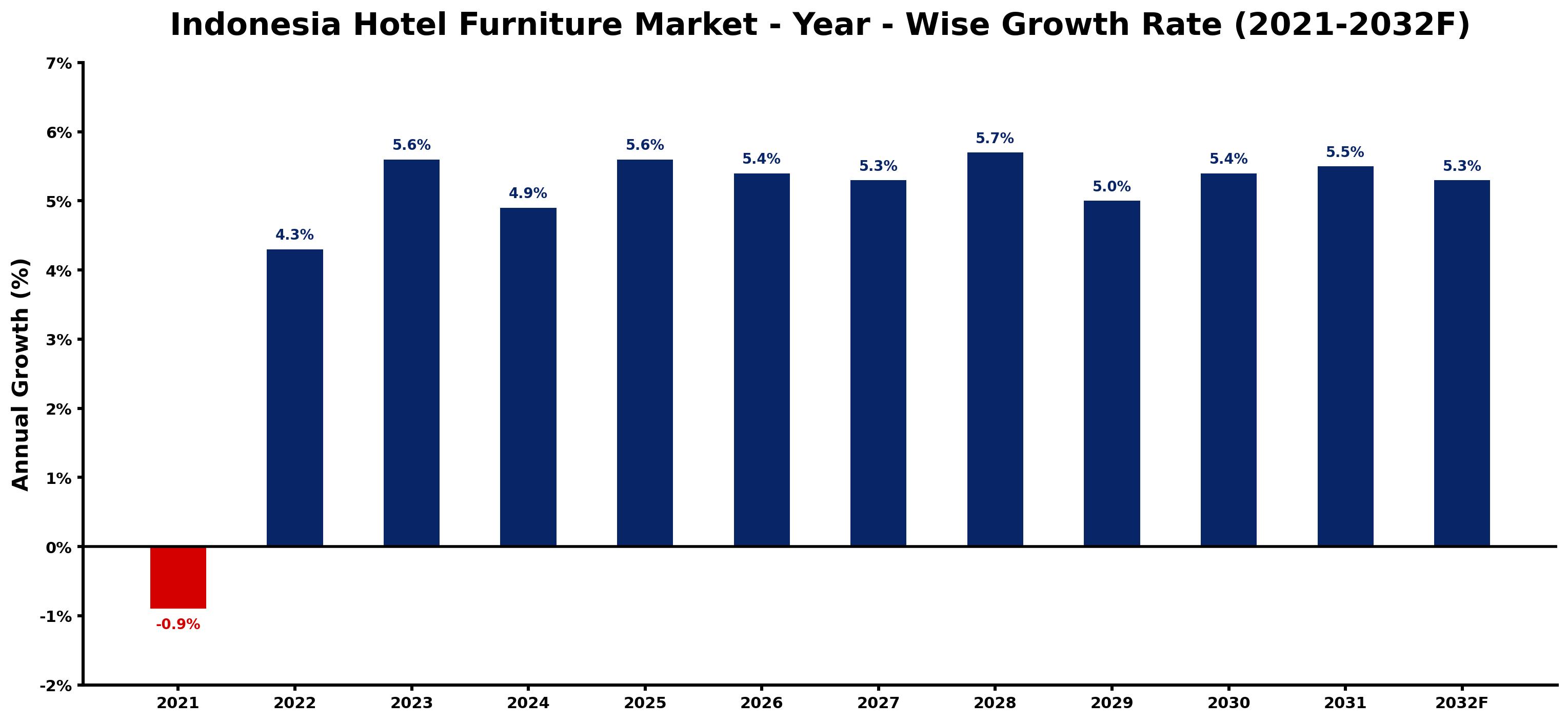
The table below presents the year wise growth rates along with the key drivers influencing the market
| Year | Growth Rate | Major Drivers |
| 2021 | -0.9% | Pandemicrelated travel restrictions significantly diminished hotel occupancy, leading to reduced furniture procurement. |
| 2022 | 4.3% | Increased domestic tourism boosts demand for comfortable and aesthetic hotel furniture. |
| 2023 | 5.6% | Sustainability trends influence hotel owners to choose eco-friendly furniture options. |
| 2024 | 4.9% | Investment in hospitality sector renovation leads to higher furniture procurement budgets. |
| 2025 | 5.6% | Emerging boutique hotels prioritize unique, locally sourced furniture to attract guests. |
| 2026 | 5.4% | Growing middle-class population drives demand for affordable yet stylish hotel amenities. |
| 2027 | 5.3% | Technological advancements lead to the incorporation of smart furniture solutions. |
| 2028 | 5.7% | Increased international collaborations enhance design standards within the local market. |
| 2029 | 5.0% | Government policies promoting tourism create more opportunities for hotel developments. |
| 2030 | 5.4% | Cultural shifts towards wellness tourism influence the selection of functional furniture. |
| 2031 | 5.5% | Digital platforms streamline procurement processes for hotel furniture suppliers. |
| 2032 | 5.3% | Collaborative design approaches become popular, emphasizing regional craftsmanship in hotel interiors. |
Note - Market size estimations and growth projections presented in this report are based on 6Wresearch's advanced forecasting approach, validated with industry datasets as of June 2026.
Indonesia Hotel Furniture Market Synopsis
The Indonesia Hotel Furniture Market is projected to reach 5.4% and witness significant growth during the forecast period (2026-2032). This growth trajectory is primarily driven by escalating tourism activities, increased investments in hospitality services, and rising disposable income levels among the population. As the tourism sector flourishes, the demand for high-quality, modern hotel furniture becomes increasingly critical for enhancing guest experiences. Furthermore, the Indonesian government's favorable initiatives aimed at attracting foreign investments in the hospitality sector are contributing to the market's expansion.
Indonesia Hotel Furniture Market Growth Drivers
Central to the growth of the Indonesia Hotel Furniture Market are several interlinked factors that create a conducive environment for business. First, the surge in tourism over recent years has significantly heightened the need for hotels and accommodations, subsequently increasing the demand for furniture solutions. Secondly, rising investment in hospitality services has propelled the growth of hotels and resorts that require modern furniture to meet the expectations of international travelers.
- Increased tourism has been a pivotal factor in shaping the Indonesia Hotel Furniture Market, with soaring visitor numbers leading to a higher demand for lodging facilities.
- Growing disposable income levels among Indonesians and foreign travelers enhance the purchasing power, prompting hotels to invest in premium furniture to elevate guest comfort and satisfaction.
- Technological advancements in furniture design and manufacturing processes allow for the production of stylish, durable, and cost-effective solutions that resonate well with modern hospitality trends.
- Customizability in furniture offerings has gained traction, with manufacturers focusing on tailoring designs to meet the specific preferences of hotel operators and guests alike.
- The establishment of new luxury hotels and resorts, especially in tourist hotspots, is further amplifying the demand for sophisticated hotel furniture solutions.
Indonesia Hotel Furniture Market Challenges and Restraints
Despite the promising growth outlook for the Indonesia Hotel Furniture Market, several challenges may impede progress. One of the primary concerns includes fluctuations in raw material prices which can significantly affect production costs. Additionally, the increasing competition from local and international manufacturers necessitates continuous innovation and quality improvement to maintain market share.
- Raw material cost volatility can lead to unpredictable pricing strategies, impacting manufacturers' profit margins and project feasibility.
- The saturation of the market in certain regions may result in price wars, limiting profitability for manufacturers and suppliers.
- Adapting to shifting consumer preferences can be challenging, as hotels may seek unique, innovative designs that meet the evolving expectations of guests.
- Sustainability concerns and regulatory pressures to use eco-friendly materials can impose additional constraints on manufacturers.
- Supply chain disruptions, particularly those arising from global events, can hinder the timely delivery of essential materials and components.
Indonesia Hotel Furniture Market Government Investment and Initiatives
The Indonesian government has taken strategic steps to boost the hotel furniture market through various investment initiatives and policy frameworks. Effective measures include the provision of tax exemptions for foreign investors entering the hospitality sector, aiming to enhance the quality and quantity of accommodations available. Infrastructure development projects, such as improving transportation links and public amenities, have been prioritized to stimulate tourist inflows and, consequently, hotel expansions.
- The government has simplified the regulatory environment for foreign investments, eliminating barriers that might deter entry into the hospitality industry.
- Investment in infrastructure has created a ripple effect in the hotel furniture sector, as improved connectivity encourages hotel developments across the archipelago.
- Policies promoting sustainable tourism have led to an increase in eco-friendly furniture projects that align with broader environmental goals.
- Collaboration with industry stakeholders to enhance vocational training programs has improved the skill sets available in the local workforce, benefiting the furniture manufacturing sector.
- Incentives for innovation within the sector encourage manufacturers to adopt advanced technologies for furniture production, thereby enhancing competitiveness.
Indonesia Hotel Furniture Market Latest Developments (May 2025 - June 2026)
Recent developments in the Indonesia Hotel Furniture Market from May 2025 to June 2026 have indicated a heightened focus on customization and sustainability. Manufacturers are increasingly investing in research and development to create eco-friendly materials catered to the hospitality industry. This trend aligns with the growing consumer consciousness regarding environmental issues. Additionally, collaborations among suppliers and designers are becoming more common as industry stakeholders aim to provide tailored solutions for hotels. There is also a marked interest in integrating technology into furniture, with smart furniture concepts gaining traction to enhance guest experiences.
Indonesia Hotel Furniture Market - Key Attractiveness of the Report
- 10 Years of Market Numbers
- Historical Data Starting from 2022 to 2025
- Base Year: 2025
- Forecast Data until 2032
- Key Performance Indicators Impacting the Market
- Major Upcoming Developments and Projects
Key Highlights of the Report:
- Indonesia Hotel Furniture Market Outlook
- Market Size of Indonesia Hotel Furniture Market, 2025
- Forecast of Indonesia Hotel Furniture Market, 2032F
- Historical Data and Forecast of Indonesia Hotel Furniture Revenues & Volume for the Period 2022-2032F
- Indonesia Hotel Furniture Market Trend Evolution
- Indonesia Hotel Furniture Market Drivers and Challenges
- Indonesia Hotel Furniture Price Trends
- Indonesia Hotel Furniture Porter's Five Forces
- Indonesia Hotel Furniture Industry Life Cycle
- Historical Data and Forecast of Indonesia Hotel Furniture Market Revenues & Volume By Product Types for the Period 2022-2032F
- Historical Data and Forecast of Indonesia Hotel Furniture Market Revenues & Volume By Table and Chairs for the Period 2022-2032F
- Historical Data and Forecast of Indonesia Hotel Furniture Market Revenues & Volume By Hotel Beds for the Period 2022-2032F
- Historical Data and Forecast of Indonesia Hotel Furniture Market Revenues & Volume By Hotel Casegoods for the Period 2022-2032F
- Historical Data and Forecast of Indonesia Hotel Furniture Market Revenues & Volume By Other for the Period 2022-2032F
- Historical Data and Forecast of Indonesia Hotel Furniture Market Revenues & Volume By Applications for the Period 2022-2032F
- Historical Data and Forecast of Indonesia Hotel Furniture Market Revenues & Volume By Business Hotel for the Period 2022-2032F
- Historical Data and Forecast of Indonesia Hotel Furniture Market Revenues & Volume By Luxury Hotel for the Period 2022-2032F
- Historical Data and Forecast of Indonesia Hotel Furniture Market Revenues & Volume By Boutique Hotel for the Period 2022-2032F
- Historical Data and Forecast of Indonesia Hotel Furniture Market Revenues & Volume By Other for the Period 2022-2032F
- Indonesia Hotel Furniture Import Export Trade Statistics
- Market Opportunity Assessment By Product Types
- Market Opportunity Assessment By Applications
- Indonesia Hotel Furniture Top Companies Market Share
- Indonesia Hotel Furniture Competitive Benchmarking By Technical and Operational Parameters
- Indonesia Hotel Furniture Company Profiles
- Indonesia Hotel Furniture Key Strategic Recommendations






































