Indonesia Hydrolysed Flour Market Size, Share & Growth Rate
The Indonesia Hydrolysed Flour Market was estimated at USD 247 Million in 2025 and is projected to reach USD 327 Million by 2032, growing at a CAGR of 4.1% from 2026 to 2032. This growth trajectory is driven primarily by increasing consumer awareness of health and nutrition, alongside a rising demand for alternative flour options in culinary applications. The convergence of health trends with innovative product development is propelling the market forward, offering diverse applications in the food industry.
Indonesia Hydrolysed Flour Market Growth Rate Analysis (2021-2032)
The hydrolysed flour market in Indonesia has rebounded significantly from a minor decline of 0.6% in 2021 to impressive growth rates of 5.8% in 2023 and projected increases of 5.1% in 2024. This upward trend is largely fueled by heightened consumer demand for healthier, high-protein alternatives and substantial investments in food production technologies. As the market matures, the steady rise in demand is bolstered by evolving consumer preferences and advancements in processing techniques. Additionally, supportive government policies aimed at enhancing agricultural sustainability have also contributed to this market’s vigor. Expectations remain positive, with growth anticipated to continue at rates around 5.4% through 2032, driven by infrastructure improvements and a focus on innovation.
Indonesia Hydrolysed Flour Market Year-wise Growth Rate and Key Drivers
This graph highlights how the Indonesia Hydrolysed Flour Market has steadily grown over the past five years, supported by major growth factors.
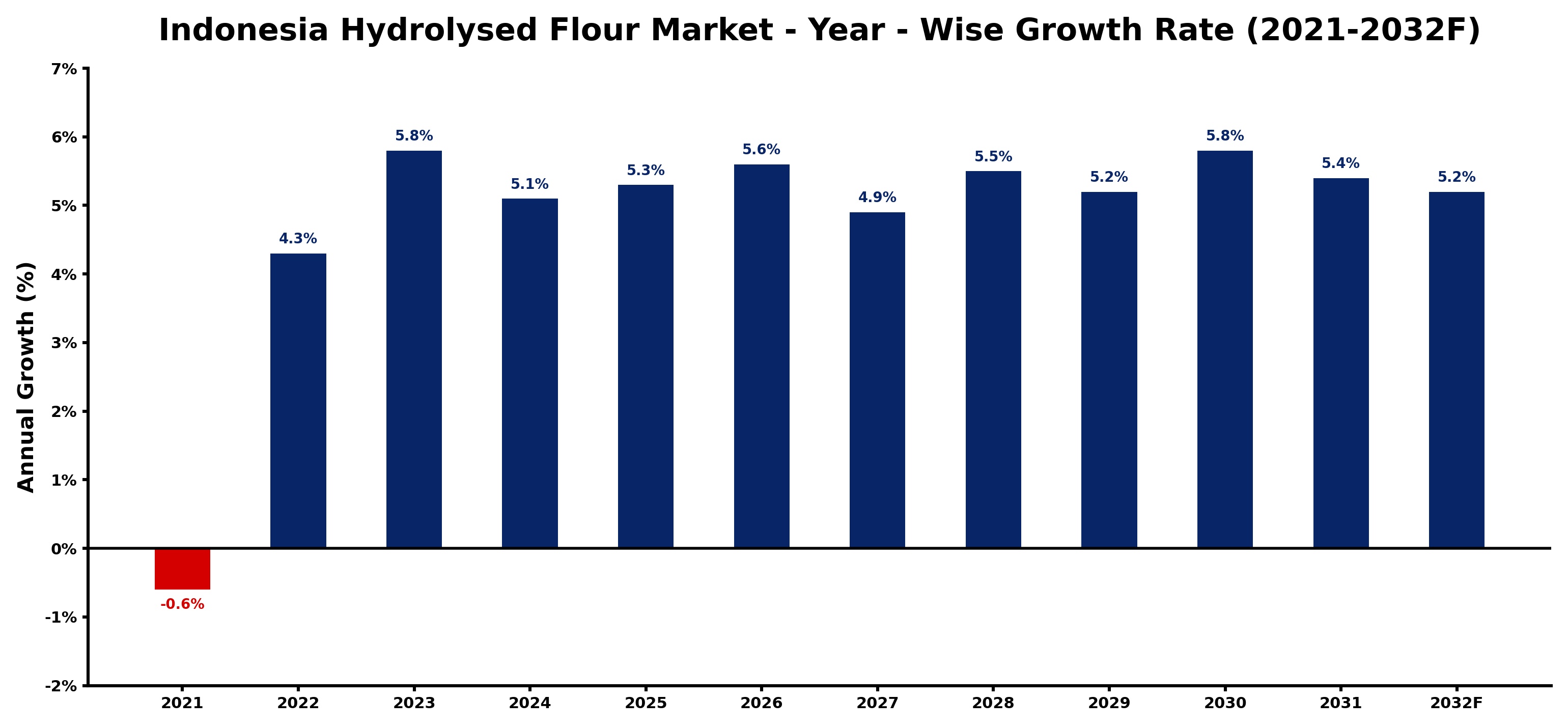
The table below presents the year‑wise growth rates along with the key drivers influencing the market
| Year | Growth Rate | Major Drivers |
| 2021 | -0.6% | Consumer preferences shifted downward |
| 2022 | 4.3% | Health trends supported market growth |
| 2023 | 5.8% | E-commerce platforms expanded reach |
| 2024 | 5.1% | Food innovation attracted new customers |
| 2025 | 5.3% | Export opportunities enhanced market presence |
| 2026 | 5.6% | Nutritional awareness drove demand increase |
| 2027 | 4.9% | Local sourcing gained popularity rapidly |
| 2028 | 5.5% | Sustainability initiatives attracted investments |
| 2029 | 5.2% | Culinary trends influenced product development |
| 2030 | 5.8% | Partnerships with chefs increased visibility |
| 2031 | 5.4% | Market education improved consumer knowledge |
| 2032 | 5.2% | Technological advancements enhanced production efficiency |
Note - Market size estimations and growth projections presented in this report are based on 6Wresearch’s advanced forecasting approach, validated with industry datasets as of June 2026.
Indonesia Hydrolysed Flour Market Synopsis
The Indonesia hydrolysed flour market is witnessing a dynamic transformation, fueled by a burgeoning interest in health-conscious products. Recent momentum has highlighted the shift towards nutrient-rich flour alternatives, as consumers seek healthier options in their diets. Looking ahead, the market is poised for sustained growth as producers expand their offerings to include innovative formulations that cater to evolving consumer preferences.
Emerging trends suggest a shift from traditional wheat flour to hydrolysed varieties, highlighting the growing versatility and nutritional benefits of hydrolysed flour. As local and international players vie for market share, the need for quality assurance and consumer education will become increasingly critical in maintaining a competitive edge.
Indonesia Hydrolysed Flour Market Key Takeaways
- The market is driven by increasing health consciousness among consumers, leading to higher demand for nutritious food products.
- Hydrolysed flour is being recognized as a versatile alternative in various food applications, especially within baking and cooking.
- Technological advancements and product innovations are crucial for manufacturers aiming to expand their offerings in this space.
- Local producers benefit from a growing awareness of hydrolysed flour's nutritional advantages over conventional options.
- Digital marketing platforms are enhancing consumer access to hydrolysed flour products, promoting brand engagement and loyalty.
Evaluation of Restraints in Indonesia Hydrolysed Flour Market
Despite the favorable growth prospects, the Indonesia hydrolysed flour market faces significant challenges. Competition from imported products poses a threat, particularly as these alternatives become more affordable due to currency fluctuations. Additionally, adherence to food safety regulations is a persistent concern, with many producers not complying with necessary manufacturing practices. This could potentially undermine consumer trust. Furthermore, a general lack of awareness surrounding the nutritional benefits of hydrolysed flour compared to traditional flours hampers market growth, necessitating targeted educational initiatives.
Indonesia Hydrolysed Flour Market Trends
Current trends indicate a robust uptick in the utilization of hydrolysed flour in baking and processed food sectors, driven by its favorable nutritional profile. The rise of home baking and cooking, exacerbated by the pandemic, has further propelled demand. Additionally, manufacturers are increasingly exploring eco-friendly packaging and sustainable sourcing practices to appeal to environmentally conscious consumers. Emerging food technologies are also integrating hydrolysed flour into gluten-free and protein-rich products, diversifying its applications across the food spectrum.
Indonesia Hydrolysed Flour Market Opportunities
The Indonesian hydrolysed flour market presents numerous growth and investment opportunities. With health and wellness trends on the rise, there is significant potential for new product development catering to specific dietary needs, such as gluten-free or high-protein options. Collaboration with health professionals to promote awareness could significantly enhance market penetration. Furthermore, expanding distribution channels through e-commerce platforms allows for broader reach and accessibility, positioning hydrolysed flour as a staple ingredient in more households.
Government Initiatives in the Indonesia Hydrolysed Flour Market
The Indonesian government is increasingly focusing on enhancing food security and nutritional standards, which has led to various initiatives aimed at promoting healthier food alternatives. Public programs aimed at improving agricultural practices and encouraging the production of functional food ingredients are set to support the hydrolysed flour market. Incentives for research and development within the food processing industry are also contributing to innovations in hydrolysed flour production, ensuring compliance with health regulations while enhancing product quality.
Future Insights of the Indonesia Hydrolysed Flour Market
Looking towards 2026-2032, the Indonesia hydrolysed flour market is expected to continue its upward trajectory. With the growing inclination towards alternative dietary solutions and a stronger emphasis on health and nutrition, the market's expansion appears promising. Anticipated advances in food technology and consumer education initiatives will likely facilitate deeper market penetration. As competition intensifies, manufacturers that leverage innovation and focus on sustainability will be well-positioned to capitalize on the evolving landscape.
Indonesia Hydrolysed Flour Market Latest Developments (May 2025 - June 2026)
Recent developments in the Indonesia hydrolysed flour market indicate a burgeoning focus on sustainability and health. Many producers are launching new product lines that incorporate hydrolysed flour into functional foods aimed at specific health concerns, such as digestive health and weight management. Moreover, the rise in local partnerships between producers and retailers is improving supply chain efficiencies, ensuring product availability amid growing consumer interest. Digital marketing campaigns are also on the rise, enhancing brand visibility and consumer engagement.
Indonesia Hydrolysed Flour Market - Key Attractiveness of the Report
- 10 Years of Market Numbers
- Historical Data Starting from 2022 to 2025
- Base Year: 2025
- Forecast Data until 2032
- Key Performance Indicators Impacting the Market
- Major Upcoming Developments and Projects
Key Highlights of the Report:
- Indonesia Hydrolysed Flour Market Outlook
- Market Size of Indonesia Hydrolysed Flour Market, 2025
- Forecast of Indonesia Hydrolysed Flour Market, 2032F
- Historical Data and Forecast of Indonesia Hydrolysed Flour Revenues & Volume for the Period 2022-2032F
- Indonesia Hydrolysed Flour Market Trend Evolution
- Indonesia Hydrolysed Flour Market Drivers and Challenges
- Indonesia Hydrolysed Flour Price Trends
- Indonesia Hydrolysed Flour Porter's Five Forces
- Indonesia Hydrolysed Flour Industry Life Cycle
- Historical Data and Forecast of Indonesia Hydrolysed Flour Market Revenues & Volume By Type for the Period 2022-2032F
- Historical Data and Forecast of Indonesia Hydrolysed Flour Market Revenues & Volume By Rice for the Period 2022-2032F
- Historical Data and Forecast of Indonesia Hydrolysed Flour Market Revenues & Volume By Wheat for the Period 2022-2032F
- Historical Data and Forecast of Indonesia Hydrolysed Flour Market Revenues & Volume By Corn for the Period 2022-2032F
- Historical Data and Forecast of Indonesia Hydrolysed Flour Market Revenues & Volume By Others for the Period 2022-2032F
- Historical Data and Forecast of Indonesia Hydrolysed Flour Market Revenues & Volume By Application for the Period 2022-2032F
- Historical Data and Forecast of Indonesia Hydrolysed Flour Market Revenues & Volume By Baby Foods for the Period 2022-2032F
- Historical Data and Forecast of Indonesia Hydrolysed Flour Market Revenues & Volume By Sports Drinks for the Period 2022-2032F
- Historical Data and Forecast of Indonesia Hydrolysed Flour Market Revenues & Volume By Breakfast Cereals for the Period 2022-2032F
- Historical Data and Forecast of Indonesia Hydrolysed Flour Market Revenues & Volume By Bakery for the Period 2022-2032F
- Historical Data and Forecast of Indonesia Hydrolysed Flour Market Revenues & Volume By Snacks for the Period 2022-2032F
- Historical Data and Forecast of Indonesia Hydrolysed Flour Market Revenues & Volume By Others for the Period 2022-2032F
- Indonesia Hydrolysed Flour Import Export Trade Statistics
- Market Opportunity Assessment By Type
- Market Opportunity Assessment By Application
- Indonesia Hydrolysed Flour Top Companies Market Share
- Indonesia Hydrolysed Flour Competitive Benchmarking By Technical and Operational Parameters
- Indonesia Hydrolysed Flour Company Profiles
- Indonesia Hydrolysed Flour Key Strategic Recommendations






































