Indonesia Hydrometer Market Size Growth Rate
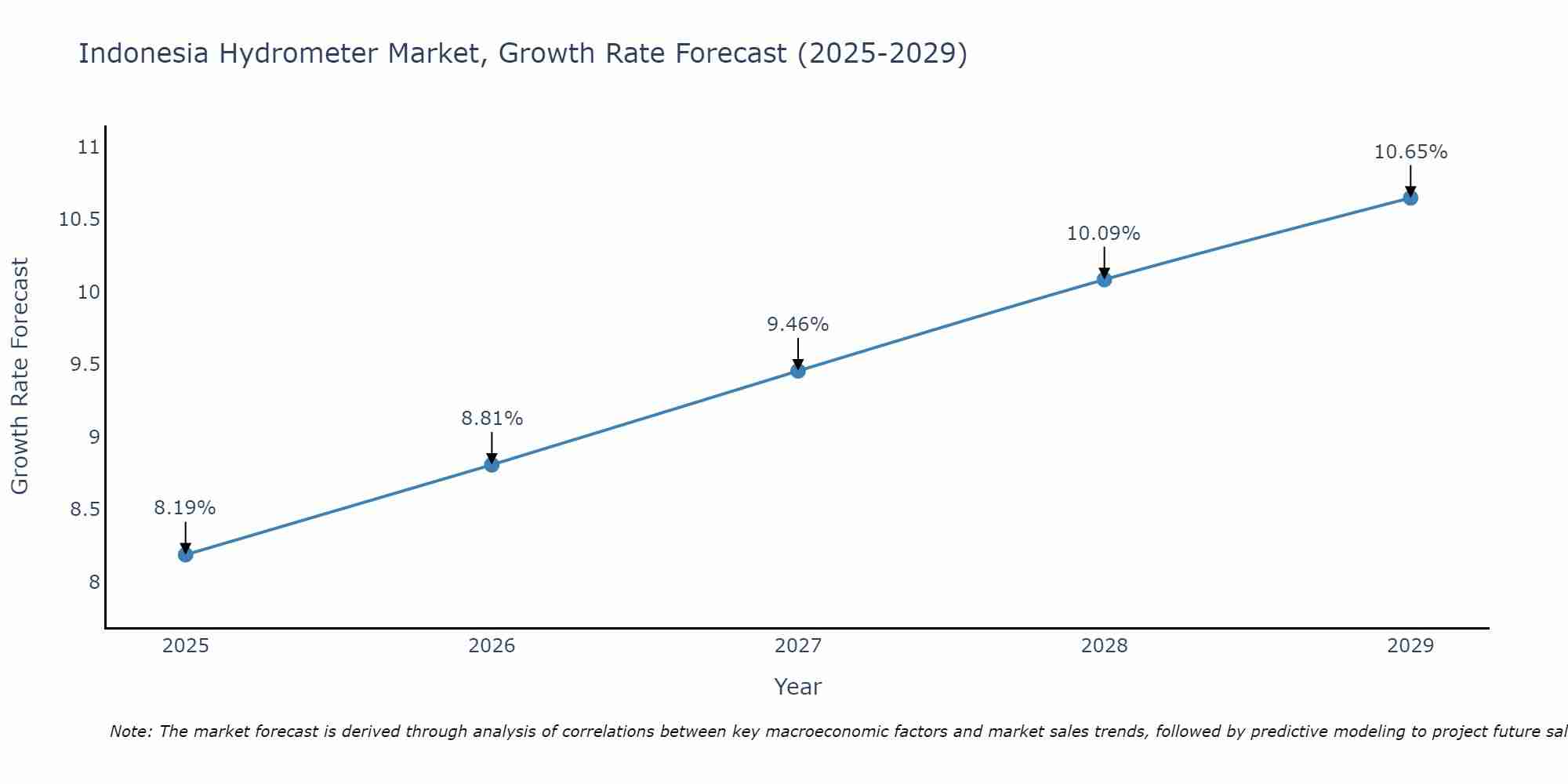
The Indonesia Hydrometer Market is poised for steady growth rate improvements from 2025 to 2029. From 8.19% in 2025, the growth rate steadily ascends to 10.65% in 2029.
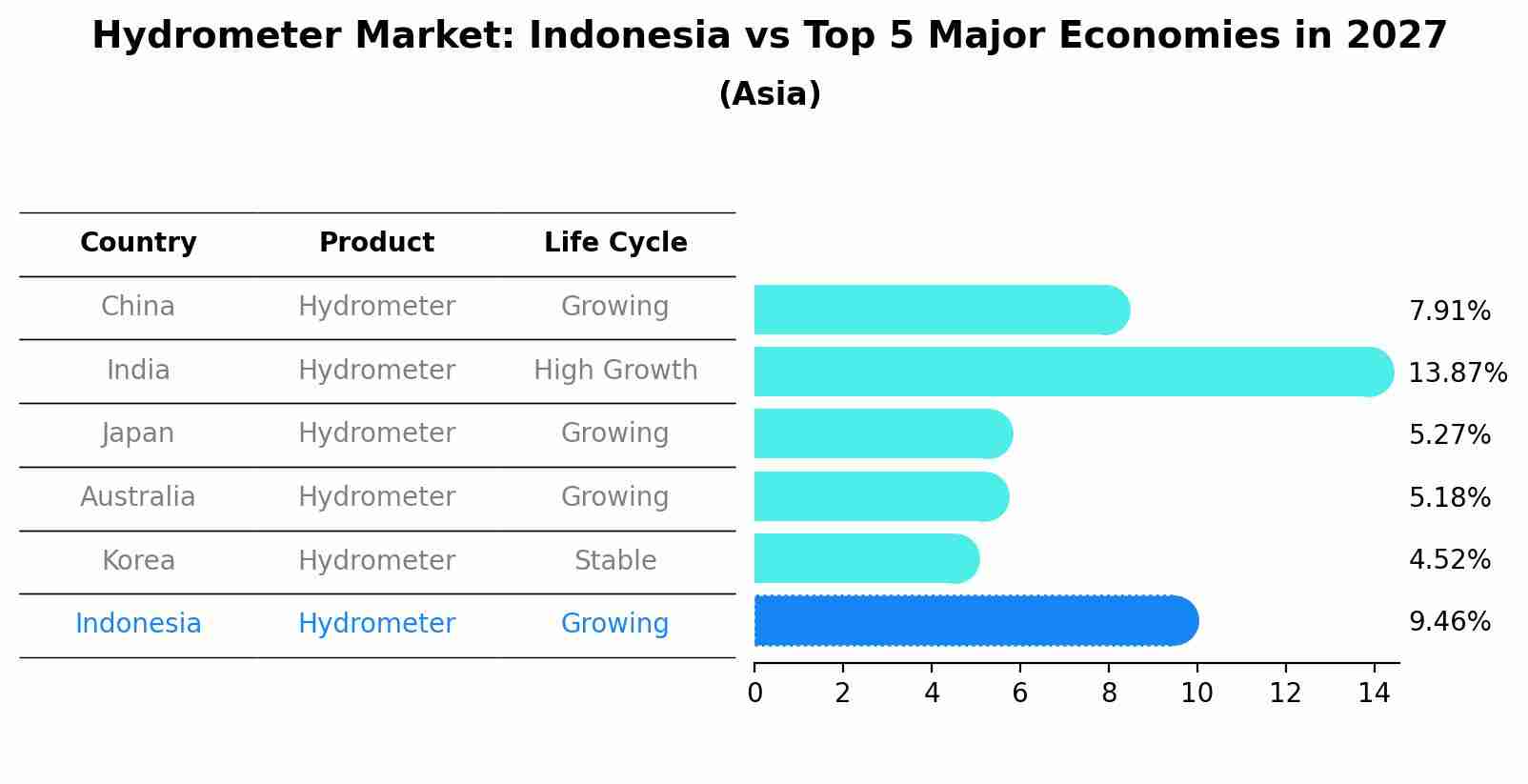
Hydrometer Market: Indonesia vs Top 5 Major Economies in 2027 (Asia)
In the Asia region, the Hydrometer market in Indonesia is projected to expand at a growing growth rate of 9.46% by 2027. The largest economy is China, followed by India, Japan, Australia and South Korea.
Indonesia Hydrometer Market Synopsis
Hydrometers play a critical role in various industries, including chemical, pharmaceutical, and food processing. These devices are used to measure the density of liquids and are essential for quality control and compliance with industry standards. The hydrometer market in Indonesia is poised for growth, primarily due to the expansion of these key sectors. As regulations and quality standards become stricter, the demand for accurate and reliable hydrometers is expected to rise. Market players may focus on developing technologically advanced hydrometers to meet the evolving needs of industries.
Drivers of the Market
The Indonesia Hydrometer market is expected to witness growth primarily driven by the expanding applications in various sectors. The demand for hydrometers is increasing in industries like petrochemicals, food and beverages, pharmaceuticals, and environmental monitoring due to their essential role in measuring the density of liquids. Additionally, the growing importance of accurate quality control processes and compliance with industry standards are driving the adoption of hydrometers. As Indonesia continues to industrialize and regulate its industries, the hydrometer market is likely to see steady growth.
Challenges of the Market
The Hydrometer Market in Indonesia is confronted with challenges related to technological advancements. As industries seek more accurate and automated measurement solutions, traditional hydrometers face the risk of becoming obsolete. Moreover, regulatory compliance and standardization in measurement accuracy pose challenges for manufacturers. Maintaining calibration and precision is crucial, but it can be expensive and time-consuming.
COVID-19 Impact on the Market
The hydrometer market in Indonesia faced disruptions during COVID-19 due to supply chain challenges and decreased laboratory testing. However, as testing and research activities resume, the market is likely to recover. Hydrometers continue to be vital in various industries, including pharmaceuticals, food and beverage, and automotive.
Key Players in the Market
The Indonesia Hydrometer market, essential for measuring the specific gravity of liquids, is characterized by a few key players. Companies like PT. Yamato Indonesia and PT. Pusaco International are prominent in offering hydrometers for various applications, including laboratories, manufacturing, and beverage industries. With a focus on accuracy and reliability, these key players are expected to maintain their strong presence in the market.
Key Highlights of the Report:
- Indonesia Hydrometer Market Outlook
- Market Size of Indonesia Hydrometer Market, 2024
- Forecast of Indonesia Hydrometer Market, 2031
- Historical Data and Forecast of Indonesia Hydrometer Revenues & Volume for the Period 2021-2031
- Indonesia Hydrometer Market Trend Evolution
- Indonesia Hydrometer Market Drivers and Challenges
- Indonesia Hydrometer Price Trends
- Indonesia Hydrometer Porter's Five Forces
- Indonesia Hydrometer Industry Life Cycle
- Historical Data and Forecast of Indonesia Hydrometer Market Revenues & Volume By Scale Type for the Period 2021-2031
- Historical Data and Forecast of Indonesia Hydrometer Market Revenues & Volume By Specific Gravity for the Period 2021-2031
- Historical Data and Forecast of Indonesia Hydrometer Market Revenues & Volume By API Gravity for the Period 2021-2031
- Historical Data and Forecast of Indonesia Hydrometer Market Revenues & Volume By Brix Scale for the Period 2021-2031
- Historical Data and Forecast of Indonesia Hydrometer Market Revenues & Volume By Baume Scale for the Period 2021-2031
- Historical Data and Forecast of Indonesia Hydrometer Market Revenues & Volume By Twaddell scale for the Period 2021-2031
- Historical Data and Forecast of Indonesia Hydrometer Market Revenues & Volume By Others for the Period 2021-2031
- Historical Data and Forecast of Indonesia Hydrometer Market Revenues & Volume By Type for the Period 2021-2031
- Historical Data and Forecast of Indonesia Hydrometer Market Revenues & Volume By Lactometer for the Period 2021-2031
- Historical Data and Forecast of Indonesia Hydrometer Market Revenues & Volume By Alcohol meter for the Period 2021-2031
- Historical Data and Forecast of Indonesia Hydrometer Market Revenues & Volume By Thermohydrometer for the Period 2021-2031
- Historical Data and Forecast of Indonesia Hydrometer Market Revenues & Volume By Urinometer for the Period 2021-2031
- Historical Data and Forecast of Indonesia Hydrometer Market Revenues & Volume By Barkometer for the Period 2021-2031
- Historical Data and Forecast of Indonesia Hydrometer Market Revenues & Volume By Battery Hydrometer for the Period 2021-2031
- Historical Data and Forecast of Indonesia Hydrometer Market Revenues & Volume By Others for the Period 2021-2031
- Historical Data and Forecast of Indonesia Hydrometer Market Revenues & Volume By End-Use for the Period 2021-2031
- Historical Data and Forecast of Indonesia Hydrometer Market Revenues & Volume By Agriculture for the Period 2021-2031
- Historical Data and Forecast of Indonesia Hydrometer Market Revenues & Volume By Petrochemical for the Period 2021-2031
- Historical Data and Forecast of Indonesia Hydrometer Market Revenues & Volume By Pharmaceutical for the Period 2021-2031
- Historical Data and Forecast of Indonesia Hydrometer Market Revenues & Volume By Food & Beverages for the Period 2021-2031
- Historical Data and Forecast of Indonesia Hydrometer Market Revenues & Volume By Others for the Period 2021-2031
- Indonesia Hydrometer Import Export Trade Statistics
- Market Opportunity Assessment By Scale Type
- Market Opportunity Assessment By Type
- Market Opportunity Assessment By End-Use
- Indonesia Hydrometer Top Companies Market Share
- Indonesia Hydrometer Competitive Benchmarking By Technical and Operational Parameters
- Indonesia Hydrometer Company Profiles
- Indonesia Hydrometer Key Strategic Recommendations






































