Indonesia Hypnotics And Sedatives Market Size, Share & Growth Rate
The Indonesia Hypnotics And Sedatives Market was estimated at USD 383 Million in 2025 and is projected to reach USD 507 Million by 2032, growing at a CAGR of 4.1% from 2026 to 2032. This growth trajectory is primarily fueled by a rising incidence of mental health disorders such as anxiety and depression, along with an increasing public focus on sleep health. As the demand for effective prescription medications intensifies, particularly for benzodiazepines, the market is poised for expansion driven by evolving healthcare policies and rising mental health awareness.
Indonesia Hypnotics And Sedatives Market Year-wise Growth Rate and Key Drivers
This graph highlights how the Indonesia Hypnotics And Sedatives Market has steadily grown over the years, supported by major growth factors.
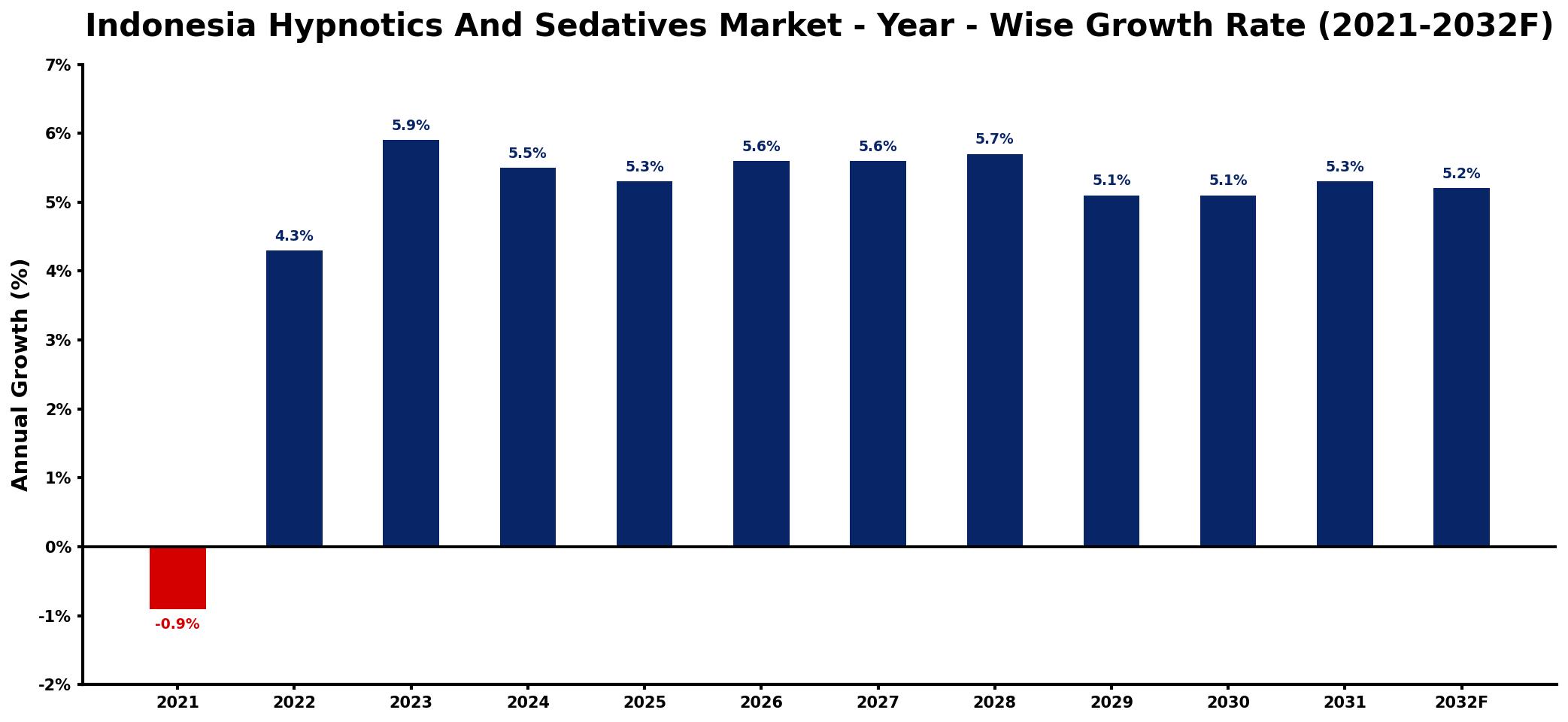
The table below presents the year‑wise growth rates along with the key drivers influencing the market
| Year | Growth Rate | Major Drivers |
| 2021 | -0.9% | decreased consumer spending on health |
| 2022 | 4.3% | rising awareness of mental health |
| 2023 | 5.9% | increased demand for wellness solutions |
| 2024 | 5.5% | growing investment in healthcare innovation |
| 2025 | 5.3% | expansion of online therapy platforms |
| 2026 | 5.6% | increased partnerships with healthcare providers |
| 2027 | 5.6% | growing acceptance of alternative treatments |
| 2028 | 5.7% | enhanced regulatory support for medications |
| 2029 | 5.1% | increased focus on preventive care |
| 2030 | 5.1% | growing regional consumption patterns |
| 2031 | 5.3% | rising prevalence of sleep disorders |
| 2032 | 5.2% | increased consumer spending on wellness |
Note: Market size estimations and growth projections presented in this report are based on 6Wresearch's proprietary forecasting methodology, utilizing the latest available industry data, government publications, and primary research inputs.
Indonesia Hypnotics And Sedatives Market Synopsis
The most significant force currently shaping the Indonesia Hypnotics and Sedatives Market is the escalating prevalence of sleep-related issues, largely attributed to stress and modern lifestyle changes. As healthcare providers become more proactive in addressing these concerns, the availability and acceptance of hypnotics and sedatives are on the rise.
In addition, government initiatives focused on mental health awareness have created a supportive environment for both patients and providers. This push for improved mental wellness services is not only increasing accessibility but also enhancing the market landscape, making it ripe for growth in the coming years.
Indonesia Hypnotics And Sedatives Market Key Takeaways
- The market is witnessing a notable rise in demand due to increased awareness of sleep disorders and related mental health issues.
- Government initiatives aimed at mental health awareness are enhancing the market's growth potential.
- The ongoing evolution in prescribing practices is influenced by the need to manage potential misuse of these medications.
- Healthcare providers are increasingly focusing on effective treatment solutions for anxiety and insomnia, contributing to market growth.
- Telehealth services have become an integral part of prescribing practices post-COVID-19, improving patient access to necessary medications.
Evaluation of Restraints in Indonesia Hypnotics And Sedatives Market
While the market holds substantial promise, several restraints hinder its growth. Regulatory frameworks concerning the prescription of hypnotics and sedatives often emphasize patient safety, which can complicate access to these medications. Additionally, the potential for misuse and addiction poses significant challenges for healthcare providers who must navigate the delicate balance between prescribing responsibly and meeting patient needs. Public awareness campaigns and education about the risks associated with these medications are critical in addressing these concerns and fostering a responsible market environment.
Indonesia Hypnotics And Sedatives Market Trends
Current trends influencing the Indonesia Hypnotics and Sedatives Market include the integration of digital health solutions, such as telehealth services, which have surged during the pandemic. These platforms enable patients to receive consultations and prescriptions remotely, enhancing access and reducing stigma. Additionally, the development of newer formulations and delivery methods for hypnotics and sedatives is also gaining traction, as pharmaceutical companies strive to offer safer and more effective treatment options that cater to the specific needs of the Indonesian population.
Indonesia Hypnotics And Sedatives Market Opportunities
There are numerous growth opportunities within the Indonesia Hypnotics and Sedatives Market. A surge in mental health awareness has opened avenues for innovative treatment options, particularly in telemedicine, which allows for greater patient engagement. Furthermore, collaboration between pharmaceutical companies and healthcare providers can facilitate the introduction of new products tailored to local needs. Investment in research and development of non-addictive alternatives and therapies addressing sleep disorders can also yield significant returns in this evolving market.
Government Initiatives in the Indonesia Hypnotics And Sedatives Market
The Indonesian government has initiated various programs aimed at enhancing mental health services, which indirectly supports the hypnotics and sedatives market. These initiatives include increased funding for mental health awareness campaigns, training for healthcare professionals, and fostering collaborative efforts between public and private sectors. Such policies underscore the government's commitment to improving mental health care access and quality across the nation, creating a favorable environment for market growth.
Future Insights of the Indonesia Hypnotics And Sedatives Market
Looking ahead to the period of 2026-2032, the Indonesia Hypnotics and Sedatives Market is expected to continue on its upward trajectory. This growth will be driven by increasing healthcare investments, broader acceptance of mental health discussions, and the potential for innovative treatment modalities. Furthermore, as the stigma surrounding mental health continues to diminish, the demand for effective sleep and anxiety disorder medications will likely surge, providing a robust landscape for future market players.
Indonesia Hypnotics And Sedatives Market Latest Developments (2025 - 2026)
Recent developments within the Indonesia Hypnotics and Sedatives Market have focused on enhancing patient access to care. With the growing use of telehealth, many healthcare providers have adapted their practices to offer more flexible consultation options. Furthermore, there has been a notable rise in product launches aimed at addressing both sleep disorders and mental health issues, reflecting a shifting market dynamic that prioritizes patient-centered care and innovative treatment approaches.
Indonesia Hypnotics And Sedatives Market - Key Attractiveness of the Report
- 10 Years of Market Numbers
- Historical Data Starting from 2022 to 2025
- Base Year: 2025
- Forecast Data until 2032
- Key Performance Indicators Impacting the Market
- Major Upcoming Developments and Projects
Key Highlights of the Report:
- Indonesia Hypnotics And Sedatives Market Outlook
- Market Size of Indonesia Hypnotics And Sedatives Market, 2025
- Forecast of Indonesia Hypnotics And Sedatives Market, 2032
- Historical Data and Forecast of Indonesia Hypnotics And Sedatives Revenues & Volume for the Period 2022-2032F
- Indonesia Hypnotics And Sedatives Market Trend Evolution
- Indonesia Hypnotics And Sedatives Market Drivers and Challenges
- Indonesia Hypnotics And Sedatives Price Trends
- Indonesia Hypnotics And Sedatives Porter's Five Forces
- Indonesia Hypnotics And Sedatives Industry Life Cycle
- Historical Data and Forecast of Indonesia Hypnotics And Sedatives Market Revenues & Volume By Type for the Period 2022-2032F
- Historical Data and Forecast of Indonesia Hypnotics And Sedatives Market Revenues & Volume By Suppository for the Period 2022-2032F
- Historical Data and Forecast of Indonesia Hypnotics And Sedatives Market Revenues & Volume By Capsule for the Period 2022-2032F
- Historical Data and Forecast of Indonesia Hypnotics And Sedatives Market Revenues & Volume By Solution for the Period 2022-2032F
- Historical Data and Forecast of Indonesia Hypnotics And Sedatives Market Revenues & Volume By Injectable for the Period 2022-2032F
- Historical Data and Forecast of Indonesia Hypnotics And Sedatives Market Revenues & Volume By End-Use for the Period 2022-2032F
- Historical Data and Forecast of Indonesia Hypnotics And Sedatives Market Revenues & Volume By Hospital for the Period 2022-2032F
- Historical Data and Forecast of Indonesia Hypnotics And Sedatives Market Revenues & Volume By Clinic for the Period 2022-2032F
- Indonesia Hypnotics And Sedatives Import Export Trade Statistics
- Market Opportunity Assessment By Type
- Market Opportunity Assessment By End-Use
- Indonesia Hypnotics And Sedatives Top Companies Market Share
- Indonesia Hypnotics And Sedatives Competitive Benchmarking By Technical and Operational Parameters
- Indonesia Hypnotics And Sedatives Company Profiles
- Indonesia Hypnotics And Sedatives Key Strategic Recommendations






































