Indonesia Identity and Access Management Market Size & Growth Rate (2026-2032)
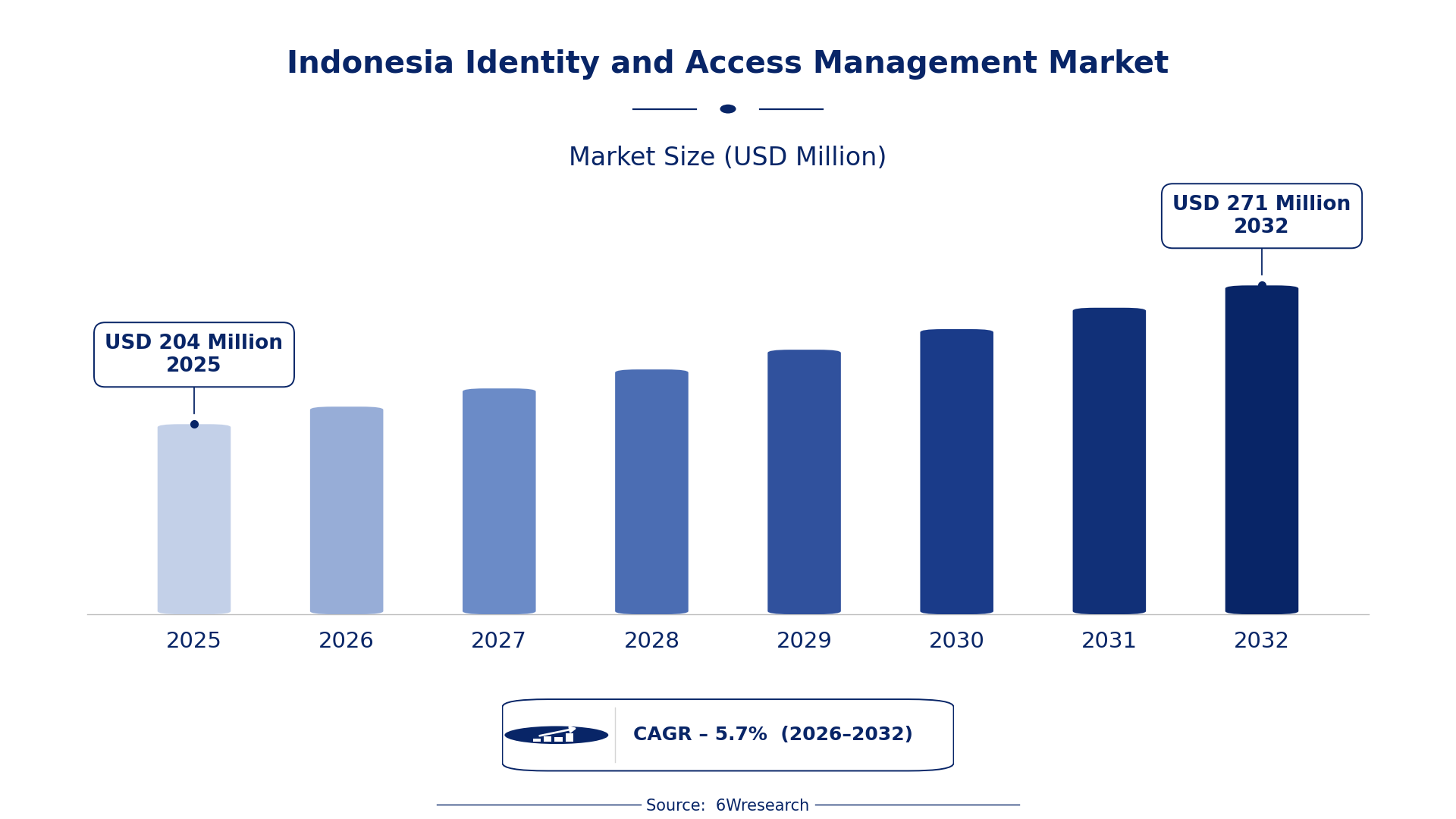
The Indonesia Identity and Access Management Market was estimated at USD 204 Million in 2025 and is projected to reach USD 271 Million by 2032, growing at a CAGR of 5.7% from 2026 to 2032.
Indonesia Identity and Access Management Market Synopsis
The Identity and Access Management (IAM) market in Indonesia is rapidly gaining attention as organizations recognize the necessity of secure digital identity management. With a surge in remote work and digital services, the demand for robust IAM solutions has never been more pressing, especially against the backdrop of escalating cyber threats.
As the Indonesian digital economy expands, IAM systems are evolving to address intricate regulatory compliance and user experience demands. Businesses are prioritizing technologies that not only enhance security but also simplify the user authentication process, ultimately ensuring both privacy and accessibility.
Indonesia Identity and Access Management Market Year-wise Growth Rate and Key Drivers
This graph illustrates the annual growth rates of the Indonesia Identity and Access Management Market from 2021 to 2032, highlighting a steady upward trajectory and projected expansion over the forecast period.
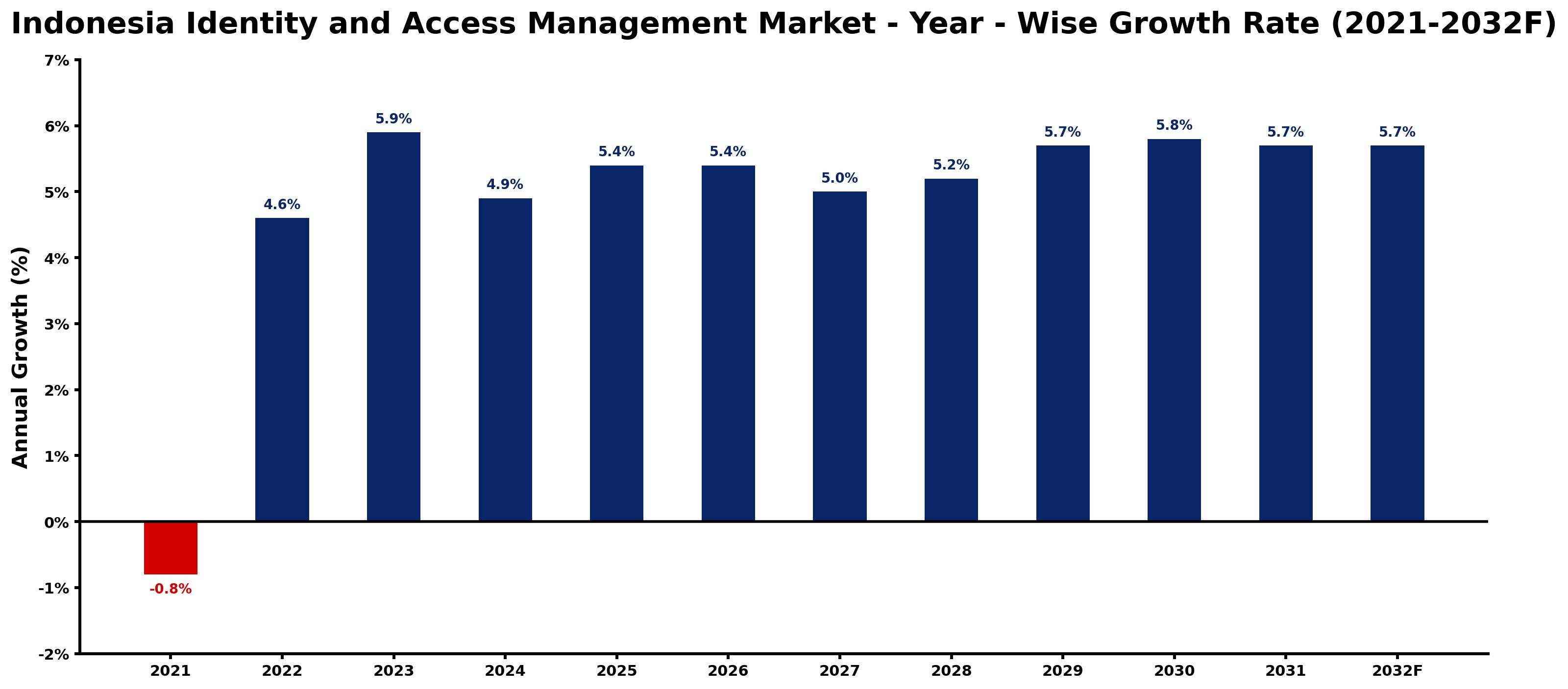
The table below presents the year‑wise growth rates along with the key drivers influencing the market
| Year | Growth Rate | Major Drivers |
| 2021 | -0.8% | Delayed digital transformation initiatives due to COVID-19 |
| 2022 | 4.6% | Government enhancing digital ID framework for citizens |
| 2023 | 5.9% | Increase in cyber threats prompting stronger security measures |
| 2024 | 4.9% | Rise in fintech solutions requires stringent access controls |
| 2025 | 5.4% | Growing cloud adoption drive for identity management tools |
| 2026 | 5.4% | Regulatory compliance necessitating updated identity verification processes |
| 2027 | 5.0% | Surge in remote work boosting authentication service demand |
| 2028 | 5.2% | Growing digital payments ecosystem needing robust access solutions |
| 2029 | 5.7% | Government initiative to bolster cybersecurity in businesses |
| 2030 | 5.8% | Expansion in digital services necessitating user identity management |
| 2031 | 5.7% | Increasing investments in tech startups driving identity technology |
| 2032 | 5.7% | Collaborations between banks and IAM providers for security |
Note: Market size estimations and growth projections presented in this report are based on 6Wresearch's proprietary forecasting methodology, utilizing the latest available industry data, government publications, and primary research inputs.
Indonesia Identity and Access Management Market Key Takeaways
Below are some of the specific key takeaways from the market, including:
- The growing emphasis on cybersecurity has catalyzed investments in IAM solutions across sectors.
- Organizations are increasingly seeking solutions that balance security with user convenience.
- Regulatory compliance is pushing firms to adopt IAM technologies that align with local and international standards.
- The pandemic has accelerated the shift towards remote access and digital services, reshaping IAM demand.
- Technological advancements continue to drive innovation within the IAM sector, particularly in identity verification processes.
Evaluation of Restraints in Indonesia Identity and Access Management Market
Despite the increasing demand for IAM solutions, several real constraints hinder market growth. A major concern is the challenge of implementing user-friendly security measures without compromising the integrity of authentication processes. Many organizations grapple with integrating new IAM systems into their existing frameworks, leading to potential disruptions. Additionally, budget constraints often limit the capabilities organizations can invest in, making it difficult for them to keep pace with rapidly evolving threats.
Indonesia Identity and Access Management Market Trends
The market is witnessing trends such as the rising adoption of cloud-based IAM solutions, offering flexibility and scalability to organizations. Additionally, there's an increasing shift toward multi-factor authentication, enhancing security against unauthorized access. The incorporation of AI and machine learning in IAM tools is beginning to streamline processes and improve accuracy in user identity verification. Furthermore, organizations are focusing on developing user-centric IAM systems that prioritize customer experiences while maintaining stringent security protocols.
Indonesia Identity and Access Management Market Opportunities
As organizations push for digital transformation, significant opportunities exist for IAM providers to create tailored solutions. The need for comprehensive identity verification systems in sectors such as banking, healthcare, and e-commerce presents a lucrative avenue for growth. Additionally, the increased focus on compliance with global data protection regulations opens doors for IAM providers to offer innovative solutions that not only meet local needs but also align with international standards. Furthermore, partnerships with tech firms can enhance service offerings, creating a competitive edge.
Government Initiatives in the Indonesia Identity and Access Management Market
Government policy significantly influences the direction of the IAM market in Indonesia. Regulatory frameworks are increasingly being established to ensure data privacy and cybersecurity, essential in fostering trust among consumers and businesses alike. As cyber threats evolve, public-sector priorities focus on creating secure digital ecosystems that protect sensitive information and promote innovation.
- A national digital infrastructure upgrade programme now in its rollout phase aims to enhance the security framework supporting IAM technologies.
- Current initiatives are focused on establishing regulatory compliance guidelines, set to be finalized by mid-2026, enhancing sector standards.
- A recently launched public-private partnership targets the development of advanced identity verification systems to mitigate rising cyber threats.
- The government is also working on a framework expected to mandate IAM implementation across public services by 2028.
Future Insights of the Indonesia Identity and Access Management Market
Looking ahead to 2026-2032, the IAM market in Indonesia is set to experience substantial growth driven by ongoing digital transformation across industries. As organizations continue to recognize the importance of cybersecurity, we anticipate an increase in demand for advanced IAM solutions that support not just security but also improve user experience. The integration of AI in IAM processes will likely redefine identity verification methodologies, enabling more efficient and secure operations. Furthermore, collaboration among private and public sectors will be key in establishing comprehensive frameworks to tackle emerging cyber threats.
Indonesia Identity and Access Management Market Latest Developments
In the past year, the IAM market in Indonesia has seen a surge in activity, particularly as companies adapt to new security challenges posed by remote work and increased online threats. Developments range from new technological innovations to enhanced regulatory frameworks aimed at tightening security measures for digital identities.
- A major technology vendor announced the launch of a new cloud-based IAM solution in late 2025, enhancing user access control across platforms.
- A public-private initiative that began in early 2025 remains underway, focusing on developing regional identity verification standards.
- A leading cybersecurity firm is currently rolling out an advanced multi-factor authentication solution aimed at enterprises by mid-2026.
- An initiative to upgrade national security protocols for digital identities is expected to commence in Q1 2026.
Indonesia Identity and Access Management Market - Key Attractiveness of the Report
- 10 Years of Market Numbers
- Historical Data Starting from 2022 to 2025
- Base Year: 2025
- Forecast Data until 2032
- Key Performance Indicators Impacting the Market
- Major Upcoming Developments and Projects
Key Highlights of the Report:
- Indonesia Identity and Access Management Market Outlook
- Market Size of Indonesia Identity and Access Management Market, 2025
- Forecast of Indonesia Identity and Access Management Market, 2032
- Historical Data and Forecast of Indonesia Identity and Access Management Revenues & Volume for the Period 2022-2032F
- Indonesia Identity and Access Management Market Trend Evolution
- Indonesia Identity and Access Management Market Drivers and Challenges
- Indonesia Identity and Access Management Price Trends
- Indonesia Identity and Access Management Porter's Five Forces
- Indonesia Identity and Access Management Industry Life Cycle
- Historical Data and Forecast of Indonesia Identity and Access Management Market Revenues & Volume By Component for the Period 2022-2032F
- Historical Data and Forecast of Indonesia Identity and Access Management Market Revenues & Volume By Solutions for the Period 2022-2032F
- Historical Data and Forecast of Indonesia Identity and Access Management Market Revenues & Volume By Services for the Period 2022-2032F
- Historical Data and Forecast of Indonesia Identity and Access Management Market Revenues & Volume By Solution for the Period 2022-2032F
- Historical Data and Forecast of Indonesia Identity and Access Management Market Revenues & Volume By Data Directory for the Period 2022-2032F
- Historical Data and Forecast of Indonesia Identity and Access Management Market Revenues & Volume By Identity Lifecycle Management for the Period 2022-2032F
- Historical Data and Forecast of Indonesia Identity and Access Management Market Revenues & Volume By Deployment Mode for the Period 2022-2032F
- Historical Data and Forecast of Indonesia Identity and Access Management Market Revenues & Volume By Cloud for the Period 2022-2032F
- Historical Data and Forecast of Indonesia Identity and Access Management Market Revenues & Volume By On-premises for the Period 2022-2032F
- Historical Data and Forecast of Indonesia Identity and Access Management Market Revenues & Volume By Organization Size for the Period 2022-2032F
- Historical Data and Forecast of Indonesia Identity and Access Management Market Revenues & Volume By SMEs for the Period 2022-2032F
- Historical Data and Forecast of Indonesia Identity and Access Management Market Revenues & Volume By Large Enterprises for the Period 2022-2032F
- Historical Data and Forecast of Indonesia Identity and Access Management Market Revenues & Volume By Vertical for the Period 2022-2032F
- Historical Data and Forecast of Indonesia Identity and Access Management Market Revenues & Volume By BFSI for the Period 2022-2032F
- Historical Data and Forecast of Indonesia Identity and Access Management Market Revenues & Volume By Travel and Hospitality for the Period 2022-2032F
- Historical Data and Forecast of Indonesia Identity and Access Management Market Revenues & Volume By Healthcare for the Period 2022-2032F
- Historical Data and Forecast of Indonesia Identity and Access Management Market Revenues & Volume By Retail and eCommerce for the Period 2022-2032F
- Historical Data and Forecast of Indonesia Identity and Access Management Market Revenues & Volume By IT and ITeS for the Period 2022-2032F
- Historical Data and Forecast of Indonesia Identity and Access Management Market Revenues & Volume By Education for the Period 2022-2032F
- Historical Data and Forecast of Indonesia Identity and Access Management Market Revenues & Volume By Others (Energy and Utilities, Telecommunication, Other Citizen Services) for the Period 2022-2032F
- Indonesia Identity and Access Management Import Export Trade Statistics
- Market Opportunity Assessment By Component
- Market Opportunity Assessment By Solution
- Market Opportunity Assessment By Deployment Mode
- Market Opportunity Assessment By Organization Size
- Market Opportunity Assessment By Vertical
- Indonesia Identity and Access Management Top Companies Market Share
- Indonesia Identity and Access Management Competitive Benchmarking By Technical and Operational Parameters
- Indonesia Identity and Access Management Company Profiles
- Indonesia Identity and Access Management Key Strategic Recommendations






































