Indonesia Industrial Chain Market: Import Trend Analysis
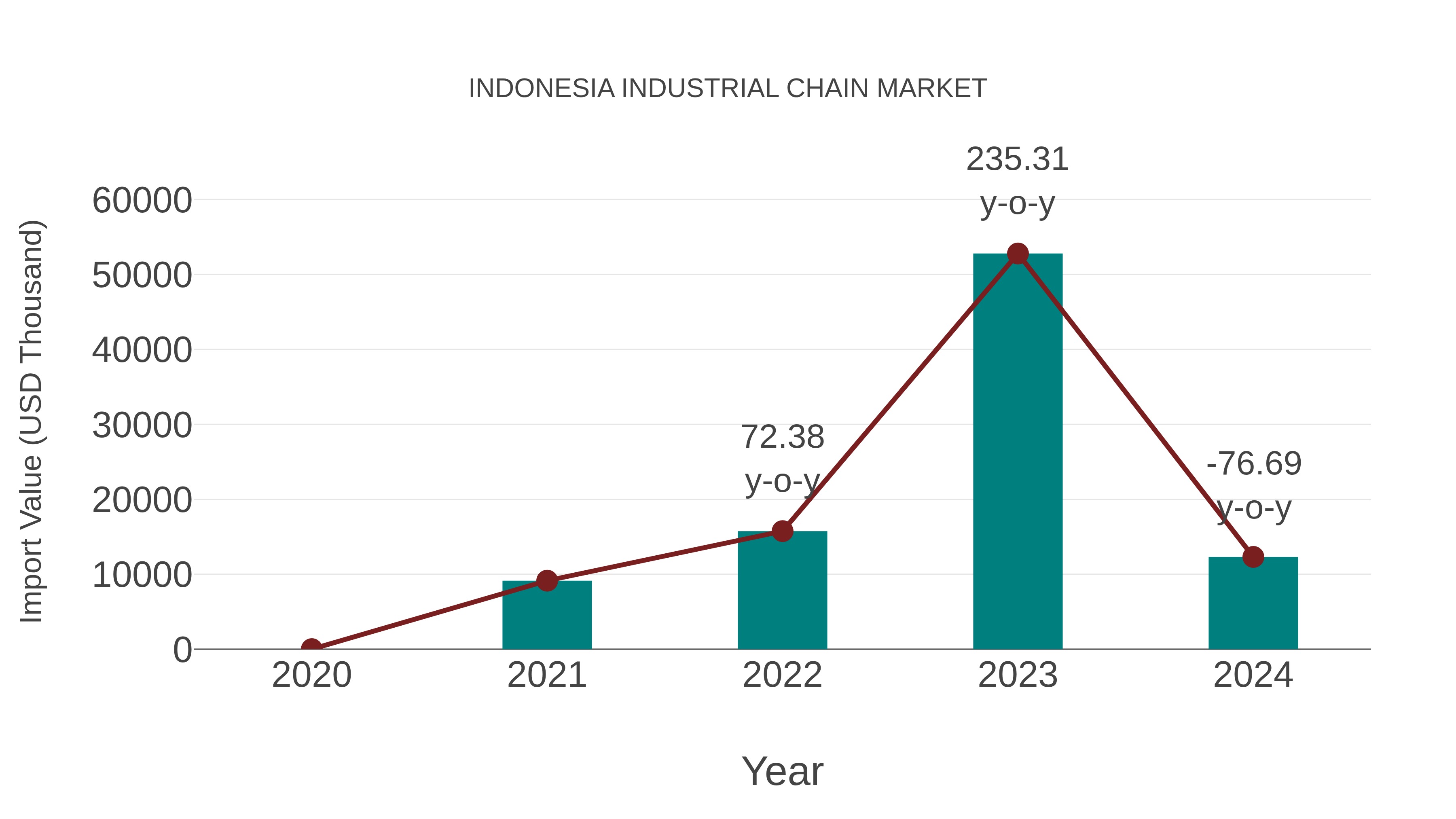
In the Indonesia industrial chain market, the import trend experienced a notable decline from 2023 to 2024, with a growth rate of -76.69%. Despite this, the compound annual growth rate (CAGR) for 2020-2024 stood at 10.44%. This significant drop in import momentum could be attributed to shifts in demand dynamics or adjustments in trade policies impacting market stability.
Indonesia Industrial Chain Market Market Overview
The industrial chain market in Indonesia is diverse and rapidly growing, encompassing various sectors such as manufacturing, agriculture, mining, and construction. The country`s strategic geographical location and abundant natural resources have attracted significant investments, leading to the development of a robust supply chain ecosystem. Key players in the industrial chain market include raw material suppliers, manufacturers, distributors, and retailers, all working together to meet the growing demand both domestically and internationally. Government initiatives to promote industrial growth, coupled with advancements in technology and infrastructure development, are driving further expansion in the sector. However, challenges such as infrastructure bottlenecks, regulatory hurdles, and environmental concerns need to be addressed to sustain long-term growth in Indonesia`s industrial chain market.
Indonesia Industrial Chain Market Trends
In the Indonesia industrial chain market, several key trends are shaping the landscape. One prominent trend is the increasing focus on sustainable and environmentally friendly practices, driven by both government regulations and consumer demand for eco-conscious products. Companies are investing in technologies and processes to reduce waste, energy consumption, and carbon emissions along the industrial chain. Another trend is the rising adoption of digitalization and automation to enhance efficiency and productivity in manufacturing processes. This includes the integration of Internet of Things (IoT) devices, artificial intelligence, and data analytics to optimize operations. Additionally, there is a growing emphasis on supply chain resilience and agility, as businesses seek to mitigate disruptions and uncertainties caused by global events such as the COVID-19 pandemic. Overall, these trends are reshaping the Indonesia industrial chain market towards a more sustainable, efficient, and flexible future.
Indonesia Industrial Chain Market Challenges
In the Indonesia industrial chain market, some challenges faced include supply chain disruptions due to infrastructure limitations and transportation inefficiencies, which can lead to delays and increased costs. Additionally, a lack of skilled labor and workforce productivity issues may impact the overall efficiency and competitiveness of the industrial chain. Regulatory complexities and bureaucratic hurdles can also create barriers to entry and hinder business operations. Moreover, fluctuations in raw material prices, currency exchange rates, and market demand pose additional challenges for companies operating within the industrial chain market in Indonesia. Adapting to rapidly changing technology and digital transformation requirements further complicate the landscape, requiring companies to invest in innovation and upskilling to remain competitive.
Indonesia Industrial Chain Market Investment Opportunities
Investment opportunities in the Indonesia industrial chain market include sectors such as manufacturing, logistics, and infrastructure development. With Indonesia`s growing population and increasing urbanization, there is a rising demand for consumer goods, driving the need for expanded manufacturing capacity. Investing in logistics companies that facilitate the movement of goods within the country can also be lucrative, given Indonesia`s vast archipelago. Additionally, the government`s focus on infrastructure development, such as ports, roads, and airports, presents opportunities for investors in construction and engineering firms. Renewable energy projects and technology advancements in the industrial sector are also areas with potential for growth and investment. Overall, the Indonesia industrial chain market offers diverse opportunities for investors looking to capitalize on the country`s economic growth and development.
Indonesia Industrial Chain Market Government Policy
The Indonesian government has implemented various policies to support and promote the industrial chain market in the country. Key initiatives include the Making Indonesia 4.0 roadmap, which aims to drive the adoption of advanced technologies in the manufacturing sector, such as automation, Internet of Things (IoT), and artificial intelligence. Additionally, the government has launched the Indonesia Industry 4.0 Readiness Index to assess and improve the readiness of industries to embrace digitalization. To attract investments and boost competitiveness, the government offers incentives and tax breaks to companies engaged in the industrial chain market. These policies demonstrate Indonesia`s commitment to fostering innovation, enhancing productivity, and driving growth in the industrial sector.
Indonesia Industrial Chain Market Future Outlook
The future outlook for the Indonesia industrial chain market appears promising, driven by factors such as increasing investments in infrastructure development, rising adoption of advanced technologies, and a growing focus on sustainability and efficiency. The country`s strategic location and abundant natural resources also position it as a favorable destination for industrial chain manufacturers and suppliers. Additionally, the government`s initiatives to enhance manufacturing capabilities and attract foreign investment are expected to further fuel market growth. With the ongoing digital transformation and industry 4.0 trends, the Indonesia industrial chain market is likely to witness innovations in product design, production processes, and supply chain management, offering opportunities for companies to expand their market presence and enhance competitiveness in the global market.
Key Highlights of the Report:
- Indonesia Industrial Chain Market Outlook
- Market Size of Indonesia Industrial Chain Market,2025
- Forecast of Indonesia Industrial Chain Market, 2032
- Historical Data and Forecast of Indonesia Industrial Chain Revenues & Volume for the Period 2022-2032F
- Indonesia Industrial Chain Market Trend Evolution
- Indonesia Industrial Chain Market Drivers and Challenges
- Indonesia Industrial Chain Price Trends
- Indonesia Industrial Chain Porter's Five Forces
- Indonesia Industrial Chain Industry Life Cycle
- Historical Data and Forecast of Indonesia Industrial Chain Market Revenues & Volume By Chain Type for the Period 2022-2032F
- Historical Data and Forecast of Indonesia Industrial Chain Market Revenues & Volume By Roller Chains for the Period 2022-2032F
- Historical Data and Forecast of Indonesia Industrial Chain Market Revenues & Volume By Leaf Chains for the Period 2022-2032F
- Historical Data and Forecast of Indonesia Industrial Chain Market Revenues & Volume By Silent Chains for the Period 2022-2032F
- Historical Data and Forecast of Indonesia Industrial Chain Market Revenues & Volume By Engineered Chains for the Period 2022-2032F
- Historical Data and Forecast of Indonesia Industrial Chain Market Revenues & Volume By Material Used for the Period 2022-2032F
- Historical Data and Forecast of Indonesia Industrial Chain Market Revenues & Volume By Stainless Steel for the Period 2022-2032F
- Historical Data and Forecast of Indonesia Industrial Chain Market Revenues & Volume By Carbon Steel for the Period 2022-2032F
- Historical Data and Forecast of Indonesia Industrial Chain Market Revenues & Volume By Alloy Steel for the Period 2022-2032F
- Historical Data and Forecast of Indonesia Industrial Chain Market Revenues & Volume By Nickel-Plated Steel for the Period 2022-2032F
- Historical Data and Forecast of Indonesia Industrial Chain Market Revenues & Volume By Application for the Period 2022-2032F
- Historical Data and Forecast of Indonesia Industrial Chain Market Revenues & Volume By Conveyor Systems for the Period 2022-2032F
- Historical Data and Forecast of Indonesia Industrial Chain Market Revenues & Volume By Power Transmission for the Period 2022-2032F
- Historical Data and Forecast of Indonesia Industrial Chain Market Revenues & Volume By Lifting Applications for the Period 2022-2032F
- Historical Data and Forecast of Indonesia Industrial Chain Market Revenues & Volume By Mining & Drilling for the Period 2022-2032F
- Historical Data and Forecast of Indonesia Industrial Chain Market Revenues & Volume By End User for the Period 2022-2032F
- Historical Data and Forecast of Indonesia Industrial Chain Market Revenues & Volume By Manufacturing for the Period 2022-2032F
- Historical Data and Forecast of Indonesia Industrial Chain Market Revenues & Volume By Automotive for the Period 2022-2032F
- Historical Data and Forecast of Indonesia Industrial Chain Market Revenues & Volume By Construction for the Period 2022-2032F
- Historical Data and Forecast of Indonesia Industrial Chain Market Revenues & Volume By Oil & Gas for the Period 2022-2032F
- Historical Data and Forecast of Indonesia Industrial Chain Market Revenues & Volume By Sales Model for the Period 2022-2032F
- Historical Data and Forecast of Indonesia Industrial Chain Market Revenues & Volume By Direct Sales for the Period 2022-2032F
- Historical Data and Forecast of Indonesia Industrial Chain Market Revenues & Volume By Distributors for the Period 2022-2032F
- Historical Data and Forecast of Indonesia Industrial Chain Market Revenues & Volume By Online Suppliers for the Period 2022-2032F
- Historical Data and Forecast of Indonesia Industrial Chain Market Revenues & Volume By Industrial Suppliers for the Period 2022-2032F
- Indonesia Industrial Chain Import Export Trade Statistics
- Market Opportunity Assessment By Chain Type
- Market Opportunity Assessment By Material Used
- Market Opportunity Assessment By Application
- Market Opportunity Assessment By End User
- Market Opportunity Assessment By Sales Model
- Indonesia Industrial Chain Top Companies Market Share
- Indonesia Industrial Chain Competitive Benchmarking By Technical and Operational Parameters
- Indonesia Industrial Chain Company Profiles
- Indonesia Industrial Chain Key Strategic Recommendations






































