Indonesia Industrial Equipment Market Size Growth Rate
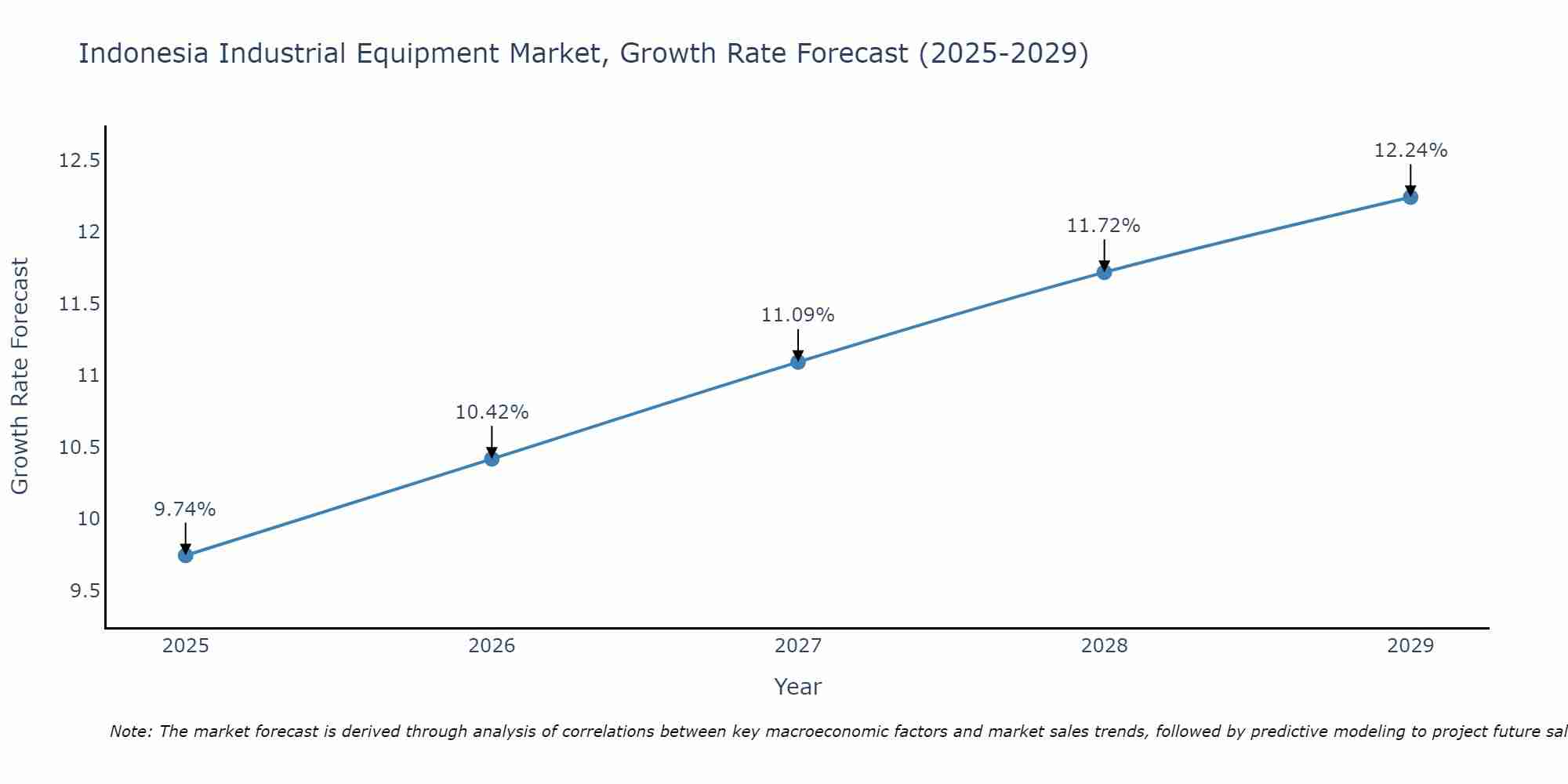
The Indonesia Industrial Equipment Market is likely to experience consistent growth rate gains over the period 2025 to 2029. Commencing at 9.74% in 2025, growth builds up to 12.24% by 2029.
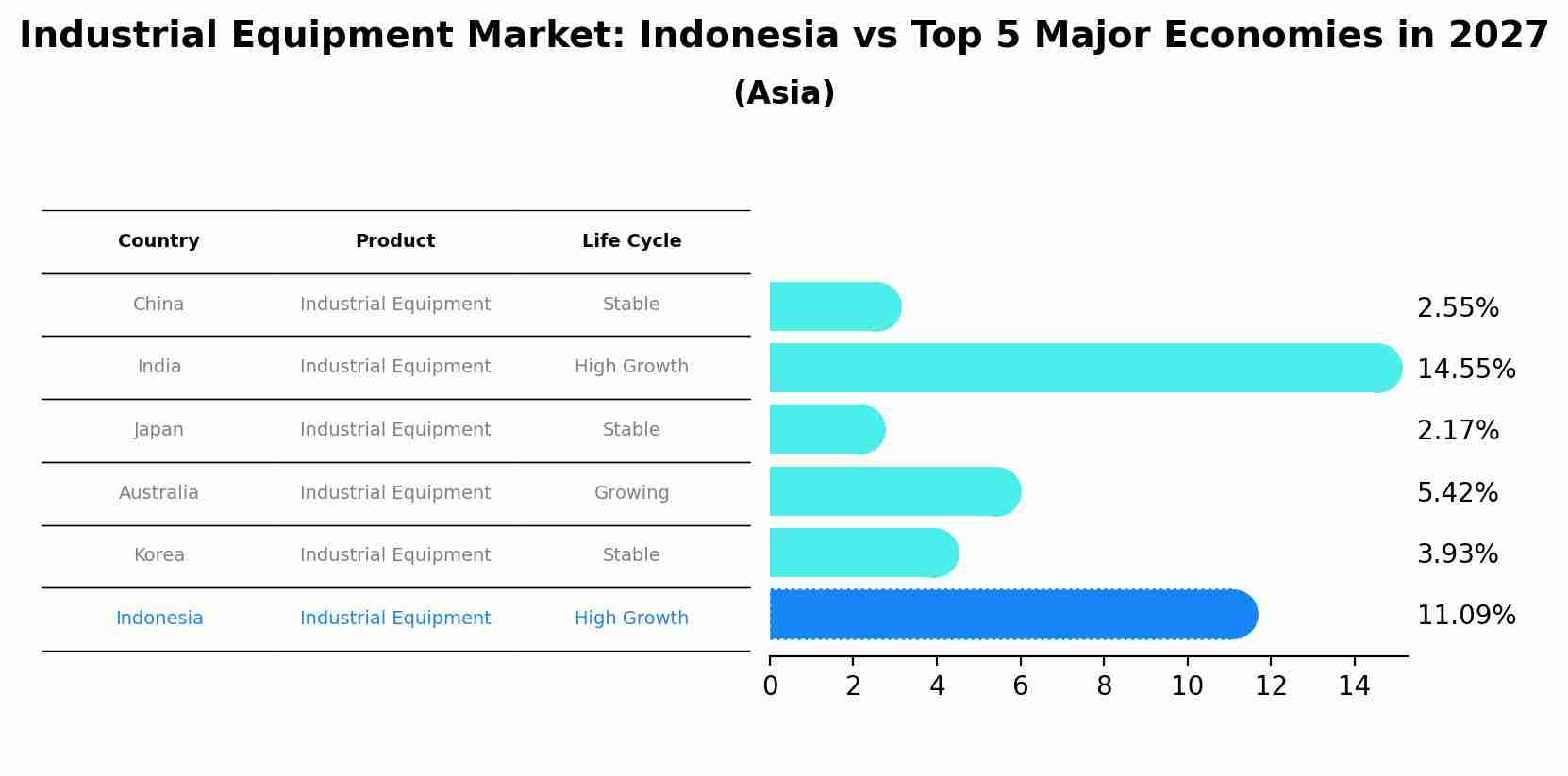
Industrial Equipment Market: Indonesia vs Top 5 Major Economies in 2027 (Asia)
By 2027, the Industrial Equipment market in Indonesia is anticipated to reach a growth rate of 11.09%, as part of an increasingly competitive Asia region, where China remains at the forefront, supported by India, Japan, Australia and South Korea, driving innovations and market adoption across sectors.
Indonesia Industrial Equipment Market Synopsis
The industrial brakes & clutches market size in Indonesia stood at $US 23 million in 2025 and is projected to expand at a compound annual growth rate (CAGR) of 6.1% during. The growth is mainly driven by increasing applications of brakes & clutches systems across various industries like automotive, marine, railroads, aerospace etc., coupled with technological advancements that have enabled manufacturers create more efficient solutions. Furthermore, regulations mandating safe operations on aircrafts has resulted into improved adoption rates amongst airlines.
Drivers of the Market
The industrial equipment market in Indonesia is buoyed by overall economic growth and industrialization. Infrastructure development, construction projects, and the establishment of new manufacturing facilities drive the demand for a wide range of industrial equipment, including material handling machinery, generators, compressors, and more. Moreover, the ongoing trend towards automation and Industry 4.0 concepts stimulates the adoption of advanced equipment for increased efficiency and productivity.
Challenges of the Market
Challenges in the broader industrial equipment market could include technological advancements and the need for regular updates, ensuring compatibility with existing systems, meeting industry-specific standards and regulations, and providing efficient after-sales service and support to clients.
COVID-19 Impact on the Market
Similar to other markets, the industrial equipment sector could have faced disruptions in manufacturing, supply chain, and demand. The initial phases of the pandemic may have led to a decrease in investments and industrial expansion plans. However, as industries resumed operations and adapted to new health protocols, the market might have shown signs of recovery, especially in sectors vital for essential goods production.
Key Players in the Market
The overall industrial equipment market in Indonesia is expected to grow due to ongoing industrialization and infrastructure development. Key players across various industrial equipment segments include PT. United Tractors Tbk, PT. Wijaya Equipments, and PT. Cipta Kridatama.
Key Highlights of the Report:
- Indonesia Industrial Equipment Market Outlook
- Market Size of Indonesia Industrial Equipment Market, 2024
- Forecast of Indonesia Industrial Equipment Market, 2031
- Historical Data and Forecast of Indonesia Industrial Equipment Revenues & Volume for the Period 2021-2031
- Indonesia Industrial Equipment Market Trend Evolution
- Indonesia Industrial Equipment Market Drivers and Challenges
- Indonesia Industrial Equipment Price Trends
- Indonesia Industrial Equipment Porter's Five Forces
- Indonesia Industrial Equipment Industry Life Cycle
- Historical Data and Forecast of Indonesia Industrial Equipment Market Revenues & Volume By Type for the Period 2021-2031
- Historical Data and Forecast of Indonesia Industrial Equipment Market Revenues & Volume By Woodworking and Paper Machinery for the Period 2021-2031
- Historical Data and Forecast of Indonesia Industrial Equipment Market Revenues & Volume By Printing Machinery and Equipment for the Period 2021-2031
- Historical Data and Forecast of Indonesia Industrial Equipment Market Revenues & Volume By Semiconductor Machinery for the Period 2021-2031
- Historical Data and Forecast of Indonesia Industrial Equipment Market Revenues & Volume By Food Product Machinery for the Period 2021-2031
- Historical Data and Forecast of Indonesia Industrial Equipment Market Revenues & Volume By Others for the Period 2021-2031
- Historical Data and Forecast of Indonesia Industrial Equipment Market Revenues & Volume By Operation for the Period 2021-2031
- Historical Data and Forecast of Indonesia Industrial Equipment Market Revenues & Volume By Autonomous for the Period 2021-2031
- Historical Data and Forecast of Indonesia Industrial Equipment Market Revenues & Volume By Semi-Autonomous for the Period 2021-2031
- Historical Data and Forecast of Indonesia Industrial Equipment Market Revenues & Volume By Manual for the Period 2021-2031
- Historical Data and Forecast of Indonesia Industrial Equipment Market Revenues & Volume By Capacity for the Period 2021-2031
- Historical Data and Forecast of Indonesia Industrial Equipment Market Revenues & Volume By Small for the Period 2021-2031
- Historical Data and Forecast of Indonesia Industrial Equipment Market Revenues & Volume By Medium for the Period 2021-2031
- Historical Data and Forecast of Indonesia Industrial Equipment Market Revenues & Volume By Large for the Period 2021-2031
- Indonesia Industrial Equipment Import Export Trade Statistics
- Market Opportunity Assessment By Type
- Market Opportunity Assessment By Operation
- Market Opportunity Assessment By Capacity
- Indonesia Industrial Equipment Top Companies Market Share
- Indonesia Industrial Equipment Competitive Benchmarking By Technical and Operational Parameters
- Indonesia Industrial Equipment Company Profiles
- Indonesia Industrial Equipment Key Strategic Recommendations






































