Indonesia Industrial Furnace Market Size, Share & Growth Rate
The Indonesia Industrial Furnace Market was estimated at USD 161 Million in 2025 and is projected to reach USD 212 Million by 2032, growing at a CAGR of 4.0% from 2026 to 2032. This growth trajectory is fueled by the expanding industrial sector, particularly in metals, chemicals, and glass manufacturing. With infrastructure projects gaining momentum, the demand for efficient and reliable thermal processing equipment is set to rise significantly in the coming years.
Indonesia Industrial Furnace Market Year-wise Growth Rate and Key Drivers
This graph highlights how the Indonesia Industrial Furnace Market has steadily grown over the years, supported by major growth factors.
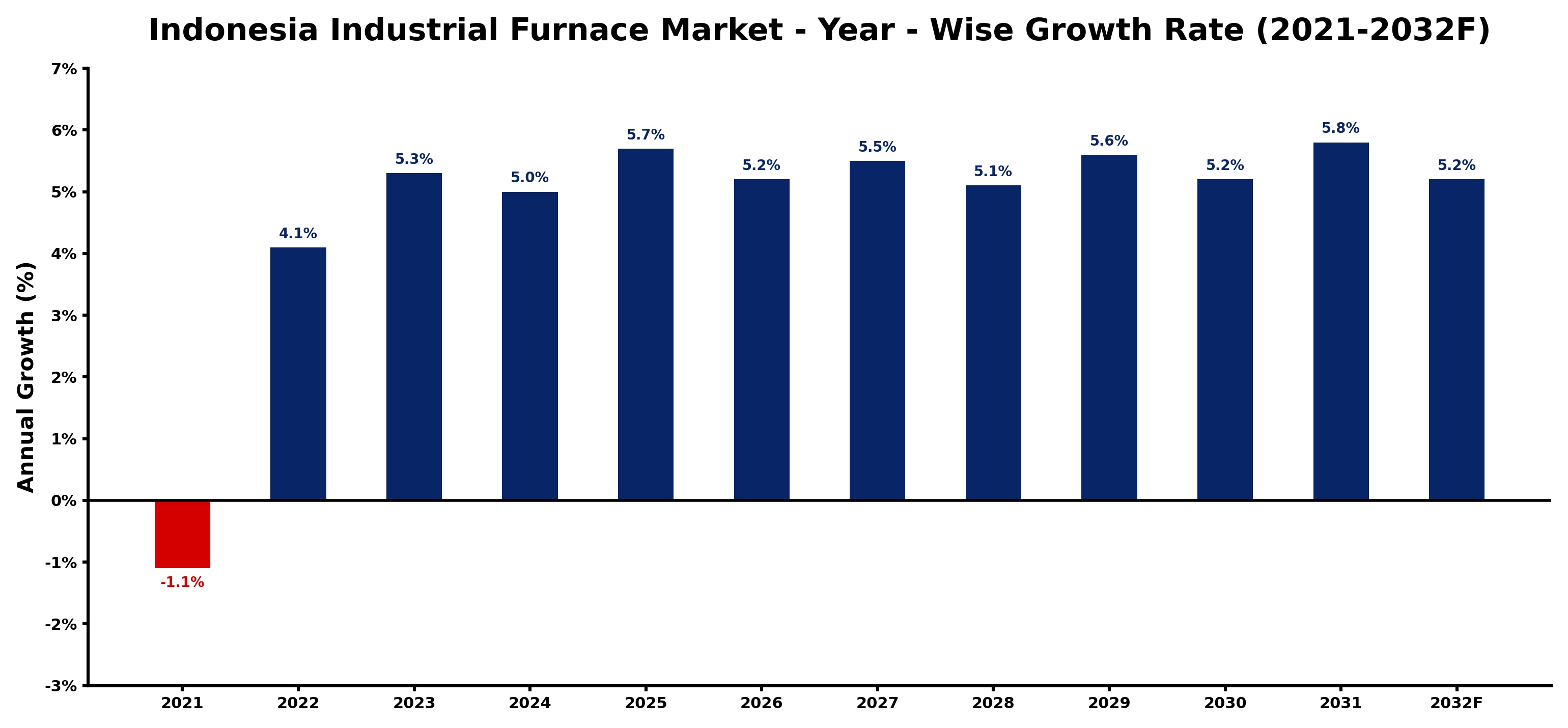
The table below presents the year‑wise growth rates along with the key drivers influencing the market
| Year | Growth Rate | Major Drivers |
| 2021 | -1.1% | Decreased vehicle exports led to reduced furnace production demand |
| 2022 | 4.1% | Domestic vehicle production ramp up fuels furnace technology investments |
| 2023 | 5.3% | Technology integration boosts efficiency in Indonesia's automotive parts production |
| 2024 | 5.0% | Modernization efforts in manufacturing boost furnace capacity utilization rates |
| 2025 | 5.7% | Domestic manufacturing investments boost industrial furnace demand for production |
| 2026 | 5.2% | Domestic vehicle production surge boosts demand for foundry equipment |
| 2027 | 5.5% | Technological upgrades in furnace design boost metalworking production capacity |
| 2028 | 5.1% | Manufacturing modernization drives furnace investment in automotive supply chains |
| 2029 | 5.6% | Domestic automotive manufacturing growth boosts demand for furnace production |
| 2030 | 5.2% | Accelerated manufacturing modernization drives furnace demand for efficiency |
| 2031 | 5.8% | Manufacturing modernization initiatives boost demand for advanced industrial furnaces |
| 2032 | 5.2% | Vehicle manufacturing surge boosts demand for high capacity furnaces |
Note - Market size estimations and growth projections presented in this report are based on 6Wresearch’s advanced forecasting approach, validated with industry datasets as of June 2026.
Indonesia Industrial Furnace Market Synopsis
The strongest force currently shaping the Indonesia Industrial Furnace Market is the increasing emphasis on energy-efficient and sustainable solutions. Manufacturers are adapting advanced technologies, such as regenerative burners and waste heat recovery systems, to meet these demands while also enhancing performance.
Additionally, the integration of automation and digital technologies is transforming how industrial furnaces operate, leading to better process control and optimization. This evolution reflects a growing commitment to not only meet regulatory requirements but also to improve overall operational efficiencies across various sectors.
Indonesia Industrial Furnace Market Key Takeaways
- Strong growth projected due to increased industrial activity and infrastructure development.
- Shift towards electric furnaces driven by cleaner operations and precise temperature control.
- Automation technologies are becoming crucial for enhancing safety and process efficiency.
- Significant investment in modernization as older furnaces are phased out in favor of advanced models.
- Compliance with stringent environmental regulations poses ongoing challenges for manufacturers.
Evaluation of Restraints in Indonesia Industrial Furnace Market
While the Indonesia Industrial Furnace Market shows strong potential, it faces several constraints that could hinder its growth. Compliance with stringent environmental regulations is a notable challenge, as both manufacturers and end-users must adapt to ever-evolving standards regarding emissions and energy efficiency. Additionally, the substantial capital investments required for the installation and maintenance of industrial furnaces can be a barrier, particularly for smaller businesses or industries with limited financial resources.
Indonesia Industrial Furnace Market Trends
The Indonesia Industrial Furnace Market is currently witnessing several key trends that are reshaping demand and technology. A marked shift towards electric furnaces is evident, driven by their cleaner operations and precise control capabilities. Furthermore, as industries increasingly prioritize sustainability, manufacturers are adopting innovative technologies, such as waste heat recovery systems, to improve energy efficiency. Additionally, the rise of Industry 4.0 has led to the integration of automation and digital solutions, facilitating advanced monitoring and control mechanisms.
Indonesia Industrial Furnace Market Opportunities
Significant growth and investment opportunities are emerging in the Indonesia Industrial Furnace Market, particularly in the realms of modernization and efficiency. As industries seek to upgrade aging infrastructure, there is a pronounced demand for advanced, energy-efficient furnace systems. Additionally, the ongoing expansion of the manufacturing sector, coupled with government initiatives aimed at enhancing local production capabilities, opens new avenues for innovation and growth in this space.
Government Initiatives in the Indonesia Industrial Furnace Market
The Indonesian government is actively promoting local manufacturing through various initiatives aimed at strengthening industrial capabilities. Public spending on infrastructure development, including energy and resource optimization projects, plays a crucial role in boosting the industrial furnace sector. Additionally, policy frameworks encouraging energy efficiency and environmental sustainability align with global trends, incentivizing businesses to adopt more advanced technologies and systems.
Future Insights of the Indonesia Industrial Furnace Market
Looking ahead to the period from 2026 to 2032, the Indonesia Industrial Furnace Market is poised for substantial growth. As the country continues to enhance its industrial capabilities, driven by infrastructure investments and modernization needs, the demand for sophisticated thermal processing solutions will expand. Furthermore, the ongoing transition towards renewable energy sources is likely to accelerate the adoption of electric and energy-efficient furnace technologies, ensuring that manufacturers stay competitive and compliant with environmental standards.
Indonesia Industrial Furnace Market Latest Developments (May 2025 - June 2026)
In recent months, the Indonesia Industrial Furnace Market has seen a flurry of activity, with manufacturers focusing on developing energy-efficient solutions to comply with stricter environmental regulations. There has also been an increase in collaborative projects aimed at leveraging digital technologies for better furnace management and operational efficiencies. As infrastructure projects gather pace, there is renewed optimism about the market's growth trajectory, alongside a commitment to innovative furnace solutions that align with global sustainability goals.
Indonesia Industrial Furnace Market - Key Attractiveness of the Report
- 10 Years of Market Numbers
- Historical Data Starting from 2022 to 2025
- Base Year: 2025
- Forecast Data until 2032
- Key Performance Indicators Impacting the Market
- Major Upcoming Developments and Projects
Key Highlights of the Report:
- Indonesia Industrial Furnace Market Outlook
- Market Size of Indonesia Industrial Furnace Market, 2025
- Forecast of Indonesia Industrial Furnace Market, 2032
- Historical Data and Forecast of Indonesia Industrial Furnace Revenues & Volume for the Period 2022-2032F
- Indonesia Industrial Furnace Market Trend Evolution
- Indonesia Industrial Furnace Market Drivers and Challenges
- Indonesia Industrial Furnace Price Trends
- Indonesia Industrial Furnace Porter's Five Forces
- Indonesia Industrial Furnace Industry Life Cycle
- Historical Data and Forecast of Indonesia Industrial Furnace Market Revenues & Volume By Furnace Type for the Period 2022-2032F
- Historical Data and Forecast of Indonesia Industrial Furnace Market Revenues & Volume By Gas/fuel Operated Industrial Furnace for the Period 2022-2032F
- Historical Data and Forecast of Indonesia Industrial Furnace Market Revenues & Volume By Electrically Operated Industrial Furnace for the Period 2022-2032F
- Historical Data and Forecast of Indonesia Industrial Furnace Market Revenues & Volume By Arrangement for the Period 2022-2032F
- Historical Data and Forecast of Indonesia Industrial Furnace Market Revenues & Volume By Tube or Clamshell Type for the Period 2022-2032F
- Historical Data and Forecast of Indonesia Industrial Furnace Market Revenues & Volume By Box Type for the Period 2022-2032F
- Historical Data and Forecast of Indonesia Industrial Furnace Market Revenues & Volume By Bottom Loading & Car Bottom Furnace for the Period 2022-2032F
- Historical Data and Forecast of Indonesia Industrial Furnace Market Revenues & Volume By Top Loading Furnace for the Period 2022-2032F
- Historical Data and Forecast of Indonesia Industrial Furnace Market Revenues & Volume By Others for the Period 2022-2032F
- Historical Data and Forecast of Indonesia Industrial Furnace Market Revenues & Volume By End-User for the Period 2022-2032F
- Historical Data and Forecast of Indonesia Industrial Furnace Market Revenues & Volume By Metals & Mining for the Period 2022-2032F
- Historical Data and Forecast of Indonesia Industrial Furnace Market Revenues & Volume By Transportation for the Period 2022-2032F
- Historical Data and Forecast of Indonesia Industrial Furnace Market Revenues & Volume By Oil & Gas for the Period 2022-2032F
- Historical Data and Forecast of Indonesia Industrial Furnace Market Revenues & Volume By Chemicals for the Period 2022-2032F
- Historical Data and Forecast of Indonesia Industrial Furnace Market Revenues & Volume By Others for the Period 2022-2032F
- Indonesia Industrial Furnace Import Export Trade Statistics
- Market Opportunity Assessment By Furnace Type
- Market Opportunity Assessment By Arrangement
- Market Opportunity Assessment By End-User
- Indonesia Industrial Furnace Top Companies Market Share
- Indonesia Industrial Furnace Competitive Benchmarking By Technical and Operational Parameters
- Indonesia Industrial Furnace Company Profiles
- Indonesia Industrial Furnace Key Strategic Recommendations






































