Indonesia Industrial Mixers and Blenders Market Summary
The indonesia industrial mixers and blenders market was estimated at USD 223 Million in 2025 and is projected to reach USD 295 Million by 2032, growing at a CAGR of 5.0% from 2026 to 2032.
Indonesia Industrial Mixers and Blenders Market Year-wise Growth Rate and Key Drivers
This graph highlights how the Indonesia Industrial Mixers and Blenders Market has steadily grown over the past five years, supported by major growth factors.
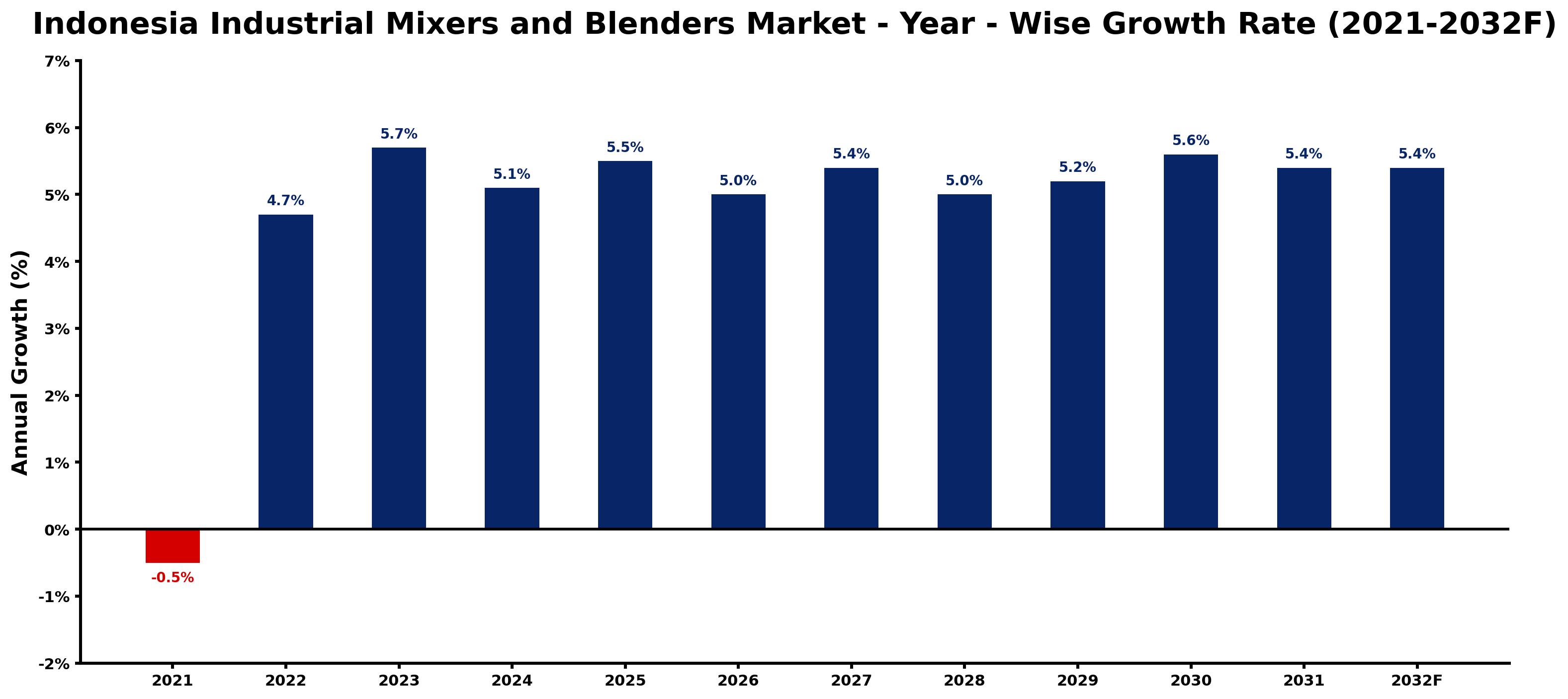
The table below presents the year wise growth rates along with the key drivers influencing the market
| Year | Growth Rate | Major Drivers |
| 2021 | -0.5% | Supply chain disruptions due to global logistics challenges hampered availability and increased costs for industrial equipment. |
| 2022 | 4.7% | Investment in food processing facilities surged, reflecting Indonesia's robust culinary landscape. |
| 2023 | 5.7% | The local demand for eco-friendly mixers gained traction alongside sustainability trends. |
| 2024 | 5.1% | Industrial upgrades became crucial as international firms expanded their operations in Indonesia. |
| 2025 | 5.5% | Emerging players entered the market, increasing competition and spurring innovation in design. |
| 2026 | 5.0% | Technological advancements in blending technology improved output quality and reduced waste. |
| 2027 | 5.4% | Urbanization influenced demand as food service businesses flourished in metropolitan areas. |
| 2028 | 5.0% | Export potential grew, driven by increased global interest in Indonesian food products. |
| 2029 | 5.2% | Local manufacturers formed partnerships, enhancing supply chain resilience and operational agility. |
| 2030 | 5.6% | Investment in R&D focused on creating tailored solutions for diverse industrial applications. |
| 2031 | 5.4% | Consumer preferences shifted towards ready-to-mix products, boosting blender sales significantly. |
| 2032 | 5.4% | Digital transformation initiatives progressed, integrating IoT solutions within industrial mixing operations. |
Note - Market size estimations and growth projections presented in this report are based on 6Wresearch's advanced forecasting approach, validated with industry datasets as of June 2026.
Indonesia Industrial Mixers and Blenders Market Synopsis
The Indonesia Industrial Mixers and Blenders Market is projected to reach 5.0% and witness significant growth during the forecast period (2026-2032). The growth trajectory of this market is largely attributed to the escalating demand for processed food, driven by the increasing population and rapid urbanization in Indonesia. Furthermore, the heightened food safety concerns among consumers are prompting businesses to adopt more efficient mixing processes, a trend further bolstered by government initiatives such as the Halal Certification Programs.
Indonesia Industrial Mixers and Blenders Market Growth Drivers
Several pivotal factors are fueling the expansion of the Indonesia Industrial Mixers and Blenders Market. These include:
- Rapid urbanization in Indonesia has significantly improved per capita income, leading to higher disposable incomes among consumers. This socioeconomic shift is propelling the demand for processed foods across diverse demographic segments.
- Consumer preferences are evolving towards convenience foods, which are increasingly in demand due to busy lifestyles. This shift necessitates advanced industrial mixers and blenders to ensure efficient food processing.
- Food safety regulations and growing consumer awareness about food quality are compelling manufacturers to invest in modern mixing technologies that can assure product consistency and safety.
- The food and beverage sector's expansion, driven by new product innovations and the emergence of local brands, necessitates advanced mixing solutions, further propelling market demand.
- Technological advancements in mixing and blending equipment are also enhancing efficiency and effectiveness, enabling producers to achieve higher production capacity and quality in their offerings.
Indonesia Industrial Mixers and Blenders Market Challenges and Restraints
Despite its potential for growth, the Indonesia Industrial Mixers and Blenders Market faces several challenges that could hinder its progress:
- The high costs associated with the maintenance and replacement of sophisticated industrial mixer parts, such as blades and agitators, create significant financial burdens for small-scale industries.
- Small and medium enterprises may struggle to justify investments in advanced mixing equipment due to budget restrictions, limiting their ability to compete effectively in a rapidly evolving market.
- Technological gaps in understanding and utilizing advanced mixing techniques can hinder productivity in less developed regions of Indonesia, creating a disparity in market development.
- Supply chain disruptions, exacerbated by global economic uncertainties, can affect the availability of essential components required for industrial mixers and blenders.
- Market volatility and fluctuating raw material costs can adversely impact the pricing strategies of manufacturers, making it challenging to maintain profitability.
Indonesia Industrial Mixers and Blenders Market Government Investment and Initiatives
The Indonesian government plays a crucial role in shaping the industrial mixers and blenders market through various investment initiatives and policies aimed at enhancing the food processing sector. Key government actions include:
- Implementation of the Halal Certification Program, which encourages food manufacturers to adopt higher standards of food safety and quality, indirectly stimulating the demand for advanced mixers and blenders.
- Public investments in infrastructure development, such as transportation and logistics, which facilitate smoother supply chains for industrial equipment and food products.
- Support for training and technical assistance programs designed to improve the skill set of the workforce in handling advanced mixing technologies and optimizing production processes.
- Promotion of investments in research and development to foster innovation in food processing technologies, which is crucial for maintaining competitive advantages in the market.
- Incentives for businesses that invest in modern equipment and technologies to boost productivity, efficiency, and sustainability in the food industry.
Indonesia Industrial Mixers and Blenders Market Latest Developments (May 2025 - June 2026)
Recent developments in the Indonesia Industrial Mixers and Blenders Market indicate a continued shift towards modernization and efficiency. Manufacturers are increasingly adopting automation and smart technologies to enhance operational performance. The focus on energy-efficient equipment has also intensified, driven by both regulatory pressures and growing consumer demand for sustainable manufacturing practices. Additionally, collaborations between local producers and international technology firms are becoming common as companies seek to integrate the latest innovations into their processing lines. As food safety remains a priority, many businesses are investing more heavily in high-quality mixers and blenders that adhere to stringent safety standards.
Indonesia Industrial Mixers and Blenders Market - Key Attractiveness of the Report
- 10 Years of Market Numbers
- Historical Data Starting from 2022 to 2025
- Base Year: 2025
- Forecast Data until 2032
- Key Performance Indicators Impacting the Market
- Major Upcoming Developments and Projects
Key Highlights of the Report:
- Indonesia Industrial Mixers and Blenders Market Outlook
- Market Size of Indonesia Industrial Mixers and Blenders Market, 2025
- Forecast of Indonesia Industrial Mixers and Blenders Market, 2032F
- Historical Data and Forecast of Indonesia Industrial Mixers and Blenders Revenues & Volume for the Period 2022-2032F
- Indonesia Industrial Mixers and Blenders Market Trend Evolution
- Indonesia Industrial Mixers and Blenders Market Drivers and Challenges
- Indonesia Industrial Mixers and Blenders Price Trends
- Indonesia Industrial Mixers and Blenders Porter's Five Forces
- Indonesia Industrial Mixers and Blenders Industry Life Cycle
- Historical Data and Forecast of Indonesia Industrial Mixers and Blenders Market Revenues & Volume By Product Type for the Period 2022-2032F
- Historical Data and Forecast of Indonesia Industrial Mixers and Blenders Market Revenues & Volume By Ribbon Blenders for the Period 2022-2032F
- Historical Data and Forecast of Indonesia Industrial Mixers and Blenders Market Revenues & Volume By High Shear Mixers for the Period 2022-2032F
- Historical Data and Forecast of Indonesia Industrial Mixers and Blenders Market Revenues & Volume By Shaft Mixers for the Period 2022-2032F
- Historical Data and Forecast of Indonesia Industrial Mixers and Blenders Market Revenues & Volume By Planetary Mixers for the Period 2022-2032F
- Historical Data and Forecast of Indonesia Industrial Mixers and Blenders Market Revenues & Volume By Conical Screw Mixers for the Period 2022-2032F
- Historical Data and Forecast of Indonesia Industrial Mixers and Blenders Market Revenues & Volume By Double Cone Blenders for the Period 2022-2032F
- Historical Data and Forecast of Indonesia Industrial Mixers and Blenders Market Revenues & Volume By End-users for the Period 2022-2032F
- Historical Data and Forecast of Indonesia Industrial Mixers and Blenders Market Revenues & Volume By Chemical for the Period 2022-2032F
- Historical Data and Forecast of Indonesia Industrial Mixers and Blenders Market Revenues & Volume By F&B for the Period 2022-2032F
- Historical Data and Forecast of Indonesia Industrial Mixers and Blenders Market Revenues & Volume By W&WW for the Period 2022-2032F
- Historical Data and Forecast of Indonesia Industrial Mixers and Blenders Market Revenues & Volume By Others? for the Period 2022-2032F
- Indonesia Industrial Mixers and Blenders Import Export Trade Statistics
- Market Opportunity Assessment By Product Type
- Market Opportunity Assessment By End-users
- Indonesia Industrial Mixers and Blenders Top Companies Market Share
- Indonesia Industrial Mixers and Blenders Competitive Benchmarking By Technical and Operational Parameters
- Indonesia Industrial Mixers and Blenders Company Profiles
- Indonesia Industrial Mixers and Blenders Key Strategic Recommendations






































