Indonesia Industrial Vacuum Cleaner Market Size, Share & Growth Rate
The Indonesia Industrial Vacuum Cleaner Market was estimated at USD 232 Million in 2025 and is projected to reach USD 307 Million by 2032, growing at a CAGR of 4.1% from 2026 to 2032. This growth trajectory can largely be attributed to advancements in filtration technology which improve air quality, along with a rising public emphasis on hygiene within manufacturing sectors. The combination of rapid urbanization and increasing disposable income has further enabled various consumer segments to invest in effective industrial cleaning solutions.
Indonesia Industrial Vacuum Cleaner Market Year-wise Growth Rate and Key Drivers
This graph highlights how the Indonesia Industrial Vacuum Cleaner Market has steadily grown over the years, supported by major growth factors.
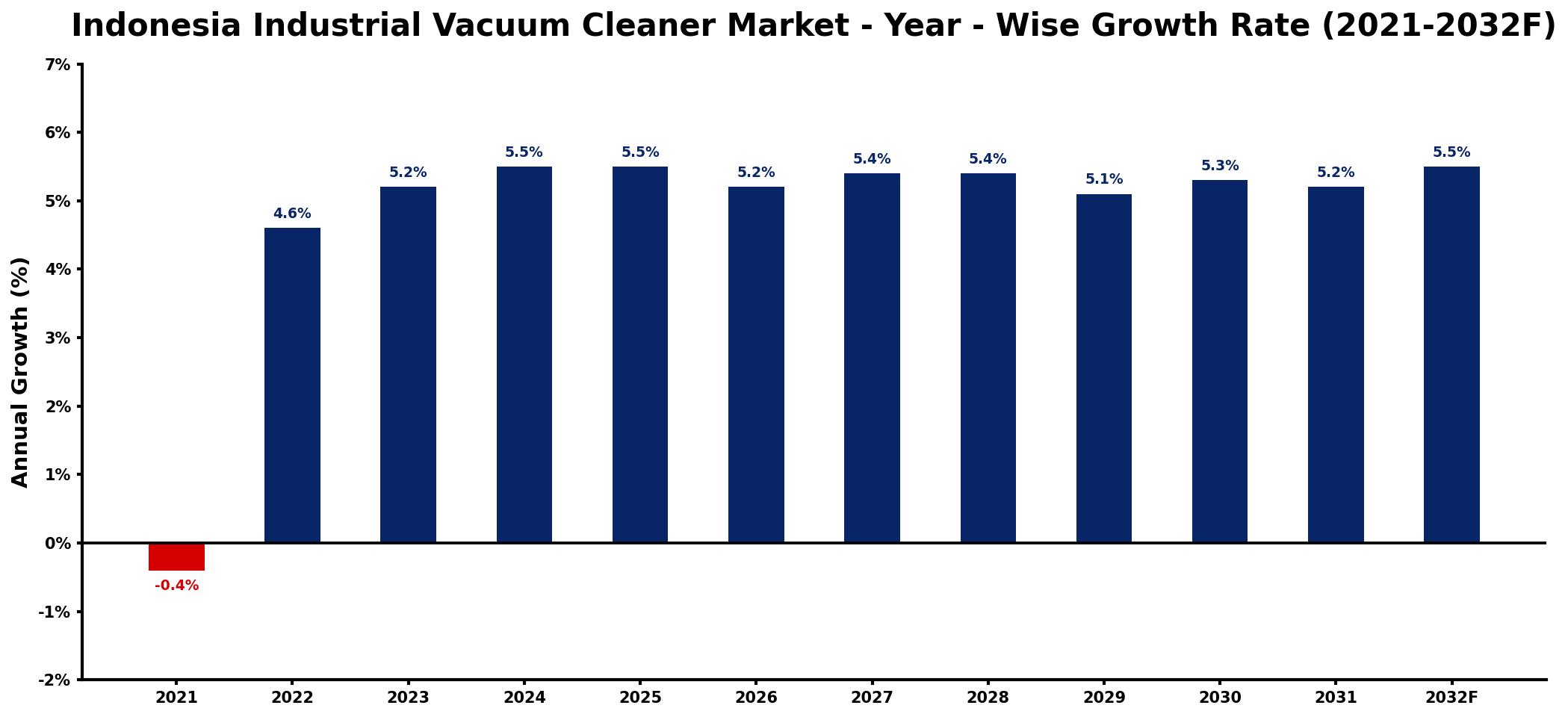
The table below presents the year‑wise growth rates along with the key drivers influencing the market
| Year | Growth Rate | Major Drivers |
| 2021 | -0.4% | decrease in manufacturing output demand |
| 2022 | 4.6% | rising focus on health standards |
| 2023 | 5.2% | growth in manufacturing sector investments |
| 2024 | 5.5% | increased automation in industries |
| 2025 | 5.5% | expansion of logistics and warehousing |
| 2026 | 5.2% | greater emphasis on sustainability practices |
| 2027 | 5.4% | higher demand from food processing |
| 2028 | 5.4% | growing downstream application demand |
| 2029 | 5.1% | increased adoption of smart technologies |
| 2030 | 5.3% | rising investments in facility maintenance |
| 2031 | 5.2% | growing awareness of hygiene practices |
| 2032 | 5.5% | rising demand from electronics |
Note: Market size estimations and growth projections presented in this report are based on 6Wresearch's proprietary forecasting methodology, utilizing the latest available industry data, government publications, and primary research inputs.
Indonesia Industrial Vacuum Cleaner Market Synopsis
In recent years, the demand for industrial vacuum cleaners has surged in Indonesia, driven by a growing awareness of workplace hygiene and safety protocols. Many manufacturing facilities are increasingly looking for robust cleaning solutions that not only comply with stringent health standards but also enhance overall operational efficiency.
The market is bolstered by the food processing and pharmaceutical industries, where maintaining a sterile environment is essential. Investments in technology and innovations in vacuum cleaner designs are addressing the diverse requirements of these sectors, ensuring a strong foundation for future market growth.
Indonesia Industrial Vacuum Cleaner Market Key Takeaways
- The market is poised for steady growth, fueled by advancements in cleaning technology and rising hygiene concerns.
- Filtration technology is a key driver, enhancing the indoor and outdoor air quality significantly.
- The increase in disposable income among consumers has broadened market accessibility.
- Key industries driving demand include manufacturing, food processing, and pharmaceuticals.
- Compliance with regulatory standards has become a fundamental aspect of cleaning solutions.
Evaluation of Restraints in Indonesia Industrial Vacuum Cleaner Market
Despite the promising growth of the Indonesia industrial vacuum cleaner market, several constraints could hinder its potential. The market faces challenges in adhering to stringent environmental regulations, which can impose higher operational costs on manufacturers. Additionally, the necessity to meet the diverse cleaning needs across various industries creates complexity in product development. Furthermore, competition among manufacturers may lead to price sensitivity, affecting profitability and investments in innovation.
Indonesia Industrial Vacuum Cleaner Market Trends
Emerging trends in the industrial vacuum cleaner market indicate a shift toward more sustainable and energy-efficient cleaning solutions. As environmental awareness increases, manufacturers are investing in developing eco-friendly products that reduce carbon footprints. Moreover, there is a growing trend towards automation in cleaning processes, with smart technology integrating IoT capabilities to provide real-time monitoring and efficient operations.
Indonesia Industrial Vacuum Cleaner Market Opportunities
Significant growth opportunities lie within the expansion of the healthcare and pharmaceutical sectors, where the demand for sterilized environments is paramount. There is also a rising trend of modular and customizable vacuum solutions that cater to specific industrial needs. As companies continue to prioritize workplace safety and cleanliness, the demand for advanced cleaning technology is expected to grow, providing fertile ground for innovative product development.
Government Initiatives in the Indonesia Industrial Vacuum Cleaner Market
The Indonesian government has shown a commitment to improving industrial hygiene standards through various initiatives and programs aimed at enhancing workplace safety. Investment in health and safety regulations has encouraged industries to upgrade their cleaning equipment, thereby providing a conducive environment for growth in the industrial vacuum cleaner market. These government initiatives also aim to promote sustainable practices within manufacturing, aligning with the global trend towards environmental responsibility.
Future Insights of the Indonesia Industrial Vacuum Cleaner Market
Looking ahead to the period from 2026 to 2032, the Indonesia industrial vacuum cleaner market is expected to experience steady growth fueled by continuous technological advancements and shifting consumer expectations. Companies that invest in research and development will likely be well-positioned to capture market share, particularly those focusing on sustainable practices and smart technology integration. Increased urbanization and rising middle-class incomes will further elevate the demand for high-quality industrial cleaning solutions.
Indonesia Industrial Vacuum Cleaner Market Latest Developments (2025 - 2026)
Recently, the industrial vacuum cleaner market has seen a notable push towards digital transformation, with manufacturers increasingly leveraging smart technologies to enhance user experience and operational efficiency. Additionally, collaboration between companies and research institutions is on the rise, aimed at developing cutting-edge solutions tailored to industry-specific cleaning challenges. This focus on innovation is expected to play a crucial role in determining market dynamics in the near future.
Indonesia Industrial Vacuum Cleaner Market - Key Attractiveness of the Report
- 10 Years of Market Numbers
- Historical Data Starting from 2022 to 2025
- Base Year: 2025
- Forecast Data until 2032
- Key Performance Indicators Impacting the Market
- Major Upcoming Developments and Projects
Key Highlights of the Report:
- Indonesia Industrial Vacuum Cleaner Market Outlook
- Market Size of Indonesia Industrial Vacuum Cleaner Market, 2025
- Forecast of Indonesia Industrial Vacuum Cleaner Market, 2032
- Historical Data and Forecast of Indonesia Industrial Vacuum Cleaner Revenues & Volume for the Period 2022-2032F
- Indonesia Industrial Vacuum Cleaner Market Trend Evolution
- Indonesia Industrial Vacuum Cleaner Market Drivers and Challenges
- Indonesia Industrial Vacuum Cleaner Price Trends
- Indonesia Industrial Vacuum Cleaner Porter's Five Forces
- Indonesia Industrial Vacuum Cleaner Industry Life Cycle
- Historical Data and Forecast of Indonesia Industrial Vacuum Cleaner Market Revenues & Volume By Type for the Period 2022-2032F
- Historical Data and Forecast of Indonesia Industrial Vacuum Cleaner Market Revenues & Volume By Dry for the Period 2022-2032F
- Historical Data and Forecast of Indonesia Industrial Vacuum Cleaner Market Revenues & Volume By Wet & Dry for the Period 2022-2032F
- Historical Data and Forecast of Indonesia Industrial Vacuum Cleaner Market Revenues & Volume By Power Source for the Period 2022-2032F
- Historical Data and Forecast of Indonesia Industrial Vacuum Cleaner Market Revenues & Volume By Electric for the Period 2022-2032F
- Historical Data and Forecast of Indonesia Industrial Vacuum Cleaner Market Revenues & Volume By Pneumatic for the Period 2022-2032F
- Historical Data and Forecast of Indonesia Industrial Vacuum Cleaner Market Revenues & Volume By Industry for the Period 2022-2032F
- Historical Data and Forecast of Indonesia Industrial Vacuum Cleaner Market Revenues & Volume By Food & Beverages for the Period 2022-2032F
- Historical Data and Forecast of Indonesia Industrial Vacuum Cleaner Market Revenues & Volume By Metalworking for the Period 2022-2032F
- Historical Data and Forecast of Indonesia Industrial Vacuum Cleaner Market Revenues & Volume By Pharmaceuticals for the Period 2022-2032F
- Historical Data and Forecast of Indonesia Industrial Vacuum Cleaner Market Revenues & Volume By Manufacturing for the Period 2022-2032F
- Historical Data and Forecast of Indonesia Industrial Vacuum Cleaner Market Revenues & Volume By Building & Construction for the Period 2022-2032F
- Historical Data and Forecast of Indonesia Industrial Vacuum Cleaner Market Revenues & Volume By Others for the Period 2022-2032F
- Indonesia Industrial Vacuum Cleaner Import Export Trade Statistics
- Market Opportunity Assessment By Type
- Market Opportunity Assessment By Power Source
- Market Opportunity Assessment By Industry
- Indonesia Industrial Vacuum Cleaner Top Companies Market Share
- Indonesia Industrial Vacuum Cleaner Competitive Benchmarking By Technical and Operational Parameters
- Indonesia Industrial Vacuum Cleaner Company Profiles
- Indonesia Industrial Vacuum Cleaner Key Strategic Recommendations






































