Indonesia Kitchen Cabinets Market: Import Trend Analysis
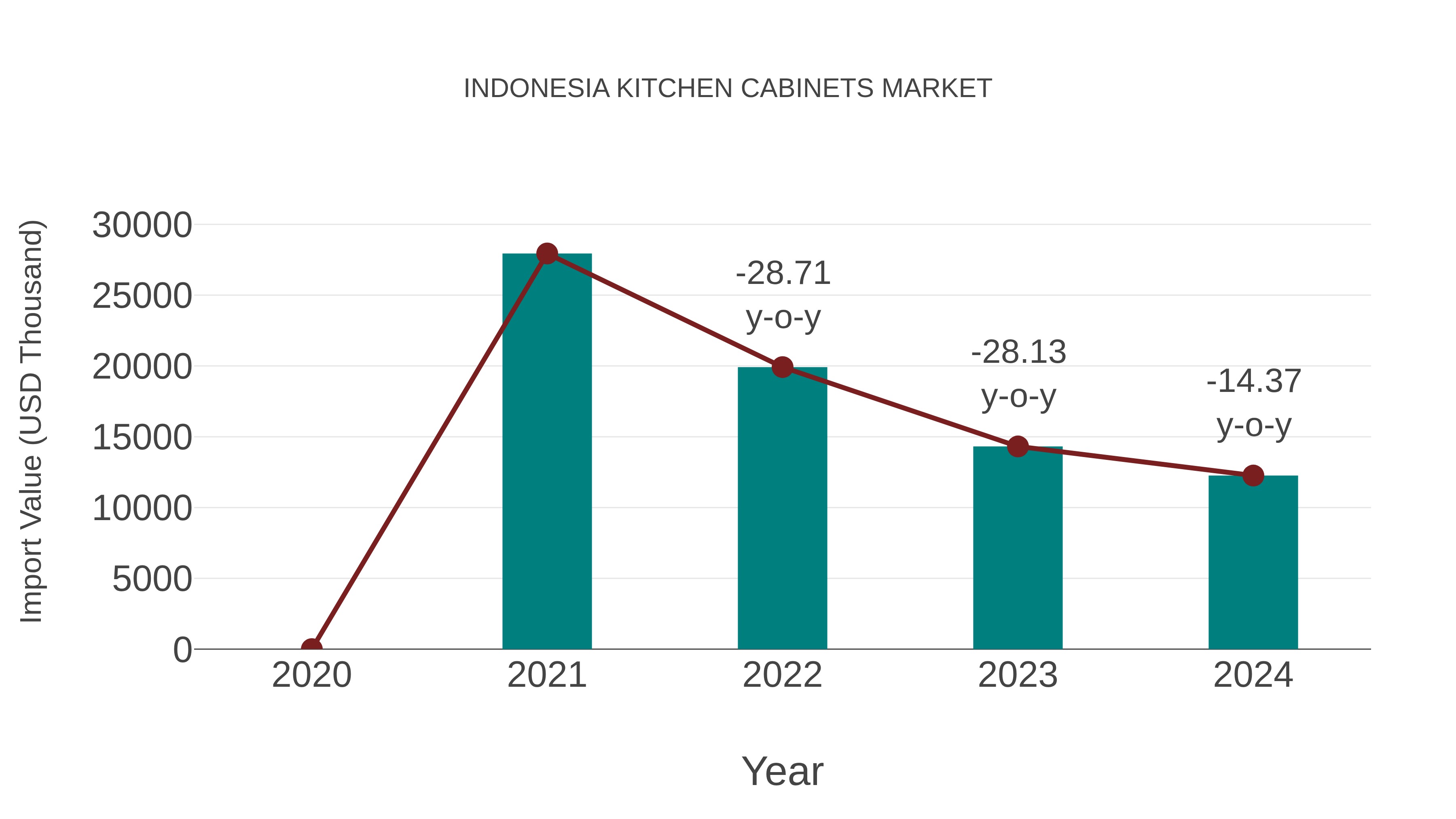
In the Indonesia kitchen cabinets market, the import trend exhibited a decline from 2023 to 2024, with a growth rate of -14.37%. The compound annual growth rate (CAGR) for imports between 2020 and 2024 stood at -24.01%. This negative momentum could be attributed to shifting demand patterns or changes in trade policies impacting market stability.
Indonesia Kitchen Cabinets Market Synopsis
The Indonesia Kitchen Cabinets market is thriving due to changing consumer preferences and urbanization. As more households opt for modular kitchens and open-plan living spaces, the demand for stylish and functional kitchen cabinets is increasing. Manufacturers are incorporating innovative designs, durable materials, and smart storage solutions to meet the evolving needs of consumers. The market`s growth is also supported by the country`s real estate development and renovation projects.
Drivers of the Market
The Indonesia Kitchen Cabinets market is witnessing growth as urbanization and rising incomes drive the demand for modern and well-designed kitchens. Consumers are increasingly looking for functional and aesthetically pleasing kitchen cabinets to enhance the overall look and functionality of their homes. The growth in the real estate sector, coupled with changing consumer lifestyles and preferences, is fueling the market. Additionally, the trend towards open-concept kitchen designs and the need for better storage solutions are boosting the sales of kitchen cabinets.
Challenges of the Market
The kitchen cabinets market in Indonesia faces challenges related to customization, as consumers have diverse preferences and space constraints. Meeting quality standards and utilizing materials that are resistant to humidity and pests is essential in this tropical climate. Distribution and installation can also be complex, given the country`s geographical diversity.
COVID-19 Impact on the Market
The kitchen cabinets market experienced fluctuations during the pandemic. Initially, as people spent more time at home, there was increased interest in kitchen renovations, leading to a surge in demand for kitchen cabinets. However, supply chain disruptions and increased costs of raw materials affected production and pricing. The market has since stabilized, with a focus on cost-effective and innovative solutions.
Key Players in the Market
The kitchen cabinets market in Indonesia is thriving, with prominent players like PT. Olympic Furniture Tbk and PT. Indachi Duta Visual commanding a significant market share. These companies offer a wide range of kitchen cabinet designs, catering to both residential and commercial sectors. The market is witnessing increased demand for modular and space-efficient designs, driving companies like PT. Ace Hardware Indonesia Tbk to adapt and expand their product lines.
Key Highlights of the Report:
- Indonesia Kitchen Cabinets Market Outlook
- Market Size of Indonesia Kitchen Cabinets Market, 2025
- Forecast of Indonesia Kitchen Cabinets Market, 2032
- Historical Data and Forecast of Indonesia Kitchen Cabinets Revenues & Volume for the Period 2022-2032F
- Indonesia Kitchen Cabinets Market Trend Evolution
- Indonesia Kitchen Cabinets Market Drivers and Challenges
- Indonesia Kitchen Cabinets Price Trends
- Indonesia Kitchen Cabinets Porter's Five Forces
- Indonesia Kitchen Cabinets Industry Life Cycle
- Historical Data and Forecast of Indonesia Kitchen Cabinets Market Revenues & Volume By Type for the Period 2022-2032F
- Historical Data and Forecast of Indonesia Kitchen Cabinets Market Revenues & Volume By Ready-to-assemble (RTA) for the Period 2022-2032F
- Historical Data and Forecast of Indonesia Kitchen Cabinets Market Revenues & Volume By Stock Kitchen Cabinets for the Period 2022-2032F
- Historical Data and Forecast of Indonesia Kitchen Cabinets Market Revenues & Volume By Semi-custom Kitchen Cabinets for the Period 2022-2032F
- Historical Data and Forecast of Indonesia Kitchen Cabinets Market Revenues & Volume By Custom Kitchen Cabinets for the Period 2022-2032F
- Historical Data and Forecast of Indonesia Kitchen Cabinets Market Revenues & Volume By Raw Material for the Period 2022-2032F
- Historical Data and Forecast of Indonesia Kitchen Cabinets Market Revenues & Volume By Wood for the Period 2022-2032F
- Historical Data and Forecast of Indonesia Kitchen Cabinets Market Revenues & Volume By Metal for the Period 2022-2032F
- Historical Data and Forecast of Indonesia Kitchen Cabinets Market Revenues & Volume By Other Raw Materials for the Period 2022-2032F
- Historical Data and Forecast of Indonesia Kitchen Cabinets Market Revenues & Volume By Distribution Channel for the Period 2022-2032F
- Historical Data and Forecast of Indonesia Kitchen Cabinets Market Revenues & Volume By Retail for the Period 2022-2032F
- Historical Data and Forecast of Indonesia Kitchen Cabinets Market Revenues & Volume By Online for the Period 2022-2032F
- Historical Data and Forecast of Indonesia Kitchen Cabinets Market Revenues & Volume By Other Distribution Channels for the Period 2022-2032F
- Historical Data and Forecast of Indonesia Kitchen Cabinets Market Revenues & Volume By Application for the Period 2022-2032F
- Historical Data and Forecast of Indonesia Kitchen Cabinets Market Revenues & Volume By Home for the Period 2022-2032F
- Historical Data and Forecast of Indonesia Kitchen Cabinets Market Revenues & Volume By Restaurants for the Period 2022-2032F
- Historical Data and Forecast of Indonesia Kitchen Cabinets Market Revenues & Volume By Other Applications for the Period 2022-2032F
- Indonesia Kitchen Cabinets Import Export Trade Statistics
- Market Opportunity Assessment By Type
- Market Opportunity Assessment By Raw Material
- Market Opportunity Assessment By Distribution Channel
- Market Opportunity Assessment By Application
- Indonesia Kitchen Cabinets Top Companies Market Share
- Indonesia Kitchen Cabinets Competitive Benchmarking By Technical and Operational Parameters
- Indonesia Kitchen Cabinets Company Profiles
- Indonesia Kitchen Cabinets Key Strategic Recommendations






































