Indonesia Ladders Market Size, Share & Growth Rate
The Indonesia Ladders Market was estimated at USD 360 Million in 2025 and is projected to reach USD 478 Million by 2032, growing at a CAGR of 4.1% from 2026 to 2032. This steady growth is bolstered by the rapid expansion of the construction sector, particularly in urban areas where multi-story buildings are increasingly common. Additionally, as workplace safety standards tighten, the demand for durable and compliant ladders will continue to rise, further strengthening the market's trajectory.
Indonesia Ladders Market Year-wise Growth Rate and Key Drivers
This graph highlights how the Indonesia Ladders Market has steadily grown over the years, supported by major growth factors.
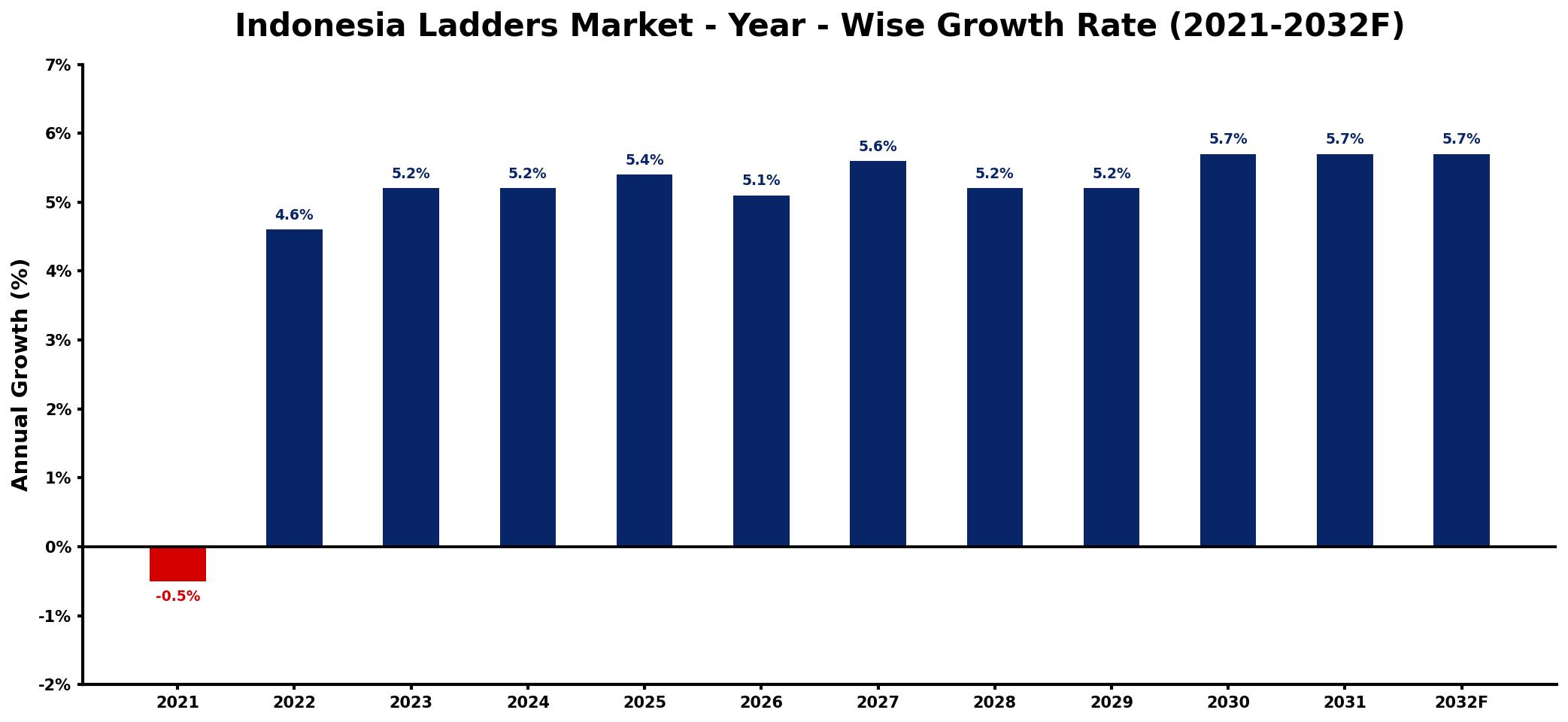
The table below presents the year‑wise growth rates along with the key drivers influencing the market
| Year | Growth Rate | Major Drivers |
| 2021 | -0.5% | Construction sector investment decline |
| 2022 | 4.6% | Residential building projects increase |
| 2023 | 5.2% | Infrastructure development accelerates growth |
| 2024 | 5.2% | Commercial renovation projects expand |
| 2025 | 5.4% | Home improvement trends rise sharply |
| 2026 | 5.1% | Industrial sector demand strengthens |
| 2027 | 5.6% | Green construction initiatives flourish |
| 2028 | 5.2% | Urbanization drives construction growth |
| 2029 | 5.2% | Safety regulations enhance market demand |
| 2030 | 5.7% | Technological advancements boost efficiency |
| 2031 | 5.7% | Export opportunities expand significantly |
| 2032 | 5.7% | Sustainable materials adoption increases |
Note: Market size estimations and growth projections presented in this report are based on 6Wresearch's proprietary forecasting methodology, utilizing the latest available industry data, government publications, and primary research inputs.
Indonesia Ladders Market Synopsis
The Indonesian ladders market is currently witnessing an upward trajectory fueled by a booming construction industry and a vibrant DIY culture among homeowners. As urbanization intensifies, the need for reliable access solutions in construction and maintenance activities is becoming more critical than ever.
Manufacturers are increasingly prioritizing safety, ergonomic design, and durability in their product offerings to meet diverse consumer needs, from professionals on job sites to DIY enthusiasts. The convergence of these factors positions the Indonesian ladders market for sustained growth in the coming years.
Indonesia Ladders Market Key Takeaways
- The market is primarily driven by construction, maintenance, and industrial activities.
- There is a growing focus on safety and quality compliance among manufacturers.
- DIY trends among homeowners are significantly boosting consumer segment sales.
- The market is anticipated to grow steadily due to urbanization and increasing multi-story buildings.
- Challenges include compliance with international safety standards and fluctuating demand dynamics.
Evaluation of Restraints in Indonesia Ladders Market
Despite its growth prospects, the Indonesia Ladders Market faces significant constraints related to safety and quality standards compliance. Many manufacturers struggle to meet international safety protocols, which can affect consumer trust and product adoption. Additionally, the variable demand from the construction and industrial sectors poses a forecasting challenge for manufacturers, complicating production and inventory management.
Indonesia Ladders Market Trends
Current trends show an increasing emphasis on ladder designs that enhance safety and usability. Innovations, such as lightweight materials and modular designs, are becoming prominent, catering to both industrial applications and individual consumers. Furthermore, eco-friendly materials are gaining traction, reflecting a broader consumer preference for sustainable products.
Indonesia Ladders Market Opportunities
The ongoing urbanization in Indonesia presents substantial opportunities for the ladders market. As cities expand and infrastructure projects increase, there is a heightened need for reliable and versatile access solutions. Additionally, the growing trend of home improvement provides manufacturers with a lucrative market segment, where tailored solutions can be marketed effectively to homeowners.
Government Initiatives in the Indonesia Ladders Market
The Indonesian government is increasingly focusing on infrastructure development, which includes various initiatives to boost the construction sector. Policies promoting safety standards in construction practices are also encouraging the adoption of high-quality ladders. Furthermore, public spending on housing and urban development is likely to drive demand for access solutions in the coming years.
Future Insights of the Indonesia Ladders Market
Looking ahead to the 2026-2032 period, the Indonesia Ladders Market is poised for robust growth driven by consistent construction activity and rising safety awareness among consumers. Manufacturers who invest in innovative designs and focus on compliance with safety standards will likely gain a competitive edge. As Indonesia's urban landscape evolves, the integration of technology in ladder design is expected to further enhance market potential.
Indonesia Ladders Market Latest Developments (2025 - 2026)
Recent developments in the Indonesia Ladders Market indicate a stronger emphasis on sustainability, with manufacturers exploring eco-friendly materials and production methods. Additionally, the industry is witnessing a surge in product launches aimed at addressing safety standards and enhancing user experience. Market players are also leveraging digital platforms for better consumer engagement and sales, adapting to the changing retail landscape.
Indonesia Ladders Market - Key Attractiveness of the Report
- 10 Years of Market Numbers
- Historical Data Starting from 2022 to 2025
- Base Year: 2025
- Forecast Data until 2032
- Key Performance Indicators Impacting the Market
- Major Upcoming Developments and Projects
Key Highlights of the Report:
- Indonesia Ladders Market Outlook
- Market Size of Indonesia Ladders Market, 2025
- Forecast of Indonesia Ladders Market, 2032
- Historical Data and Forecast of Indonesia Ladders Revenues & Volume for the Period 2022-2032F
- Indonesia Ladders Market Trend Evolution
- Indonesia Ladders Market Drivers and Challenges
- Indonesia Ladders Price Trends
- Indonesia Ladders Porter's Five Forces
- Indonesia Ladders Industry Life Cycle
- Historical Data and Forecast of Indonesia Ladders Market Revenues & Volume By Application for the Period 2022-2032F
- Historical Data and Forecast of Indonesia Ladders Market Revenues & Volume By Industrial for the Period 2022-2032F
- Historical Data and Forecast of Indonesia Ladders Market Revenues & Volume By Domestic for the Period 2022-2032F
- Historical Data and Forecast of Indonesia Ladders Market Revenues & Volume By Commercial for the Period 2022-2032F
- Indonesia Ladders Import Export Trade Statistics
- Market Opportunity Assessment By Application
- Indonesia Ladders Top Companies Market Share
- Indonesia Ladders Competitive Benchmarking By Technical and Operational Parameters
- Indonesia Ladders Company Profiles
- Indonesia Ladders Key Strategic Recommendations






































