Indonesia Lithographic Printing for Packaging Market Summary
The indonesia lithographic printing for packaging market was estimated at USD 214 Million in 2025 and is projected to reach USD 285 Million by 2032, growing at a CAGR of 5.7% from 2026 to 2032.
Indonesia Lithographic Printing for Packaging Market Year-wise Growth Rate and Key Drivers
This graph highlights how the Indonesia Lithographic Printing for Packaging Market has steadily grown over the past five years, supported by major growth factors.
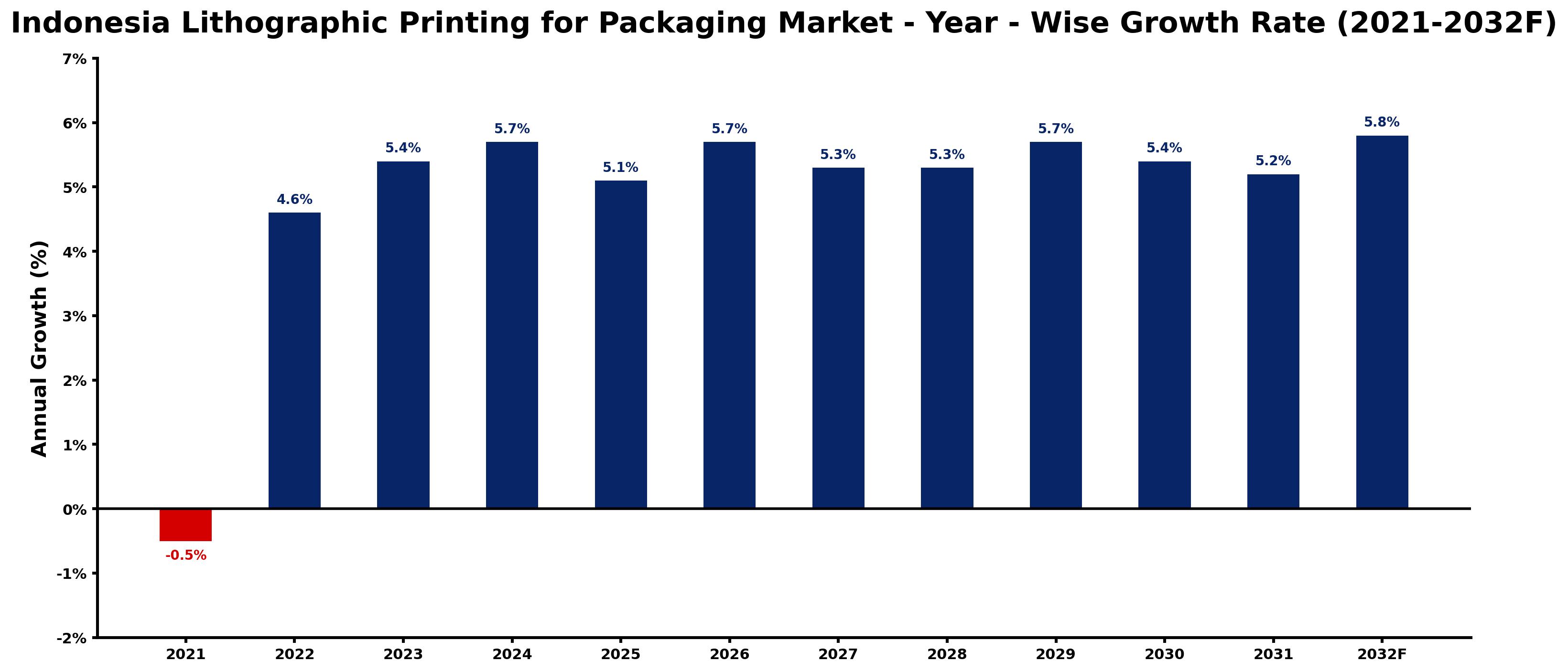
The table below presents the year wise growth rates along with the key drivers influencing the market
| Year | Growth Rate | Major Drivers |
| 2021 | -0.5% | Economic uncertainty and prolonged pandemic effects diminished investment in packaging innovations and upgrades. |
| 2022 | 4.6% | Investment in sustainable materials propels innovation within the lithographic printing segment. |
| 2023 | 5.4% | Technological upgrades in printing machinery enhance production efficiency and quality standards. |
| 2024 | 5.7% | E-commerce expansion demands diverse packaging solutions catering to online consumer preferences. |
| 2025 | 5.1% | Branding strategies increasingly prioritize unique packaging designs, fostering competition among printers. |
| 2026 | 5.7% | Rising disposable income among consumers influences premium packaging market segments. |
| 2027 | 5.3% | Increased awareness of environmental issues drives the shift towards eco-friendly printing solutions. |
| 2028 | 5.3% | Partnerships between brands and printers emphasize customized packaging for enhanced customer experiences. |
| 2029 | 5.7% | Development of urban areas fuels demand for localized packaging that supports local businesses. |
| 2030 | 5.4% | Technological convergence in digital and analog printing offers hybrid packaging solutions. |
| 2031 | 5.2% | Regulatory frameworks increasingly favor sustainable practices, impacting materials used in printing. |
| 2032 | 5.8% | Market consolidation among printers enhances capabilities and expands service offerings across regions. |
Note - Market size estimations and growth projections presented in this report are based on 6Wresearch's advanced forecasting approach, validated with industry datasets as of June 2026.
Indonesia Lithographic Printing for Packaging Market Synopsis
The Indonesia Lithographic Printing for Packaging Market is projected to reach 5.7% and witness significant growth during the forecast period (2026-2032). The increasing demand for printed packaging products is primarily driving this market, coupled with their expanding applications across various end-user segments. Advancements in technology, a shift toward eco-friendly designs, improved cost efficiency, and enhanced print quality are also significant contributors to the market's growth trajectory. Additionally, innovations in digital printing technologies have bolstered consumer adoption, facilitating quicker turnaround times and greater customization options for lithographic prints.
Indonesia Lithographic Printing for Packaging Market Growth Drivers
The market is benefiting from several key factors that are shaping its future. The following elements are crucial in facilitating market expansion:
- Rising Consumer Demand: The proliferation of e-commerce and retail sectors has led to an increased need for attractive and functional packaging, propelling the demand for lithographic printing.
- Sustainable Packaging Practices: Stringent regulations concerning product safety and environmental sustainability have heightened the focus on using sustainable materials, such as paperboard, consequently driving the demand for lithographic printing services.
- Technological Advancements: Innovations such as web-to-print solutions enable customers to easily design and order customized labels online, reducing miscommunication and waste associated with traditional methods.
- Enhanced Print Quality: Lithographic printing is recognized for its superior resolution, allowing businesses to achieve high-quality visuals and detailed graphics that enhance the marketability of their products.
- Cost Efficiency: The reduced setup times associated with lithographic printing compared to traditional methods significantly lower production costs, making it an attractive option for manufacturers.
Indonesia Lithographic Printing for Packaging Market Trends and Opportunities
The Indonesia Lithographic Printing for Packaging Market is currently experiencing several noteworthy trends that present robust opportunities for growth:
- Increased Customization: Brands are increasingly looking for personalized packaging solutions to differentiate themselves in a crowded marketplace, creating demand for lithographic printing that offers customization capabilities.
- Integration of Digital Technologies: The seamless integration of digital technologies with traditional lithographic methods is providing enhanced flexibility and efficiency, allowing for faster production cycles and lower costs.
- Mainstream Adoption of Eco-friendly Inks: The industry is witnessing a shift toward water-based inks that meet global environmental standards, thus appealing to eco-conscious consumers.
- Focus on Brand Identity: As competition intensifies, businesses are leveraging lithographic printing to reinforce their brand identity through unique and appealing packaging designs.
- Emergence of Smart Packaging: The adoption of smart packaging solutions, which incorporate technology such as QR codes and NFC tags, is becoming more prevalent, providing new avenues for lithographic printing applications.
Indonesia Lithographic Printing for Packaging Market Challenges and Restraints
While the market is set for growth, several challenges may impact its trajectory:
- Raw Material Costs: Fluctuations in the prices of raw materials used in lithographic printing may create cost pressures for manufacturers, affecting profitability.
- Regulatory Compliance: Adhering to an evolving landscape of regulations governing packaging materials can pose challenges, requiring continuous adaptation from businesses.
- Competition from Digital Printing: The rise of digital printing technologies, which offer significant advantages in terms of flexibility and turnaround, presents challenges to traditional lithographic printing.
- Environmental Concerns: As customers demand more sustainable options, lithographic printers must innovate continuously to meet these expectations without sacrificing quality.
- Market Saturation: The increasing number of providers in the lithographic printing space could lead to market saturation, making differentiation crucial for maintaining competitive advantage.
Indonesia Lithographic Printing for Packaging Market Government Investment and Initiatives
The Indonesian government has recognized the importance of the lithographic printing sector within its broader economic framework and is actively promoting growth through various initiatives.
These initiatives focus on enhancing industrial capabilities, encouraging sustainable practices, and supporting technological advancements. The government is also offering incentives aimed at reducing the operational costs of packaging companies that adopt environmentally friendly materials and processes. Investments in infrastructure to support logistics for the packaging industry are part of a broader strategy to stimulate economic growth and improve export capabilities.
Indonesia Lithographic Printing for Packaging Market Latest Developments (May 2025 - June 2026)
Recent developments within the Indonesia Lithographic Printing for Packaging Market reveal a dynamic and evolving industry landscape. Throughout this period, companies have increasingly turned to sustainability, with many adopting innovative processes and materials that meet eco-friendly standards.
Investments in advanced printing technologies have risen, allowing for cost-effective production while enhancing print quality. Additionally, market participants have focused on expanding their digital capabilities, improving customization options for clients. The regulatory framework has also evolved, with more stringent environmental standards spurring companies to adapt their processes accordingly. This continuous progression illustrates the market's resilience and adaptability to changing consumer and regulatory demands.
Indonesia Lithographic Printing for Packaging Market - Key Attractiveness of the Report
- 10 Years of Market Numbers
- Historical Data Starting from 2022 to 2025
- Base Year: 2025
- Forecast Data until 2032
- Key Performance Indicators Impacting the Market
- Major Upcoming Developments and Projects
Key Highlights of the Report:
- Indonesia Lithographic Printing for Packaging Market Outlook
- Market Size of Indonesia Lithographic Printing for Packaging Market, 2025
- Forecast of Indonesia Lithographic Printing for Packaging Market, 2032F
- Historical Data and Forecast of Indonesia Lithographic Printing for Packaging Revenues & Volume for the Period 2022-2032F
- Indonesia Lithographic Printing for Packaging Market Trend Evolution
- Indonesia Lithographic Printing for Packaging Market Drivers and Challenges
- Indonesia Lithographic Printing for Packaging Price Trends
- Indonesia Lithographic Printing for Packaging Porter's Five Forces
- Indonesia Lithographic Printing for Packaging Industry Life Cycle
- Historical Data and Forecast of Indonesia Lithographic Printing for Packaging Market Revenues & Volume By Printing Ink Types for the Period 2022-2032F
- Historical Data and Forecast of Indonesia Lithographic Printing for Packaging Market Revenues & Volume By U.V based for the Period 2022-2032F
- Historical Data and Forecast of Indonesia Lithographic Printing for Packaging Market Revenues & Volume By Aqueous for the Period 2022-2032F
- Historical Data and Forecast of Indonesia Lithographic Printing for Packaging Market Revenues & Volume By Strikethrough for the Period 2022-2032F
- Historical Data and Forecast of Indonesia Lithographic Printing for Packaging Market Revenues & Volume By Material for the Period 2022-2032F
- Historical Data and Forecast of Indonesia Lithographic Printing for Packaging Market Revenues & Volume By Paper & Paperboard for the Period 2022-2032F
- Historical Data and Forecast of Indonesia Lithographic Printing for Packaging Market Revenues & Volume By Plastic for the Period 2022-2032F
- Historical Data and Forecast of Indonesia Lithographic Printing for Packaging Market Revenues & Volume By Application for the Period 2022-2032F
- Historical Data and Forecast of Indonesia Lithographic Printing for Packaging Market Revenues & Volume By Food & Beverages for the Period 2022-2032F
- Historical Data and Forecast of Indonesia Lithographic Printing for Packaging Market Revenues & Volume By Cosmetics & Toiletries for the Period 2022-2032F
- Historical Data and Forecast of Indonesia Lithographic Printing for Packaging Market Revenues & Volume By Healthcare for the Period 2022-2032F
- Historical Data and Forecast of Indonesia Lithographic Printing for Packaging Market Revenues & Volume By Other? for the Period 2022-2032F
- Indonesia Lithographic Printing for Packaging Import Export Trade Statistics
- Market Opportunity Assessment By Printing Ink Types
- Market Opportunity Assessment By Material
- Market Opportunity Assessment By Application
- Indonesia Lithographic Printing for Packaging Top Companies Market Share
- Indonesia Lithographic Printing for Packaging Competitive Benchmarking By Technical and Operational Parameters
- Indonesia Lithographic Printing for Packaging Company Profiles
- Indonesia Lithographic Printing for Packaging Key Strategic Recommendations






































