Indonesia Log Management Market Size & Growth Rate (2026-2032)
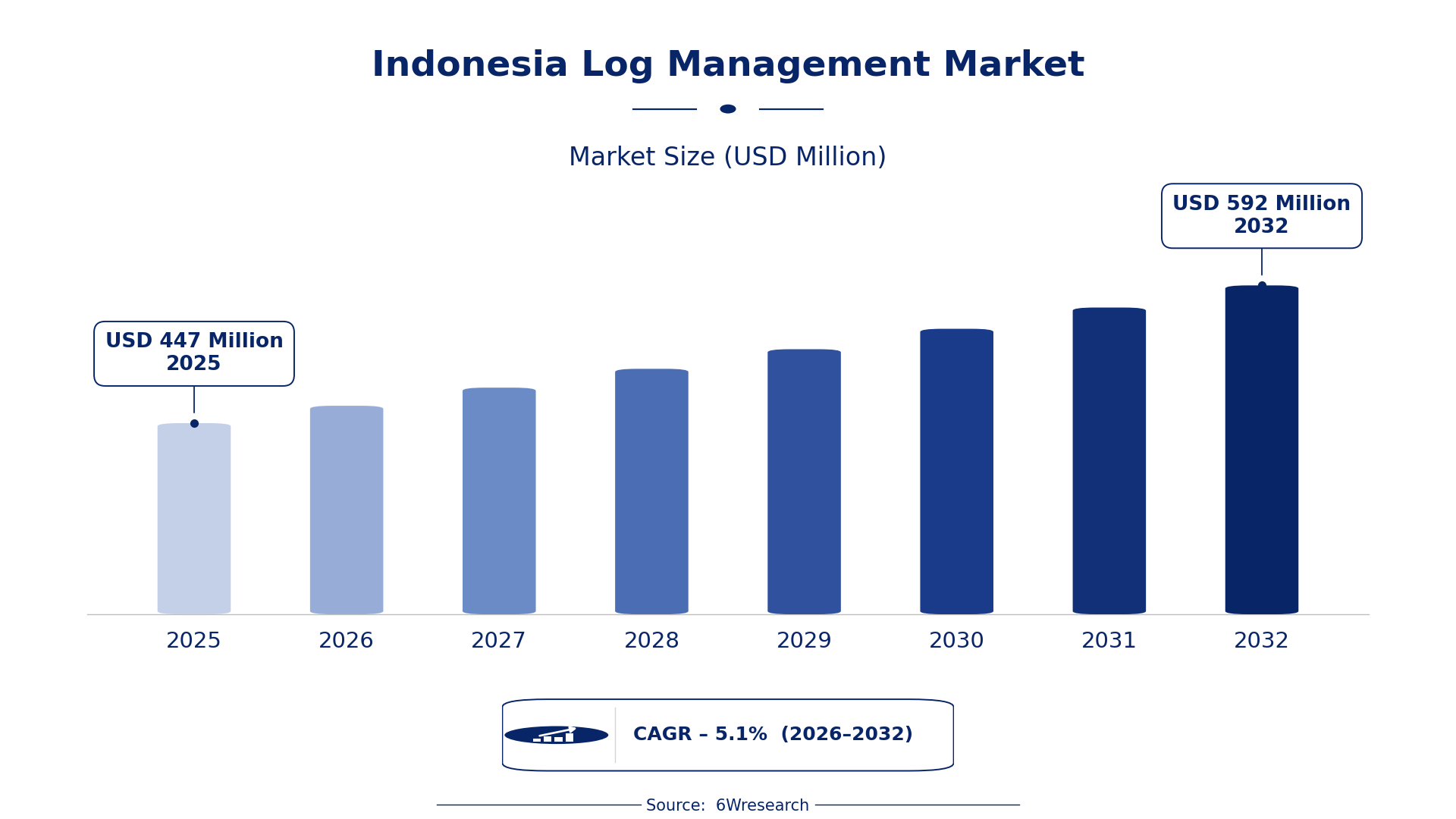
The Indonesia Log Management Market was estimated at USD 447 Million in 2025 and is projected to reach USD 592 Million by 2032, growing at a CAGR of 5.1% from 2026 to 2032.
Indonesia Log Management Market Synopsis
As organizations across Indonesia realize the importance of data management, the log management market is witnessing a notable surge. While the current landscape reflects a strong demand for log management solutions, future growth will largely hinge on how well organizations adapt to increasing data complexity and evolving compliance requirements.
The market has seen a substantial uptick in interest due to a heightened focus on security measures and operational efficiency. However, the ability to effectively harness data while keeping costs manageable will define the trajectory of log management solutions in Indonesia.
Indonesia Log Management Market Year-wise Growth Rate and Key Drivers
This graph illustrates the annual growth rates of the Indonesia Log Management Market from 2021 to 2032, highlighting a steady upward trajectory and projected expansion over the forecast period.
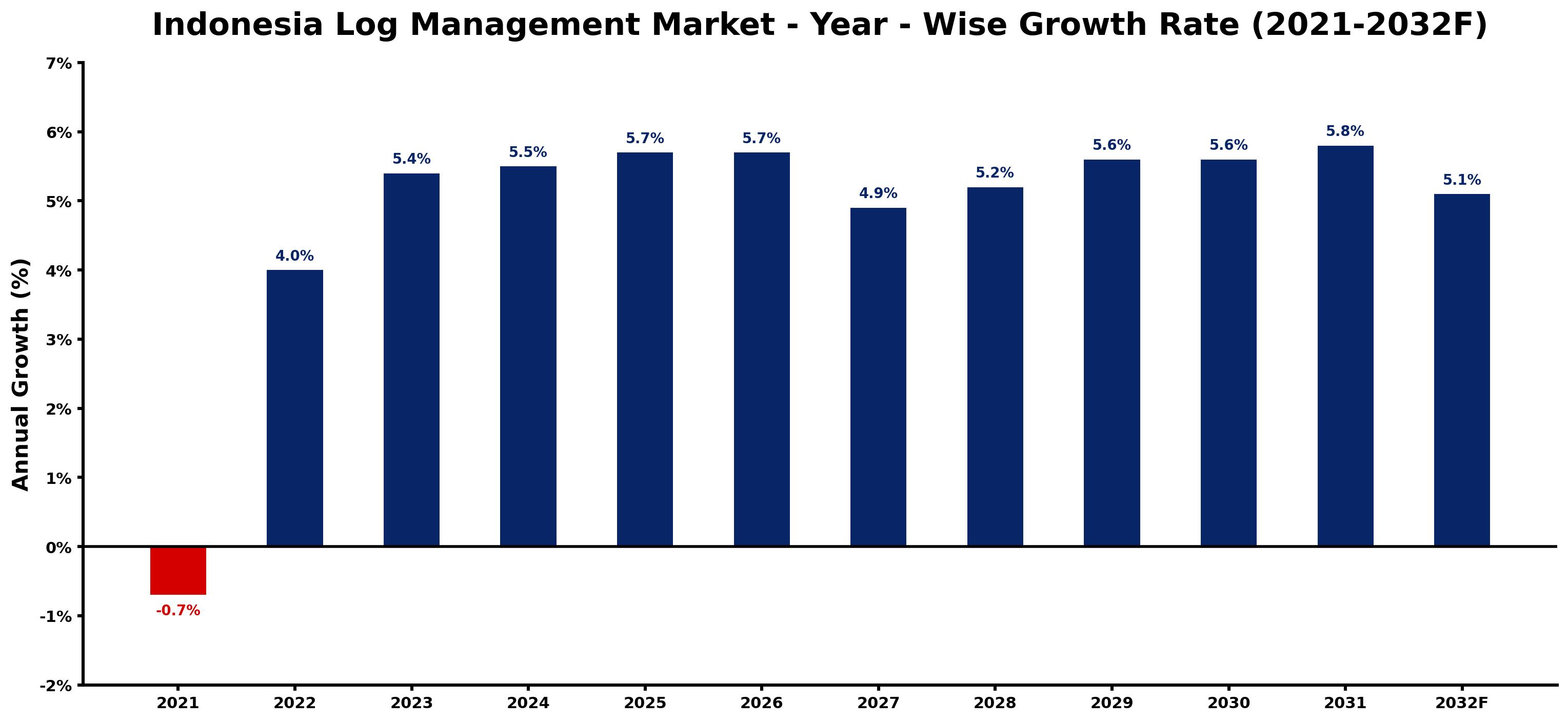
The table below presents the year‑wise growth rates along with the key drivers influencing the market
| Year | Growth Rate | Major Drivers |
| 2021 | -0.7% | Government data localization regulations hindered cloud adoption. |
| 2022 | 4.0% | National Cybersecurity Strategy boosting log management adoption. |
| 2023 | 5.4% | Rising awareness of data privacy regulations enhancing monitoring needs. |
| 2024 | 5.5% | Increased digital transaction volume driving log analysis demand. |
| 2025 | 5.7% | Public sector digitalization efforts requiring robust log solutions. |
| 2026 | 5.7% | Telecommunications sector growth necessitating advanced log tracking. |
| 2027 | 4.9% | Local tech startups focusing on integrated log management tools. |
| 2028 | 5.2% | E-commerce expansion creating higher log generation rates. |
| 2029 | 5.6% | Financial services sector enhancing cybersecurity, increasing log demand. |
| 2030 | 5.6% | Government regulations mandating comprehensive data logging practices. |
| 2031 | 5.8% | IT incidents raising need for improved log auditing solutions. |
| 2032 | 5.1% | Rising adoption of cloud services driving log management needs. |
Note: Market size estimations and growth projections presented in this report are based on 6Wresearch's proprietary forecasting methodology, utilizing the latest available industry data, government publications, and primary research inputs.
Indonesia Log Management Market Key Takeaways
Below are some of the specific key takeaways from the market, including:
- Growing concerns about security and compliance are driving investment in log management tools.
- COVID-19 has accelerated the demand for log management as businesses adapt to increased remote work.
- Complexity in managing extensive log data presents ongoing challenges for organizations.
- Efficient log management is vital for real-time anomaly detection and operational improvements.
- The market is increasingly characterized by advancements in automation and analytics capabilities.
Evaluation of Restraints in Indonesia Log Management Market
Despite its growth potential, the Indonesia log management market faces serious challenges. Organizations grapple with the overwhelming volume of data produced, which complicates effective log collection and analysis. Balancing data retention requirements with cost constraints can stifle innovation and limit investment in advanced log management solutions. As organizations strive for compliance and operational visibility, the burden of managing extensive log data can deter progress in this essential area.
Indonesia Log Management Market Trends
A significant trend emerging within the Indonesia log management market is the shift towards automation. Businesses are increasingly seeking automated solutions to handle the extensive log data generated by their IT environments. This trend not only enhances efficiency but also ensures a more proactive approach to security.
Additionally, the integration of advanced analytics tools into log management solutions is gaining traction. Companies are prioritizing analytics capabilities that provide deeper insights into log data, aiding in the detection of anomalies and potential threats more effectively.
Indonesia Log Management Market Opportunities
The log management market in Indonesia presents lucrative opportunities, particularly for vendors offering innovative solutions that cater to specific industry needs. Organizations looking to enhance security and compliance can benefit from tailored log management tools that address their unique challenges.
on top of that, businesses that embrace cloud-based log management solutions are likely to experience a competitive edge. The flexibility and scalability of cloud solutions can effectively accommodate growing log data, allowing for smoother operations and enhanced data insights.
Government Initiatives in the Indonesia Log Management Market
The Indonesian government is increasingly recognizing the importance of data management and security, which directly impacts the log management market. Regulatory frameworks are evolving to enhance data protection and compliance standards, encouraging businesses to adopt effective log management solutions. This environment is crucial for maintaining trust and reliability in digital transactions across sectors.
- A regulatory framework introduced in 2023 mandating stronger data protection measures for organizations handling sensitive information.
- A national cybersecurity initiative currently underway aims to bolster the security posture of critical infrastructure by promoting advanced log management practices.
- Planned public-private partnerships expected to focus on improving digital literacy among businesses, facilitating better understanding and adoption of log management tools.
- A recently completed program that incentivizes companies to upgrade their log management systems to comply with new regulatory standards.
Future Insights of the Indonesia Log Management Market
From 2026 to 2032, the Indonesia log management market is set to evolve significantly. As organizations strive for operational excellence and robust security frameworks, the demand for effective log management solutions will only intensify. Companies that can adapt quickly to changing regulations and technological advancements will find themselves well-positioned for growth. The emphasis on automation and advanced analytics will remain a defining characteristic, driving innovations that cater to the expanding data landscape.
Indonesia Log Management Market Latest Developments
In the past year, the Indonesia log management market has seen a variety of developments indicating a move towards more sophisticated solutions. Companies are actively seeking ways to enhance their data management capabilities in response to increasing compliance pressures and operational challenges.
- A major technology vendor launched a new log management solution in early 2023, aimed at automating log data analysis for enhanced security.
- An initiative that began in mid-2023 focuses on integrating AI-driven analytics into existing log management platforms to improve threat detection.
- A partnership formed in late 2023 between regional operators and cybersecurity firms is currently underway to develop integrated log management solutions.
- Plans are in motion for a new public program expected to start by early 2025, promoting cloud-based log management adoption among SMEs.
Indonesia Log Management Market - Key Attractiveness of the Report
- 10 Years of Market Numbers
- Historical Data Starting from 2022 to 2025
- Base Year: 2025
- Forecast Data until 2032
- Key Performance Indicators Impacting the Market
- Major Upcoming Developments and Projects
Key Highlights of the Report:
- Indonesia Log Management Market Outlook
- Market Size of Indonesia Log Management Market, 2025
- Forecast of Indonesia Log Management Market, 2032
- Historical Data and Forecast of Indonesia Log Management Revenues & Volume for the Period 2022-2032F
- Indonesia Log Management Market Trend Evolution
- Indonesia Log Management Market Drivers and Challenges
- Indonesia Log Management Price Trends
- Indonesia Log Management Porter's Five Forces
- Indonesia Log Management Industry Life Cycle
- Historical Data and Forecast of Indonesia Log Management Market Revenues & Volume By Component for the Period 2022-2032F
- Historical Data and Forecast of Indonesia Log Management Market Revenues & Volume By Solution for the Period 2022-2032F
- Historical Data and Forecast of Indonesia Log Management Market Revenues & Volume By Services for the Period 2022-2032F
- Historical Data and Forecast of Indonesia Log Management Market Revenues & Volume By Organization Size for the Period 2022-2032F
- Historical Data and Forecast of Indonesia Log Management Market Revenues & Volume By Large Enterprises for the Period 2022-2032F
- Historical Data and Forecast of Indonesia Log Management Market Revenues & Volume By SMEs for the Period 2022-2032F
- Historical Data and Forecast of Indonesia Log Management Market Revenues & Volume By Deployment Mode for the Period 2022-2032F
- Historical Data and Forecast of Indonesia Log Management Market Revenues & Volume By Cloud for the Period 2022-2032F
- Historical Data and Forecast of Indonesia Log Management Market Revenues & Volume By On-premises for the Period 2022-2032F
- Historical Data and Forecast of Indonesia Log Management Market Revenues & Volume By Vertical for the Period 2022-2032F
- Historical Data and Forecast of Indonesia Log Management Market Revenues & Volume By IT and ITeS for the Period 2022-2032F
- Historical Data and Forecast of Indonesia Log Management Market Revenues & Volume By BFSI for the Period 2022-2032F
- Historical Data and Forecast of Indonesia Log Management Market Revenues & Volume By Healthcare for the Period 2022-2032F
- Historical Data and Forecast of Indonesia Log Management Market Revenues & Volume By Telecom, and Education for the Period 2022-2032F
- Indonesia Log Management Import Export Trade Statistics
- Market Opportunity Assessment By Component
- Market Opportunity Assessment By Organization Size
- Market Opportunity Assessment By Deployment Mode
- Market Opportunity Assessment By Vertical
- Indonesia Log Management Top Companies Market Share
- Indonesia Log Management Competitive Benchmarking By Technical and Operational Parameters
- Indonesia Log Management Company Profiles
- Indonesia Log Management Key Strategic Recommendations






































