Indonesia Lubrication System Market Summary
The indonesia lubrication system market was estimated at USD 225 Million in 2025 and is projected to reach USD 298 Million by 2032, growing at a CAGR of 5.4% from 2026 to 2032.
Indonesia Lubrication System Market Year-wise Growth Rate and Key Drivers
This graph highlights how the Indonesia Lubrication System Market has steadily grown over the past five years, supported by major growth factors.
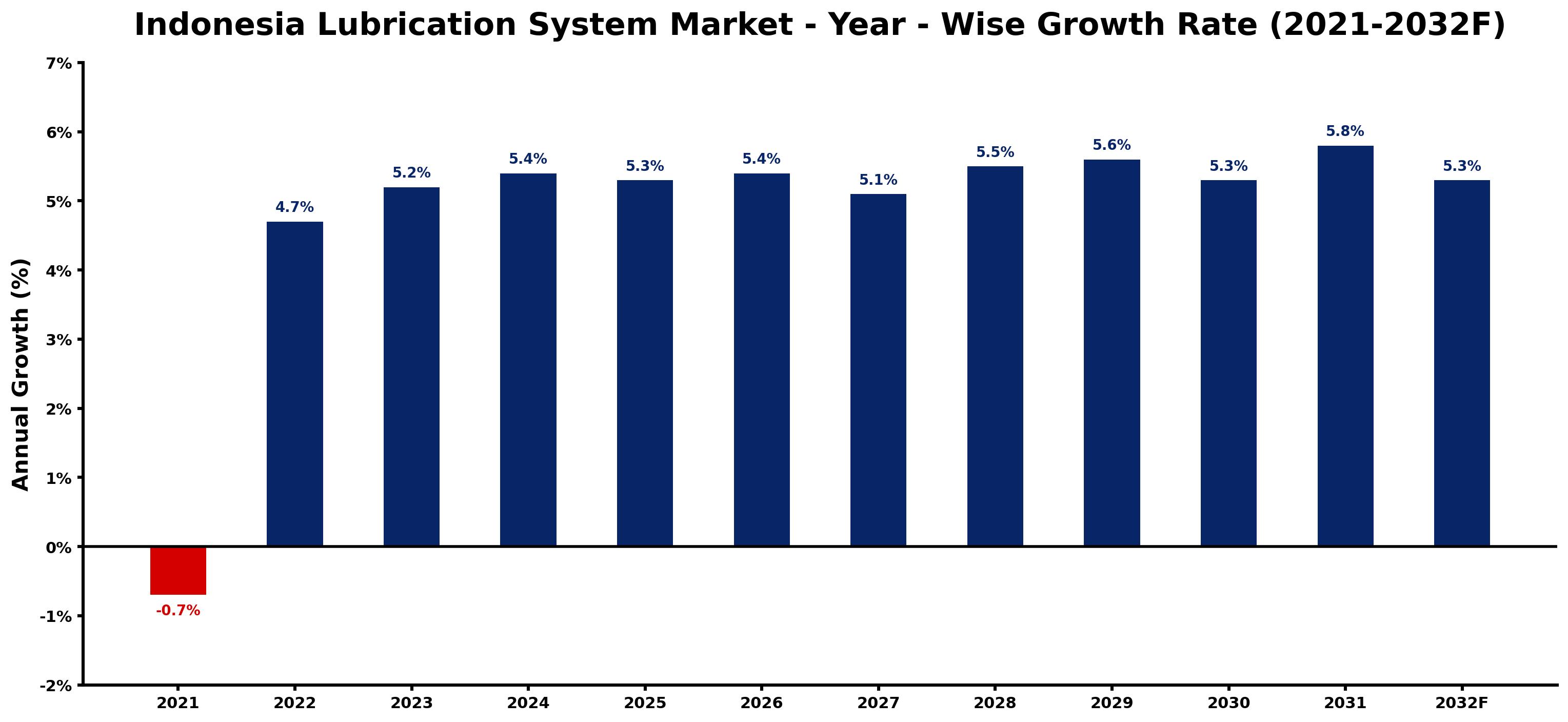
The table below presents the year wise growth rates along with the key drivers influencing the market
| Year | Growth Rate | Major Drivers |
| 2021 | -0.7% | Supply chain disruptions hindered manufacturing capabilities, leading to decreased availability of lubrication products. |
| 2022 | 4.7% | Rising automotive production volumes highlighted the need for efficient lubrication solutions. |
| 2023 | 5.2% | Infrastructure development projects supported by foreign investments prompted lubrication system enhancements. |
| 2024 | 5.4% | Increased awareness of equipment maintenance improved the uptake of advanced lubrication technologies. |
| 2025 | 5.3% | Growth in e-commerce logistics fostered demand for specialized lubrication systems in warehousing. |
| 2026 | 5.4% | Emerging trends in electric vehicles required innovative lubrication products to ensure performance. |
| 2027 | 5.1% | Sustainability pressures encouraged manufacturers to adopt eco-friendly lubrication solutions. |
| 2028 | 5.5% | Enhanced manufacturing capabilities in Indonesia attracted global players seeking lubrication partnerships. |
| 2029 | 5.6% | Rising urbanization created a surge in demand for lubricants in construction machinery. |
| 2030 | 5.3% | Technological advancements in lubrication systems positioned Indonesia as a regional innovation hub. |
| 2031 | 5.8% | Market players increasingly focused on supply chain efficiency to reduce operational costs. |
| 2032 | 5.3% | Collaboration between local firms and multinationals strengthened the overall market landscape. |
Note - Market size estimations and growth projections presented in this report are based on 6Wresearch's advanced forecasting approach, validated with industry datasets as of June 2026.
Indonesia Lubrication System Market Synopsis
The Indonesia Lubrication System Market is projected to reach 5.4% and witness significant growth during the forecast period (2026-2032). The market dynamics are driven by several pivotal factors, including the surging demand for vehicles and the increasing reliance on industrial machinery. Robust investments in infrastructure development are anticipated to create new opportunities for lubricant manufacturers across the nation. Additionally, the rising focus on environmental protection has prompted a shift towards bio-based lubricants, further expanding the horizon for the Indonesia lubrication system market.
Indonesia Lubrication System Market Growth Drivers
The growth trajectory of the Indonesia Lubrication System Market is primarily influenced by the following key drivers:
- The rapid increase in the demand for automobiles is significantly impacting the lubrication market. With the rising disposable income levels, more consumers are purchasing vehicles from leading automotive brands, thereby boosting the sales of automotive lubricants.
- Industrial sectors such as manufacturing, agriculture, and construction are undergoing rapid development, leading to an increased installation of industrial machinery. This trend necessitates frequent maintenance and the application of quality lubricants, driving the demand for lubrication systems.
- Government initiatives aimed at infrastructure development have led to the rise of construction projects across the country, which in turn increases the demand for machinery and associated lubricants.
- Environmental awareness is fostering a shift towards sustainable practices. As a result, the demand for bio-based lubricants is gaining traction among companies keen to align with eco-friendly initiatives.
- Technological advancements in lubrication solutions are paving the way for more efficient products and services, offering greater value to customers and stimulating market growth.
Indonesia Lubrication System Market Challenges and Restraints
Despite the favorable growth prospects, the Indonesia Lubrication System Market faces several challenges that could impede its development:
- Volatility in oil prices can lead to unpredictable fluctuations in the cost of lubricants, impacting manufacturers and consumers alike.
- Intense competition from internationally established brands poses a challenge for local manufacturers struggling to achieve cost competitiveness. Imported lubricants may be offered at lower prices, which affects local market share.
- Limited awareness regarding the benefits of high-quality lubricants among some sectors may result in suboptimal product usage, affecting long-term operational efficiencies.
- Dependency on fossil fuels for traditional lubricants could hinder the adoption of greener alternatives, limiting market growth within specific segments.
- Regulatory challenges and compliance requirements for lubricant manufacturing can increase operational costs, impacting smaller players in the market.
Indonesia Lubrication System Market Investment Opportunities
The Indonesia Lubrication System Market presents several investment opportunities in the coming years, particularly in the following areas:
- Investment in the development and production of bio-based lubricants is becoming increasingly attractive as companies respond to environmental concerns and customer preferences for sustainable products.
- Technological innovation in lubrication systems can provide greater efficiencies and improved performance, making research and development a lucrative avenue for investment.
- Expansion into under-penetrated regions within Indonesia can yield significant returns, especially as urbanization and industrial activities continue to grow.
- Strategic partnerships with local industries could bolster market presence and enhance product distribution networks, optimizing supply chain efficiencies.
- Government-backed initiatives for infrastructure projects create opportunities for lubricant suppliers to engage in long-term contracts, ensuring a stable revenue stream.
Indonesia Lubrication System Market Government Investment and Initiatives
The Indonesian government has been proactive in promoting industrial growth and infrastructure development, which is expected to benefit the lubrication system market significantly. Initiatives aimed at enhancing transportation networks, upgrading manufacturing facilities, and boosting agricultural efficiency are at the forefront of policy agendas. Public spending on infrastructure projects is anticipated to amplify the demand for lubricants across various sectors, creating a conducive environment for market expansion. Moreover, incentives for adopting environmentally friendly practices, including the use of bio-based lubricants, align with global sustainability trends and may further stimulate investments within the lubrication system industry.
Indonesia Lubrication System Market Latest Developments (May 2025 - June 2026)
Recent developments within the Indonesia Lubrication System Market from May 2025 to June 2026 illustrate a shift towards innovation and sustainability. Companies have begun integrating advanced technologies to produce high-performance lubricants, reflecting the industry's response to increasing demands for efficiency. Furthermore, partnerships between local manufacturers and international players have emerged, fostering knowledge transfer and enhancing product offerings. The trend towards bio-based lubricants has gained momentum, with several new products entering the market. Moreover, industry stakeholders are actively participating in government initiatives aimed at infrastructure projects, aligning their growth strategies with national development plans.
Indonesia Lubrication System Market - Key Attractiveness of the Report
- 10 Years of Market Numbers
- Historical Data Starting from 2022 to 2025
- Base Year: 2025
- Forecast Data until 2032
- Key Performance Indicators Impacting the Market
- Major Upcoming Developments and Projects
Key Highlights of the Report:
- Indonesia Lubrication System Market Outlook
- Market Size of Indonesia Lubrication System Market, 2025
- Forecast of Indonesia Lubrication System Market, 2032F
- Historical Data and Forecast of Indonesia Lubrication System Revenues & Volume for the Period 2022-2032F
- Indonesia Lubrication System Market Trend Evolution
- Indonesia Lubrication System Market Drivers and Challenges
- Indonesia Lubrication System Price Trends
- Indonesia Lubrication System Porter's Five Forces
- Indonesia Lubrication System Industry Life Cycle
- Historical Data and Forecast of Indonesia Lubrication System Market Revenues & Volume By Line Type for the Period 2022-2032F
- Historical Data and Forecast of Indonesia Lubrication System Market Revenues & Volume By Manual Lubrication Systems for the Period 2022-2032F
- Historical Data and Forecast of Indonesia Lubrication System Market Revenues & Volume By Automatic Lubrication Systems for the Period 2022-2032F
- Historical Data and Forecast of Indonesia Lubrication System Market Revenues & Volume By Product Type for the Period 2022-2032F
- Historical Data and Forecast of Indonesia Lubrication System Market Revenues & Volume By Single-Product Lubrication Systems for the Period 2022-2032F
- Historical Data and Forecast of Indonesia Lubrication System Market Revenues & Volume By Dual-Product Lubrication Systems for the Period 2022-2032F
- Historical Data and Forecast of Indonesia Lubrication System Market Revenues & Volume By Multi-Product Lubrication Systems for the Period 2022-2032F
- Historical Data and Forecast of Indonesia Lubrication System Market Revenues & Volume By Series Progressive for the Period 2022-2032F
- Historical Data and Forecast of Indonesia Lubrication System Market Revenues & Volume By Circulating Oil for the Period 2022-2032F
- Historical Data and Forecast of Indonesia Lubrication System Market Revenues & Volume By Oil & Air for the Period 2022-2032F
- Historical Data and Forecast of Indonesia Lubrication System Market Revenues & Volume By Application for the Period 2022-2032F
- Historical Data and Forecast of Indonesia Lubrication System Market Revenues & Volume By Cement Plants for the Period 2022-2032F
- Historical Data and Forecast of Indonesia Lubrication System Market Revenues & Volume By Steel Industry for the Period 2022-2032F
- Historical Data and Forecast of Indonesia Lubrication System Market Revenues & Volume By Mining & Mineral Processing for the Period 2022-2032F
- Historical Data and Forecast of Indonesia Lubrication System Market Revenues & Volume By Paper & Printing for the Period 2022-2032F
- Historical Data and Forecast of Indonesia Lubrication System Market Revenues & Volume By Automotive for the Period 2022-2032F
- Historical Data and Forecast of Indonesia Lubrication System Market Revenues & Volume By Industrial Machine & Machine Tools for the Period 2022-2032F
- Historical Data and Forecast of Indonesia Lubrication System Market Revenues & Volume By Construction Machines Machines for the Period 2022-2032F
- Indonesia Lubrication System Import Export Trade Statistics
- Market Opportunity Assessment By Line Type
- Market Opportunity Assessment By Product Type
- Market Opportunity Assessment By Application
- Indonesia Lubrication System Top Companies Market Share
- Indonesia Lubrication System Competitive Benchmarking By Technical and Operational Parameters
- Indonesia Lubrication System Company Profiles
- Indonesia Lubrication System Key Strategic Recommendations






































