Indonesia Magnesium Metal Market Size, Share & Growth Rate
The Indonesia Magnesium Metal Market was estimated at USD 356 Million in 2025 and is projected to reach USD 470 Million by 2032, growing at a CAGR of 4.0% from 2026 to 2032. This growth trajectory is being propelled by rising domestic industrial demand, particularly from the automotive and aerospace sectors, coupled with favorable government policies that encourage investments and innovation. As manufacturers seek to explore new applications for magnesium, both local consumption and export potential are set to rise significantly.
Indonesia Magnesium Metal Market Year-wise Growth Rate and Key Drivers
This graph highlights how the Indonesia Magnesium Metal Market has steadily grown over the years, supported by major growth factors.
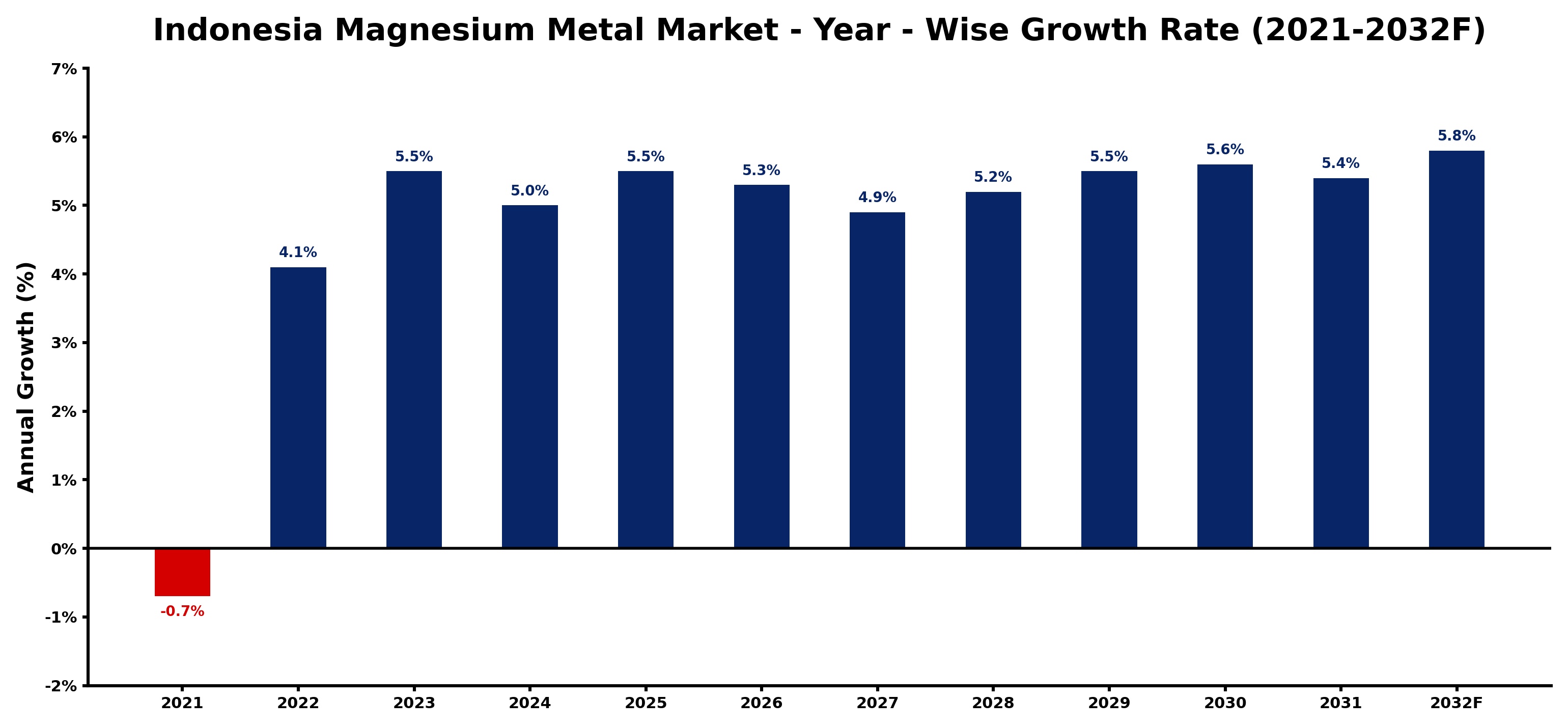
The table below presents the year‑wise growth rates along with the key drivers influencing the market
| Year | Growth Rate | Major Drivers |
| 2021 | -0.7% | Supply chain disruptions affected production |
| 2022 | 4.1% | Automotive sector demand increased significantly |
| 2023 | 5.5% | Construction projects expanded magnesium use |
| 2024 | 5.0% | Aerospace industry growth drove demand |
| 2025 | 5.5% | Renewable energy applications gained traction |
| 2026 | 5.3% | Electronics manufacturing boosted consumption |
| 2027 | 4.9% | Healthcare applications expanded market reach |
| 2028 | 5.2% | Consumer goods innovation drove growth |
| 2029 | 5.5% | Export opportunities enhanced market potential |
| 2030 | 5.6% | Sustainability trends increased magnesium usage |
| 2031 | 5.4% | Infrastructure development fueled demand surge |
| 2032 | 5.8% | Technological advancements improved production efficiency |
Note - Market size estimations and growth projections presented in this report are based on 6Wresearch’s advanced forecasting approach, validated with industry datasets as of June 2026.
Indonesia Magnesium Metal Market Synopsis
As the leading producer of magnesium metal in Southeast Asia, Indonesia plays a crucial role in the global magnesium supply chain. In 2025, the country produced around 18,000 tons of primary magnesium metal, with a significant portion earmarked for exports, especially to major markets like China and India.
However, an uptick in domestic consumption driven by increased industrial activity and innovative applications is reshaping the market landscape. This surge reflects Indonesia's strategic positioning to not only meet international demand but also cater to its growing local industries.
Indonesia Magnesium Metal Market Key Takeaways
- Indonesia is the largest magnesium metal producer in Southeast Asia, with a production output of approximately 18,000 tons in 2025.
- The market is experiencing robust growth, driven by rising domestic demand and increasing investment in key sectors like automotive and aerospace.
- Government initiatives are fostering a conducive environment for market expansion, including tax incentives for manufacturers.
- Projected market growth at a CAGR of 4.0% indicates a healthy outlook through 2032.
- Emerging applications in various industries are creating new opportunities for market players to innovate and diversify their product offerings.
Evaluation of Restraints in Indonesia Magnesium Metal Market
Despite favorable growth conditions, the Indonesia Magnesium Metal Market faces certain restraints that could impede its momentum. Fluctuations in exchange rates may create uncertainties for exporters, affecting profitability margins. Additionally, the availability of cheaper substitutes in the market can challenge the competitive pricing of magnesium products. Environmental concerns related to the extraction processes also pose regulatory hurdles, necessitating ongoing scrutiny and adaptation from market participants.
Indonesia Magnesium Metal Market Trends
The Indonesia magnesium market is witnessing several noteworthy trends. There is a marked shift towards lighter materials in the automotive sector, driven by increased fuel efficiency and emissions regulations, which emphasizes the need for magnesium and its alloys. Furthermore, research into new applications for magnesium in high-performance industries, such as aerospace, is gaining traction. These developments are complemented by advancements in extraction and processing technologies, enhancing the sustainability and efficiency of magnesium production.
Indonesia Magnesium Metal Market Opportunities
The current landscape presents substantial growth and investment opportunities within the Indonesia Magnesium Metal Market. With a focus on sustainable practices, innovations in recycling and secondary production of magnesium offer pathways to not only meet local demand but also enhance export capabilities. Additionally, expanding the application of magnesium in emerging sectors such as renewable energy storage and electric vehicles represents a critical opportunity for market players to diversify their portfolios and capture new customer segments.
Government Initiatives in the Indonesia Magnesium Metal Market
The Indonesian government has implemented several initiatives aimed at bolstering the magnesium industry. These include tax incentives for businesses engaged in magnesium manufacturing and processing, as well as policies designed to attract foreign investment. Furthermore, public spending in infrastructure and technology development is expected to facilitate growth in the sector, creating a more favorable environment for both domestic and international players.
Future Insights of the Indonesia Magnesium Metal Market
Looking ahead to 2026-2032, the Indonesia Magnesium Metal Market is poised for sustained growth. A combination of increasing domestic consumption, particularly in the automotive and aerospace sectors, along with strategic government support, will underpin this expansion. As manufacturers continue to innovate and adopt magnesium across various applications, the market is likely to evolve rapidly, presenting new opportunities and competitive dynamics that stakeholders should actively monitor.
Indonesia Magnesium Metal Market Latest Developments (May 2025 - June 2026)
Recent developments in the Indonesia Magnesium Metal Market indicate a trend towards greater local sourcing amid disruptions in global supply chains. Companies are increasingly investing in enhanced production facilities and research initiatives focused on the sustainable use of magnesium. Additionally, collaborations between industry stakeholders and government bodies are emerging, aimed at advancing technologies that optimize magnesium extraction and processing.
Indonesia Magnesium Metal Market - Key Attractiveness of the Report
- 10 Years of Market Numbers
- Historical Data Starting from 2022 to 2025
- Base Year: 2025
- Forecast Data until 2032
- Key Performance Indicators Impacting the Market
- Major Upcoming Developments and Projects
Key Highlights of the Report:
- Indonesia Magnesium Metal Market Outlook
- Market Size of Indonesia Magnesium Metal Market, 2025
- Forecast of Indonesia Magnesium Metal Market, 2032
- Historical Data and Forecast of Indonesia Magnesium Metal Revenues & Volume for the Period 2022-2032F
- Indonesia Magnesium Metal Market Trend Evolution
- Indonesia Magnesium Metal Market Drivers and Challenges
- Indonesia Magnesium Metal Price Trends
- Indonesia Magnesium Metal Porter's Five Forces
- Indonesia Magnesium Metal Industry Life Cycle
- Historical Data and Forecast of Indonesia Magnesium Metal Market Revenues & Volume By Application for the Period 2022-2032F
- Historical Data and Forecast of Indonesia Magnesium Metal Market Revenues & Volume By Die Casting for the Period 2022-2032F
- Historical Data and Forecast of Indonesia Magnesium Metal Market Revenues & Volume By Aluminum Alloys for the Period 2022-2032F
- Historical Data and Forecast of Indonesia Magnesium Metal Market Revenues & Volume By Titanium Reduction for the Period 2022-2032F
- Historical Data and Forecast of Indonesia Magnesium Metal Market Revenues & Volume By Iron & Steel Making for the Period 2022-2032F
- Historical Data and Forecast of Indonesia Magnesium Metal Market Revenues & Volume By Others for the Period 2022-2032F
- Historical Data and Forecast of Indonesia Magnesium Metal Market Revenues & Volume By End-user Industry for the Period 2022-2032F
- Historical Data and Forecast of Indonesia Magnesium Metal Market Revenues & Volume By Automotive for the Period 2022-2032F
- Historical Data and Forecast of Indonesia Magnesium Metal Market Revenues & Volume By Aerospace for the Period 2022-2032F
- Historical Data and Forecast of Indonesia Magnesium Metal Market Revenues & Volume By Electronics for the Period 2022-2032F
- Historical Data and Forecast of Indonesia Magnesium Metal Market Revenues & Volume By Sports for the Period 2022-2032F
- Historical Data and Forecast of Indonesia Magnesium Metal Market Revenues & Volume By Medical for the Period 2022-2032F
- Historical Data and Forecast of Indonesia Magnesium Metal Market Revenues & Volume By Others for the Period 2022-2032F
- Indonesia Magnesium Metal Import Export Trade Statistics
- Market Opportunity Assessment By Application
- Market Opportunity Assessment By End-user Industry
- Indonesia Magnesium Metal Top Companies Market Share
- Indonesia Magnesium Metal Competitive Benchmarking By Technical and Operational Parameters
- Indonesia Magnesium Metal Company Profiles
- Indonesia Magnesium Metal Key Strategic Recommendations






































