Indonesia Managed Security Services Market Summary
The indonesia managed security services market was estimated at USD 437 Million in 2025 and is projected to reach USD 581 Million by 2032, growing at a CAGR of 5.1% from 2026 to 2032.
Indonesia Managed Security Services Market Year-wise Growth Rate and Key Drivers
This graph highlights how the Indonesia Managed Security Services Market has steadily grown over the past five years, supported by major growth factors.
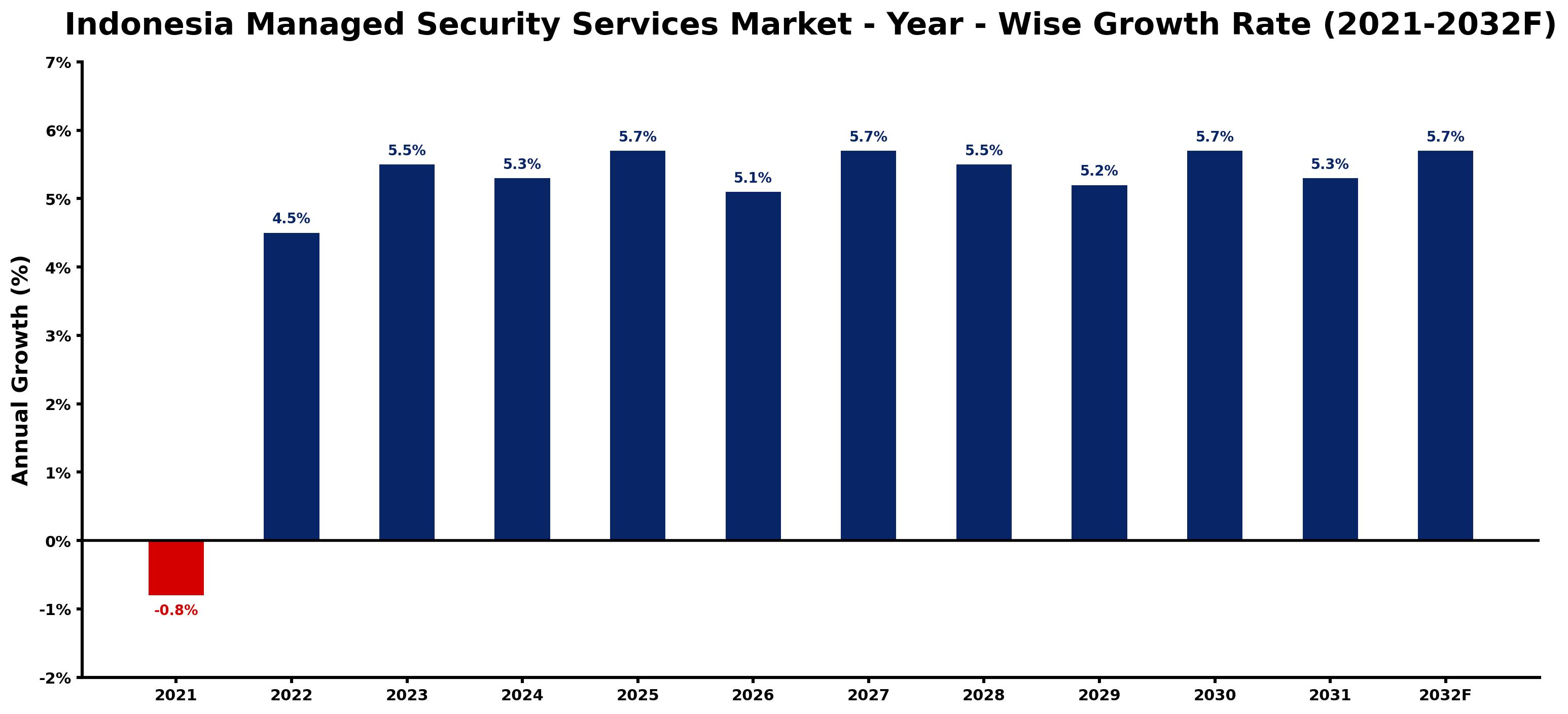
The table below presents the year wise growth rates along with the key drivers influencing the market
| Year | Growth Rate | Major Drivers |
| 2021 | -0.8% | Intensified competition from local providers led to price reductions, undermining overall market value and growth. |
| 2022 | 4.5% | Ransomware attacks increased, prompting businesses to reassess their cybersecurity strategies significantly. |
| 2023 | 5.5% | Emerging technologies like IoT presented new security challenges requiring managed service adaptations. |
| 2024 | 5.3% | Corporate budgets reflected a noticeable shift towards prioritizing cybersecurity investments over traditional IT. |
| 2025 | 5.7% | Cybersecurity talent shortages intensified, elevating demand for outsourced managed security services. |
| 2026 | 5.1% | Local enterprises began emphasizing compliance, driving up interest in tailored security solutions. |
| 2027 | 5.7% | Collaboration between tech firms and security providers fostered innovative service offerings in the market. |
| 2028 | 5.5% | Regional geopolitical tensions heightened, creating urgency for robust security measures among corporations. |
| 2029 | 5.2% | Increased awareness of data privacy laws incentivized businesses to enhance their security postures. |
| 2030 | 5.7% | The integration of AI in security services enhanced threat detection capabilities and efficiency. |
| 2031 | 5.3% | Digital banking expansion necessitated stronger security frameworks for financial service providers. |
| 2032 | 5.7% | Sustainable business practices influenced provider operations, focusing on eco-friendly security solutions. |
Note - Market size estimations and growth projections presented in this report are based on 6Wresearch's advanced forecasting approach, validated with industry datasets as of June 2026.
Indonesia Managed Security Services Market Synopsis
The Indonesia Managed Security Services Market is projected to reach 5.1% and witness significant growth during the forecast period (2026-2032). This dynamic market is rapidly emerging as a focal point for cybersecurity investments in Southeast Asia. The increase in digital transformation initiatives across various sectors has created an upsurge in demand for managed security services. Furthermore, heightened awareness of cybersecurity risks among organizations is driving the adoption of robust security frameworks and solutions. Government-driven digital initiatives, such as e-Government Indonesia, are also anticipated to bolster the market landscape, creating favorable conditions for both local and international service providers.
Indonesia Managed Security Services Market Growth Drivers
The growth trajectory of the Indonesia Managed Security Services Market can be attributed to several key factors:
- Increased digitalization among businesses has led to a higher demand for advanced cybersecurity solutions, as organizations seek to protect sensitive data and maintain the integrity of their operations.
- The adoption of cloud technologies has prompted businesses to rely on managed security services to ensure comprehensive security measures are in place, allowing them to focus on core business activities.
- The growing frequency of cyberattacks and data breaches has raised awareness and urgency in organizations to invest in proactive security measures, driving demand for managed security services.
- Government initiatives aimed at enhancing the country's cybersecurity infrastructure are providing a conducive environment for the growth of managed security services, contributing to overall market development.
- A shift towards compliance with international cybersecurity standards is pushing organizations to adopt managed services that ensure adherence and mitigate risks associated with non-compliance.
Indonesia Managed Security Services Market Challenges and Restraints
Despite the positive outlook, the Indonesia Managed Security Services Market faces several challenges:
- A shortage of skilled cybersecurity professionals has resulted in increased competition for talent among service providers, impacting service quality and innovation.
- There is often a lack of awareness among small and medium enterprises about the benefits of managed security services, leading to underinvestment in necessary cybersecurity solutions.
- The evolving nature of cyber threats necessitates continuous adaptation and upgrading of security measures, which can be financially burdensome for some organizations.
- Regulatory compliance continues to evolve, and organizations may struggle to keep pace with changing laws and standards, leading to potential risks in their security posture.
- Concerns surrounding data privacy and protection can hinder organizations from fully embracing managed security services, particularly in industries handling sensitive information.
Indonesia Managed Security Services Market Government Investment and Initiatives
The Indonesian government has recognized the importance of enhancing the nation's cybersecurity capabilities, prompting various initiatives aimed at fostering growth in the managed security services sector. Key aspects of government investment and initiatives include:
- Implementation of national cybersecurity strategies that prioritize the strengthening of defenses against cyber threats across both public and private sectors.
- Promotion of e-Government initiatives that not only enhance public service delivery but also create a demand for secure IT infrastructures and managed security solutions.
- Financial incentives and funding opportunities for organizations that invest in cybersecurity technologies, aimed at increasing adoption rates among enterprises.
- Collaboration with international partners to leverage expertise and technologies in developing robust cybersecurity frameworks tailored to local needs.
- Establishment of cybersecurity awareness programs to educate organizations on the importance of security measures and the role of managed services in mitigating risks.
Indonesia Managed Security Services Market Latest Developments (May 2025 - June 2026)
Recent developments in the Indonesia Managed Security Services Market indicate a continued focus on innovation and responsiveness to emerging cyber threats. During the period from May 2025 to June 2026, several notable trends have emerged:
- Increased collaboration among service providers to create integrated cybersecurity solutions that cater to the unique challenges faced by different sectors.
- Advancements in artificial intelligence and machine learning technologies have begun to reshape the landscape of managed security services, enabling more proactive threat detection and response capabilities.
- The push towards compliance with international frameworks, such as GDPR and PCI-DSS, has led organizations to reassess their security strategies and engage more deeply with managed service providers.
- An increase in cyber insurance offerings has been observed, as companies seek to mitigate potential losses from cyber incidents, further driving awareness of managed security services.
- The development of specialized managed security services that cater to critical industries, such as healthcare and finance, has gained traction, reflecting the need for tailored approaches to security challenges.
Indonesia Managed Security Services Market - Key Attractiveness of the Report
- 10 Years of Market Numbers
- Historical Data Starting from 2022 to 2025
- Base Year: 2025
- Forecast Data until 2032
- Key Performance Indicators Impacting the Market
- Major Upcoming Developments and Projects
The growth is driven by increased digitalization, rising cybersecurity threats, government initiatives, and a shift towards cloud-based security solutions.
The government is implementing national strategies, promoting e-Government initiatives, and providing financial incentives for cybersecurity investments.
Challenges include a shortage of skilled professionals, evolving regulatory compliance, and concerns over data privacy.
Recent trends include advancements in AI technologies, an increase in cyber insurance offerings, and growth in specialized services for critical industries.
Key Highlights of the Report:
- Indonesia Managed Security Services Market Outlook
- Market Size of Indonesia Managed Security Services Market, 2025
- Forecast of Indonesia Managed Security Services Market, 2032
- Historical Data and Forecast of Indonesia Managed Security Services Revenues & Volume for the Period 2022-2032
- Indonesia Managed Security Services Market Trend Evolution
- Indonesia Managed Security Services Market Drivers and Challenges
- Indonesia Managed Security Services Price Trends
- Indonesia Managed Security Services Porter's Five Forces
- Indonesia Managed Security Services Industry Life Cycle
- Historical Data and Forecast of Indonesia Managed Security Services Market Revenues & Volume By Type for the Period 2022-2032
- Historical Data and Forecast of Indonesia Managed Security Services Market Revenues & Volume By Unified threat management for the Period 2022-2032
- Historical Data and Forecast of Indonesia Managed Security Services Market Revenues & Volume By DDoS for the Period 2022-2032
- Historical Data and Forecast of Indonesia Managed Security Services Market Revenues & Volume By Managed SIEM for the Period 2022-2032
- Historical Data and Forecast of Indonesia Managed Security Services Market Revenues & Volume By Managed endpoint threat detection for the Period 2022-2032
- Historical Data and Forecast of Indonesia Managed Security Services Market Revenues & Volume By Managed two factor authentication for the Period 2022-2032
- Historical Data and Forecast of Indonesia Managed Security Services Market Revenues & Volume By Compliance management for the Period 2022-2032
- Historical Data and Forecast of Indonesia Managed Security Services Market Revenues & Volume By Vulnerability management for the Period 2022-2032
- Historical Data and Forecast of Indonesia Unified threat management Managed Security Services Market Revenues & Volume By Others for the Period 2022-2032
- Historical Data and Forecast of Indonesia Managed Security Services Market Revenues & Volume By Deployment for the Period 2022-2032
- Historical Data and Forecast of Indonesia Managed Security Services Market Revenues & Volume By Cloud-based for the Period 2022-2032
- Historical Data and Forecast of Indonesia Managed Security Services Market Revenues & Volume By On-premise for the Period 2022-2032
- Historical Data and Forecast of Indonesia Managed Security Services Market Revenues & Volume By Organization for the Period 2022-2032
- Historical Data and Forecast of Indonesia Managed Security Services Market Revenues & Volume By Small and medium enterprises for the Period 2022-2032
- Historical Data and Forecast of Indonesia Managed Security Services Market Revenues & Volume By Large enterprises for the Period 2022-2032
- Historical Data and Forecast of Indonesia Managed Security Services Market Revenues & Volume By Applications for the Period 2022-2032
- Historical Data and Forecast of Indonesia Managed Security Services Market Revenues & Volume By BFSI for the Period 2022-2032
- Historical Data and Forecast of Indonesia Managed Security Services Market Revenues & Volume By Government/defense for the Period 2022-2032
- Historical Data and Forecast of Indonesia Managed Security Services Market Revenues & Volume By Healthcare for the Period 2022-2032
- Historical Data and Forecast of Indonesia Managed Security Services Market Revenues & Volume By Manufacturing for the Period 2022-2032
- Historical Data and Forecast of Indonesia Managed Security Services Market Revenues & Volume By Telecom & IT for the Period 2022-2032
- Historical Data and Forecast of Indonesia Managed Security Services Market Revenues & Volume By Retail for the Period 2022-2032
- Historical Data and Forecast of Indonesia Managed Security Services Market Revenues & Volume By Others for the Period 2022-2032
- Indonesia Managed Security Services Import Export Trade Statistics
- Market Opportunity Assessment By Type
- Market Opportunity Assessment By Deployment
- Market Opportunity Assessment By Organization
- Market Opportunity Assessment By Applications
- Indonesia Managed Security Services Top Companies Market Share
- Indonesia Managed Security Services Competitive Benchmarking By Technical and Operational Parameters
- Indonesia Managed Security Services Company Profiles
- Indonesia Managed Security Services Key Strategic Recommendations






































