Indonesia Meat Packaging Market Summary
The indonesia meat packaging market was estimated at USD 467 Million in 2025 and is projected to reach USD 619 Million by 2032, growing at a CAGR of 5.5% from 2026 to 2032.
Indonesia Meat Packaging Market Year-wise Growth Rate and Key Drivers
This graph highlights how the Indonesia Meat Packaging Market has steadily grown over the past five years, supported by major growth factors.
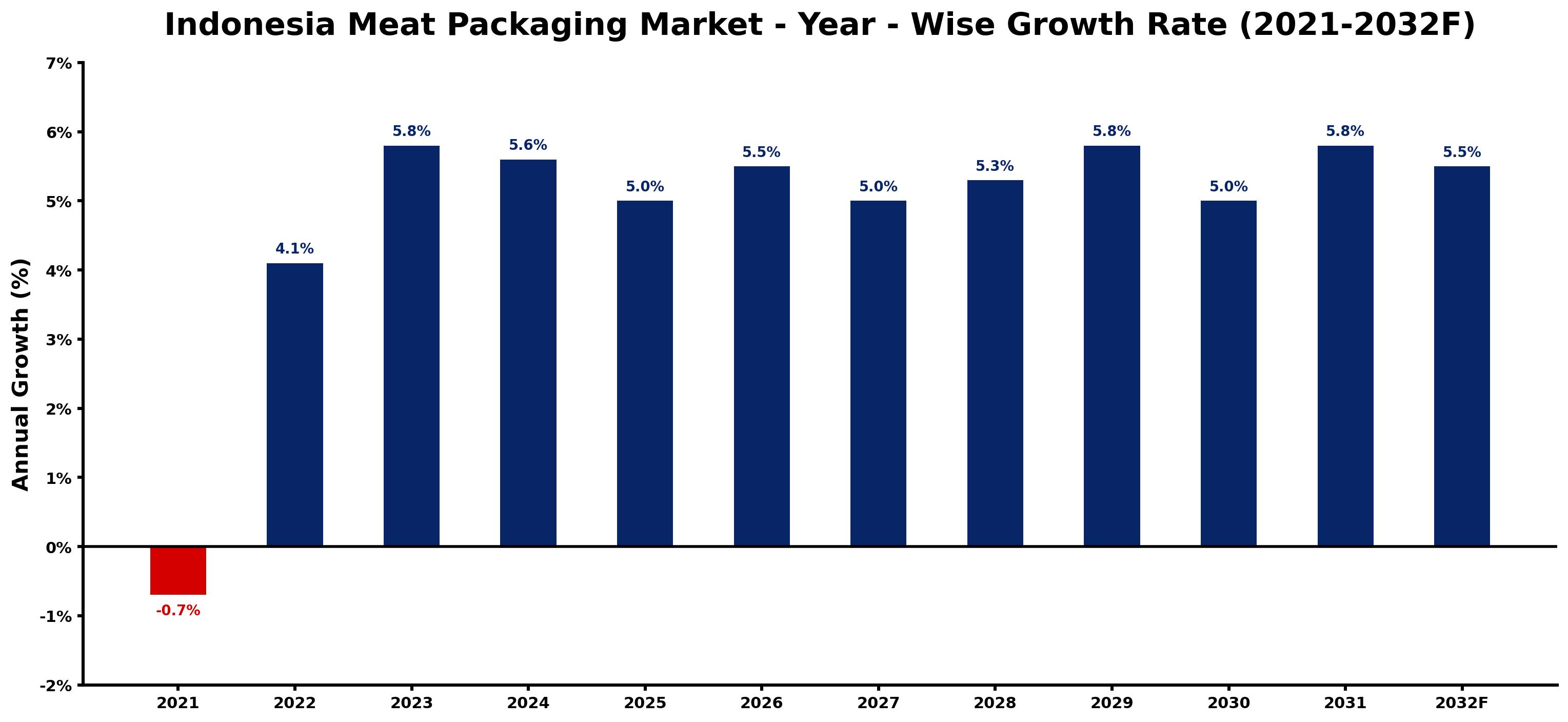
The table below presents the year wise growth rates along with the key drivers influencing the market
| Year | Growth Rate | Major Drivers |
| 2021 | -0.7% | Stringent import restrictions diminished the availability of key meat products, leading to reduced market activity. |
| 2022 | 4.1% | Shift towards e-commerce drove investments in efficient meat packaging solutions. |
| 2023 | 5.8% | Urbanization trends increased demand for ready-to-eat meat products in cities. |
| 2024 | 5.6% | Health awareness prompted consumers to seek packaged organic meat options. |
| 2025 | 5.0% | Technological advancements enabled smarter, sustainable packaging innovations across manufacturers. |
| 2026 | 5.5% | Rising disposable incomes facilitated premium meat packaging preferences among consumers. |
| 2027 | 5.0% | Expansion of supermarkets and hypermarkets created new distribution channels for packaged meat. |
| 2028 | 5.3% | Food safety regulations prompted upgrades in packaging technologies and materials used. |
| 2029 | 5.8% | Environmental concerns shifted focus towards biodegradable and eco-friendly packaging solutions. |
| 2030 | 5.0% | Emergence of plant-based meat alternatives required diverse packaging methods and designs. |
| 2031 | 5.8% | Localized sourcing practices strengthened relationships between farmers and meat packaging companies. |
| 2032 | 5.5% | Digital marketing strategies transformed consumer engagement and purchasing patterns in meat sector. |
Note - Market size estimations and growth projections presented in this report are based on 6Wresearch's advanced forecasting approach, validated with industry datasets as of June 2026.
Indonesia Meat Packaging Market Synopsis
The Indonesia Meat Packaging Market is projected to reach 5.5% and witness significant growth during the forecast period (2026-2032). The increasing consumer demand for packaged and processed meats, coupled with substantial investments in modern cold storage infrastructure, are pivotal drivers of this growth. Indonesia has emerged as one of Asia's largest markets for processed and packaged meat products, a trend fueled by local manufacturers who are increasingly focused on innovating product offerings in line with consumer preferences and adhering to strict food safety standards established by regulatory bodies like BPOM (Indonesia National Agency of Drug and Food Control). Furthermore, advancements in processing technologies are streamlining production and quality control processes, which is vital for sustaining market momentum.
Indonesia Meat Packaging Market Growth Drivers
Central to the growth of the Indonesia Meat Packaging Market are several key factors that collectively enhance demand for packaged meat products.
- Increased disposable incomes among urban households have been a game-changer, fostering higher expenditure on convenience foods, including canned meats that require minimal preparation, thereby bolstering market demand.
- The rise in health consciousness has led consumers to prefer packaged meat options that ensure longer shelf life and maintain quality, driving both innovation and investment in efficient packaging solutions.
- Government initiatives promoting investment in sophisticated cold chain logistics have significantly improved the storage and distribution of perishable products, facilitating faster delivery and broader market reach.
- Urbanization trends in Indonesia have altered consumption patterns, with a growing preference for processed and ready-to-eat meat products, therefore enhancing the overall market landscape.
- Technological advancements, such as automated filling machines and vacuum sealing, have streamlined production, reducing costs and enhancing food safety, which is critical for maintaining consumer trust.
Indonesia Meat Packaging Market Challenges and Restraints
Despite the promising growth trajectory of the Indonesia Meat Packaging Market, several challenges and restraints must be navigated cautiously.
- Stringent regulations imposed by food safety authorities necessitate persistent compliance efforts from manufacturers, which can lead to increased operational costs.
- Fluctuating raw material prices can adversely impact production viability, creating potential instability in pricing for packaged meat products.
- Intense competition among local manufacturers may result in market oversaturation, leading to price wars that could undermine profit margins.
- Consumer perception regarding the health implications of processed meats may pose a challenge, necessitating continuous efforts in marketing and education.
- Infrastructure development in certain regions might lag, limiting access to necessary logistics and slowing market expansion efforts, especially in less urbanized areas.
Indonesia Meat Packaging Market Investment Opportunities
The growth of the Indonesia Meat Packaging Market presents a variety of investment opportunities poised to enhance market dynamics.
- Investments in cold storage facilities are crucial, as they ensure that meat products maintain quality from production to consumer, thereby making it a critical area for growth.
- Emerging trends in sustainable packaging materials are attracting investments, as environmentally-friendly solutions are increasingly favored by consumers.
- Opportunities exist in expanding distribution networks, particularly in rural areas, enhancing market reach and consumer access to packaged meats.
- Research and development investments focused on health-oriented meat products will cater to the increasing health-conscious demographic.
- Partnerships with technology firms for advanced processing equipment are vital for efficiency gains and maintaining competitive advantage in the market.
Indonesia Meat Packaging Market Government Investment and Initiatives
The Indonesian government plays a crucial role in the growth and development of the meat packaging sector through various policies and initiatives.
- The government encourages private sector investment in advanced cold chain facilities, enhancing the overall logistics framework for meat products and improving their marketability.
- Grants and incentives from agencies like Bappenas facilitate the establishment of state-of-the-art cooling houses and blast freezers, thereby supporting the meat industry's infrastructure.
- Regulatory frameworks established by BPOM ensure that health standards are upheld, fostering consumer confidence in local meat products.
- The government's focus on food security has resulted in initiatives aimed at boosting domestic production capabilities, thereby reducing dependence on imports.
- Ongoing dialogue with industry stakeholders allows for policy adjustments that enable a more agile response to market changes and consumer trends.
Indonesia Meat Packaging Market Latest Developments (May 2025 - June 2026)
The period from May 2025 to June 2026 has witnessed notable developments within the Indonesia Meat Packaging Market that are shaping its trajectory.
- Local manufacturers have begun to adopt innovative techniques, including smart packaging that extends shelf life and provides consumers with freshness indicators, catering to the growing demand for quality assurance.
- The collaboration between governmental bodies and industry players has strengthened efforts to enhance food safety measures, particularly in the handling and transport stages of meat packaging.
- Emerging trends indicate a rise in consumer preference for value-added products, such as marinated or seasoned meats, prompting manufacturers to diversify their product portfolios.
- Investment in research and development has resulted in novel preservation technologies that ensure meat quality while conforming to stricter sustainability norms.
- Policy initiatives aimed at promoting local sourcing of raw materials have started to take effect, boosting the local economy and reducing the environmental footprint associated with meat supply chains.
Indonesia Meat Packaging Market - Key Attractiveness of the Report
- 10 Years of Market Numbers
- Historical Data Starting from 2022 to 2025
- Base Year: 2025
- Forecast Data until 2032
- Key Performance Indicators Impacting the Market
- Major Upcoming Developments and Projects
Key Highlights of the Report:
- Indonesia Meat Packaging Market Outlook
- Market Size of Indonesia Meat Packaging Market, 2025
- Forecast of Indonesia Meat Packaging Market, 2032F
- Historical Data and Forecast of Indonesia Meat Packaging Revenues & Volume for the Period 2022-2032F
- Indonesia Meat Packaging Market Trend Evolution
- Indonesia Meat Packaging Market Drivers and Challenges
- Indonesia Meat Packaging Price Trends
- Indonesia Meat Packaging Porter's Five Forces
- Indonesia Meat Packaging Industry Life Cycle
- Historical Data and Forecast of Indonesia Meat Packaging Market Revenues & Volume By Material Type for the Period 2022-2032F
- Historical Data and Forecast of Indonesia Meat Packaging Market Revenues & Volume By Plastic for the Period 2022-2032F
- Historical Data and Forecast of Indonesia Meat Packaging Market Revenues & Volume By Rigid? for the Period 2022-2032F
- Historical Data and Forecast of Indonesia Meat Packaging Market Revenues & Volume By Metal for the Period 2022-2032F
- Historical Data and Forecast of Indonesia Meat Packaging Market Revenues & Volume By Meat Type for the Period 2022-2032F
- Historical Data and Forecast of Indonesia Meat Packaging Market Revenues & Volume By Fresh and Frozen for the Period 2022-2032F
- Historical Data and Forecast of Indonesia Meat Packaging Market Revenues & Volume By Processed for the Period 2022-2032F
- Historical Data and Forecast of Indonesia Meat Packaging Market Revenues & Volume By Ready to Eat for the Period 2022-2032F
- Indonesia Meat Packaging Import Export Trade Statistics
- Market Opportunity Assessment By Material Type
- Market Opportunity Assessment By Meat Type
- Indonesia Meat Packaging Top Companies Market Share
- Indonesia Meat Packaging Competitive Benchmarking By Technical and Operational Parameters
- Indonesia Meat Packaging Company Profiles
- Indonesia Meat Packaging Key Strategic Recommendations






































