Indonesia Meningococcal Vaccines Market Size, Share & Growth Rate
The Indonesia Meningococcal Vaccines Market was estimated at USD 188 Million in 2025 and is projected to reach USD 250 Million by 2032, growing at a CAGR of 4.2% from 2026 to 2032. This anticipated growth reflects increasing public awareness and proactive government initiatives aimed at preventing meningococcal diseases. As more individuals recognize the importance of vaccination, the demand for effective meningococcal vaccines continues to rise, bolstered by the potential for government-led public health campaigns.
Indonesia Meningococcal Vaccines Market Year-wise Growth Rate and Key Drivers
This graph highlights how the Indonesia Meningococcal Vaccines Market has steadily grown over the years, supported by major growth factors.
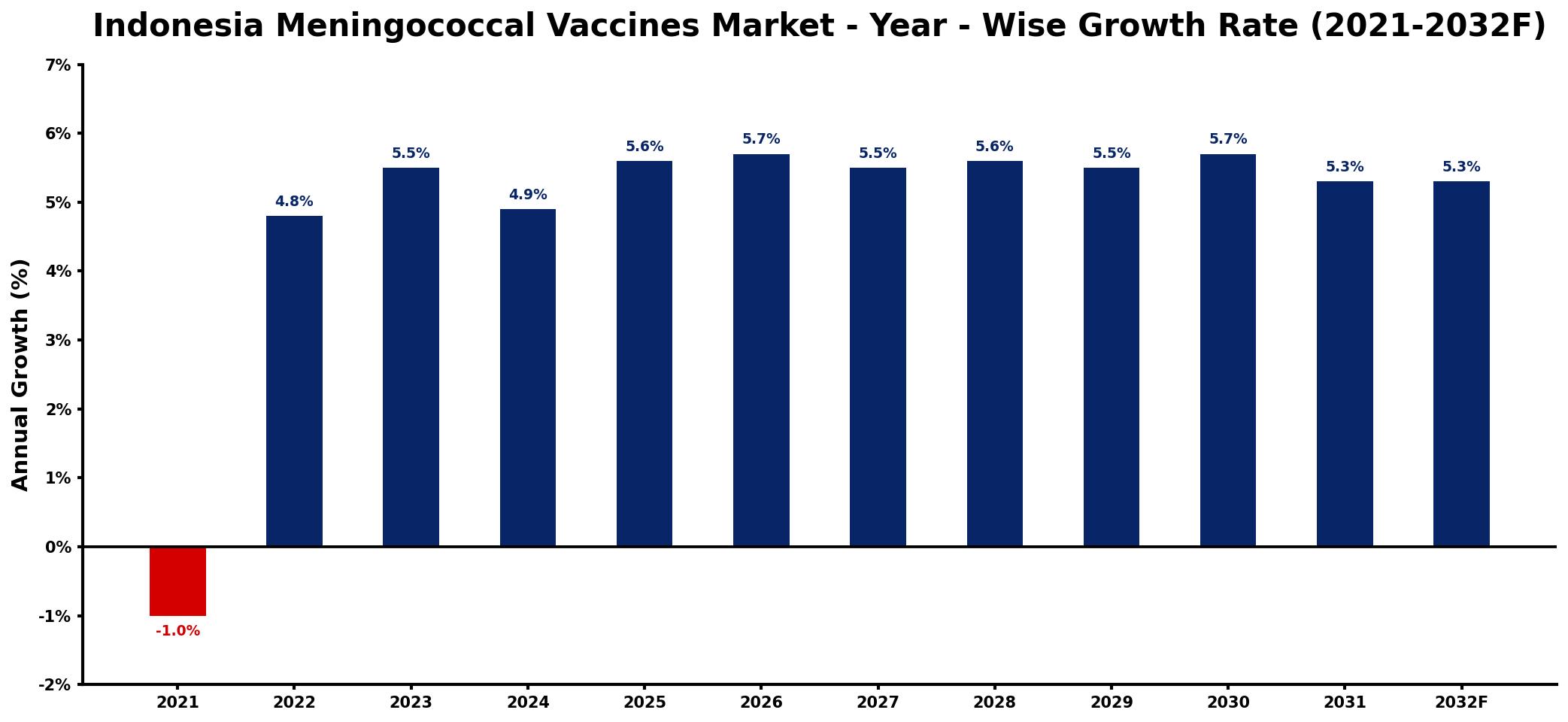
The table below presents the year‑wise growth rates along with the key drivers influencing the market
| Year | Growth Rate | Major Drivers |
| 2021 | -1.0% | Decreased public health funding |
| 2022 | 4.8% | Increased awareness of disease prevention |
| 2023 | 5.5% | Rising healthcare infrastructure investments |
| 2024 | 4.9% | Expansion of immunization programs |
| 2025 | 5.6% | Growing private sector participation |
| 2026 | 5.7% | Enhanced disease surveillance systems |
| 2027 | 5.5% | Strengthened partnerships with NGOs |
| 2028 | 5.6% | Wider distribution network development |
| 2029 | 5.5% | Broader access to healthcare services |
| 2030 | 5.7% | Innovative healthcare financing models |
| 2031 | 5.3% | Improved regulatory frameworks established |
| 2032 | 5.3% | Greater emphasis on preventive care |
Note: Market size estimations and growth projections presented in this report are based on 6Wresearch's proprietary forecasting methodology, utilizing the latest available industry data, government publications, and primary research inputs.
Indonesia Meningococcal Vaccines Market Synopsis
The Indonesia Meningococcal Vaccines market has gained significant momentum in recent years, fueled by rising healthcare awareness and targeted vaccination drives. However, the path ahead involves overcoming several key challenges to maintain this upward trajectory.
With the growing incidence of meningococcal infections and heightened travel requirements, vaccination against this disease has become increasingly critical. The collective efforts of healthcare providers and pharmaceutical companies are essential to ensure that this market continues to thrive while prioritizing public safety and health.
Indonesia Meningococcal Vaccines Market Key Takeaways
- The market is witnessing a robust growth trajectory, driven by heightened awareness of vaccine-preventable diseases.
- Government initiatives play a vital role in promoting widespread vaccination coverage across the nation.
- Travel-related mandates are contributing to the surge in meningococcal vaccine demand.
- Key industry players are focusing on research and development to enhance vaccine efficacy and safety.
- Collaboration between public health organizations and the pharmaceutical sector is essential for overcoming barriers to vaccination.
Evaluation of Restraints in Indonesia Meningococcal Vaccines Market
Despite the positive outlook, several restraints could impede the Indonesia Meningococcal Vaccines market. Access to healthcare facilities remains a significant issue, particularly in rural areas, where vaccination rates are lower. Furthermore, misinformation regarding vaccine safety may contribute to hesitancy among the population. Complex regulatory processes and stringent safety standards can slow the introduction of new vaccines. Additionally, maintaining a consistent supply chain is vital to prevent shortages that could negatively impact vaccination efforts.
Indonesia Meningococcal Vaccines Market Trends
Currently, there is a noticeable shift toward innovative vaccine delivery methods, which aim to enhance acceptance and accessibility. Digital health platforms are emerging as essential tools for educating the public about vaccine benefits and dispelling myths surrounding vaccination. Increased collaboration among stakeholders is fostering an environment where new vaccination initiatives can be developed, further enhancing the overall immunization landscape. Furthermore, the momentum gained from COVID-19 vaccination efforts has instilled a greater sense of urgency in addressing other vaccine-preventable diseases, including meningococcal infections.
Indonesia Meningococcal Vaccines Market Opportunities
The Indonesia Meningococcal Vaccines market presents several opportunities for growth and investment. With government initiatives focused on increasing immunization coverage, stakeholders have the chance to contribute significantly to public health. Emerging technologies in vaccine research and development could lead to more effective formulations that cater to diverse populations. Additionally, tapping into the travel sector to address vaccination requirements can create new avenues for vaccine distribution and education, making it essential for companies to adapt their strategies accordingly.
Government Initiatives in the Indonesia Meningococcal Vaccines Market
The Indonesian government is actively promoting vaccination through various public health initiatives aimed at controlling meningococcal diseases. Through nationwide vaccination programs, awareness campaigns, and collaboration with international health organizations, the government seeks to improve immunization rates. Furthermore, funding for public health initiatives has been increased, reflecting a commitment to combatting vaccine-preventable diseases and ensuring a healthier population.
Future Insights of the Indonesia Meningococcal Vaccines Market
Looking ahead to the 2026-2032 period, the Indonesia Meningococcal Vaccines market is poised for continued growth. An increased focus on public health, along with rising demand for preventive healthcare, will drive this trend. As the government enhances its vaccination efforts and public awareness campaigns gain momentum, the market will likely see a steady increase in immunization rates. This shift underscores the vital role that meningococcal vaccines will play in safeguarding public health in Indonesia.
Indonesia Meningococcal Vaccines Market Latest Developments (2025 - 2026)
Recent developments in the Indonesia Meningococcal Vaccines market include the launch of new vaccination campaigns targeting high-risk populations and initiatives aimed at improving vaccine access in underserved areas. The government has initiated partnerships with healthcare providers to enhance distribution channels, ensuring that vaccines reach those most in need. Additionally, there have been advancements in vaccine technology, with research focusing on increasing the efficacy and safety of meningococcal vaccines.
Indonesia Meningococcal Vaccines Market - Key Attractiveness of the Report
- 10 Years of Market Numbers
- Historical Data Starting from 2022 to 2025
- Base Year: 2025
- Forecast Data until 2032
- Key Performance Indicators Impacting the Market
- Major Upcoming Developments and Projects
Key Highlights of the Report:
- Indonesia Meningococcal Vaccines Market Outlook
- Market Size of Indonesia Meningococcal Vaccines Market, 2025
- Forecast of Indonesia Meningococcal Vaccines Market, 2032
- Historical Data and Forecast of Indonesia Meningococcal Vaccines Revenues & Volume for the Period 2022-2032F
- Indonesia Meningococcal Vaccines Market Trend Evolution
- Indonesia Meningococcal Vaccines Market Drivers and Challenges
- Indonesia Meningococcal Vaccines Price Trends
- Indonesia Meningococcal Vaccines Porter's Five Forces
- Indonesia Meningococcal Vaccines Industry Life Cycle
- Historical Data and Forecast of Indonesia Meningococcal Vaccines Market Revenues & Volume By Product for the Period 2022-2032F
- Historical Data and Forecast of Indonesia Meningococcal Vaccines Market Revenues & Volume By Polysaccharide for the Period 2022-2032F
- Historical Data and Forecast of Indonesia Meningococcal Vaccines Market Revenues & Volume By Conjugate for the Period 2022-2032F
- Historical Data and Forecast of Indonesia Meningococcal Vaccines Market Revenues & Volume By Age Group for the Period 2022-2032F
- Historical Data and Forecast of Indonesia Meningococcal Vaccines Market Revenues & Volume By Infants for the Period 2022-2032F
- Historical Data and Forecast of Indonesia Meningococcal Vaccines Market Revenues & Volume By Children for the Period 2022-2032F
- Historical Data and Forecast of Indonesia Meningococcal Vaccines Market Revenues & Volume By Adolescents & Young Adults for the Period 2022-2032F
- Historical Data and Forecast of Indonesia Meningococcal Vaccines Market Revenues & Volume By Adults for the Period 2022-2032F
- Historical Data and Forecast of Indonesia Meningococcal Vaccines Market Revenues & Volume By Distribution Channel for the Period 2022-2032F
- Historical Data and Forecast of Indonesia Meningococcal Vaccines Market Revenues & Volume By Pharmacies for the Period 2022-2032F
- Historical Data and Forecast of Indonesia Meningococcal Vaccines Market Revenues & Volume By Community Clinics for the Period 2022-2032F
- Historical Data and Forecast of Indonesia Meningococcal Vaccines Market Revenues & Volume By Public Health Agencies for the Period 2022-2032F
- Historical Data and Forecast of Indonesia Meningococcal Vaccines Market Revenues & Volume By Others for the Period 2022-2032F
- Indonesia Meningococcal Vaccines Import Export Trade Statistics
- Market Opportunity Assessment By Product
- Market Opportunity Assessment By Age Group
- Market Opportunity Assessment By Distribution Channel
- Indonesia Meningococcal Vaccines Top Companies Market Share
- Indonesia Meningococcal Vaccines Competitive Benchmarking By Technical and Operational Parameters
- Indonesia Meningococcal Vaccines Company Profiles
- Indonesia Meningococcal Vaccines Key Strategic Recommendations






































