Indonesia Metal Shredder Machine Market Size, Share & Growth Rate
The Indonesia Metal Shredder Machine Market was estimated at USD 370 Million in 2025 and is projected to reach USD 490 Million by 2032, growing at a CAGR of 4.1% from 2026 to 2032. This steady growth trajectory is propelled by the increasing urgency for efficient waste management and recycling practices across various sectors in Indonesia, including automotive and construction. Additionally, rising investments in infrastructure and a growing awareness of environmental sustainability are further enhancing the demand for advanced metal shredding solutions.
Indonesia Metal Shredder Machine Market Year-wise Growth Rate and Key Drivers
This graph highlights how the Indonesia Metal Shredder Machine Market has steadily grown over the years, supported by major growth factors.
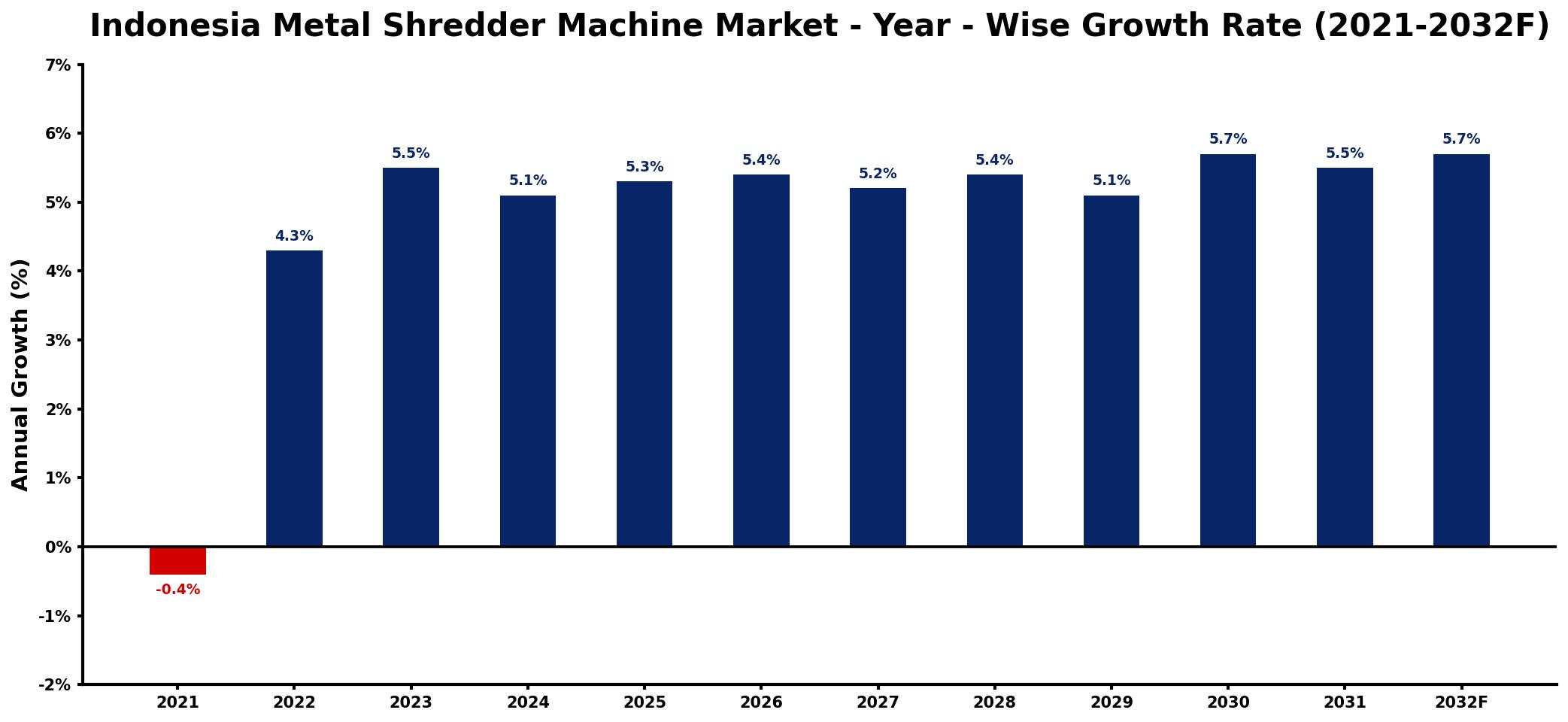
The table below presents the year‑wise growth rates along with the key drivers influencing the market
| Year | Growth Rate | Major Drivers |
| 2021 | -0.4% | Decreased industrial recycling activities |
| 2022 | 4.3% | Rising demand for recycling initiatives |
| 2023 | 5.5% | Increased investment in waste management |
| 2024 | 5.1% | Expansion of manufacturing sectors |
| 2025 | 5.3% | Growing urbanization and infrastructure projects |
| 2026 | 5.4% | Surge in eco-friendly practices |
| 2027 | 5.2% | Enhanced government regulations on waste |
| 2028 | 5.4% | Development of circular economy strategies |
| 2029 | 5.1% | Growth in automotive recycling industry |
| 2030 | 5.7% | Rising consumer awareness on sustainability |
| 2031 | 5.5% | Increased collaboration among industries |
| 2032 | 5.7% | Advancements in recycling technologies |
Note: Market size estimations and growth projections presented in this report are based on 6Wresearch's proprietary forecasting methodology, utilizing the latest available industry data, government publications, and primary research inputs.
Indonesia Metal Shredder Machine Market Synopsis
The need for effective recycling solutions has never been more critical in Indonesia, where industrial growth has led to increased metal waste generation. This dynamic is compelling manufacturers and recycling centers to upgrade their operations with modern metal shredder machines, enabling them to process scrap more efficiently and sustainably.
Moreover, the market is witnessing a surge in adoption due to enhanced product quality and energy conservation. Industries ranging from electronics to construction are turning to metal shredders, not just for compliance with regulations, but to boost operational efficiency and reduce costs in the long term.
Indonesia Metal Shredder Machine Market Key Takeaways
- The market is projected to experience a robust growth rate driven by rising recycling needs.
- Major industries such as automotive and construction are increasingly investing in metal shredding technology.
- Technological advancements are enhancing machine efficiency and lowering operational costs.
- Government incentives for waste management are likely to bolster market growth further.
- Despite growth potential, there remains a gap in awareness regarding advanced recycling technologies.
Evaluation of Restraints in Indonesia Metal Shredder Machine Market
One of the notable restraints in the Indonesia Metal Shredder Machine Market is the limited awareness and adoption of advanced recycling technologies among various sectors. Many companies still utilize traditional methods for metal waste disposal, which can hinder the transition to more efficient shredding solutions. This lag in technological adoption can limit the overall market potential, as stakeholders may be hesitant to invest in new machinery without clear insights into the benefits. Furthermore, economic fluctuations can also affect budgets allocated for upgrading machinery, thereby impacting overall market growth.
Indonesia Metal Shredder Machine Market Trends
Currently, there is a marked trend towards automation in the metal shredding process. Manufacturers are increasingly integrating IoT technologies and smart systems into shredder machines, enabling real-time monitoring and enhanced operational efficiency. Additionally, the emphasis on eco-friendly practices is steering companies towards machines that not only shred metal waste effectively but also minimize energy consumption and emissions.
Indonesia Metal Shredder Machine Market Opportunities
The market is ripe with opportunities, particularly for manufacturers offering innovative solutions tailored to specific industry needs. As industries seek to improve their recycling capabilities, there is a growing demand for custom-designed shredders that can handle unique types of metal waste. Furthermore, with the Indonesian government emphasizing sustainability, investment in metal shredding technology presents a lucrative avenue for growth, as both public and private sectors seek to enhance their recycling efforts.
Government Initiatives in the Indonesia Metal Shredder Machine Market
The Indonesian government has launched various initiatives aimed at enhancing waste management systems and promoting recycling. These initiatives often include public spending on infrastructure improvements and technology upgrades for waste processing facilities. Moreover, there are incentives for businesses that adopt greener technologies, including metal shredder machines, which further encourages investment in this sector.
Future Insights of the Indonesia Metal Shredder Machine Market
Looking ahead to 2026-2032, the Indonesia Metal Shredder Machine Market is expected to witness significant transformation fueled by technological advancements and rising industrial demand. As industries become more aware of the benefits associated with efficient recycling, there will be a marked shift towards adopting advanced shredding technologies. Moreover, as sustainability becomes a core focus for many corporations, the integration of eco-friendly solutions in metal shredding operations is likely to gain momentum, thus shaping the future landscape of this market.
Indonesia Metal Shredder Machine Market Latest Developments (2025 - 2026)
In recent months, several key developments have surfaced in the Indonesia Metal Shredder Machine Market, including new product launches that incorporate cutting-edge technology aimed at improving efficiency. Manufacturers have been increasingly showcasing machines designed with enhanced safety features and user-friendly interfaces, making them attractive to a broader range of industries. Additionally, partnerships between local firms and technology providers are on the rise, focusing on integrating automated solutions into shredding processes, ensuring manufacturers remain competitive in a rapidly evolving market.
Indonesia Metal Shredder Machine Market - Key Attractiveness of the Report
- 10 Years of Market Numbers
- Historical Data Starting from 2022 to 2025
- Base Year: 2025
- Forecast Data until 2032
- Key Performance Indicators Impacting the Market
- Major Upcoming Developments and Projects
Key Highlights of the Report:
- Indonesia Metal Shredder Machine Market Outlook
- Market Size of Indonesia Metal Shredder Machine Market, 2025
- Forecast of Indonesia Metal Shredder Machine Market, 2032
- Historical Data and Forecast of Indonesia Metal Shredder Machine Revenues & Volume for the Period 2022-2032F
- Indonesia Metal Shredder Machine Market Trend Evolution
- Indonesia Metal Shredder Machine Market Drivers and Challenges
- Indonesia Metal Shredder Machine Price Trends
- Indonesia Metal Shredder Machine Porter's Five Forces
- Indonesia Metal Shredder Machine Industry Life Cycle
- Historical Data and Forecast of Indonesia Metal Shredder Machine Market Revenues & Volume By Type for the Period 2022-2032F
- Historical Data and Forecast of Indonesia Metal Shredder Machine Market Revenues & Volume By Mechanical Shredder Machine for the Period 2022-2032F
- Historical Data and Forecast of Indonesia Metal Shredder Machine Market Revenues & Volume By Shock Wave Shredder Machine for the Period 2022-2032F
- Historical Data and Forecast of Indonesia Metal Shredder Machine Market Revenues & Volume By Application for the Period 2022-2032F
- Historical Data and Forecast of Indonesia Metal Shredder Machine Market Revenues & Volume By Iron and Steel for the Period 2022-2032F
- Historical Data and Forecast of Indonesia Metal Shredder Machine Market Revenues & Volume By Aluminum and Copper for the Period 2022-2032F
- Historical Data and Forecast of Indonesia Metal Shredder Machine Market Revenues & Volume By Non-Ferrous Metals for the Period 2022-2032F
- Indonesia Metal Shredder Machine Import Export Trade Statistics
- Market Opportunity Assessment By Type
- Market Opportunity Assessment By Application
- Indonesia Metal Shredder Machine Top Companies Market Share
- Indonesia Metal Shredder Machine Competitive Benchmarking By Technical and Operational Parameters
- Indonesia Metal Shredder Machine Company Profiles
- Indonesia Metal Shredder Machine Key Strategic Recommendations






































