Indonesia Metalworking Machinery Market Size, Share & Growth Rate
The Indonesia Metalworking Machinery Market was estimated at USD 408 Million in 2025 and is projected to reach USD 539 Million by 2032, growing at a CAGR of 4.1% from 2026 to 2032. This growth trajectory is fueled by a surge in both domestic and foreign investments, particularly in infrastructure and energy sectors, driving the demand for advanced metalworking solutions. Furthermore, increasing industrialization and urbanization in Indonesia are expected to create a burgeoning landscape for manufacturers, enabling enhanced production capabilities.
Indonesia Metalworking Machinery Market Year-wise Growth Rate and Key Drivers
This graph highlights how the Indonesia Metalworking Machinery Market has steadily grown over the years, supported by major growth factors.
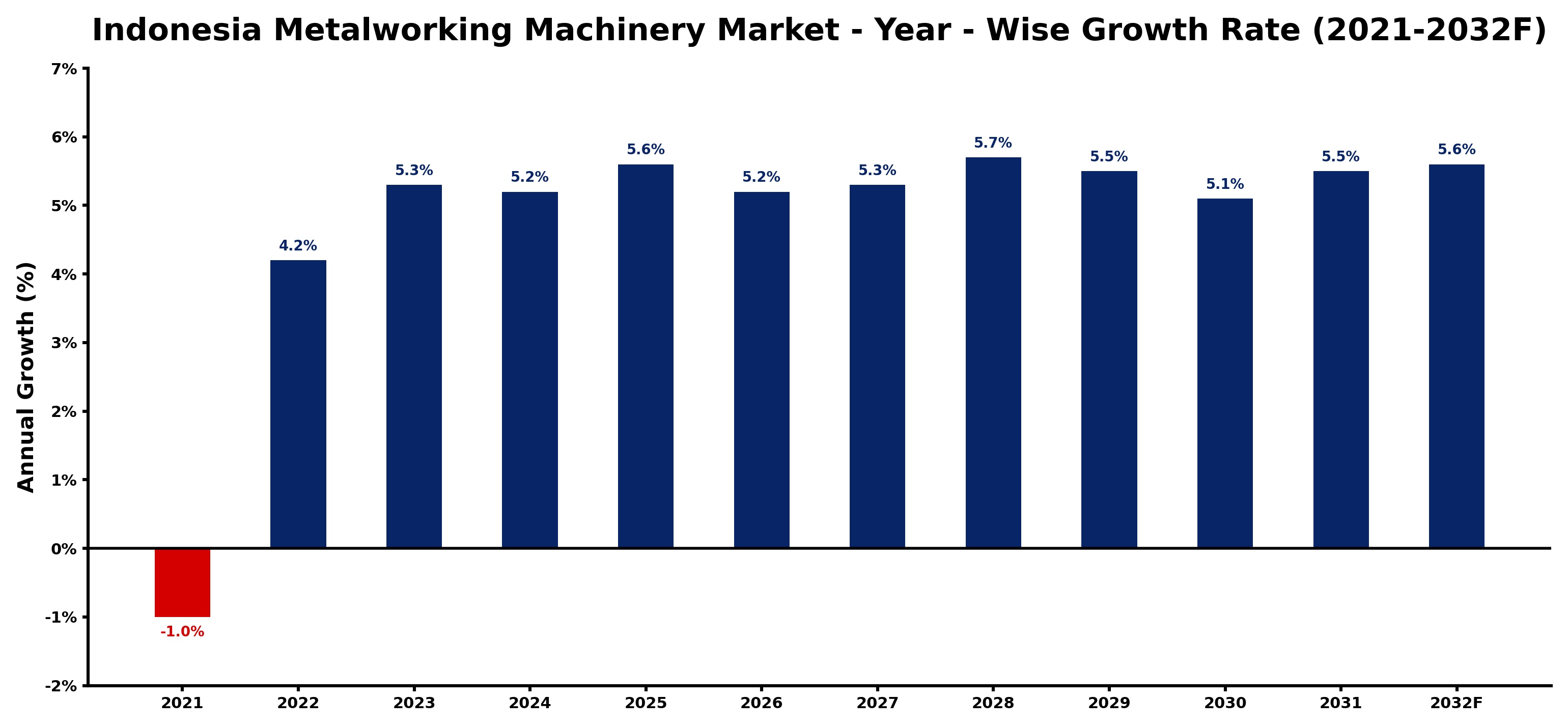
The table below presents the year‑wise growth rates along with the key drivers influencing the market
| Year | Growth Rate | Major Drivers |
| 2021 | -1.0% | Increasing adoption of advanced technologies |
| 2022 | 4.2% | Increasing industrial automation investments |
| 2023 | 5.3% | Increasing industrial infrastructure investments |
| 2024 | 5.2% | Growing urbanization and commercial development |
| 2025 | 5.6% | Growing urbanization and commercial development |
| 2026 | 5.2% | Expansion of transportation and logistics networks |
| 2027 | 5.3% | Growing renewable energy integration projects |
| 2028 | 5.7% | Government infrastructure modernization initiatives |
| 2029 | 5.5% | Increasing smart city development projects |
| 2030 | 5.1% | Expansion of manufacturing activities |
| 2031 | 5.5% | Growing renewable energy integration projects |
| 2032 | 5.6% | Government infrastructure modernization initiatives |
Note - Market size estimations and growth projections presented in this report are based on 6Wresearch’s advanced forecasting approach, validated with industry datasets as of June 2026.
Indonesia Metalworking Machinery Market Synopsis
In recent years, the Indonesia metalworking machinery market has gained significant momentum, driven by robust investments and technological advancements. However, as the country looks toward the future, challenges in labor skills and cost competitiveness from imports loom over sustained growth.
Looking ahead, the landscape is marked by opportunities in automation and improved efficiencies, which could redefine operational standards for local manufacturers. With favorable government policies and rising production demands, the market is poised for a transformative phase that emphasizes innovation and productivity enhancements.
Indonesia Metalworking Machinery Market Key Takeaways
- Projected market growth fueled by rising industrial and urbanization activities across Indonesia.
- Increased preference for automated machinery as businesses seek efficiency and accuracy.
- Growing foreign and domestic investments aimed at enhancing infrastructure and industrial capabilities.
- Challenges posed by imported low-cost machinery and technology obsolescence impacting local manufacturers.
- Government initiatives encouraging FDI are expected to bolster market dynamics moving forward.
Evaluation of Restraints in Indonesia Metalworking Machinery Market
Despite the positive outlook, several constraints are hindering the full potential of the Indonesia metalworking machinery market. Cost competitiveness remains a significant concern as lower-priced imports from countries like China create pressure on local manufacturers. Additionally, a noticeable technology gap persists, with older machinery unable to keep pace with modern operational demands. Compounding these issues is the challenge of sourcing skilled labor, which is critical for operating advanced machinery and maintaining it effectively. Moreover, the availability of specialized parts for sophisticated equipment is limited, making repairs and maintenance cumbersome and costly for businesses.
Indonesia Metalworking Machinery Market Trends
Current trends indicate a significant shift towards automation technology as manufacturers prioritize efficiency and precision in their operations. The adoption of smart manufacturing practices, leveraging IoT and AI, is reshaping the market dynamics by enhancing operational efficiencies. Additionally, there is a rising emphasis on environmentally sustainable manufacturing processes, compelling companies to adopt energy-efficient machinery that aligns with global sustainability goals. These trends not only drive innovation within the industry but also lead to improved production standards across various sectors.
Indonesia Metalworking Machinery Market Opportunities
The Indonesia metalworking machinery market presents several promising opportunities for growth and investment. The increasing demand for advanced manufacturing technologies, particularly in sectors like automotive and aerospace, opens avenues for local and foreign manufacturers to establish a strong foothold. Furthermore, government incentives aimed at enhancing the domestic manufacturing landscape can facilitate partnerships between local companies and international suppliers, fostering knowledge transfer and technological advancements. The growing focus on automation technology also offers significant potential for innovative machinery providers to capitalize on the shift towards more efficient production processes.
Government Initiatives in the Indonesia Metalworking Machinery Market
The Indonesian government has recognized the importance of enhancing the manufacturing sector as part of its broader economic development agenda. Policies aimed at attracting foreign direct investment (FDI) have been implemented, fostering an environment conducive to technological transfer and innovation. Infrastructure development projects, coupled with support for small and medium-sized enterprises (SMEs) in the manufacturing domain, are expected to strengthen the metalworking machinery sector. Public spending in education and vocational training also seeks to address the skills gap in the labor force, further supporting industry growth.
Future Insights of the Indonesia Metalworking Machinery Market
Looking towards 2026-2032, the Indonesia metalworking machinery market is set to embark on a path of sustainable growth. The continued emphasis on industrialization and infrastructure development will likely drive demand for cutting-edge machinery capable of meeting evolving production needs. Moreover, advancements in automation and technology adoption will redefine operational capabilities, compelling companies to invest in smarter, more efficient solutions. As global manufacturing trends continue to evolve, Indonesia's market position can strengthen, particularly if it capitalizes on its strategic location and growing industrial base.
Indonesia Metalworking Machinery Market Latest Developments (May 2025 - June 2026)
Recent developments in the Indonesia metalworking machinery market reflect a gradual recovery from the disruptions caused by the COVID-19 pandemic. Industry players are increasingly investing in modernization initiatives, including upgrading production facilities to integrate advanced technologies. Collaborative efforts between local manufacturers and international machinery suppliers are gaining traction, aimed at enhancing operational efficiencies and product offerings. Furthermore, there has been a noticeable increase in participation from tech-driven firms specializing in automation solutions, which are positioning themselves to meet the growing demand for high-efficiency manufacturing processes.
Indonesia Metalworking Machinery Market - Key Attractiveness of the Report
- 10 Years of Market Numbers
- Historical Data Starting from 2022 to 2025
- Base Year: 2025
- Forecast Data until 2032
- Key Performance Indicators Impacting the Market
- Major Upcoming Developments and Projects
Key Highlights of the Report:
- Indonesia Metalworking Machinery Market Outlook
- Market Size of Indonesia Metalworking Machinery Market, 2025
- Forecast of Indonesia Metalworking Machinery Market, 2032
- Historical Data and Forecast of Indonesia Metalworking Machinery Revenues & Volume for the Period 2022-2032F
- Indonesia Metalworking Machinery Market Trend Evolution
- Indonesia Metalworking Machinery Market Drivers and Challenges
- Indonesia Metalworking Machinery Price Trends
- Indonesia Metalworking Machinery Porter's Five Forces
- Indonesia Metalworking Machinery Industry Life Cycle
- Historical Data and Forecast of Indonesia Metalworking Machinery Market Revenues & Volume By Type for the Period 2022-2032F
- Historical Data and Forecast of Indonesia Metalworking Machinery Market Revenues & Volume By Special Die And Tool Die Set, Jig, And Fixture for the Period 2022-2032F
- Historical Data and Forecast of Indonesia Metalworking Machinery Market Revenues & Volume By Machine Tool for the Period 2022-2032F
- Historical Data and Forecast of Indonesia Metalworking Machinery Market Revenues & Volume By Industrial Mold for the Period 2022-2032F
- Historical Data and Forecast of Indonesia Metalworking Machinery Market Revenues & Volume By Rolling Mill And Other Metalworking Machinery for the Period 2022-2032F
- Historical Data and Forecast of Indonesia Metalworking Machinery Market Revenues & Volume By Cutting Tool And Machine Tool Accessory for the Period 2022-2032F
- Historical Data and Forecast of Indonesia Metalworking Machinery Market Revenues & Volume By Applications for the Period 2022-2032F
- Historical Data and Forecast of Indonesia Metalworking Machinery Market Revenues & Volume By Automotive for the Period 2022-2032F
- Historical Data and Forecast of Indonesia Metalworking Machinery Market Revenues & Volume By Manufacturing for the Period 2022-2032F
- Historical Data and Forecast of Indonesia Metalworking Machinery Market Revenues & Volume By Others for the Period 2022-2032F
- Historical Data and Forecast of Indonesia Metalworking Machinery Market Revenues & Volume By Capacity for the Period 2022-2032F
- Historical Data and Forecast of Indonesia Metalworking Machinery Market Revenues & Volume By Small for the Period 2022-2032F
- Historical Data and Forecast of Indonesia Metalworking Machinery Market Revenues & Volume By Medium for the Period 2022-2032F
- Historical Data and Forecast of Indonesia Metalworking Machinery Market Revenues & Volume By Large for the Period 2022-2032F
- Indonesia Metalworking Machinery Import Export Trade Statistics
- Market Opportunity Assessment By Type
- Market Opportunity Assessment By Applications
- Market Opportunity Assessment By Capacity
- Indonesia Metalworking Machinery Top Companies Market Share
- Indonesia Metalworking Machinery Competitive Benchmarking By Technical and Operational Parameters
- Indonesia Metalworking Machinery Company Profiles
- Indonesia Metalworking Machinery Key Strategic Recommendations






































