Indonesia Microlearning Market Size & Growth Rate (2026-2032)
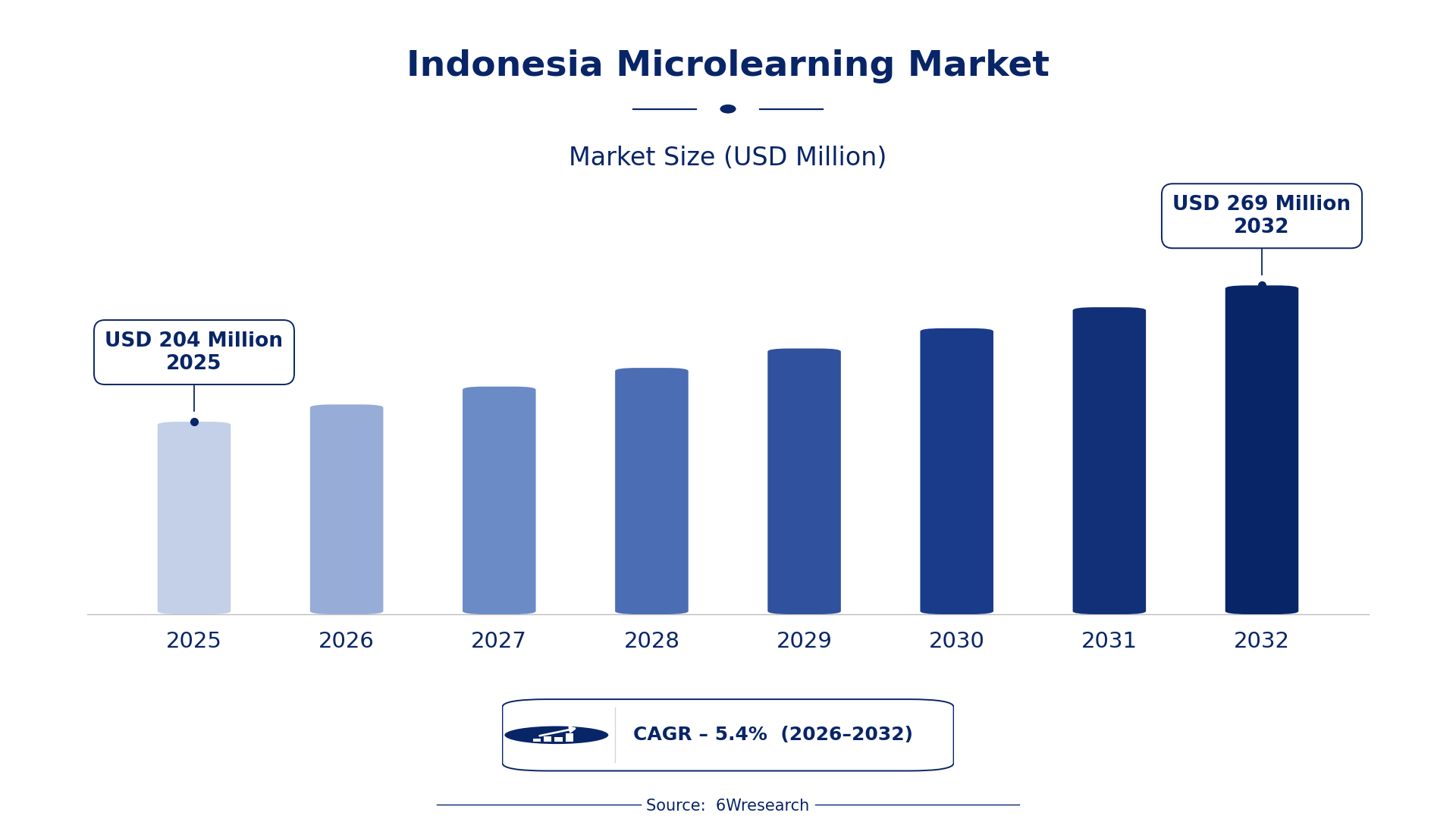
The Indonesia Microlearning Market was estimated at USD 204 Million in 2025 and is projected to reach USD 269 Million by 2032, growing at a CAGR of 5.4% from 2026 to 2032.
Indonesia Microlearning Market Synopsis
The microlearning market in Indonesia is on an upward trajectory as organizations increasingly recognize the need for agile and targeted training solutions. With the rise of remote work and digital learning, microlearning offers a timely response to evolving workforce demands, enabling employees to acquire new skills efficiently.
As Indonesia's economy continues to digitalize, businesses are turning to microlearning to enhance workforce competency. The appeal lies in its accessibility; bite-sized content is designed for easy consumption, making learning possible anytime and anywhere. This trend is not just a passing phase; it's reshaping how organizations approach employee development.
Indonesia Microlearning Market Year-wise Growth Rate and Key Drivers
This graph illustrates the annual growth rates of the Indonesia Microlearning Market from 2021 to 2032, highlighting a steady upward trajectory and projected expansion over the forecast period.
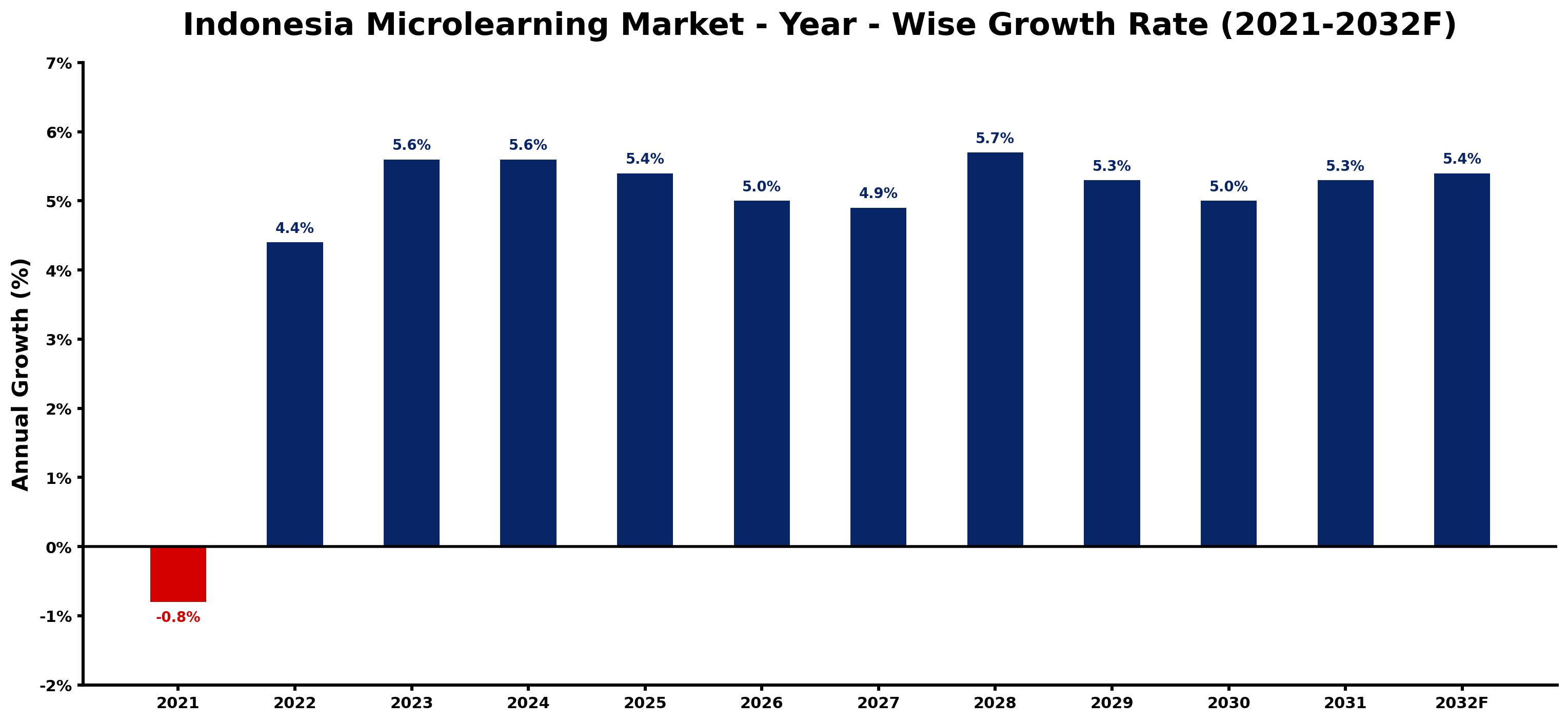
The table below presents the year‑wise growth rates along with the key drivers influencing the market
| Year | Growth Rate | Major Drivers |
| 2021 | -0.8% | Increased regulations by Indonesia's Ministry of Education |
| 2022 | 4.4% | Government's Kopernik initiative promoting digital education access |
| 2023 | 5.6% | Rising smartphone penetration enhancing mobile learning opportunities |
| 2024 | 5.6% | Corporate training programs increasingly adopting microlearning strategies |
| 2025 | 5.4% | Young population driving demand for innovative learning solutions |
| 2026 | 5.0% | Partnerships between edtech and government supporting skill development |
| 2027 | 4.9% | Increased focus on remote work necessitating continuous learning |
| 2028 | 5.7% | Investments in local content fostering culturally relevant microlearning |
| 2029 | 5.3% | Growing interest in lifelong learning among Indonesian workforce |
| 2030 | 5.0% | Local universities integrating microlearning into traditional curricula |
| 2031 | 5.3% | Regulatory support for digital platforms enhancing educational content delivery |
| 2032 | 5.4% | Adoption of gamification techniques driving user engagement in microlearning |
Note: Market size estimations and growth projections presented in this report are based on 6Wresearch's proprietary forecasting methodology, utilizing the latest available industry data, government publications, and primary research inputs.
Indonesia Microlearning Market Key Takeaways
Below are some of the specific key takeaways from the market, including:
- Rapidly growing demand for upskilling and continuous learning among Indonesian employees.
- Integration of mobile platforms is making microlearning more accessible for users.
- Content relevance and engagement remain critical factors for successful microlearning initiatives.
- COVID-19 accelerated the adoption of microlearning as organizations adapted to remote training.
- Companies are increasingly utilizing analytics to measure training effectiveness and learner progress.
Evaluation of Restraints in Indonesia Microlearning Market
Despite its growth, the microlearning market in Indonesia faces several hurdles. Content relevance is a major issue; organizations often struggle to tailor microlearning modules that resonate with specific learning needs. This challenge is compounded by the necessity of maintaining engagement over time. on top of that, establishing effective analytics and feedback mechanisms can be technically complex, making it difficult for organizations to track learner progress accurately. These restraints can hinder the overall effectiveness of microlearning programs, impacting their adoption rates.
Indonesia Microlearning Market Trends
Current trends indicate a shift towards incorporating gamification elements within microlearning modules. This approach not only enhances engagement but also promotes a more interactive learning experience. Additionally, there is a growing emphasis on personalized learning paths, allowing employees to navigate their development journey according to individual needs and preferences. on top of that, organizations are increasingly focusing on the integration of artificial intelligence to deliver tailored content and assessments, which is expected to streamline learning processes.
Indonesia Microlearning Market Opportunities
Opportunities abound in the Indonesian microlearning market, particularly for providers who can offer customized solutions to meet diverse organizational needs. The demand for language learning and soft skills training is on the rise, providing a fertile ground for content developers. on top of that, as businesses continue to invest in employee development, partnerships with educational institutions to enhance course offerings present a strategic advantage. Companies that can harness data analytics to improve learning outcomes will also find themselves well-positioned for growth.
Government Initiatives in the Indonesia Microlearning Market
Government policies are playing a crucial role in shaping the microlearning market in Indonesia. With a focus on enhancing workforce skills through digital education, the government is prioritizing initiatives that support learning and development. By fostering public-private partnerships, authorities aim to bridge the skills gap and prepare the workforce for future challenges.
- A recently launched national digital education initiative aims to improve access to online learning resources across the country.
- A current initiative underway focuses on enhancing digital literacy among educators to ensure effective delivery of microlearning content.
- Planned reforms in the education sector by 2026 will include the integration of microlearning methodologies into formal training programs.
- A public-private collaboration is expected to create a centralized platform for microlearning resources, enhancing accessibility for businesses.
- Recent funding initiatives for technology in education are aimed at facilitating the development of innovative microlearning solutions.
Future Insights of the Indonesia Microlearning Market
Looking ahead to 2026-2032, the Indonesia microlearning market is expected to continue its upward momentum. The increasing emphasis on employee upskilling and the necessity for organizations to adapt to technological advancements will drive demand. Companies that prioritize tailored learning solutions and leverage analytics for continuous improvement will likely dominate the market. As digital learning becomes entrenched in corporate culture, the microlearning approach will become a standard practice in workforce development.
Indonesia Microlearning Market Latest Developments
Recent activities in the Indonesia microlearning market reflect a dynamic and evolving industry. Companies are increasingly seeking innovative ways to enhance their training programs, and several significant developments have emerged over the last year.
- A leading regional operator launched an interactive microlearning platform in early 2025, aimed at providing engaging training experiences for employees.
- An ongoing initiative focuses on integrating augmented reality features into microlearning modules, enhancing visual learning experiences for users.
- A major technology vendor is currently developing a suite of AI-driven tools to personalize microlearning experiences, set to roll out in late 2025.
- A planned partnership with educational institutions is expected to expand microlearning content offerings by mid-2026.
- Another significant initiative involves a collaboration between industry leaders to standardize microlearning content across various sectors, enhancing overall quality.
Indonesia Microlearning Market - Key Attractiveness of the Report
- 10 Years of Market Numbers
- Historical Data Starting from 2022 to 2025
- Base Year: 2025
- Forecast Data until 2032
- Key Performance Indicators Impacting the Market
- Major Upcoming Developments and Projects
Key Highlights of the Report:
- Indonesia Microlearning Market Outlook
- Market Size of Indonesia Microlearning Market, 2025
- Forecast of Indonesia Microlearning Market, 2032
- Historical Data and Forecast of Indonesia Microlearning Revenues & Volume for the Period 2022-2032F
- Indonesia Microlearning Market Trend Evolution
- Indonesia Microlearning Market Drivers and Challenges
- Indonesia Microlearning Price Trends
- Indonesia Microlearning Porter's Five Forces
- Indonesia Microlearning Industry Life Cycle
- Historical Data and Forecast of Indonesia Microlearning Market Revenues & Volume By Component for the Period 2022-2032F
- Historical Data and Forecast of Indonesia Microlearning Market Revenues & Volume By Solution for the Period 2022-2032F
- Historical Data and Forecast of Indonesia Microlearning Market Revenues & Volume By Services for the Period 2022-2032F
- Historical Data and Forecast of Indonesia Microlearning Market Revenues & Volume By Industry for the Period 2022-2032F
- Historical Data and Forecast of Indonesia Microlearning Market Revenues & Volume By Retail for the Period 2022-2032F
- Historical Data and Forecast of Indonesia Microlearning Market Revenues & Volume By Manufacturing for the Period 2022-2032F
- Historical Data and Forecast of Indonesia Microlearning Market Revenues & Volume By Logistics for the Period 2022-2032F
- Historical Data and Forecast of Indonesia Microlearning Market Revenues & Volume By BFSI for the Period 2022-2032F
- Historical Data and Forecast of Indonesia Microlearning Market Revenues & Volume By Telecom for the Period 2022-2032F
- Historical Data and Forecast of Indonesia Microlearning Market Revenues & Volume By IT for the Period 2022-2032F
- Historical Data and Forecast of Indonesia Microlearning Market Revenues & Volume By Healthcare for the Period 2022-2032F
- Historical Data and Forecast of Indonesia Microlearning Market Revenues & Volume By Life Sciences for the Period 2022-2032F
- Historical Data and Forecast of Indonesia Microlearning Market Revenues & Volume By Deployment Type for the Period 2022-2032F
- Historical Data and Forecast of Indonesia Microlearning Market Revenues & Volume By On-Premises for the Period 2022-2032F
- Historical Data and Forecast of Indonesia Microlearning Market Revenues & Volume By Cloud for the Period 2022-2032F
- Historical Data and Forecast of Indonesia Microlearning Market Revenues & Volume By Organization Size for the Period 2022-2032F
- Historical Data and Forecast of Indonesia Microlearning Market Revenues & Volume By SMEs for the Period 2022-2032F
- Historical Data and Forecast of Indonesia Microlearning Market Revenues & Volume By Large Enterprises for the Period 2022-2032F
- Indonesia Microlearning Import Export Trade Statistics
- Market Opportunity Assessment By Component
- Market Opportunity Assessment By Industry
- Market Opportunity Assessment By Deployment Type
- Market Opportunity Assessment By Organization Size
- Indonesia Microlearning Top Companies Market Share
- Indonesia Microlearning Competitive Benchmarking By Technical and Operational Parameters
- Indonesia Microlearning Company Profiles
- Indonesia Microlearning Key Strategic Recommendations






































