Indonesia Microprocessor Market Size, Share & Growth Rate
The Indonesia Microprocessor Market was estimated at USD 253 Million in 2025 and is projected to reach USD 334 Million by 2032, growing at a CAGR of 4.0% from 2026 to 2032. This growth trajectory is strongly influenced by the expanding use of consumer electronics such as smartphones and laptops, alongside a burgeoning demand for efficient computing power across various sectors. Government initiatives promoting digital transformation further amplify the necessity for robust microprocessor solutions in both consumer and industrial applications.
Indonesia Microprocessor Market Year-wise Growth Rate and Key Drivers
This graph highlights how the Indonesia Microprocessor Market has steadily grown over the years, supported by major growth factors.
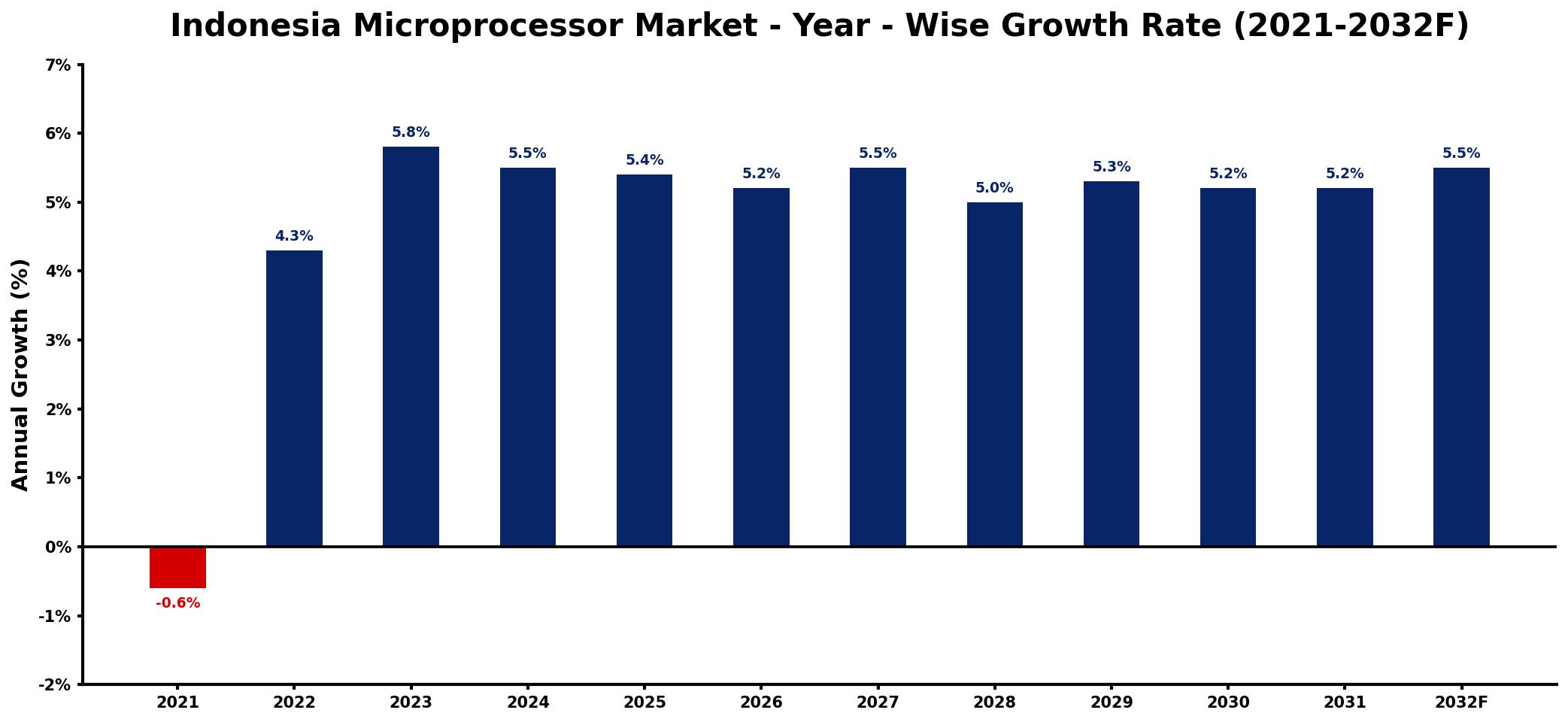
The table below presents the year‑wise growth rates along with the key drivers influencing the market
| Year | Growth Rate | Major Drivers |
| 2021 | -0.6% | falling export shipment volumes |
| 2022 | 4.3% | increased overall sector activity |
| 2023 | 5.8% | Increased investment in AI technologies |
| 2024 | 5.5% | enhanced product quality standards |
| 2025 | 5.4% | Growth in automotive electronics applications |
| 2026 | 5.2% | Surge in cloud computing requirements |
| 2027 | 5.5% | Emerging markets drive new opportunities |
| 2028 | 5.0% | Smart home adoption fuels demand |
| 2029 | 5.3% | Rising demand for gaming devices |
| 2030 | 5.2% | strengthening underlying market demand |
| 2031 | 5.2% | Sustainable technology investments increase focus |
| 2032 | 5.5% | Healthcare technology integration expands market |
Note: Market size estimations and growth projections presented in this report are based on 6Wresearch's proprietary forecasting methodology, utilizing the latest available industry data, government publications, and primary research inputs.
Indonesia Microprocessor Market Synopsis
As Indonesia's digital landscape evolves, the demand for microprocessors is increasingly driven by the surge in smartphone and tablet usage. These devices not only enhance connectivity but also stimulate further adoption of Internet of Things (IoT) applications across homes and industries. Consequently, the urgency for innovative, energy-efficient microprocessors becomes paramount.
Furthermore, the country's growing internet penetration and rising disposable incomes are expected to propel demand for advanced computing technologies. Government policies aimed at supporting digitalization initiatives enhance the need for microprocessor capabilities, cementing the role of these components in Indonesia's technological advancement.
Indonesia Microprocessor Market Key Takeaways
- Robust growth driven by the increasing adoption of smartphones, laptops, and IoT applications.
- Intel Corporation is a dominant player, leading revenue contributions across microprocessor segments.
- The market is supported by favorable government initiatives aimed at enhancing digital infrastructure.
- Technological advancements necessitate constant innovation and energy efficiency in microprocessor designs.
- COVID-19 catalyzed a surge in demand for computing devices, impacting the microprocessor supply chain dynamics.
Evaluation of Restraints in Indonesia Microprocessor Market
Despite the encouraging growth trajectory, the Indonesia microprocessor market encounters significant restraints. The rapid pace of technological innovation presents challenges as manufacturers strive to keep up with evolving demands for high-performance and energy-efficient solutions. Additionally, supply chain disruptions, particularly influenced by global events such as the COVID-19 pandemic, pose risks of shortages and increased costs. Companies in this space must continuously adapt to mitigate these challenges while addressing the growing expectations from consumers and businesses alike.
Indonesia Microprocessor Market Trends
Current trends in the Indonesia microprocessor market indicate a shift towards greater integration of artificial intelligence and machine learning capabilities within microprocessors. This evolution reflects the growing need for devices to process large volumes of data quickly and efficiently. Moreover, the rise of smart cities and home automation is driving innovation in microprocessor applications, necessitating designs that support connectivity and interoperability among various devices.
Indonesia Microprocessor Market Opportunities
The outlook for the Indonesia microprocessor market reveals numerous growth opportunities, particularly within the IoT sector. As industries embrace smart technologies for agriculture, healthcare, and urban development, the demand for specialized microprocessors is poised to rise. Furthermore, investments in local semiconductor manufacturing capabilities present a chance for market players to secure a competitive edge and meet the specific needs of the Indonesian market.
Government Initiatives in the Indonesia Microprocessor Market
The Indonesian government is actively promoting various initiatives aimed at fostering digital transformation within the country. These include policy frameworks encouraging investment in technology infrastructure and incentives for local businesses to adopt advanced computing solutions. Such government support plays a crucial role in stimulating growth in the microprocessor market, fostering an environment conducive to innovation and technological advancement.
Future Insights of the Indonesia Microprocessor Market
Looking ahead to the 2026-2032 period, the Indonesia microprocessor market is set to experience sustained growth driven by ongoing advancements in consumer technology and IoT applications. As digital integration deepens across various sectors, including manufacturing and services, the demand for sophisticated, energy-efficient microprocessors will become even more pronounced. Market players who can leverage emerging technologies and consumer trends will be well-positioned for success in this dynamic landscape.
Indonesia Microprocessor Market Latest Developments (2025 - 2026)
Recent developments in the Indonesia microprocessor market reflect a continued focus on enhancing performance and energy efficiency. Companies are increasingly investing in R&D to create microprocessors capable of supporting advanced applications in AI and IoT. Additionally, there is a growing emphasis on local partnerships to strengthen supply chains and meet the rising demand for computing solutions in various sectors.
Indonesia Microprocessor Market - Key Attractiveness of the Report
- 10 Years of Market Numbers
- Historical Data Starting from 2022 to 2025
- Base Year: 2025
- Forecast Data until 2032
- Key Performance Indicators Impacting the Market
- Major Upcoming Developments and Projects
Key Highlights of the Report:
- Indonesia Microprocessor Market Outlook
- Market Size of Indonesia Microprocessor Market, 2025
- Forecast of Indonesia Microprocessor Market, 2032
- Historical Data and Forecast of Indonesia Microprocessor Revenues & Volume for the Period 2022-2032F
- Indonesia Microprocessor Market Trend Evolution
- Indonesia Microprocessor Market Drivers and Challenges
- Indonesia Microprocessor Price Trends
- Indonesia Microprocessor Porter's Five Forces
- Indonesia Microprocessor Industry Life Cycle
- Historical Data and Forecast of Indonesia Microprocessor Market Revenues & Volume By Technology for the Period 2022-2032F
- Historical Data and Forecast of Indonesia Microprocessor Market Revenues & Volume By CISC for the Period 2022-2032F
- Historical Data and Forecast of Indonesia Microprocessor Market Revenues & Volume By RISC for the Period 2022-2032F
- Historical Data and Forecast of Indonesia Microprocessor Market Revenues & Volume By ASIC for the Period 2022-2032F
- Historical Data and Forecast of Indonesia Microprocessor Market Revenues & Volume By Superscalar for the Period 2022-2032F
- Historical Data and Forecast of Indonesia Microprocessor Market Revenues & Volume By DSP for the Period 2022-2032F
- Historical Data and Forecast of Indonesia Microprocessor Market Revenues & Volume By Application for the Period 2022-2032F
- Historical Data and Forecast of Indonesia Microprocessor Market Revenues & Volume By Smartphones for the Period 2022-2032F
- Historical Data and Forecast of Indonesia Microprocessor Market Revenues & Volume By Personal Computers for the Period 2022-2032F
- Historical Data and Forecast of Indonesia Microprocessor Market Revenues & Volume By Servers for the Period 2022-2032F
- Historical Data and Forecast of Indonesia Microprocessor Market Revenues & Volume By Tablets for the Period 2022-2032F
- Historical Data and Forecast of Indonesia Microprocessor Market Revenues & Volume By Embedded Devices for the Period 2022-2032F
- Historical Data and Forecast of Indonesia Microprocessor Market Revenues & Volume By Others for the Period 2022-2032F
- Indonesia Microprocessor Import Export Trade Statistics
- Market Opportunity Assessment By Technology
- Market Opportunity Assessment By Application
- Indonesia Microprocessor Top Companies Market Share
- Indonesia Microprocessor Competitive Benchmarking By Technical and Operational Parameters
- Indonesia Microprocessor Company Profiles
- Indonesia Microprocessor Key Strategic Recommendations






































