Indonesia Microtomes Market Size, Share & Growth Rate
The Indonesia Microtomes Market was estimated at USD 323 Million in 2025 and is projected to reach USD 427 Million by 2032, growing at a CAGR of 4.1% from 2026 to 2032. This growth is driven by an increasing focus on research within histology and pathology, alongside a surge in healthcare facility establishments across Indonesia. The ongoing advancements in microtome technology, particularly in automation and precision, are also enhancing the capabilities of laboratories, thus positively impacting demand.
Indonesia Microtomes Market Year-wise Growth Rate and Key Drivers
This graph highlights how the Indonesia Microtomes Market has steadily grown over the years, supported by major growth factors.
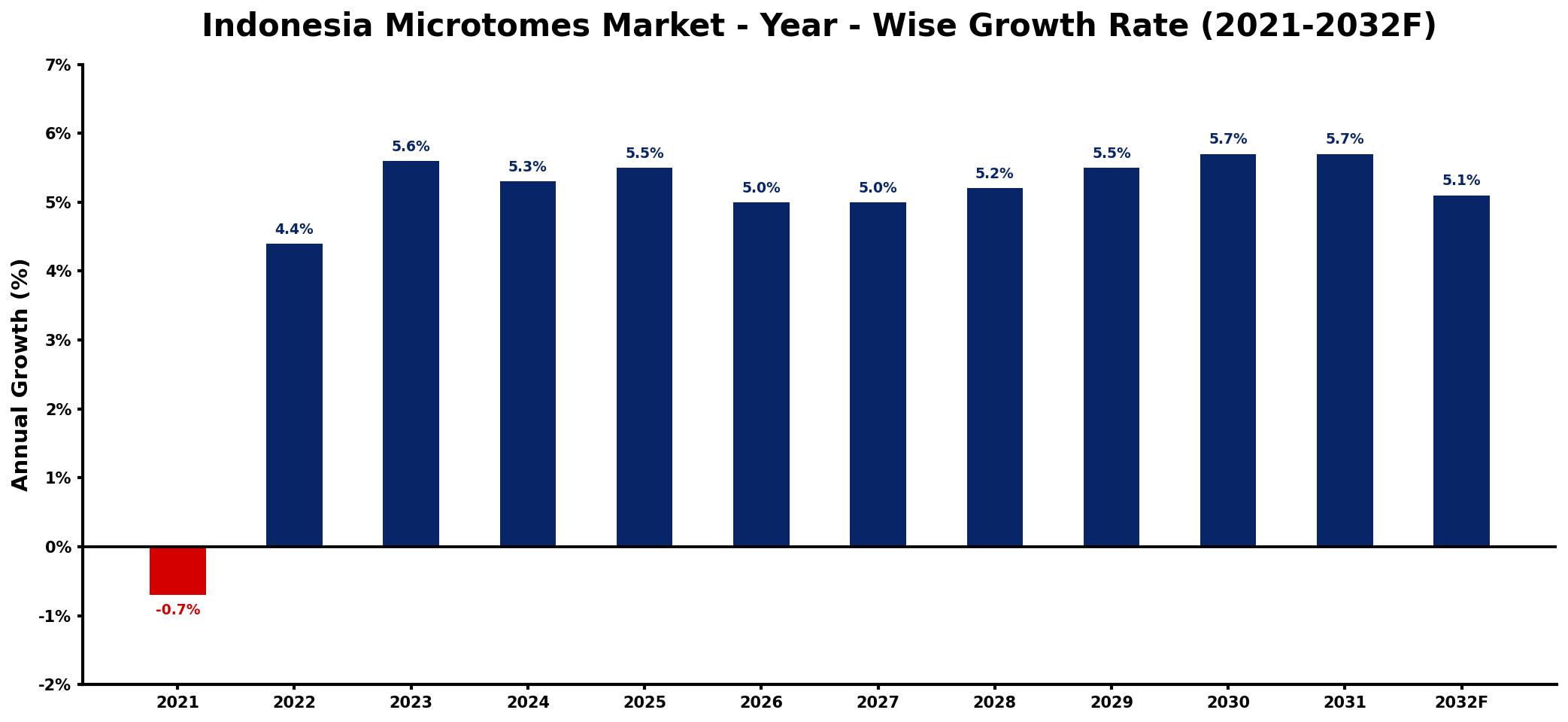
The table below presents the year‑wise growth rates along with the key drivers influencing the market
| Year | Growth Rate | Major Drivers |
| 2021 | -0.7% | reduced funding for laboratory research |
| 2022 | 4.4% | increased healthcare investments nationwide |
| 2023 | 5.6% | growing demand for diagnostics tools |
| 2024 | 5.3% | expansion of research facilities planned |
| 2025 | 5.5% | rising focus on personalized medicine |
| 2026 | 5.0% | advancements in laboratory technologies |
| 2027 | 5.0% | increased training for laboratory staff |
| 2028 | 5.2% | enhanced partnerships with universities |
| 2029 | 5.5% | growing interest in pathology studies |
| 2030 | 5.7% | increased production capacity utilization |
| 2031 | 5.7% | increased government healthcare initiatives |
| 2032 | 5.1% | rising public health awareness campaigns |
Note: Market size estimations and growth projections presented in this report are based on 6Wresearch's proprietary forecasting methodology, utilizing the latest available industry data, government publications, and primary research inputs.
Indonesia Microtomes Market Synopsis
The Indonesia Microtomes market is currently experiencing a phase of recovery following the impacts of the COVID-19 pandemic, which had led to significant disruptions in healthcare spending. As laboratories and hospitals resume normal operations, the importance of microtomes in tissue sample preparation is reigniting market growth.
Looking ahead, the market is poised for sustained expansion. With ongoing research activities in pharmaceuticals and an increasing prevalence of diseases necessitating histopathological examination, the demand for microtomes is expected to rise, further solidifying their critical role in scientific and medical applications.
Indonesia Microtomes Market Key Takeaways
- The market is projected to grow from USD 323 Million in 2025 to USD 427 Million by 2032.
- Technological advancements in microtome automation are set to enhance operational efficiency.
- Increasing disease prevalence is driving the necessity for precise tissue sectioning.
- Healthcare facility expansion is significantly influencing market dynamics.
- Post-pandemic recovery is expected to accelerate demand for microtomes in various laboratories.
Evaluation of Restraints in Indonesia Microtomes Market
Despite the promising growth trajectory of the Indonesia Microtomes market, several restraints continue to impede its progress. A primary concern is the high demand for precision in tissue sectioning, which necessitates sophisticated technology. Balancing this need with affordability remains a significant challenge for manufacturers. Furthermore, ensuring user-friendly designs and minimal maintenance requirements is crucial for sustaining customer satisfaction. Regulatory compliance and rigorous quality assurance standards also pose additional hurdles that require careful navigation within the market.
Indonesia Microtomes Market Trends
The microtome market in Indonesia is being shaped by a multitude of current and emerging trends. A notable shift towards automation is enhancing operational capabilities and precision in sample processing, catering to the increasing demand for efficiency in laboratory settings. Additionally, there is a growing emphasis on environmentally friendly manufacturing processes, aligning with global sustainability goals. Moreover, the integration of digital technologies into microtome systems is on the rise, promising improved data management and analysis capabilities for researchers.
Indonesia Microtomes Market Opportunities
The prospects for growth within the Indonesia Microtomes market are substantial. With the ongoing investment in healthcare infrastructure, particularly in rural and underserved regions, there exists a vast opportunity for market expansion. Additionally, the burgeoning field of biotechnology and personalized medicine presents avenues for innovative applications of microtomes, fostering new revenue streams. Collaborative ventures between public institutions and private sector players are also likely to drive technological advancements and further bolster market dynamics.
Government Initiatives in the Indonesia Microtomes Market
The Indonesian government has recognized the importance of bolstering healthcare infrastructure and research capabilities. Initiatives aimed at increasing public spending on health and science research are pivotal to the development of this market. Programs that promote partnerships between research institutions and industry players are being encouraged, fostering an environment conducive to innovation. Moreover, governmental support for education and training in biomedical fields is vital for ensuring a skilled workforce capable of advancing microtome technology.
Future Insights of the Indonesia Microtomes Market
Looking ahead to 2026-2032, the Indonesia Microtomes market is expected to evolve significantly. With the anticipated surge in healthcare demands and the expansion of research activities, the market will likely see increased investments in technology that enhance precision and efficiency. Innovations in microtome design, alongside the continued integration of automation, will cater to the sophisticated needs of modern laboratories. Overall, the alignment of market growth with healthcare improvement initiatives suggests a promising horizon for stakeholders in this sector.
Indonesia Microtomes Market Latest Developments (2025 - 2026)
The microtome market in Indonesia is currently witnessing several developments that may influence its trajectory. Industry players are increasingly investing in the research and development of advanced microtome models, focusing on automation and user-friendly features. Additionally, collaborations between public and private sectors are fostering innovation, leading to the introduction of state-of-the-art microtome solutions tailored for the Indonesian market. As healthcare services resume fully post-COVID-19, an uptick in procurement activities for laboratory instruments, including microtomes, is anticipated.
Indonesia Microtomes Market - Key Attractiveness of the Report
- 10 Years of Market Numbers
- Historical Data Starting from 2022 to 2025
- Base Year: 2025
- Forecast Data until 2032
- Key Performance Indicators Impacting the Market
- Major Upcoming Developments and Projects
Key Highlights of the Report:
- Indonesia Microtomes Market Outlook
- Market Size of Indonesia Microtomes Market, 2025
- Forecast of Indonesia Microtomes Market, 2032
- Historical Data and Forecast of Indonesia Microtomes Revenues & Volume for the Period 2022-2032F
- Indonesia Microtomes Market Trend Evolution
- Indonesia Microtomes Market Drivers and Challenges
- Indonesia Microtomes Price Trends
- Indonesia Microtomes Porter's Five Forces
- Indonesia Microtomes Industry Life Cycle
- Historical Data and Forecast of Indonesia Microtomes Market Revenues & Volume By Product for the Period 2022-2032F
- Historical Data and Forecast of Indonesia Microtomes Market Revenues & Volume By Microtome Devices for the Period 2022-2032F
- Historical Data and Forecast of Indonesia Microtomes Market Revenues & Volume By Accessories for the Period 2022-2032F
- Historical Data and Forecast of Indonesia Microtomes Market Revenues & Volume By Technology for the Period 2022-2032F
- Historical Data and Forecast of Indonesia Microtomes Market Revenues & Volume By Fully Automated for the Period 2022-2032F
- Historical Data and Forecast of Indonesia Microtomes Market Revenues & Volume By Semi-Automated for the Period 2022-2032F
- Historical Data and Forecast of Indonesia Microtomes Market Revenues & Volume By Manual for the Period 2022-2032F
- Indonesia Microtomes Import Export Trade Statistics
- Market Opportunity Assessment By Product
- Market Opportunity Assessment By Technology
- Indonesia Microtomes Top Companies Market Share
- Indonesia Microtomes Competitive Benchmarking By Technical and Operational Parameters
- Indonesia Microtomes Company Profiles
- Indonesia Microtomes Key Strategic Recommendations






































