Indonesia Mining Lubricants Market: Import Trend Analysis
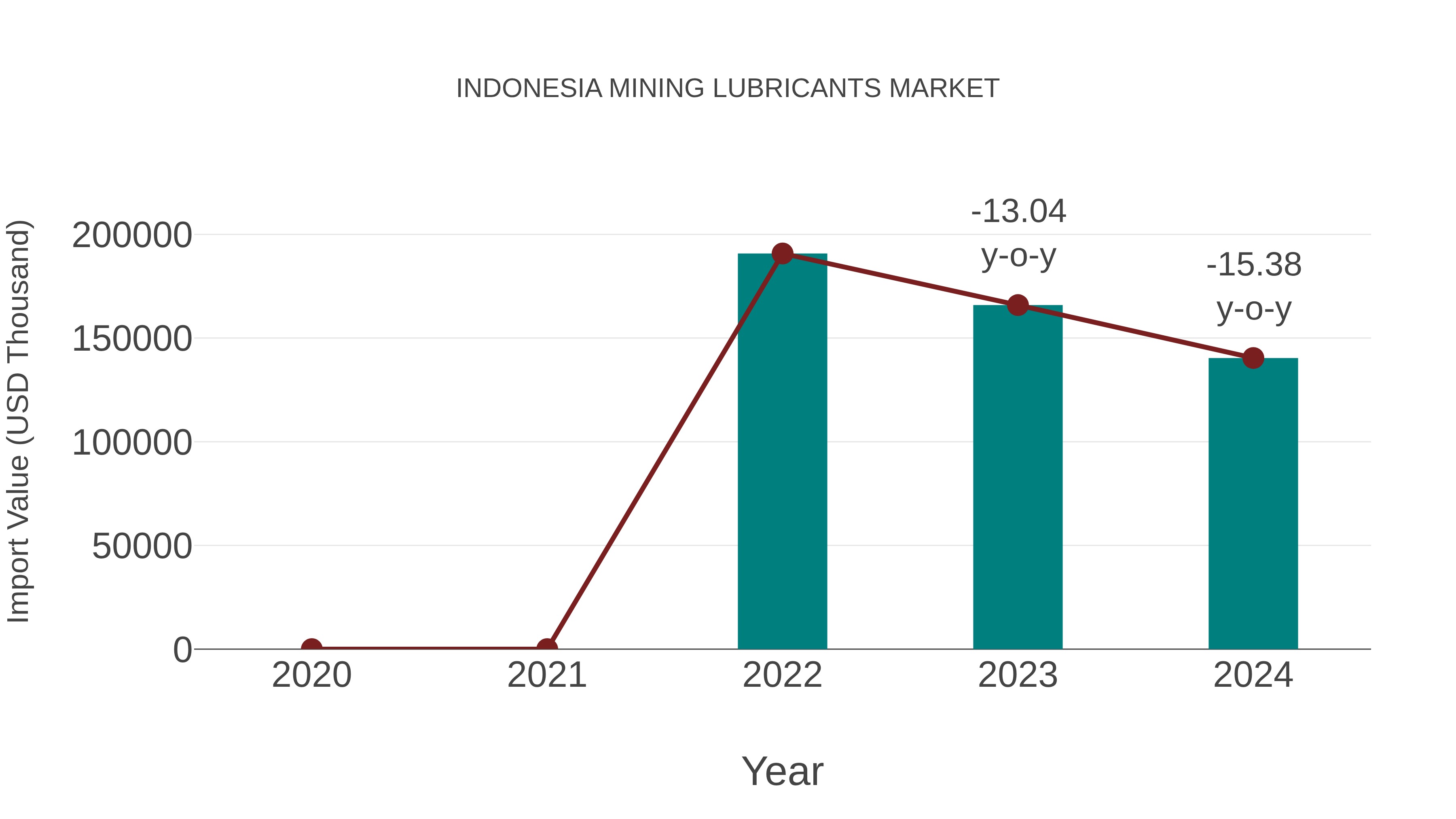
In the Indonesia mining lubricants market, the import trend experienced a decline from 2023 to 2024, with a growth rate of -15.38%. The compound annual growth rate (CAGR) for the period 2020-2024 stood at -14.22%. This negative import momentum could be attributed to a combination of reduced demand in the mining sector and potential shifts in trade policies impacting the market stability.
Indonesia Mining Lubricants Market Overview
The Mining Lubricants market in Indonesia is intricately linked to the country`s thriving mining industry. As the demand for minerals and resources continues to grow, the need for specialized lubricants for heavy machinery used in mining operations has surged, driving the market`s expansion.
Drivers of the Market
The mining lubricants market is influenced by the growth of the mining industry in Indonesia. The need for high-performance lubricants to ensure the smooth operation of heavy mining equipment is a key driver.
Challenges of the Market
The mining lubricants market in Indonesia faces challenges related to the mining industry`s cyclical nature and environmental concerns. The demand for mining lubricants is closely tied to the health of the mining sector, which can experience boom and bust cycles. Economic and geopolitical factors can impact the demand for minerals and, consequently, the demand for mining lubricants. Additionally, the mining industry is under increasing scrutiny for its environmental impact, making it crucial for the market to develop and provide environmentally friendly lubricants while maintaining performance.
COVID-19 Impacts on the Market
The mining lubricants market in Indonesia was impacted by the COVID-19 pandemic. With a slowdown in mining activities and challenges related to workforce safety, the demand for mining lubricants experienced a downturn. Supply chain disruptions and delays in maintenance also affected the market. As the mining industry gradually recovers, the mining lubricants market is working to regain its stability.
Key Players of the Makret
Prominent players in the Indonesian mining lubricants market include ExxonMobil Corporation, Royal Dutch Shell plc, Chevron Corporation, and FUCHS. These companies are renowned for their expertise in the production and distribution of lubricants specifically designed for mining applications.
Key Highlights of the Report:
- Indonesia Mining Lubricants Market Outlook
- Market Size of Indonesia Mining Lubricants Market, 2025
- Forecast of Indonesia Mining Lubricants Market, 2032
- Historical Data and Forecast of Indonesia Mining Lubricants Revenues & Volume for the Period 2022-2032F
- Indonesia Mining Lubricants Market Trend Evolution
- Indonesia Mining Lubricants Market Drivers and Challenges
- Indonesia Mining Lubricants Price Trends
- Indonesia Mining Lubricants Porter's Five Forces
- Indonesia Mining Lubricants Industry Life Cycle
- Historical Data and Forecast of Indonesia Mining Lubricants Market Revenues & Volume By End Use Industry for the Period 2022-2032F
- Historical Data and Forecast of Indonesia Mining Lubricants Market Revenues & Volume By Coal Mining for the Period 2022-2032F
- Historical Data and Forecast of Indonesia Mining Lubricants Market Revenues & Volume By Iron ORE Mining for the Period 2022-2032F
- Historical Data and Forecast of Indonesia Mining Lubricants Market Revenues & Volume By Bauxite Mining for the Period 2022-2032F
- Historical Data and Forecast of Indonesia Mining Lubricants Market Revenues & Volume By Rare Earth Mineral Mining for the Period 2022-2032F
- Historical Data and Forecast of Indonesia Mining Lubricants Market Revenues & Volume By Precious Metals Mining for the Period 2022-2032F
- Historical Data and Forecast of Indonesia Mining Lubricants Market Revenues & Volume By Type for the Period 2022-2032F
- Historical Data and Forecast of Indonesia Mining Lubricants Market Revenues & Volume By Mineral Oil Lubricants for the Period 2022-2032F
- Historical Data and Forecast of Indonesia Mining Lubricants Market Revenues & Volume By Synthetic Lubricants for the Period 2022-2032F
- Indonesia Mining Lubricants Import Export Trade Statistics
- Market Opportunity Assessment By End Use Industry
- Market Opportunity Assessment By Type
- Indonesia Mining Lubricants Top Companies Market Share
- Indonesia Mining Lubricants Competitive Benchmarking By Technical and Operational Parameters
- Indonesia Mining Lubricants Company Profiles
- Indonesia Mining Lubricants Key Strategic Recommendations






































