Indonesia Mobile Security Market Size & Growth Rate (2026-2032)
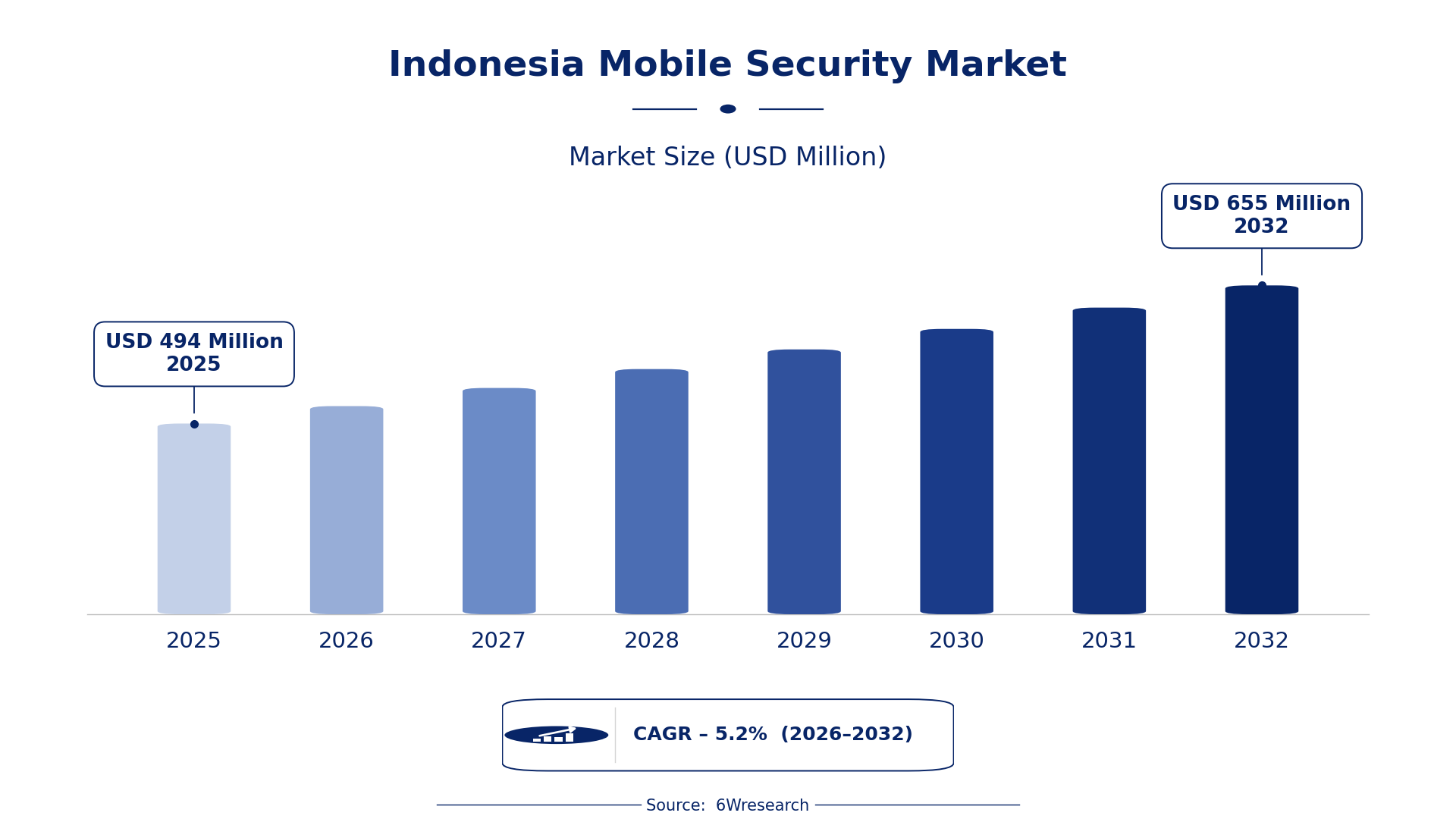
The Indonesia Mobile Security Market was estimated at USD 494 Million in 2025 and is projected to reach USD 655 Million by 2032, growing at a CAGR of 5.2% from 2026 to 2032.
Indonesia Mobile Security Market Synopsis
With the rapid adoption of smartphones in Indonesia, mobile security has surged to the forefront of both corporate and personal priorities. As of late, nearly 70% of the population relies on mobile devices for day-to-day activities, amplifying the necessity for robust security measures to combat the rising tide of cyber threats.
As users increasingly depend on mobile applications for transactions, communications, and information storage, the market for mobile security solutions has expanded. Many businesses are realizing the importance of investing in sophisticated security technologies that ensure the protection of sensitive information stored on mobile devices, as well as compliance with regulatory mandates.
Indonesia Mobile Security Market Year-wise Growth Rate and Key Drivers
This graph illustrates the annual growth rates of the Indonesia Mobile Security Market from 2021 to 2032, highlighting a steady upward trajectory and projected expansion over the forecast period.
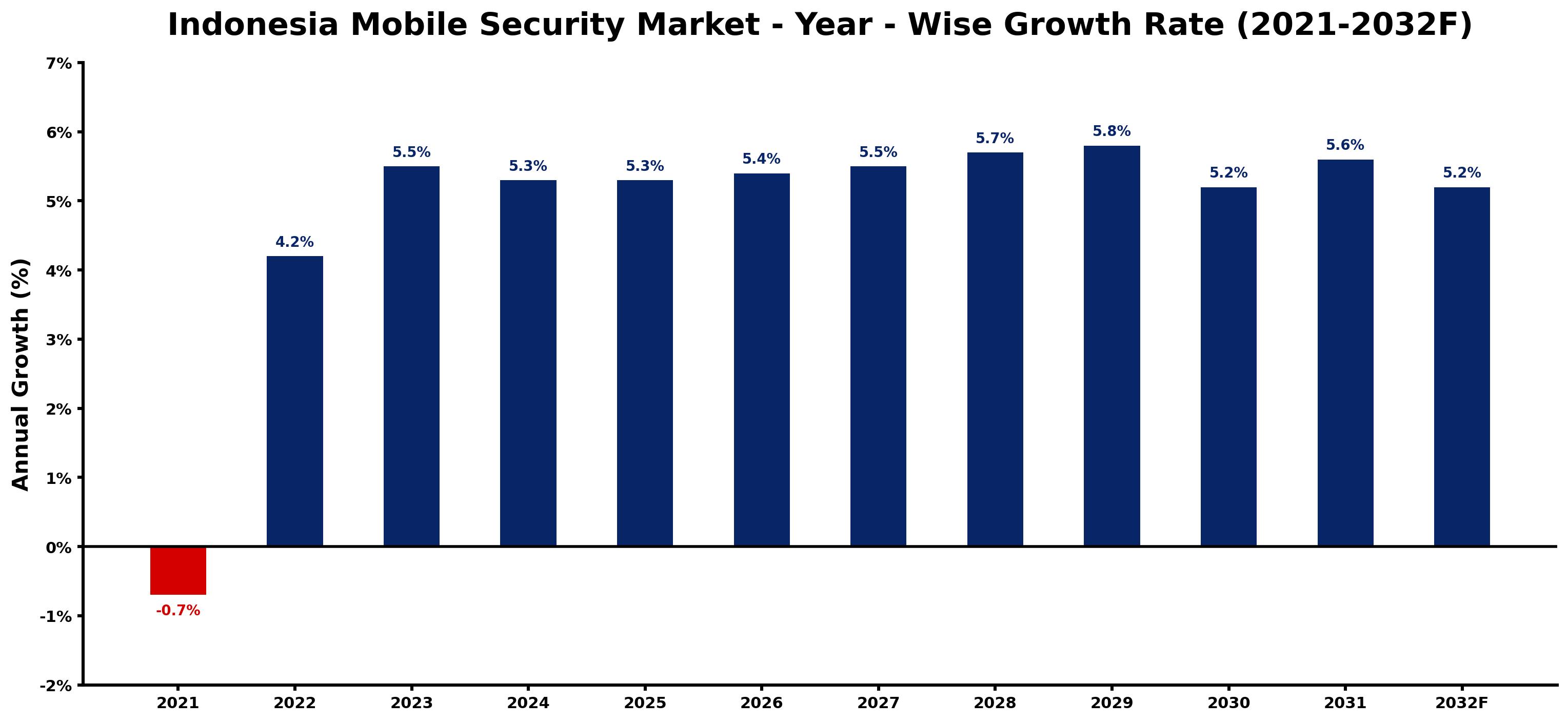
The table below presents the year‑wise growth rates along with the key drivers influencing the market
| Year | Growth Rate | Major Drivers |
| 2021 | -0.7% | Regulatory restrictions from Kominfo on app security features. |
| 2022 | 4.2% | Rising concerns over mobile data privacy regulations. |
| 2023 | 5.5% | Increased cyber threats targeting Indonesian digital transactions. |
| 2024 | 5.3% | Adoption of biometric authentication by local financial institutions. |
| 2025 | 5.3% | Enhanced mobile security awareness among Indonesian consumers. |
| 2026 | 5.4% | Government policies supporting fintech innovation and security. |
| 2027 | 5.5% | Growth in mobile app usage necessitating stronger security measures. |
| 2028 | 5.7% | Partnerships between telecom companies and security firms. |
| 2029 | 5.8% | Educational campaigns on mobile security for businesses. |
| 2030 | 5.2% | Local enterprises mandating compliance with data protection laws. |
| 2031 | 5.6% | Allocation of budget for public sector cybersecurity upgrades. |
| 2032 | 5.2% | Increased focus on protecting sensitive personal information. |
Note: Market size estimations and growth projections presented in this report are based on 6Wresearch's proprietary forecasting methodology, utilizing the latest available industry data, government publications, and primary research inputs.
Indonesia Mobile Security Market Key Takeaways
Below are some of the specific key takeaways from the market, including:
- Growing smartphone penetration is driving demand for mobile security solutions.
- The shift toward remote work has broadened opportunities for cybercriminals.
- Investments in mobile security technologies are increasingly viewed as essential.
- Local companies are stepping up to meet the demand for tailored security solutions.
- Complexity in securing diverse device configurations presents an ongoing challenge.
Evaluation of Restraints in Indonesia Mobile Security Market
The Indonesia Mobile Security Market faces a significant hurdle in securing a fragmented mobile device ecosystem. With numerous operating systems and device models in circulation, creating universal security solutions becomes increasingly complicated. This fragmentation not only complicates the delivery of effective security services but also results in potential vulnerabilities that cybercriminals can exploit. Additionally, varying levels of user awareness regarding mobile security further impede market growth, as many individuals and organizations may underestimate the risks associated with inadequate protection.
Indonesia Mobile Security Market Trends
The market is witnessing a surge in demand for Artificial Intelligence (AI)-driven security solutions that offer real-time threat detection and response. As organizations increasingly adopt cloud-based services, the integration of mobile security solutions with cloud computing platforms is becoming a common trend. on top of that, the growing emphasis on data privacy regulations is pushing businesses to invest in solutions that not only protect mobile devices but also ensure compliance with local laws.
Indonesia Mobile Security Market Opportunities
There is a promising landscape for growth as businesses look for mobile security solutions that can cater to the increasing complexity of cyber threats. The ongoing digital transformation across various sectors, including banking and finance, healthcare, and e-commerce, presents substantial investment opportunities. Additionally, with the rise in cybercrime rates, there is an increasing willingness from organizations to allocate budgets specifically for enhanced mobile security measures.
Government Initiatives in the Indonesia Mobile Security Market
The Indonesian government is actively shaping the mobile security market by implementing policies aimed at enhancing national cybersecurity. Regulatory bodies are focusing on frameworks that mandate security protocols across industries, ensuring that businesses prioritize mobile security in their operations. This proactive stance is crucial in a market where mobile device usage is proliferating and, consequently, cyber threats are escalating.
- A regulatory framework established in 2023 requires businesses to implement mobile security measures in line with national standards.
- Current initiatives include public awareness campaigns focused on the importance of mobile security for consumers and businesses alike.
- A national cybersecurity strategy introduced in late 2024 emphasizes the development of security infrastructure for mobile applications.
- Upcoming plans involve a collaborative project between the government and private sector to enhance cybersecurity training programs expected to launch by mid-2026.
Future Insights of the Indonesia Mobile Security Market
Looking ahead to 2026-2032, the Indonesia Mobile Security Market is likely to experience significant evolution. As the smartphone penetration continues to rise, the demand for comprehensive security solutions will only intensify. on top of that, with a greater push toward digital payment systems, organizations will need to ensure that mobile security measures are not only effective but also innovative. Companies that can adapt to the shifting landscape and meet the diverse needs of consumers and businesses will find ample opportunities for growth.
Indonesia Mobile Security Market Latest Developments
In the past year, the Indonesia Mobile Security Market has seen several important developments that highlight its growth trajectory. The focus on security has prompted technology providers to innovate and offer solutions tailored to local market needs. As the reliance on mobile devices continues to deepen, these developments signify a critical step forward in addressing the growing concerns of data breaches and cyber threats.
- A new mobile security application was launched in early 2025, aimed specifically at small businesses to protect their data on mobile devices.
- Ongoing partnerships between technology firms and local governments are working to enhance mobile security infrastructure, set to continue through 2026.
- A recent investment in a mobile threat intelligence platform was made by a regional player, enhancing their capabilities in real-time threat detection.
- Upcoming features for existing mobile security solutions are expected to roll out in Q3 2025, adding advanced AI capabilities for better threat mitigation.
Indonesia Mobile Security Market - Key Attractiveness of the Report
- 10 Years of Market Numbers
- Historical Data Starting from 2022 to 2025
- Base Year: 2025
- Forecast Data until 2032
- Key Performance Indicators Impacting the Market
- Major Upcoming Developments and Projects
Key Highlights of the Report:
- Indonesia Mobile Security Market Outlook
- Market Size of Indonesia Mobile Security Market, 2025
- Forecast of Indonesia Mobile Security Market, 2032
- Historical Data and Forecast of Indonesia Mobile Security Revenues & Volume for the Period 2022-2032F
- Indonesia Mobile Security Market Trend Evolution
- Indonesia Mobile Security Market Drivers and Challenges
- Indonesia Mobile Security Price Trends
- Indonesia Mobile Security Porter's Five Forces
- Indonesia Mobile Security Industry Life Cycle
- Historical Data and Forecast of Indonesia Mobile Security Market Revenues & Volume By End User for the Period 2022-2032F
- Historical Data and Forecast of Indonesia Mobile Security Market Revenues & Volume By Individual for the Period 2022-2032F
- Historical Data and Forecast of Indonesia Mobile Security Market Revenues & Volume By Enterprise (Solution (Authentication, Application Security, & Device Security), Service) for the Period 2022-2032F
- Historical Data and Forecast of Indonesia Mobile Security Market Revenues & Volume By Deployment Mode for the Period 2022-2032F
- Historical Data and Forecast of Indonesia Mobile Security Market Revenues & Volume By On-premises for the Period 2022-2032F
- Historical Data and Forecast of Indonesia Mobile Security Market Revenues & Volume By Cloud for the Period 2022-2032F
- Historical Data and Forecast of Indonesia Mobile Security Market Revenues & Volume By Organization Size for the Period 2022-2032F
- Historical Data and Forecast of Indonesia Mobile Security Market Revenues & Volume By Small and Medium-Sized Enterprises (SMEs) for the Period 2022-2032F
- Historical Data and Forecast of Indonesia Mobile Security Market Revenues & Volume By Large Enterprises for the Period 2022-2032F
- Historical Data and Forecast of Indonesia Mobile Security Market Revenues & Volume By Vertical for the Period 2022-2032F
- Historical Data and Forecast of Indonesia Mobile Security Market Revenues & Volume By BFSI for the Period 2022-2032F
- Historical Data and Forecast of Indonesia Mobile Security Market Revenues & Volume By Telecom & IT for the Period 2022-2032F
- Historical Data and Forecast of Indonesia Mobile Security Market Revenues & Volume By Retail for the Period 2022-2032F
- Historical Data and Forecast of Indonesia Mobile Security Market Revenues & Volume By Healthcare for the Period 2022-2032F
- Historical Data and Forecast of Indonesia Mobile Security Market Revenues & Volume By Government & Defense for the Period 2022-2032F
- Historical Data and Forecast of Indonesia Mobile Security Market Revenues & Volume By Manufacturing for the Period 2022-2032F
- Historical Data and Forecast of Indonesia Mobile Security Market Revenues & Volume By Others for the Period 2022-2032F
- Historical Data and Forecast of Indonesia Mobile Security Market Revenues & Volume By Operating System for the Period 2022-2032F
- Historical Data and Forecast of Indonesia Mobile Security Market Revenues & Volume By iOS for the Period 2022-2032F
- Historical Data and Forecast of Indonesia Mobile Security Market Revenues & Volume By Android for the Period 2022-2032F
- Indonesia Mobile Security Import Export Trade Statistics
- Market Opportunity Assessment By End User
- Market Opportunity Assessment By Deployment Mode
- Market Opportunity Assessment By Organization Size
- Market Opportunity Assessment By Vertical
- Market Opportunity Assessment By Operating System
- Indonesia Mobile Security Top Companies Market Share
- Indonesia Mobile Security Competitive Benchmarking By Technical and Operational Parameters
- Indonesia Mobile Security Company Profiles
- Indonesia Mobile Security Key Strategic Recommendations






































