Indonesia Mold Release Agents Market: Import Trend Analysis
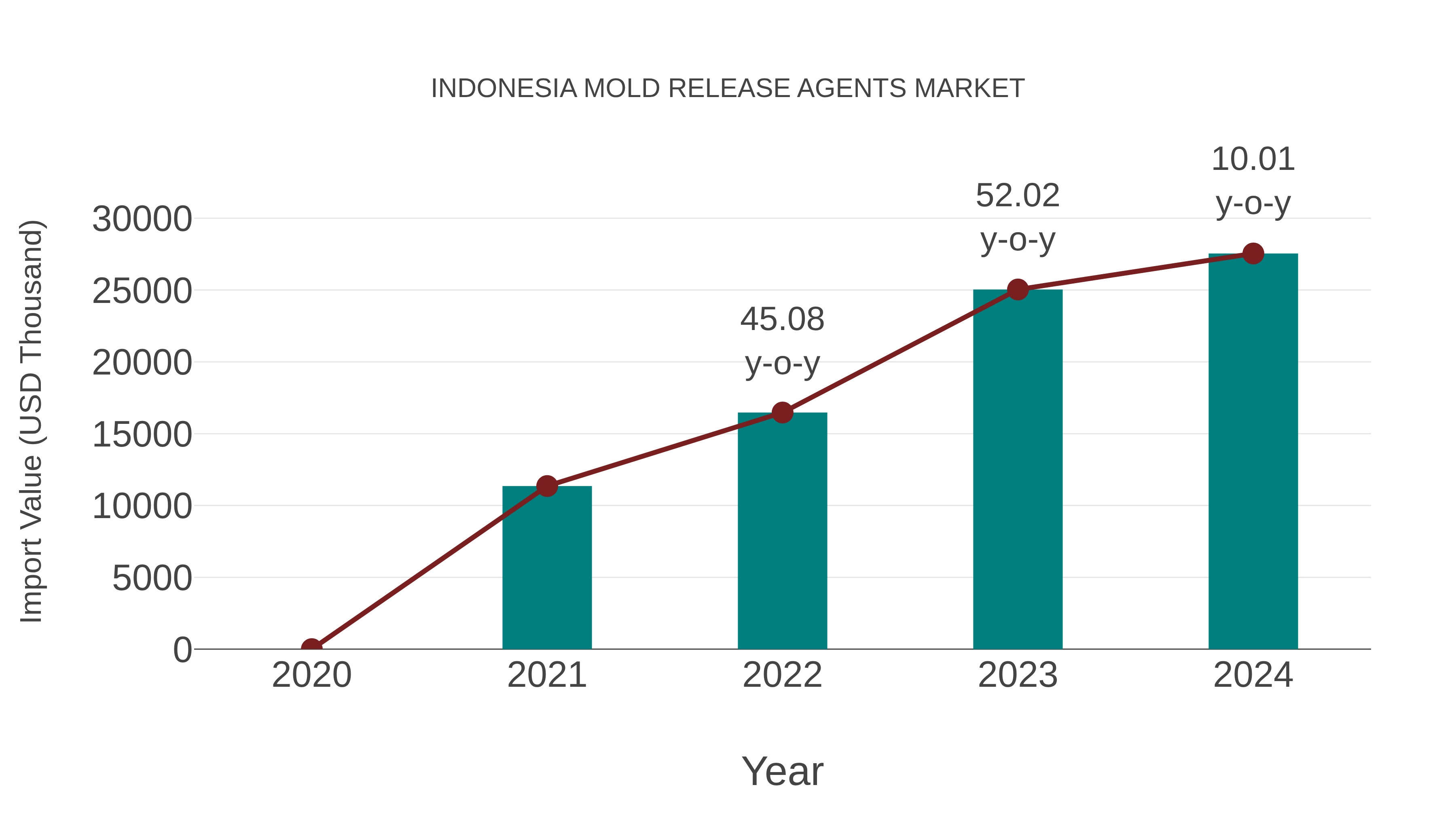
Indonesia`s import momentum for mold release agents in 2024 exhibited a notable growth rate of 10.01%, following a robust compound annual growth rate (CAGR) of 34.37% from 2020 to 2023. This surge can be attributed to a significant demand shift towards high-quality release agents, potentially driven by advancements in manufacturing processes or increasing quality standards within the industry.
Indonesia Mold Release Agents Market Overview
The Indonesia mold release agents market plays a pivotal role in the country`s manufacturing sector, providing solutions for releasing products from molds with precision and efficiency. It is integral to industries like automotive, construction, and electronics. The market is driven by the increasing demand for high-quality molded products and the pursuit of efficient manufacturing processes. As Indonesia`s industrial landscape evolves, the mold release agents market will remain essential in ensuring smooth and reliable production processes.
Drivers of the Market
The Mold Release Agents Market in Indonesia is expanding due to the growth of the manufacturing and construction sectors. Mold release agents are essential in various manufacturing processes, including foundries, plastic molding, and concrete production. The increasing industrialization, infrastructure development, and construction activities are driving the demand for mold release agents. Furthermore, as industries aim to enhance efficiency and reduce waste in their processes, the adoption of advanced and eco-friendly mold release agents has gained momentum. This, in turn, is contributing to the market`s growth.
Challenges of the Market
Mold release agents are essential in various industries, but challenges include product quality, cost-effectiveness, and environmental impact. Developing high-quality, cost-effective release agents that are environmentally friendly presents a significant challenge for the market.
COVID-19 Impacts on the Market
The mold release agents market in Indonesia faced challenges during the pandemic due to disruptions in manufacturing and production processes. The automotive and construction industries, significant users of mold release agents, were impacted. However, the healthcare and packaging sectors saw increased demand for mold release agents in the production of medical devices and packaging materials. As the economy recovers and industries adapt to new norms, the mold release agents market is expected to gradually rebound.
Key Players of the Makret
In the Indonesia Mold Release Agents market, key players include Chem-Trend, Henkel, and Croda. They offer mold release agents for manufacturing processes in industries such as automotive and plastics.
Key Highlights of the Report:
- Indonesia Mold Release Agents Market Outlook
- Market Size of Indonesia Mold Release Agents Market, 2025
- Forecast of Indonesia Mold Release Agents Market, 2032
- Historical Data and Forecast of Indonesia Mold Release Agents Revenues & Volume for the Period 2022-2032F
- Indonesia Mold Release Agents Market Trend Evolution
- Indonesia Mold Release Agents Market Drivers and Challenges
- Indonesia Mold Release Agents Price Trends
- Indonesia Mold Release Agents Porter's Five Forces
- Indonesia Mold Release Agents Industry Life Cycle
- Historical Data and Forecast of Indonesia Mold Release Agents Market Revenues & Volume By Product Type for the Period 2022-2032F
- Historical Data and Forecast of Indonesia Mold Release Agents Market Revenues & Volume By Water-based for the Period 2022-2032F
- Historical Data and Forecast of Indonesia Mold Release Agents Market Revenues & Volume By Solvent-based for the Period 2022-2032F
- Historical Data and Forecast of Indonesia Mold Release Agents Market Revenues & Volume By Application for the Period 2022-2032F
- Historical Data and Forecast of Indonesia Mold Release Agents Market Revenues & Volume By Die-casting for the Period 2022-2032F
- Historical Data and Forecast of Indonesia Mold Release Agents Market Revenues & Volume By Rubber Molding for the Period 2022-2032F
- Historical Data and Forecast of Indonesia Mold Release Agents Market Revenues & Volume By Plastic Molding for the Period 2022-2032F
- Historical Data and Forecast of Indonesia Mold Release Agents Market Revenues & Volume By PU Molding for the Period 2022-2032F
- Historical Data and Forecast of Indonesia Mold Release Agents Market Revenues & Volume By Concrete for the Period 2022-2032F
- Historical Data and Forecast of Indonesia Mold Release Agents Market Revenues & Volume By Wood Composite & Panel Pressing for the Period 2022-2032F
- Historical Data and Forecast of Indonesia Mold Release Agents Market Revenues & Volume By Composite Molding for the Period 2022-2032F
- Indonesia Mold Release Agents Import Export Trade Statistics
- Market Opportunity Assessment By Product Type
- Market Opportunity Assessment By Application
- Indonesia Mold Release Agents Top Companies Market Share
- Indonesia Mold Release Agents Competitive Benchmarking By Technical and Operational Parameters
- Indonesia Mold Release Agents Company Profiles
- Indonesia Mold Release Agents Key Strategic Recommendations






































