Indonesia Motorcycle components Market Size, Share & Growth Rate
The Indonesia Motorcycle components Market was estimated at USD 479 Million in 2025 and is projected to reach USD 636 Million by 2032, growing at a CAGR of 4.1% from 2026 to 2032. This growth trajectory is propelled by a burgeoning demand for motorcycles fueled by rising disposable incomes and a desire for efficient transportation. Additionally, the increasing penetration of electric motorcycles is altering the components landscape, as manufacturers adapt to new technologies and consumer preferences.
Indonesia Motorcycle components Market Growth Rate Analysis (2021-2032)
The Indonesian motorcycle components market has experienced a notable resurgence, recovering from a slight decline of 0.6% in 2021. A strong demand rebound in 2022 fueled a growth of 4.2%, and continued investments in local manufacturing have propelled growth further, reaching 5.7% in 2023. This upward trend is expected to sustain, with growth projected at around 5.3% in 2024 and 5.5% in 2025, driven by increased consumer demand and the push for advanced technology in motorcycle manufacturing. Additionally, evolving infrastructure and digitalization in supply chains are enhancing operational efficiencies. By 2032, growth could peak at 5.8%, underlining a robust market environment poised for expansion.
Indonesia Motorcycle components Market Year-wise Growth Rate and Key Drivers
This graph highlights how the Indonesia Motorcycle components Market has steadily grown over the past five years, supported by major growth factors.
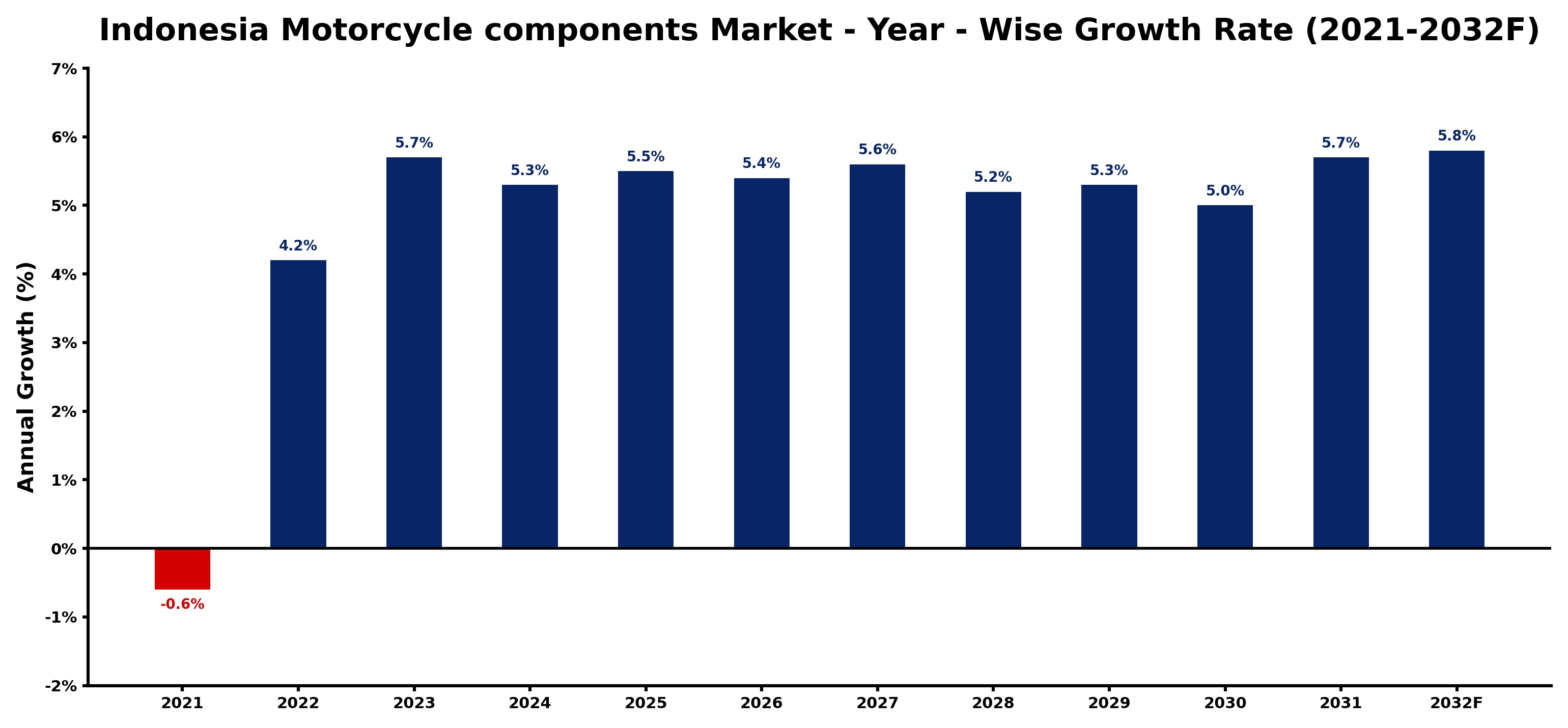
The table below presents the year‑wise growth rates along with the key drivers influencing the market
| Year | Growth Rate | Major Drivers |
| 2021 | -0.6% | Supply chain disruptions hinder timely delivery of motorcycle components |
| 2022 | 4.2% | Motorcycle production ramp up boosts demand for precision metal parts |
| 2023 | 5.7% | Domestic motorcycle component production aligns with supply chain investments |
| 2024 | 5.3% | Higher motorcycle assembly efficiency drives demand for precision components |
| 2025 | 5.5% | Advanced machining technology boosted motorcycle engine component precision manufacturing |
| 2026 | 5.4% | New assembly plants boost domestic motorcycle component production capabilities |
| 2027 | 5.6% | Local assembly plant openings boost motorcycle component manufacturing capacity |
| 2028 | 5.2% | Export driven motorcycle parts demand fuels local manufacturing investments |
| 2029 | 5.3% | Manufacturing modernization boosts precision tooling adoption across suppliers |
| 2030 | 5.0% | Advanced machining technologies optimize local motorcycle component production efficiency |
| 2031 | 5.7% | Domestic motorcycle manufacturers adopt advanced automation for production efficiency |
| 2032 | 5.8% | Domestic motorcycle production ramp up drives component supply chain optimization |
Note - Market size estimations and growth projections presented in this report are based on 6Wresearch's advanced forecasting approach, validated with industry datasets as of June 2026.
Indonesia Motorcycle components Market Synopsis
The motorcycle components market in Indonesia is characterized by a vibrant aftermarket, driven by a significant demand for replacement parts. Routine maintenance and repairs are pivotal, as motorcycle ownership is widespread among the growing urban population, necessitating a steady supply of components such as filters, brakes, and tires.
Simultaneously, the local manufacturing sector is experiencing expansion, with several manufacturers scaling up their production capabilities to cater to both domestic and international markets. This trend not only reinforces supply chains but also leads to increased localization of component sourcing.
Indonesia Motorcycle components Market Key Takeaways
- The market is significantly influenced by a strong domestic demand for motorcycles and their components.
- Electric motorcycle components are increasingly being developed in response to environmental concerns.
- Growing urbanization and disposable incomes are driving the surge in motorcycle ownership.
- The market is recovering post-pandemic, indicating a rebound in consumer spending and manufacturing activity.
- Market players are navigating challenges posed by counterfeit parts and compliance with environmental regulations.
Evaluation of Restraints in Indonesia Motorcycle components Market
Despite the robust growth potential, the Indonesia Motorcycle components market faces significant challenges. Counterfeit and substandard components continue to undermine consumer trust and safety, posing a barrier to legitimate businesses. Furthermore, compliance with stringent environmental regulations demands ongoing innovation and investment from manufacturers, impacting profit margins and operational efficiency. The need for heightened consumer awareness regarding the risks associated with counterfeit parts remains critical for ensuring market integrity.
Indonesia Motorcycle components Market Trends
Current trends in the Indonesia Motorcycle components market are marked by a shift toward lightweight materials such as aluminum alloys and carbon composites, which enhance fuel efficiency. Additionally, the integration of digital technologies—like GPS navigation and smartphone connectivity—into motorcycles is creating new demand for specialized components. As electric vehicles gain traction, the market is also witnessing increased investment in batteries, power electronics, and other related technologies.
Indonesia Motorcycle components Market Opportunities
Genuine growth opportunities abound in the Indonesia Motorcycle components market, particularly in the electric motorcycle sector. As consumers increasingly seek greener transportation options, manufacturers who can innovate and adapt to these demands will thrive. Moreover, the ongoing push for localized manufacturing presents a significant opportunity for component suppliers to establish themselves within Indonesia, reducing reliance on imports and boosting local economies.
Government Initiatives in the Indonesia Motorcycle components Market
The Indonesian government is actively promoting the motorcycle industry through policies aimed at enhancing manufacturing capabilities and encouraging investment. Public spending on infrastructure improvements is set to bolster the transportation network, which indirectly supports the growth of the motorcycle market. Additionally, various incentives for electric vehicle production are emerging, aiming to support sustainable transportation solutions in the country.
Future Insights of the Indonesia Motorcycle components Market
Looking ahead to 2026-2032, the Indonesia Motorcycle components market is poised for significant transformation. The rise of electric motorcycles will continue to reshape component requirements, while advancements in technology will drive innovation in existing components. As consumer preferences evolve toward higher performance and sustainability, manufacturers that successfully align with these trends will likely capture a substantial share of the market.
Indonesia Motorcycle components Market Latest Developments (May 2025 - June 2026)
The motorcycle components industry in Indonesia is currently witnessing an uptick in collaborations between local manufacturers and international partners, aimed at enhancing technology transfer and production efficiency. Furthermore, there is a notable increase in R&D investments directed toward electric components, reflecting the market's response to environmental mandates and consumer shifts. Additionally, improvements in logistics and supply chain management are being implemented to address the repercussions of previous disruptions.
Indonesia Motorcycle components Market - Key Attractiveness of the Report
- 10 Years of Market Numbers
- Historical Data Starting from 2022 to 2025
- Base Year: 2025
- Forecast Data until 2032
- Key Performance Indicators Impacting the Market
- Major Upcoming Developments and Projects
Key Highlights of the Report:
- Indonesia Motorcycle components Market Outlook
- Market Size of Indonesia Motorcycle components Market, 2025
- Forecast of Indonesia Motorcycle components Market, 2032
- Historical Data and Forecast of Indonesia Motorcycle components Revenues & Volume for the Period 2022-2032F
- Indonesia Motorcycle components Market Trend Evolution
- Indonesia Motorcycle components Market Drivers and Challenges
- Indonesia Motorcycle components Price Trends
- Indonesia Motorcycle components Porter's Five Forces
- Indonesia Motorcycle components Industry Life Cycle
- Historical Data and Forecast of Indonesia Motorcycle components Market Revenues & Volume By Type for the Period 2022-2032F
- Historical Data and Forecast of Indonesia Motorcycle components Market Revenues & Volume By Engine & Drivetrain for the Period 2022-2032F
- Historical Data and Forecast of Indonesia Motorcycle components Market Revenues & Volume By Tires for the Period 2022-2032F
- Historical Data and Forecast of Indonesia Motorcycle components Market Revenues & Volume By Structural for the Period 2022-2032F
- Historical Data and Forecast of Indonesia Motorcycle components Market Revenues & Volume By Electrical and Electronic for the Period 2022-2032F
- Historical Data and Forecast of Indonesia Motorcycle components Market Revenues & Volume By Other for the Period 2022-2032F
- Historical Data and Forecast of Indonesia Motorcycle components Market Revenues & Volume By Applications for the Period 2022-2032F
- Historical Data and Forecast of Indonesia Motorcycle components Market Revenues & Volume By Electric Bicycles for the Period 2022-2032F
- Historical Data and Forecast of Indonesia Motorcycle components Market Revenues & Volume By Motorcycles for the Period 2022-2032F
- Indonesia Motorcycle components Import Export Trade Statistics
- Market Opportunity Assessment By Type
- Market Opportunity Assessment By Applications
- Indonesia Motorcycle components Top Companies Market Share
- Indonesia Motorcycle components Competitive Benchmarking By Technical and Operational Parameters
- Indonesia Motorcycle components Company Profiles
- Indonesia Motorcycle components Key Strategic Recommendations






































