Indonesia Multifunctional Composite Materials Market Summary
The indonesia multifunctional composite materials market was estimated at USD 325 Million in 2025 and is projected to reach USD 430 Million by 2032, growing at a CAGR of 5.6% from 2026 to 2032.
Indonesia Multifunctional Composite Materials Market Year-wise Growth Rate and Key Drivers
This graph highlights how the Indonesia Multifunctional Composite Materials Market has steadily grown over the past five years, supported by major growth factors.
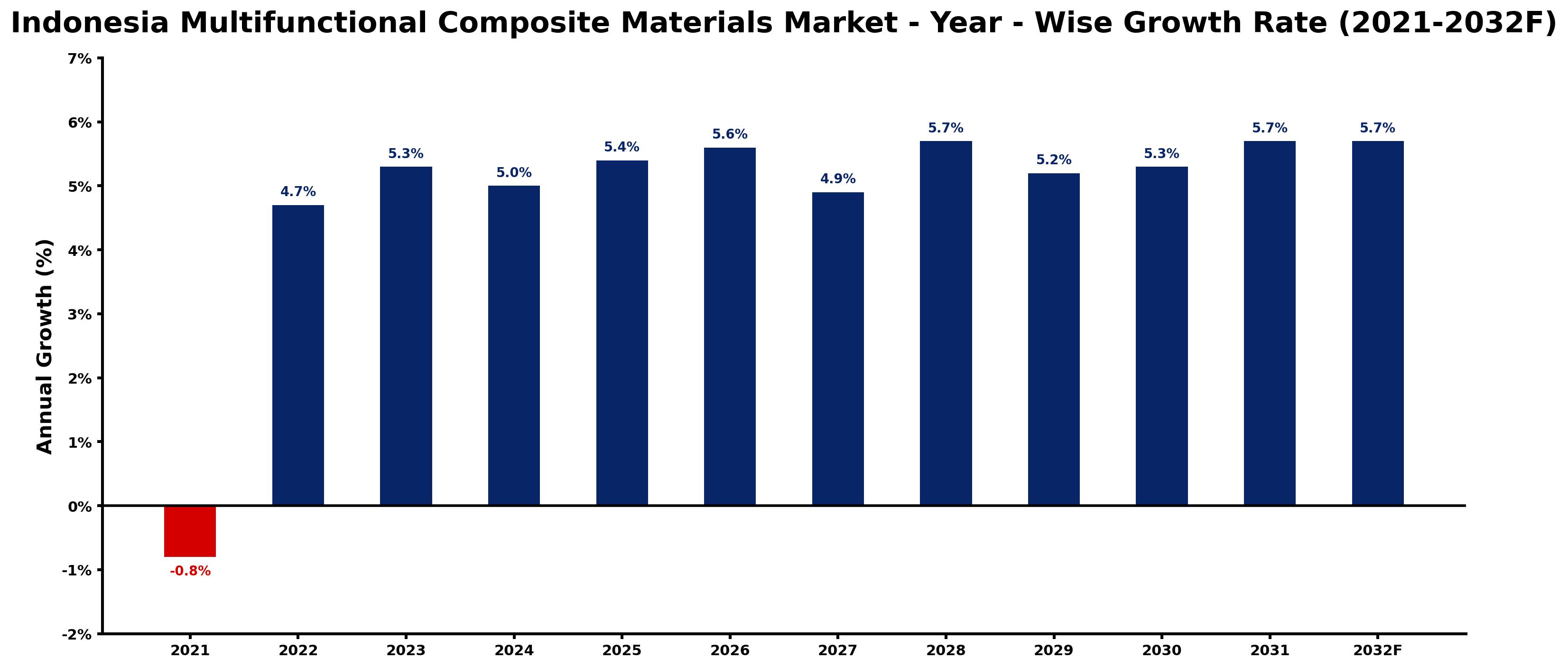
The table below presents the year wise growth rates along with the key drivers influencing the market
| Year | Growth Rate | Major Drivers |
| 2021 | -0.8% | Supply chain disruptions caused by the pandemic hindered production capabilities in the multifunctional composite materials sector. |
| 2022 | 4.7% | Sustainability trends encouraged manufacturers to explore alternative composite materials in production. |
| 2023 | 5.3% | Local manufacturing capabilities improved, reducing reliance on imported composite materials significantly. |
| 2024 | 5.0% | R&D efforts in multifunctional materials attracted foreign investment into the sector. |
| 2025 | 5.4% | A burgeoning automotive sector sought lightweight composites for improved fuel efficiency. |
| 2026 | 5.6% | Innovative applications in the construction industry showcased multifunctional materials' versatility. |
| 2027 | 4.9% | Collaborations between universities and industries fueled advancements in material science research. |
| 2028 | 5.7% | Consumer awareness around eco-friendly products influenced purchasing decisions across sectors. |
| 2029 | 5.2% | Automotive electrification needs drove a surge in the demand for advanced composite materials. |
| 2030 | 5.3% | Increased urbanization in major cities created higher demand for durable multifunctional composites. |
| 2031 | 5.7% | The advent of smart materials opened new avenues for multifunctional composite applications. |
| 2032 | 5.7% | Mature markets began emphasizing recycling initiatives, promoting sustainable composite material solutions. |
Note - Market size estimations and growth projections presented in this report are based on 6Wresearch's advanced forecasting approach, validated with industry datasets as of June 2026.
Indonesia Multifunctional Composite Materials Market Synopsis
The Indonesia Multifunctional Composite Materials Market is projected to reach 5.6% and witness significant growth during the forecast period (2026-2032). This growth is primarily driven by the increasing demand for lightweight, high-performance components across various industries, including aerospace, automotive, consumer electronics, and medical sectors. The remarkable strength and durability of these materials make them ideal for applications where performance is critical. Furthermore, the upward trend in infrastructure development projects within the nation is expected to fuel market expansion. The advent of advanced manufacturing techniques, such as 3D printing, is enhancing production efficiency and encouraging local manufacturers to incorporate these state-of-the-art materials into large-scale production processes, thereby stimulating overall market growth.
Indonesia Multifunctional Composite Materials Market Growth Drivers
Several factors are propelling the growth of the Indonesia Multifunctional Composite Materials Market:
- Increasing Demand for Lightweight Components: The composite materials offer superior lightweight properties compared to traditional metals. This characteristic is particularly beneficial in sectors such as aerospace and automotive, where reducing weight is essential for improving fuel efficiency and performance.
- Diverse Applications Across Multiple Industries: Multifunctional composite materials are being adopted in a wide array of applications, including defense, marine, offshore energy, and construction, due to their enhanced strength and durability. This broad applicability fuels demand across various sectors, solidifying their market position in Indonesia.
- Technological Advancements in Manufacturing Processes: The shift towards innovative production technologies, such as 3D printing and automated manufacturing, is enhancing the efficiency of producing multifunctional composites. This trend is encouraging manufacturers to adopt newer materials, ultimately driving market growth.
- Rising Environmental Awareness: There is a growing emphasis on sustainability in manufacturing. Multifunctional composite materials often have a lower environmental impact compared to conventional materials, attracting businesses focused on eco-friendly practices.
- Government Support for Material Innovation: The Indonesian government's emphasis on promoting material innovations and supporting research and development in the composite materials sector is creating a favorable environment for market expansion.
Indonesia Multifunctional Composite Materials Market Challenges and Restraints
While the market exhibits strong growth potential, it also faces certain challenges:
- High Initial Investment Costs: The adoption of multifunctional composite materials often necessitates significant upfront investments in technology and production equipment. This financial barrier can deter small and medium-sized enterprises from entering the market or transitioning from traditional materials.
- Fluctuations in Raw Material Prices: The market is susceptible to price volatility in the raw materials required for composite production. Any fluctuations in supply or demand can impact production costs and, consequently, overall profitability.
- Lack of Skilled Workforce: The intricate manufacturing processes for multifunctional composites require a specialized skill set. The current shortage of skilled labor familiar with advanced composite technologies can hinder growth in the sector.
- Regulatory Compliance Challenges: Navigating the complex regulatory landscape can be daunting for manufacturers, as stringent compliance with safety and environmental standards is paramount.
- Competition from Alternative Materials: As innovation in material science continues, alternative materials may emerge, offering similar or superior performance characteristics. This competition can pose a threat to the adoption of multifunctional composites in various industries.
Indonesia Multifunctional Composite Materials Market Government Investment and Initiatives
The Indonesian government has recognized the strategic importance of developing the multifunctional composite materials sector. Various initiatives and investments are being pursued to enhance research, development, and production capabilities:
- The government is promoting public-private partnerships to encourage investment in advanced material technologies, thereby facilitating technology transfer and innovation.
- Funding programs aimed at supporting R&D in composite materials are being implemented to stimulate innovation, enhance local manufacturing capabilities, and reduce dependency on imports.
- Infrastructure investment in key sectors like transportation and energy is being prioritized, providing opportunities for the deployment of multifunctional composites in critical projects.
- Incentives are being offered to companies investing in sustainable manufacturing practices, including the development and use of eco-friendly composites.
- Regulatory frameworks are being established to streamline processes, ensuring that manufacturers can navigate compliance with safety and environmental standards more effectively.
Indonesia Multifunctional Composite Materials Market Latest Developments (May 2025 - June 2026)
In the period from May 2025 to June 2026, the Indonesia Multifunctional Composite Materials Market has witnessed significant developments reflecting its growing prominence:
- Continuous advancements in 3D printing technology have led to increased adoption of multifunctional composites, with manufacturers seeking to leverage rapid prototyping capabilities for more efficient product development.
- Industry forums and conferences have emerged that focus on the integration of multifunctional composites in various sectors, fostering collaboration between stakeholders and encouraging the sharing of knowledge and best practices.
- Increased R&D activities have been observed as companies aim to enhance the performance characteristics of composite materials, focusing on improving durability and functionality for specific applications.
- There has been a marked increase in collaborations between local universities and industries to develop tailored solutions that cater to the unique needs of the Indonesian market.
- Awareness campaigns on the benefits of multifunctional composites are being launched to educate potential users on their advantages over traditional materials, supporting market expansion.
Indonesia Multifunctional Composite Materials Market - Key Attractiveness of the Report
- 10 Years of Market Numbers
- Historical Data Starting from 2022 to 2025
- Base Year: 2025
- Forecast Data until 2032
- Key Performance Indicators Impacting the Market
- Major Upcoming Developments and Projects
Key Highlights of the Report:
- Indonesia Multifunctional Composite Materials Market Outlook
- Market Size of Indonesia Multifunctional Composite Materials Market, 2025
- Forecast of Indonesia Multifunctional Composite Materials Market, 2032F
- Historical Data and Forecast of Indonesia Multifunctional Composite Materials Revenues & Volume for the Period 2022-2032F
- Indonesia Multifunctional Composite Materials Market Trend Evolution
- Indonesia Multifunctional Composite Materials Market Drivers and Challenges
- Indonesia Multifunctional Composite Materials Price Trends
- Indonesia Multifunctional Composite Materials Porter's Five Forces
- Indonesia Multifunctional Composite Materials Industry Life Cycle
- Historical Data and Forecast of Indonesia Multifunctional Composite Materials Market Revenues & Volume By Product Type for the Period 2022-2032F
- Historical Data and Forecast of Indonesia Multifunctional Composite Materials Market Revenues & Volume By Carbon Fiber for the Period 2022-2032F
- Historical Data and Forecast of Indonesia Multifunctional Composite Materials Market Revenues & Volume By Fabrics/Reinforcements for the Period 2022-2032F
- Historical Data and Forecast of Indonesia Multifunctional Composite Materials Market Revenues & Volume By Prepregs/Resins for the Period 2022-2032F
- Historical Data and Forecast of Indonesia Multifunctional Composite Materials Market Revenues & Volume By Adhesives for the Period 2022-2032F
- Historical Data and Forecast of Indonesia Multifunctional Composite Materials Market Revenues & Volume By Honeycomb for the Period 2022-2032F
- Historical Data and Forecast of Indonesia Multifunctional Composite Materials Market Revenues & Volume By Other for the Period 2022-2032F
- Historical Data and Forecast of Indonesia Multifunctional Composite Materials Market Revenues & Volume By Applications for the Period 2022-2032F
- Historical Data and Forecast of Indonesia Multifunctional Composite Materials Market Revenues & Volume By Aerospace Industry for the Period 2022-2032F
- Historical Data and Forecast of Indonesia Multifunctional Composite Materials Market Revenues & Volume By Medical Industry for the Period 2022-2032F
- Historical Data and Forecast of Indonesia Multifunctional Composite Materials Market Revenues & Volume By Machinery Industry for the Period 2022-2032F
- Historical Data and Forecast of Indonesia Multifunctional Composite Materials Market Revenues & Volume By Achitechture Industry for the Period 2022-2032F
- Historical Data and Forecast of Indonesia Multifunctional Composite Materials Market Revenues & Volume By Other for the Period 2022-2032F
- Indonesia Multifunctional Composite Materials Import Export Trade Statistics
- Market Opportunity Assessment By Product Type
- Market Opportunity Assessment By Applications
- Indonesia Multifunctional Composite Materials Top Companies Market Share
- Indonesia Multifunctional Composite Materials Competitive Benchmarking By Technical and Operational Parameters
- Indonesia Multifunctional Composite Materials Company Profiles
- Indonesia Multifunctional Composite Materials Key Strategic Recommendations






































