Indonesia MVNO Market Size & Growth Rate (2026-2032)
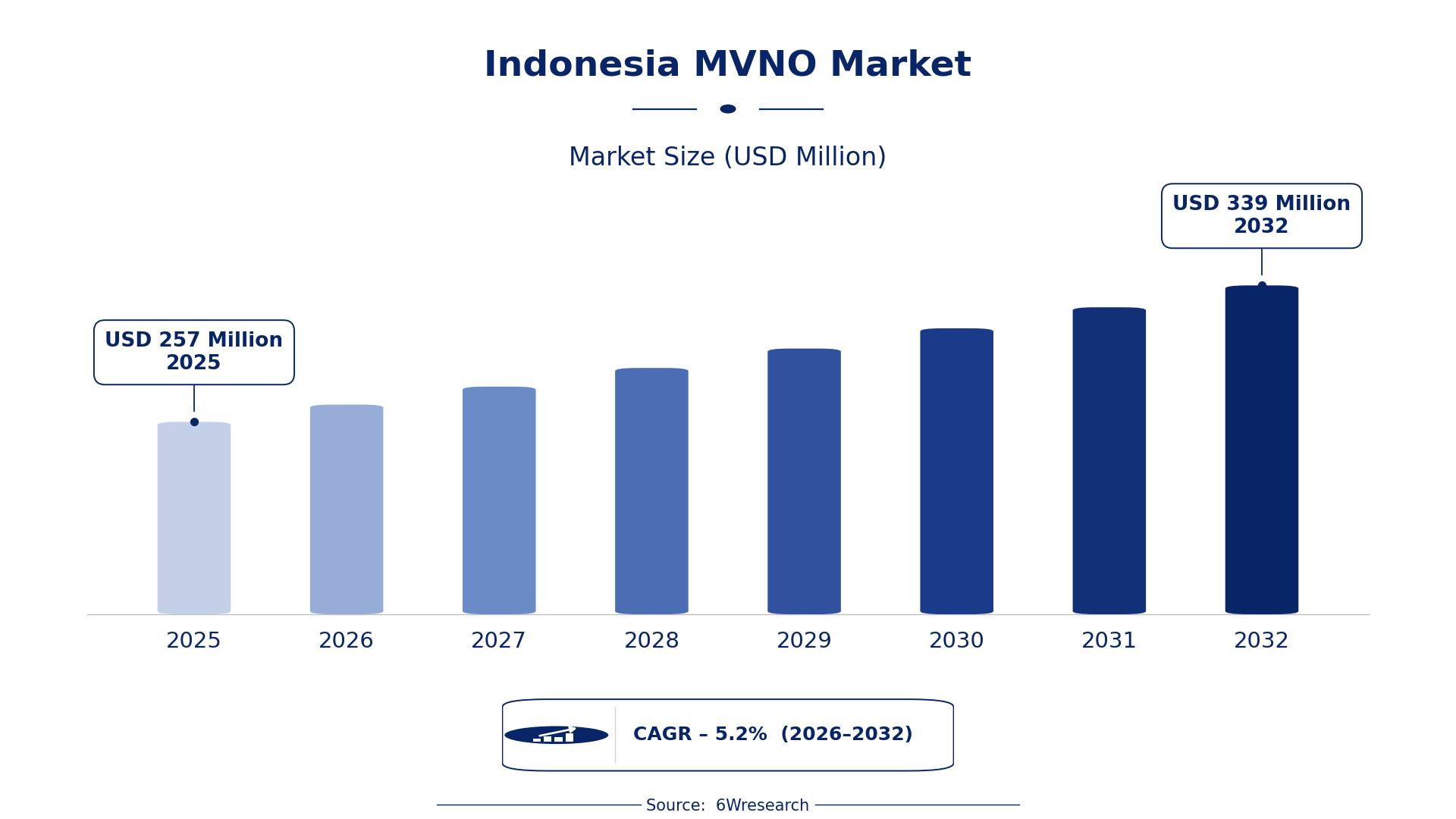
The Indonesia MVNO Market was estimated at USD 257 Million in 2025 and is projected to reach USD 339 Million by 2032, growing at a CAGR of 5.2% from 2026 to 2032.
Indonesia MVNO Market Synopsis
The MVNO market in Indonesia is carving a niche in a saturated telecommunications space, as new players offer innovative, cost-effective mobile services. Consumers are increasingly drawn to diverse plans and tailored offerings, which are reshaping their mobile experience.
With established operators dominating the market, MVNOs are finding ways to differentiate themselves through competitive pricing and unique service packages. This competitive dynamic is crucial for attracting a tech-savvy consumer base that prioritizes value and flexibility in mobile services.
Indonesia MVNO Market Year-wise Growth Rate and Key Drivers
This graph illustrates the annual growth rates of the Indonesia MVNO Market from 2021 to 2032, highlighting a steady upward trajectory and projected expansion over the forecast period.
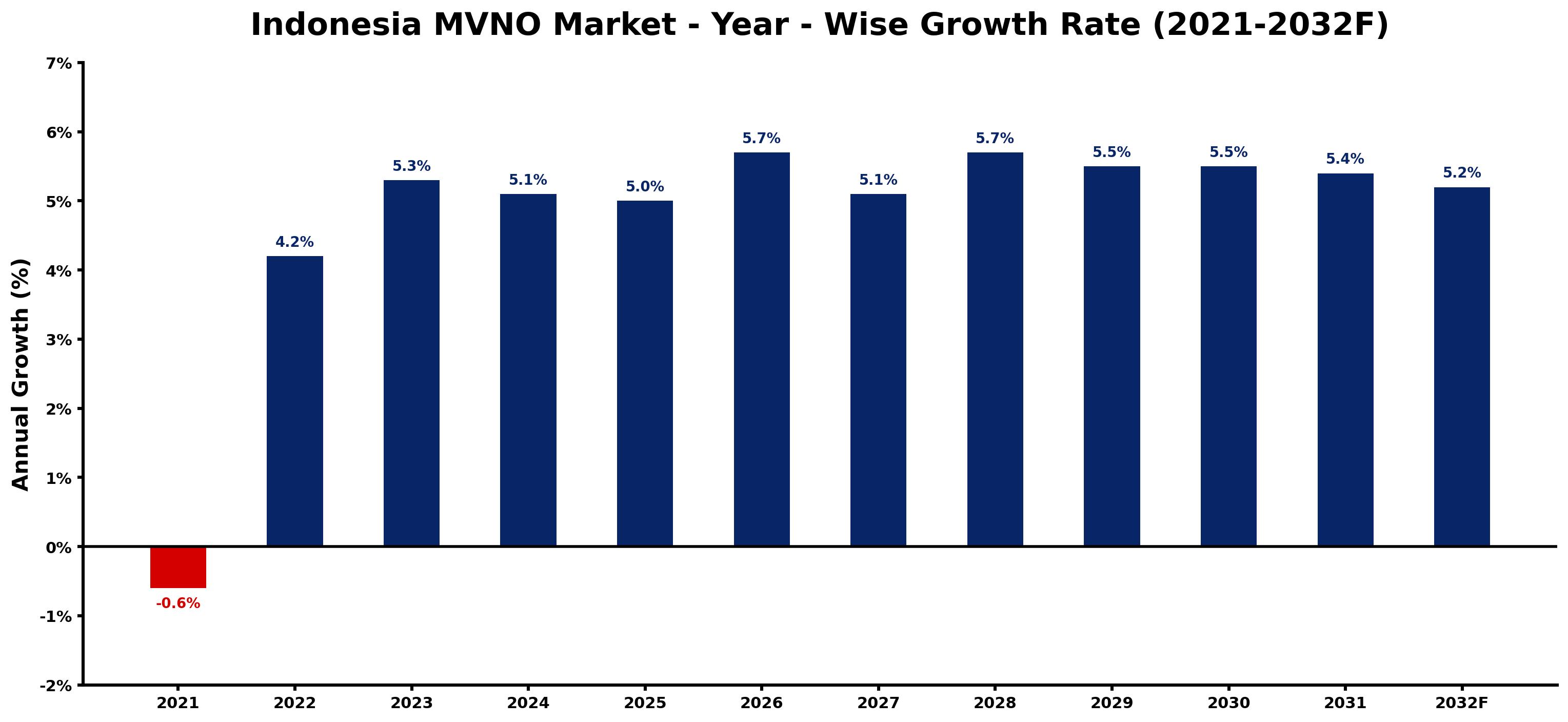
The table below presents the year‑wise growth rates along with the key drivers influencing the market
| Year | Growth Rate | Major Drivers |
| 2021 | -0.6% | Government regulations limiting foreign MVNO investments. |
| 2022 | 4.2% | Implementation of 5G regulations by Indonesian authorities. |
| 2023 | 5.3% | Rising smartphone penetration in urban areas of Indonesia. |
| 2024 | 5.1% | Investment in digital infrastructure by local telecom startups. |
| 2025 | 5.0% | High demand for affordable data plans among millennials. |
| 2026 | 5.7% | Government support for digital economy initiatives in Indonesia. |
| 2027 | 5.1% | Growth in e-commerce driving mobile data usage. |
| 2028 | 5.7% | Increased adoption of mobile payment solutions nationwide. |
| 2029 | 5.5% | Launch of new MVNOs targeting niche markets. |
| 2030 | 5.5% | Prominent marketing campaigns by MVNOs enhancing brand visibility. |
| 2031 | 5.4% | Partnerships between MVNOs and local content providers growing. |
| 2032 | 5.2% | Continued urban migration leading to higher mobile subscriptions. |
Note: Market size estimations and growth projections presented in this report are based on 6Wresearch's proprietary forecasting methodology, utilizing the latest available industry data, government publications, and primary research inputs.
Indonesia MVNO Market Key Takeaways
Below are some of the specific key takeaways from the market, including:
- Increasing competition is fostering innovation and better service offerings among MVNOs.
- Cost-effective plans are a primary draw for consumers seeking flexible mobile options.
- Regulatory challenges continue to pose barriers to entry for new MVNOs.
- Consumer behavior is shifting towards value-driven mobile services, influenced by economic factors.
- Established operators maintain a significant advantage with extensive infrastructure.
Evaluation of Restraints in Indonesia MVNO Market
The MVNO market in Indonesia faces notable hurdles, particularly in terms of competition and regulatory pressures. New entrants often grapple with the dominance of established mobile network operators, which possess extensive infrastructure and established customer bases. This uneven playing field makes it challenging for MVNOs to carve out their market share. on top of that, regulatory hurdles, including licensing requirements and spectrum allocation, complicate market entry for new players. These factors create a cautious environment where innovation and competitive pricing must be balanced against the realities of operating within stringent regulations.
Indonesia MVNO Market Trends
Several key trends are shaping the MVNO market in Indonesia. First, there’s a noticeable shift towards digital services, as consumers increasingly prefer mobile applications for their communication and transaction needs. This trend is pushing MVNOs to enhance their digital platforms and improve user experience.
Second, a growing emphasis on personalized service offerings is emerging, with MVNOs tailoring plans to meet specific consumer needs. Lastly, partnerships between MVNOs and technology firms are on the rise, allowing for the integration of advanced features and services that can attract a broader customer base.
Indonesia MVNO Market Opportunities
The potential for growth in the Indonesia MVNO market is significant, particularly in underserved regions where mobile service access remains limited. MVNOs can capitalize on this gap by offering affordable and accessible plans tailored to local needs. on top of that, as smartphone penetration continues to increase, there’s an opportunity for MVNOs to bundle data services with value-added offerings, such as entertainment and e-commerce solutions, enhancing customer loyalty.
Additionally, the rise of digital payment solutions presents a unique opportunity for MVNOs to integrate financial services into their offerings, thus appealing to a broader audience and driving revenue growth.
Government Initiatives in the Indonesia MVNO Market
Government policies are instrumental in shaping the MVNO market in Indonesia, with a focus on enhancing telecommunications infrastructure and accessibility. Regulatory frameworks are being updated to promote fair competition and support the entry of new players. This proactive stance is crucial in fostering a more competitive environment that benefits consumers.
- A national digital infrastructure upgrade programme initiated in early 2023 aims to enhance connectivity across rural areas.
- Current efforts include a review of licensing regulations to streamline the entry process for new MVNOs, ensuring a level playing field.
- A planned public-private partnership expected to launch in late 2024 focuses on expanding mobile service access to underserved regions.
- Recently completed initiatives have established clearer guidelines for spectrum allocation, facilitating easier access for MVNOs.
- Ongoing workshops aimed at educating potential MVNOs about regulatory compliance are designed to boost market participation.
Future Insights of the Indonesia MVNO Market
Looking ahead to 2026-2032, the Indonesia MVNO market is likely to experience steady growth driven by evolving consumer preferences and increased demand for flexible mobile services. As digital transformation accelerates, MVNOs that adapt to consumer needs and invest in innovative service offerings will find themselves well-positioned to capture market share.
Regulatory support will remain crucial, as policymakers continue to facilitate a competitive environment. The integration of emerging technologies, such as 5G, will also shape the future, enabling MVNOs to offer enhanced services and attract a broader customer base.
Indonesia MVNO Market Latest Developments
Over the past year, the Indonesia MVNO market has witnessed dynamic activity, with several initiatives aimed at enhancing service offerings and expanding market reach. The competitive nature of the market has driven many players to innovate and adapt to changing consumer needs.
- A leading regional operator announced the launch of a new mobile plan in Q1 2023 that targets budget-conscious consumers, featuring unique data bundles.
- An ongoing partnership between two technology firms is focused on developing a new app to enhance customer engagement, which began in mid-2023.
- A rollout of new customer service initiatives, expected to complete by mid-2024, aims to improve customer satisfaction and retention.
- A pilot programme for a loyalty rewards scheme launched in early 2023 is currently being evaluated for broader implementation.
- Plans for a major infrastructure upgrade to support 5G services are set to begin in late 2024, enhancing network capabilities for MVNOs.
Indonesia MVNO Market - Key Attractiveness of the Report
- 10 Years of Market Numbers
- Historical Data Starting from 2022 to 2025
- Base Year: 2025
- Forecast Data until 2032
- Key Performance Indicators Impacting the Market
- Major Upcoming Developments and Projects
There’s a noticeable shift toward value-driven mobile services as consumers increasingly seek flexibility and affordability in their mobile plans, driving MVNOs to adapt their offerings.
Key Highlights of the Report:
- Indonesia MVNO Market Outlook
- Market Size of Indonesia MVNO Market, 2025
- Forecast of Indonesia MVNO Market, 2032
- Historical Data and Forecast of Indonesia MVNO Revenues & Volume for the Period 2022-2032F
- Indonesia MVNO Market Trend Evolution
- Indonesia MVNO Market Drivers and Challenges
- Indonesia MVNO Price Trends
- Indonesia MVNO Porter's Five Forces
- Indonesia MVNO Industry Life Cycle
- Historical Data and Forecast of Indonesia MVNO Market Revenues & Volume By Operational Model for the Period 2022-2032F
- Historical Data and Forecast of Indonesia MVNO Market Revenues & Volume By Reseller for the Period 2022-2032F
- Historical Data and Forecast of Indonesia MVNO Market Revenues & Volume By Service Operator for the Period 2022-2032F
- Historical Data and Forecast of Indonesia MVNO Market Revenues & Volume By Full MVNO for the Period 2022-2032F
- Historical Data and Forecast of Indonesia MVNO Market Revenues & Volume By Organization Size for the Period 2022-2032F
- Historical Data and Forecast of Indonesia MVNO Market Revenues & Volume By SMES for the Period 2022-2032F
- Historical Data and Forecast of Indonesia MVNO Market Revenues & Volume By Large Enterprise for the Period 2022-2032F
- Historical Data and Forecast of Indonesia MVNO Market Revenues & Volume By Subscriber for the Period 2022-2032F
- Historical Data and Forecast of Indonesia MVNO Market Revenues & Volume By Consumer for the Period 2022-2032F
- Historical Data and Forecast of Indonesia MVNO Market Revenues & Volume By Enterprise for the Period 2022-2032F
- Indonesia MVNO Import Export Trade Statistics
- Market Opportunity Assessment By Operational Model
- Market Opportunity Assessment By Organization Size
- Market Opportunity Assessment By Subscriber
- Indonesia MVNO Top Companies Market Share
- Indonesia MVNO Competitive Benchmarking By Technical and Operational Parameters
- Indonesia MVNO Company Profiles
- Indonesia MVNO Key Strategic Recommendations






































