Indonesia Network Slicing Market Size, Share & Growth Rate
The Indonesia Network Slicing Market was estimated at USD 190 Million in 2025 and is projected to reach USD 251 Million by 2032, growing at a CAGR of 4.1% from 2026 to 2032. This growth trajectory is primarily driven by the expanding adoption of 5G technology across various sectors, emphasizing the need for customized network solutions. As industries recognize the benefits of efficient resource allocation, low latency, and tailored services, the demand for network slicing continues to surge, facilitating innovations in smart cities and industrial IoT applications.
Indonesia Network Slicing Market Year-wise Growth Rate and Key Drivers
This graph highlights how the Indonesia Network Slicing Market has steadily grown over the years, supported by major growth factors.
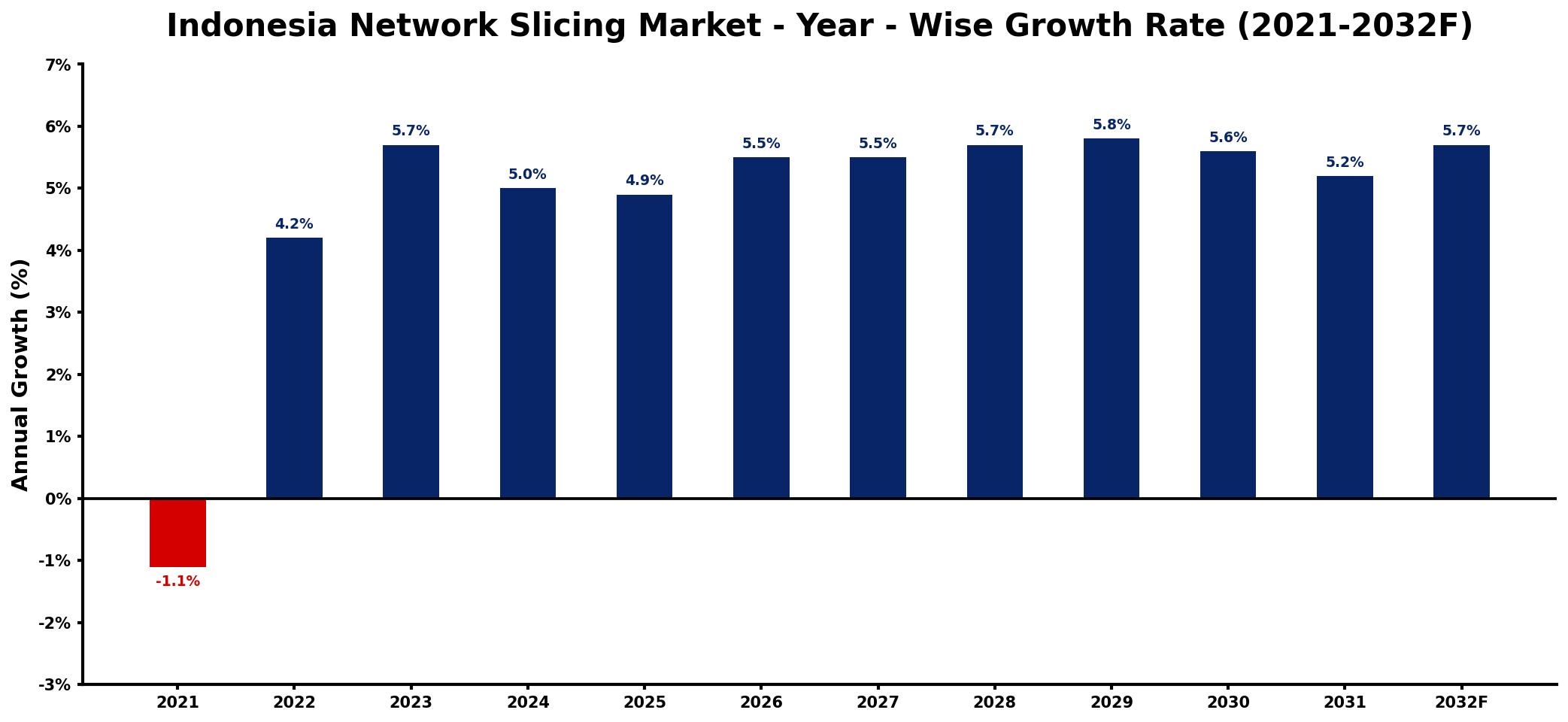
The table below presents the year‑wise growth rates along with the key drivers influencing the market
| Year | Growth Rate | Major Drivers |
| 2021 | -1.1% | Decreased investment in telecommunications infrastructure |
| 2022 | 4.2% | Rising demand for mobile connectivity |
| 2023 | 5.7% | Expansion of 5G technology adoption |
| 2024 | 5.0% | Increased enterprise digital transformation initiatives |
| 2025 | 4.9% | Growing IoT device installations globally |
| 2026 | 5.5% | Enhanced cloud service provider offerings |
| 2027 | 5.5% | Surge in smart city projects |
| 2028 | 5.7% | rising procurement volume requirements |
| 2029 | 5.8% | Increased funding for telecommunications startups |
| 2030 | 5.6% | growing automotive sector requirements |
| 2031 | 5.2% | growing commercial sector adoption |
| 2032 | 5.7% | Growth in virtual reality applications |
Note: Market size estimations and growth projections presented in this report are based on 6Wresearch's proprietary forecasting methodology, utilizing the latest available industry data, government publications, and primary research inputs.
Indonesia Network Slicing Market Synopsis
The strongest force shaping the Indonesia Network Slicing Market right now is the increasing need for flexible and customized network solutions in a post-pandemic environment. Organizations across diverse sectors are actively seeking technologies that can adapt to their unique requirements, ensuring optimal performance and resource utilization.
In addition, the advent of 5G technology has created new opportunities for network operators to offer differentiated services tailored to specific applications. As manufacturing, healthcare, and transportation sectors explore the potential of network slicing, the market is set to evolve further, accommodating diverse and dynamic demands.
Indonesia Network Slicing Market Key Takeaways
- The market is gaining momentum due to the increasing penetration of 5G technology and its applications.
- Customization and resource allocation remain significant drivers in fulfilling diverse industry needs.
- Network slicing enables efficient resource management, supporting applications in smart cities and industrial IoT.
- COVID-19 has highlighted the importance of network flexibility, accelerating innovation in network slicing.
- Key market participants are pushing for advanced solutions that cater to vertical-specific demands.
Evaluation of Restraints in Indonesia Network Slicing Market
Despite the promising growth outlook, several restraints hinder the full potential of the Indonesia Network Slicing Market. One of the primary challenges is the complexity of customizing network slices effectively for a multitude of vertical applications. Ensuring both network isolation and optimal resource utilization presents a balancing act that requires sophisticated management techniques. The lack of standardized frameworks may also impede operators' ability to streamline processes and deliver tailored solutions efficiently, ultimately limiting widespread adoption.
Indonesia Network Slicing Market Trends
Current trends indicate a significant shift towards the integration of artificial intelligence and machine learning into network slicing solutions. These technologies are enabling more intelligent resource allocation and real-time management, further enhancing service delivery. Additionally, industries are increasingly recognizing the necessity for low-latency connections and high reliability, which are critical for applications ranging from telemedicine to autonomous vehicles.
Moreover, as enterprises begin to understand the vast potential of 5G, there is a growing trend towards collaborative partnerships among stakeholders. Such alliances between telecom operators, technology providers, and industry players are pivotal in fostering innovations that cater to specific market needs, paving the way for more robust and versatile network slicing solutions.
Indonesia Network Slicing Market Opportunities
The Indonesia Network Slicing Market holds several genuine growth opportunities, particularly in sectors that require tailored network solutions. The burgeoning smart city initiatives, for instance, offer a substantial canvas for deploying customized network slices that can support a wide range of applications from traffic management to public safety. Additionally, industries such as healthcare can leverage network slicing to enhance telehealth services, ensuring reliable and high-performance connectivity for critical applications.
Investment in research and development to address the challenges of customization and resource allocation also presents an avenue for market players. As technology matures, the development of standardized frameworks will enable operators to optimize their offerings and provide improved services across various sectors.
Government Initiatives in the Indonesia Network Slicing Market
The Indonesian government is taking significant steps to foster the growth of digital infrastructure, which plays a crucial role in the advancement of the network slicing market. Initiatives aimed at expanding broadband access and enhancing 5G deployment are critical to establishing a more resilient network infrastructure. Additionally, public spending on technological advancements and digital economy programs further incentivizes investment in network slicing solutions, helping to create an ecosystem that supports various industries.
Future Insights of the Indonesia Network Slicing Market
Looking ahead to the period between 2026 and 2032, the Indonesia Network Slicing Market is poised for significant transformation driven by technological advancements and evolving consumer demands. The continuous deployment of 5G infrastructure will enable greater flexibility and scalability, opening doors to new applications and business models. As industries embrace digital transformation, the demand for more sophisticated and customized network solutions is expected to escalate, leading to a more competitive landscape among service providers.
Indonesia Network Slicing Market Latest Developments (2025 - 2026)
Recent developments in the Indonesia Network Slicing Market indicate an increased focus on collaboration between telecom operators and technology firms, aimed at enhancing network efficiency and service delivery. The industry is witnessing efforts to innovate network management solutions, with particular emphasis on AI-driven analytics to optimize performance. Additionally, initiatives to educate enterprises about the benefits of network slicing are gaining traction, further promoting its adoption across various sectors.
Indonesia Network Slicing Market - Key Attractiveness of the Report
- 10 Years of Market Numbers
- Historical Data Starting from 2022 to 2025
- Base Year: 2025
- Forecast Data until 2032
- Key Performance Indicators Impacting the Market
- Major Upcoming Developments and Projects
Key Highlights of the Report:
- Indonesia Network Slicing Market Outlook
- Market Size of Indonesia Network Slicing Market, 2025
- Forecast of Indonesia Network Slicing Market, 2032
- Historical Data and Forecast of Indonesia Network Slicing Revenues & Volume for the Period 2022-2032F
- Indonesia Network Slicing Market Trend Evolution
- Indonesia Network Slicing Market Drivers and Challenges
- Indonesia Network Slicing Price Trends
- Indonesia Network Slicing Porter's Five Forces
- Indonesia Network Slicing Industry Life Cycle
- Historical Data and Forecast of Indonesia Network Slicing Market Revenues & Volume By Component for the Period 2022-2032F
- Historical Data and Forecast of Indonesia Network Slicing Market Revenues & Volume By Solution for the Period 2022-2032F
- Historical Data and Forecast of Indonesia Network Slicing Market Revenues & Volume By Services (Professional & Managed) for the Period 2022-2032F
- Historical Data and Forecast of Indonesia Network Slicing Market Revenues & Volume By End User for the Period 2022-2032F
- Historical Data and Forecast of Indonesia Network Slicing Market Revenues & Volume By Telecom Operators for the Period 2022-2032F
- Historical Data and Forecast of Indonesia Network Slicing Market Revenues & Volume By Enterprises for the Period 2022-2032F
- Historical Data and Forecast of Indonesia Network Slicing Market Revenues & Volume By Application for the Period 2022-2032F
- Historical Data and Forecast of Indonesia Network Slicing Market Revenues & Volume By Manufacturing for the Period 2022-2032F
- Historical Data and Forecast of Indonesia Network Slicing Market Revenues & Volume By Government for the Period 2022-2032F
- Historical Data and Forecast of Indonesia Network Slicing Market Revenues & Volume By Automotive for the Period 2022-2032F
- Historical Data and Forecast of Indonesia Network Slicing Market Revenues & Volume By Media and Entertainment for the Period 2022-2032F
- Indonesia Network Slicing Import Export Trade Statistics
- Market Opportunity Assessment By Component
- Market Opportunity Assessment By End User
- Market Opportunity Assessment By Application
- Indonesia Network Slicing Top Companies Market Share
- Indonesia Network Slicing Competitive Benchmarking By Technical and Operational Parameters
- Indonesia Network Slicing Company Profiles
- Indonesia Network Slicing Key Strategic Recommendations






































