Indonesia Nonmetallic Mineral Product Market Size, Share & Growth Rate
The Indonesia Nonmetallic Mineral Product Market was estimated at USD 425 Million in 2025 and is projected to reach USD 558 Million by 2032, growing at a CAGR of 4.0% from 2026 to 2032. This growth trajectory is primarily driven by the rapid expansion of the construction sector, particularly in infrastructure and residential projects. As urbanization accelerates, the demand for essential products like cement, ceramics, and glass is set to rise significantly, positioning the market for robust development in the coming years.
Indonesia Nonmetallic Mineral Product Market Year-wise Growth Rate and Key Drivers
This graph highlights how the Indonesia Nonmetallic Mineral Product Market has steadily grown over the years, supported by major growth factors.
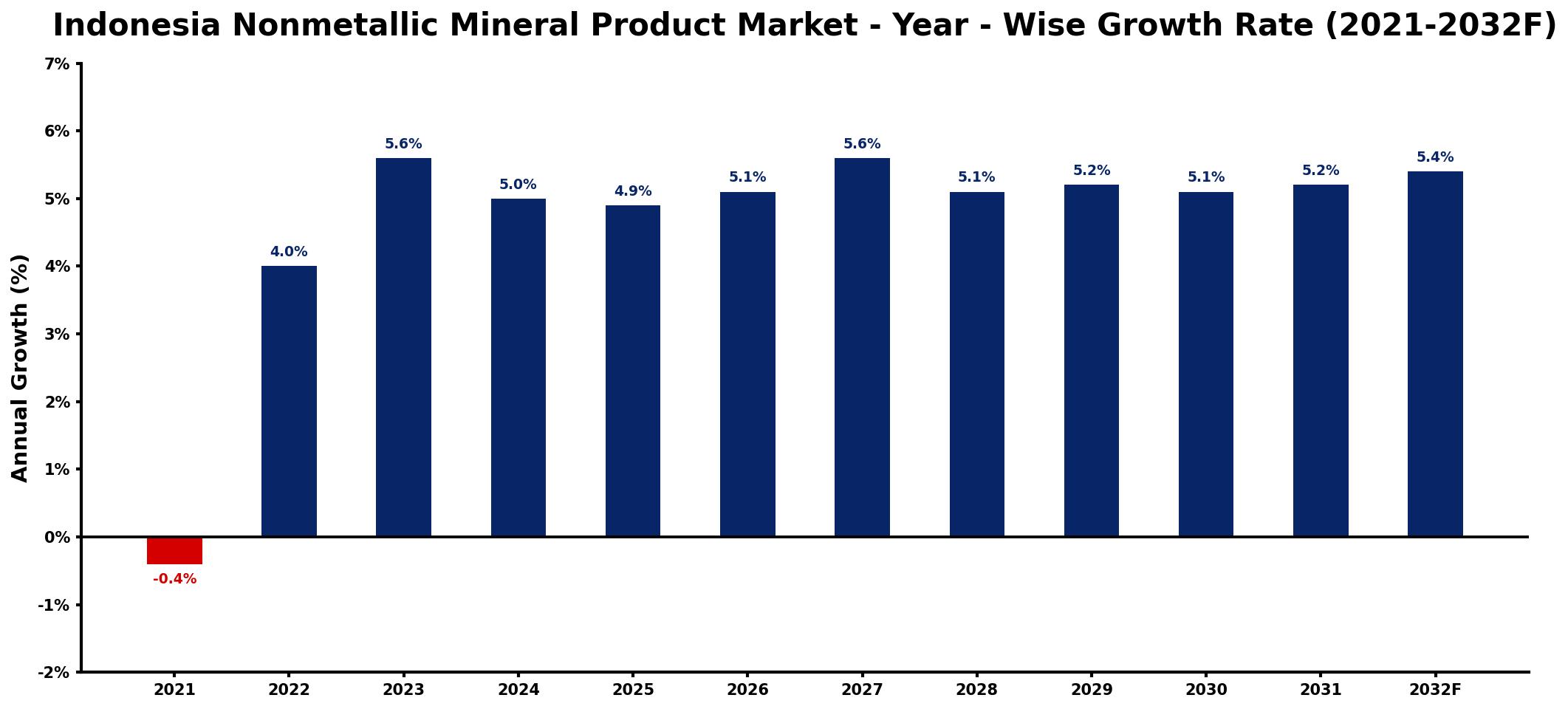
The table below presents the year‑wise growth rates along with the key drivers influencing the market
| Year | Growth Rate | Major Drivers |
| 2021 | -0.4% | decreased construction activity levels |
| 2022 | 4.0% | increased infrastructure development projects |
| 2023 | 5.6% | growing demand in manufacturing sector |
| 2024 | 5.0% | expansion in export markets |
| 2025 | 4.9% | rising investments in construction |
| 2026 | 5.1% | increased urbanization and housing demand |
| 2027 | 5.6% | growing adoption of green technologies |
| 2028 | 5.1% | strengthening supply chain networks |
| 2029 | 5.2% | enhanced government regulatory support |
| 2030 | 5.1% | rising consumer spending on construction |
| 2031 | 5.2% | increased foreign direct investments |
| 2032 | 5.4% | growing partnerships with local businesses |
Note: Market size estimations and growth projections presented in this report are based on 6Wresearch's proprietary forecasting methodology, utilizing the latest available industry data, government publications, and primary research inputs.
Indonesia Nonmetallic Mineral Product Market Synopsis
A significant force shaping the Indonesia Nonmetallic Mineral Product Market is the ongoing surge in infrastructure development. Government initiatives focusing on urbanization and economic resilience are accelerating investments in construction, thus creating a strong demand for nonmetallic mineral products. Coupled with a burgeoning real estate sector, this momentum is expected to maintain the market's positive outlook.
Additionally, the increasing integration of nonmetallic minerals in various manufacturing processes is pivotal. The automotive, electronics, and packaging industries are evolving, relying heavily on minerals like glass and ceramics, which will further enhance market growth. However, the balance between industrial expansion and environmental considerations remains a crucial factor in shaping future dynamics.
Indonesia Nonmetallic Mineral Product Market Key Takeaways
- The market is driven by significant investments in infrastructure and construction projects.
- Real estate expansion is a key contributor to the growing demand for nonmetallic minerals.
- Environmental sustainability is becoming increasingly important, influencing regulatory practices.
- Technological advancements in mineral processing are enhancing efficiency and product quality.
- Recovery from the pandemic is leading to renewed confidence in construction and manufacturing sectors.
Evaluation of Restraints in Indonesia Nonmetallic Mineral Product Market
One of the critical constraints facing the Indonesia Nonmetallic Mineral Product Market is the environmental impact associated with mineral extraction. The need to ensure sustainability and adhere to stringent regulations can limit operational capabilities for companies. Challenges such as habitat destruction and ecological imbalance necessitate a careful approach to mining practices. The drive for balance between resource extraction and environmental preservation will be a constant negotiation point for stakeholders in this market.
Indonesia Nonmetallic Mineral Product Market Trends
Current trends indicate a growing emphasis on sustainable practices within the nonmetallic mineral sector. Companies are increasingly adopting eco-friendly extraction and processing methods to mitigate environmental impacts. Additionally, advancements in technology are enabling improved efficiency in production processes, which enhances competitiveness. The shift toward smart construction materials, including innovative ceramics and advanced composites, is also shaping the landscape of the market.
Indonesia Nonmetallic Mineral Product Market Opportunities
The primary growth opportunities lie in the increasing demand for sustainable building materials. As urban centers expand, the market for high-performance and environmentally friendly products will flourish. Furthermore, investments in renewable energy infrastructures, such as solar panels that require specialized glass and ceramics, will contribute to market dynamism. Collaborations across industries to develop innovative solutions will also present avenues for significant investment and growth.
Government Initiatives in the Indonesia Nonmetallic Mineral Product Market
The Indonesian government is actively promoting initiatives aimed at enhancing infrastructure development and encouraging sustainable mining practices. Various public spending programs are being implemented to bolster construction projects while adhering to environmental regulations. Additionally, incentives for adopting green technologies in the extraction and processing of nonmetallic minerals are creating a more attractive landscape for investors in this sector.
Future Insights of the Indonesia Nonmetallic Mineral Product Market
Looking forward to 2026-2032, the Indonesia Nonmetallic Mineral Product Market is poised for sustained growth, driven by robust infrastructure projects and urban development. As regulatory frameworks tighten around environmental sustainability, companies that adapt to these changes will not only survive but thrive. The ongoing push for modernization in manufacturing processes will also lead to diversification in product offerings, aligning with global trends toward sustainability and efficiency.
Indonesia Nonmetallic Mineral Product Market Latest Developments (2025 - 2026)
Recent industry developments indicate a surge in collaborative initiatives aimed at enhancing production capabilities and addressing environmental challenges. Stakeholders are increasingly focusing on integrating advanced technologies in mineral processing, leading to innovations in product quality. Additionally, government-led infrastructure projects are expected to gain momentum, signaling a rebound in market activity post-pandemic.
Indonesia Nonmetallic Mineral Product Market - Key Attractiveness of the Report
- 10 Years of Market Numbers
- Historical Data Starting from 2022 to 2025
- Base Year: 2025
- Forecast Data until 2032
- Key Performance Indicators Impacting the Market
- Major Upcoming Developments and Projects
Key Highlights of the Report:
- Indonesia Nonmetallic Mineral Product Market Outlook
- Market Size of Indonesia Nonmetallic Mineral Product Market, 2025
- Forecast of Indonesia Nonmetallic Mineral Product Market, 2032
- Historical Data and Forecast of Indonesia Nonmetallic Mineral Product Revenues & Volume for the Period 2022-2032FF
- Indonesia Nonmetallic Mineral Product Market Trend Evolution
- Indonesia Nonmetallic Mineral Product Market Drivers and Challenges
- Indonesia Nonmetallic Mineral Product Price Trends
- Indonesia Nonmetallic Mineral Product Porter's Five Forces
- Indonesia Nonmetallic Mineral Product Industry Life Cycle
- Historical Data and Forecast of Indonesia Nonmetallic Mineral Product Market Revenues & Volume By Form Type for the Period 2022-2032FF
- Historical Data and Forecast of Indonesia Nonmetallic Mineral Product Market Revenues & Volume By Powder Form for the Period 2022-2032FF
- Historical Data and Forecast of Indonesia Nonmetallic Mineral Product Market Revenues & Volume By Liquid Form for the Period 2022-2032FF
- Historical Data and Forecast of Indonesia Nonmetallic Mineral Product Market Revenues & Volume By End User for the Period 2022-2032FF
- Historical Data and Forecast of Indonesia Nonmetallic Mineral Product Market Revenues & Volume By Jewellery for the Period 2022-2032FF
- Historical Data and Forecast of Indonesia Nonmetallic Mineral Product Market Revenues & Volume By Construction for the Period 2022-2032FF
- Historical Data and Forecast of Indonesia Nonmetallic Mineral Product Market Revenues & Volume By Iron & Ore for the Period 2022-2032FF
- Indonesia Nonmetallic Mineral Product Import Export Trade Statistics
- Market Opportunity Assessment By Form Type
- Market Opportunity Assessment By End User
- Indonesia Nonmetallic Mineral Product Top Companies Market Share
- Indonesia Nonmetallic Mineral Product Competitive Benchmarking By Technical and Operational Parameters
- Indonesia Nonmetallic Mineral Product Company Profiles
- Indonesia Nonmetallic Mineral Product Key Strategic Recommendations






































